
Read summarized version with
What is Agile Documentation?
Agile documentation is a way of creating and maintaining project information that follows the Agile Manifesto’s core principles. Instead of producing all documentation upfront, agile teams create just enough to support the work at hand. They update it incrementally as the project moves forward.
Think of it as flipping traditional documentation on its head. Teams don’t spend weeks writing detailed specifications before any code gets written. They document as they go, capturing information when it’s fresh and relevant rather than months later when memories have faded. What matters is whether the documentation actually helps deliver working software.
Now, this doesn’t mean agile teams skip documentation entirely. That’s probably the most common misconception out there. Every document simply has to earn its place. If something doesn’t provide clear value to the team, stakeholders, or end users, it probably shouldn’t exist. You end up with documentation that’s lighter, more current, and genuinely useful rather than checkbox-filling busywork.
Key Characteristics of Agile Documentation
- Just Barely Good Enough: Create documentation that satisfies its purpose fully and nothing more. This aligns with lean documentation principles. Excessive detail only adds maintenance burden without adding value.
- Iterative and Incremental: Documentation evolves alongside the product. It gets updated sprint by sprint as features ship and requirements shift.
- Collaborative: Multiple team members contribute. Stakeholders provide input early and often rather than reviewing massive documents at the end.
- Document-Late: Defer creating deliverable documentation until the information has stabilized. This reduces rework when things inevitably change.
- User-Centric: Every document targets a specific audience with specific needs, whether developers, end users, or compliance auditors.
Agile Documentation Examples
Example 1: Software Development Team
A development team ditches their 200-page requirements specification in favor of a living product backlog and lightweight architectural decision records. User stories capture requirements in plain language, and acceptance criteria serve as executable specifications. Technical documentation gets written during or immediately after implementation. The team spends less time on documentation and more time shipping features that users actually want.
Example 2: Marketing Department
A marketing team adopts agile documentation for their campaign processes. Instead of rigid campaign playbooks that nobody reads, they maintain a shared wiki with quick reference guides for common tasks. After each campaign, they capture lessons learned in a brief retrospective document. The documentation stays current because updating it is part of their sprint workflow, not a separate project that keeps getting deprioritized.
Agile Documentation vs Traditional Documentation
Traditional documentation assumes you can predict everything upfront. Agile documentation assumes you can’t, and it builds that uncertainty right into the process.
| Aspect | Agile Documentation | Traditional Documentation |
|---|---|---|
| Purpose | Enable team progress and knowledge sharing | Satisfy contractual or compliance requirements |
| Timing | Created incrementally during development | Created upfront before development begins |
| When to use | Fast-moving projects with evolving requirements | Fixed-scope projects with strict regulatory needs |
| Maintenance | Updated continuously as part of regular work | Often neglected until formal review cycles |
| Ownership | Shared across the team | Assigned to dedicated documentation roles |
How Glitter AI Helps with Agile Documentation
Glitter AI fits naturally into agile documentation practices. Teams can capture processes without interrupting their workflow. Record what you’re doing, and Glitter generates step-by-step documentation automatically. No separate documentation phase required, which aligns perfectly with the document-late principle and with scrum documentation practices.
The platform also supports how iterative agile documentation needs to be. When processes change, updating documentation is as simple as recording the new workflow. Teams share knowledge quickly through visual guides rather than lengthy written procedures. Documentation stays light and accessible while still capturing what matters, reinforcing a healthy documentation culture across the team.
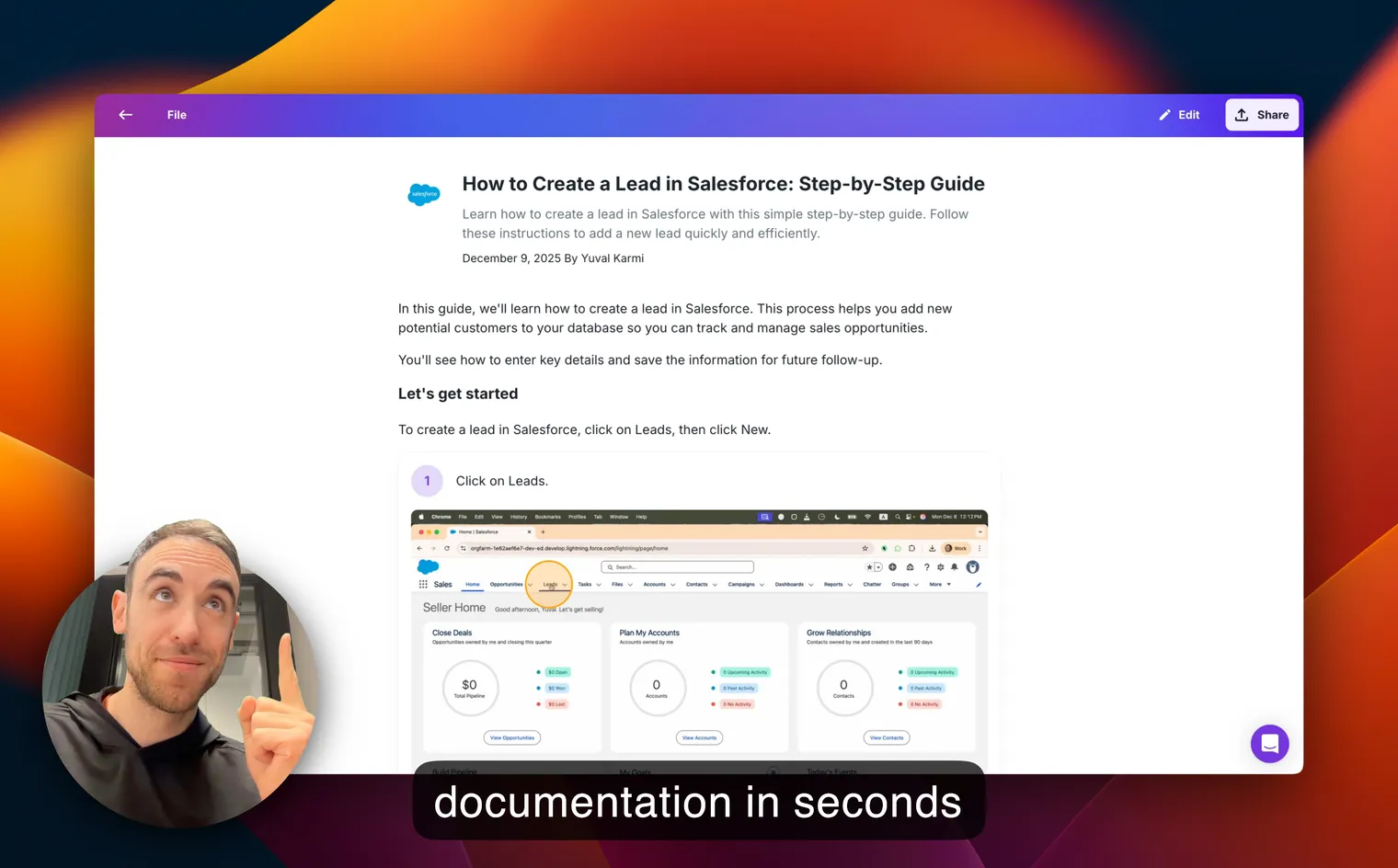
Teach your co-workers or customers how to get stuff done – in seconds.

Frequently Asked Questions
What is agile documentation?
Agile documentation is a lightweight approach to creating and maintaining project information that prioritizes flexibility, collaboration, and delivering just enough documentation at the right time to support the team's work.
What is an example of documentation in agile?
Common examples include product backlogs, user stories with acceptance criteria, sprint retrospective notes, architectural decision records, and living wikis that get updated as the project evolves.
What are agile documentation best practices?
Best practices include documenting incrementally during sprints, deferring detailed documentation until information stabilizes, using templates for consistency, including documentation in your definition of done, and focusing on the audience's actual needs.
Does agile mean no documentation?
No. The Agile Manifesto values working software over comprehensive documentation, but that doesn't mean zero documentation. It means creating documentation that provides genuine value rather than documentation for its own sake.
How do you manage documentation in agile projects?
Include documentation tasks in your sprint backlog, treat it as part of the definition of done for features, use collaborative tools that support real-time updates, and review documentation during retrospectives.
What is just barely good enough documentation?
Just barely good enough means documentation that fully satisfies its purpose without unnecessary detail. It provides enough information for its intended audience to do their job, but nothing extra that would add maintenance burden.
How often should agile documentation be updated?
Documentation should be updated whenever the underlying process or product changes. In practice, this usually means reviewing and updating relevant documentation at the end of each sprint as part of the regular workflow.
What types of documentation are used in agile?
Common types include product backlogs, user stories, acceptance criteria, burndown charts, retrospective notes, architectural decision records, API documentation, and user-facing help content.
How do agile teams handle compliance documentation?
Agile teams handle compliance documentation by integrating it into their regular workflow. They create required documentation incrementally, automate generation where possible, and build compliance checkpoints into their definition of done.
What tools support agile documentation?
Tools like wikis, knowledge bases, and platforms like Glitter AI support agile documentation by enabling quick updates, visual content creation, version control, and collaborative editing that fits into sprint-based workflows.