
Read summarized version with
What is Process Documentation?
Process documentation is the practice of writing down how work actually gets done in your organization. It captures workflows, tasks, and the steps needed to complete a business process from beginning to end. Think of it as a reference guide that helps everyone on your team execute tasks the same way, following company standards.
What sets process documentation apart from individual step-by-step task procedures or work instructions? It’s the big-picture view. Instead of focusing on a single task, process documentation shows all the related activities in sequence: the steps involved, who’s responsible for what, decision points along the way, alternate paths when things don’t go as planned, and the various outcomes you might see. This becomes especially valuable when employees leave or change roles, since the knowledge doesn’t walk out the door with them.
At its core, process documentation helps standardize how your team performs tasks. It cuts down on variability and errors, and gives you a clear roadmap for meeting industry standards and staying compliant with regulations. When paired with a well-organized procedure manual, teams can quickly find the guidance they need.
Key Characteristics of Process Documentation
- Full Workflow Coverage: Captures everything from start to finish, including inputs, outputs, decision points, and everyone involved. It’s not just about one task in isolation.
- Big Picture with Practical Detail: Gives you that high-level view of how things connect while still including enough detail to actually guide execution.
- Meant to Evolve: This isn’t a document you write once and forget. It should be reviewed and updated, ideally with a capture tool like one of the best iorad alternatives, as your business needs, tools, and workflows change.
- Institutional Memory: Captures the expertise, workflows, and lessons learned over time so that knowledge doesn’t disappear when people move on.
- Shows How Teams Connect: Documents how different departments interact, what they pass between each other, and how it all fits together in the bigger business process.
Process Documentation Examples
Example 1: Employee Onboarding Process
Picture a tech company’s process documentation for bringing new software engineers on board. It covers the entire journey from offer acceptance through the first 90 days. You’ll find prerequisites like background checks and equipment ordering. It spells out who does what: HR handles paperwork, IT sets up accounts, the hiring manager runs check-ins, and a buddy helps the new hire get settled. The documentation walks through day-one activities, weekly milestones, training modules, system access, and knowledge transfer sessions. For different situations (remote vs. on-site, junior vs. senior engineers), there are decision trees that branch accordingly. And when someone needs the nitty-gritty details on setting up a development environment, the documentation links to specific task-level instructions.
Example 2: Procure-to-Pay Process
A manufacturing company might document its procure-to-pay process, covering everything from “we need to buy something” to “payment sent.” The documentation lays out clear boundaries for the process, then walks through each step: identifying the need, selecting a supplier, issuing a purchase order, receiving the goods, verifying the invoice, getting payment approved, and finally sending the payment. It assigns roles (procurement team, finance, the department that made the request), sets approval thresholds based on dollar amounts, and explains what to do when exceptions pop up. Having this documented makes it much easier to spot bottlenecks and stay on the right side of financial controls.
Process Documentation vs Standard Operating Procedure
These two are closely related, but they serve different purposes and work at different levels of detail, much like the broader procedure vs process distinction.
| Aspect | Process Documentation | Standard Operating Procedure |
|---|---|---|
| Purpose | Shows how work flows through the organization from a bird’s-eye view | Provides specific instructions for routine, repetitive activities |
| Scope | Broad and strategic, covering the full journey from start to finish | Focused on one particular procedure with clear boundaries |
| Detail Level | High-level view with key steps, decision points, and stakeholder interactions | Step-by-step instructions with specific actions and standards |
| Audience | Multiple stakeholders across departments who need to understand how things connect | The specific people responsible for executing that particular procedure |
| When to use | When you need to map out entire business processes or understand cross-functional workflows | When you want to make sure a routine task gets done the same way every time |
How Glitter AI Helps with Process Documentation
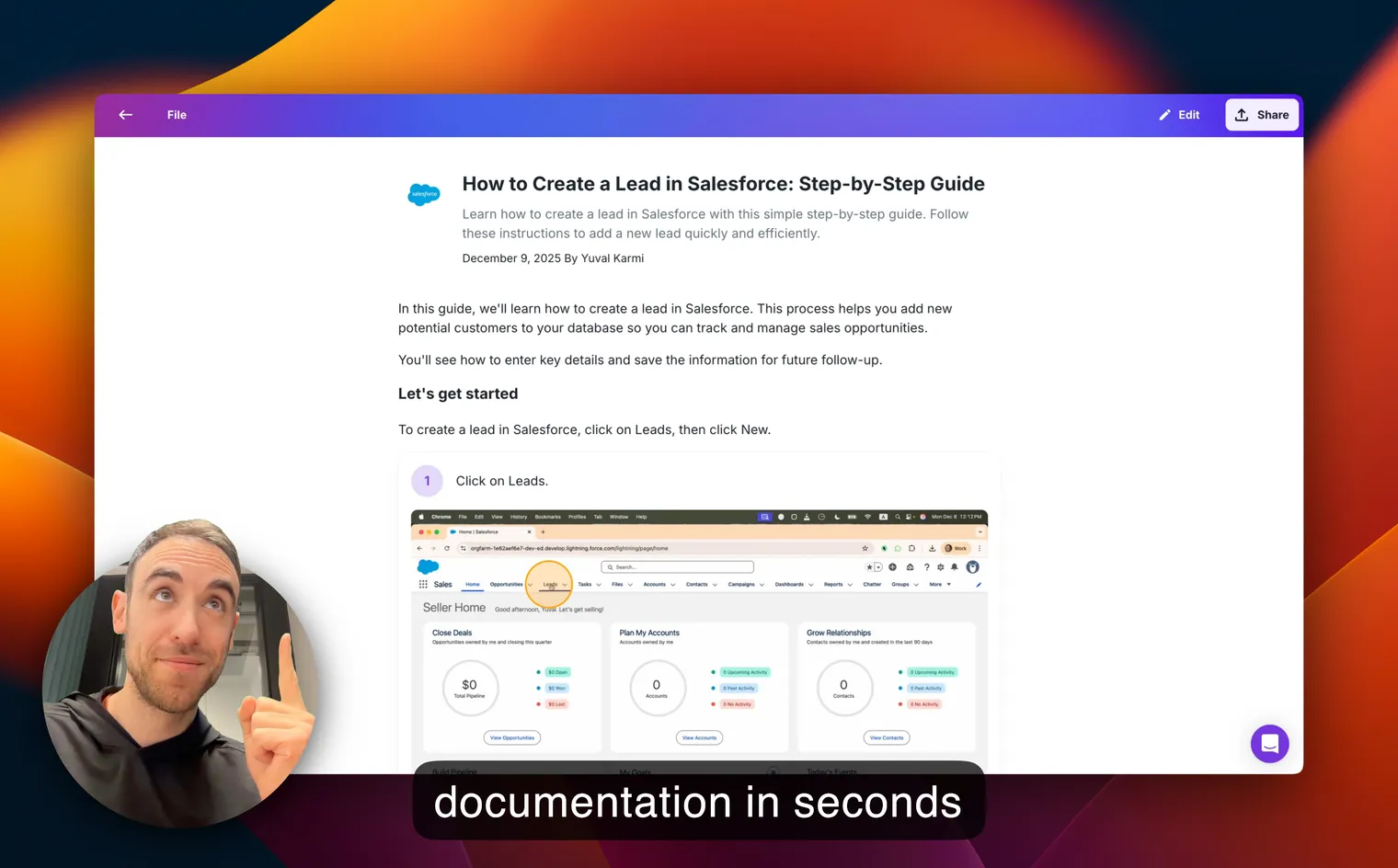
Creating process documentation used to mean sitting down and writing everything out from memory, which takes forever and often misses details, the very problem that screen-recording tools in our Guidde alternatives roundup set out to solve. Glitter AI changes that. Using screen recording, much like the tools covered in our roundup of the best Loom alternatives, Glitter captures your processes as you actually perform them, then automatically generates step-by-step documentation with screenshots, descriptions, and annotations.
Teams can build out their documentation quickly using the AI SOP generator, and because Glitter captures what you’re really doing (not what you think you’re doing), the result tends to be more accurate even without a dedicated documentation specialist on staff, and it survives periodic reviews far better than hand-written notes. That accuracy carries over even when you’re documenting a process that belongs to someone else’s role, since the recording reflects their actual workflow instead of your best guess at it. Multiple people can contribute through real-time editing, and AI transcription turns spoken narration into clean written steps, keeping every internal process current. That accuracy is especially valuable for compliance-heavy accounting and financial services teams, for engineering groups that lean on scrum documentation, and for software documentation in a developer’s workflow. It is a faster, more durable alternative to ad hoc captures like the Windows Steps Recorder, and it gives a systems integrator a reliable record when defining the to-be process during a migration. The same captured material doubles as process training content. Version control is built in, so updating documentation is straightforward. Your process documentation becomes something that actually grows and changes with your business, staying useful over time instead of collecting dust.
Teach your co-workers or customers how to get stuff done – in seconds.

Frequently Asked Questions
What is process documentation?
Process documentation is a detailed written record that outlines the tasks, steps, and workflows needed to complete a business process from start to finish. It serves as a reference guide ensuring employees can execute tasks consistently according to company standards.
What is an example of process documentation?
An employee onboarding process document that maps the complete journey from offer acceptance through the first 90 days, including stakeholder responsibilities, milestones, training modules, system access steps, and decision trees for different employee types.
Why is process documentation important?
Process documentation preserves institutional knowledge, ensures consistency across teams, reduces errors, enables faster onboarding, supports compliance requirements, and provides a foundation for continuous improvement by making workflows visible and analyzable.
What is the difference between process documentation and SOPs?
Process documentation provides a high-level, strategic view of entire workflows and cross-functional interactions, while SOPs are detailed step-by-step instructions for completing specific routine tasks within those larger processes.
How do you create effective process documentation?
Create effective process documentation by documenting in real-time as work happens, using visual aids like flowcharts, involving stakeholders who execute the process, employing standardized templates, and regularly reviewing documentation to ensure it remains accurate and current.