

Read summarized version with
I’ll never forget my first month-end close without documented procedures.
It was month three at my first startup. Our bookkeeper quit with two days notice. She handed me a spreadsheet with 47 tabs and said “good luck.”
I spent 63 hours that month trying to figure out what she did, with nothing resembling a bookkeeping checklist to follow. Which invoices needed coding. Which accounts to reconcile. What order to do things in. Why certain adjustments were made.
That month cost us thousands in late payments, missed discounts, and my time that should have been spent building the company.
I’m Yuval, founder of Glitter AI. After running a startup for years and learning these lessons the expensive way, I want to share what I know about creating accounting SOPs that actually prevent disasters like mine.
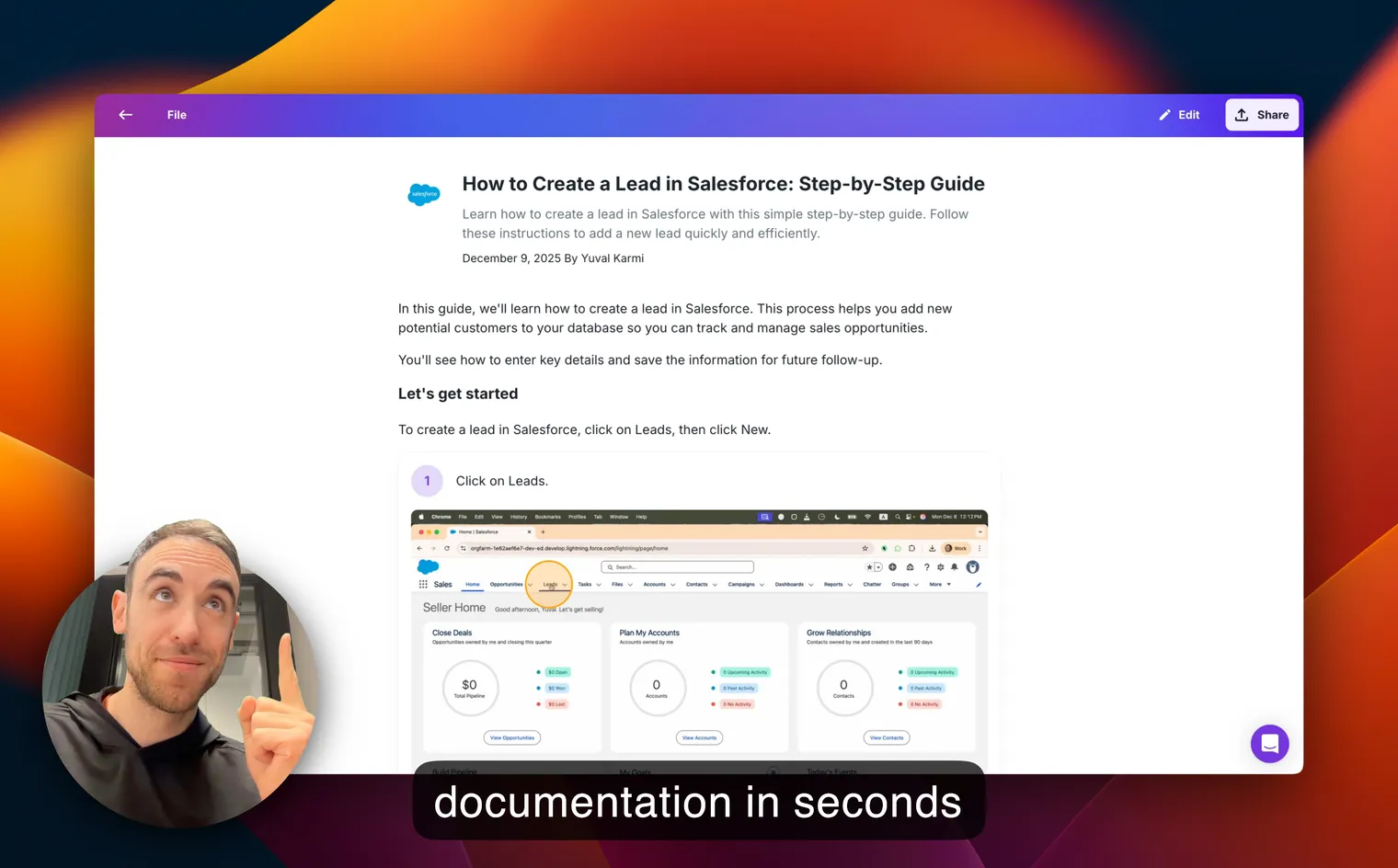
Glitter AI captures your screen and voice to turn financial workflows into step-by-step SOPs

What is an Accounting SOP?
An accounting SOP (Standard Operating Procedure) is a documented, step-by-step guide for completing specific financial tasks. It’s the recipe your finance team follows to ensure accounting work gets done accurately, consistently, and in compliance with regulations. If you want the full overview on SOPs in general, check out my comprehensive SOP guide.
If you’re still pinning down what an SOP means in a business context, that primer pairs well with this guide. The key difference between regular documentation and an accounting SOP is rigor. Accounting processes deal with money, compliance, and regulations. Getting them wrong has real consequences: failed audits, tax penalties, financial misstatements, or worse.
Good accounting SOPs serve multiple purposes:
- Compliance: Document controls for auditors and regulators
- Consistency: Ensure tasks are performed the same way every time
- Training: Onboard new finance team members faster
- Business continuity: Protect against knowledge loss when someone leaves
- Efficiency: Eliminate confusion about how tasks should be done
Think of accounting SOPs as the guardrails that keep your financial operations running smoothly, even when things change.
Why Accounting Departments Need SOPs
Here’s a stat that surprised me: according to McKinsey, employees spend nearly 20% of their work week searching for internal information or tracking down colleagues who can help with specific tasks.
That’s not the worst part, though.
Without documented accounting procedures, you’re vulnerable to:
Financial Errors: When each person does things their own way, mistakes multiply. Manual processes increase the likelihood of simple accounting mistakes such as transposing digits, misplacing decimal points, and double-counting transactions.
Compliance Risks: Regulators and auditors expect documented controls. No SOP means no proof of compliance, which can mean failed audits or regulatory penalties.
Knowledge Silos: When procedures live in someone’s head, you’re one resignation away from chaos. I learned this the hard way with my bookkeeper.
Training Nightmares: New finance hires spend weeks figuring out “how things are done here” instead of contributing productively.
Inconsistent Month-End: Without standardized procedures, your close process takes longer each month and produces inconsistent results.
One finance manager on Reddit described their situation perfectly: “We had procedures scattered across Excel files, someone’s OneNote, a few Word docs from 2018, and whatever the senior accountant remembered. When she retired, we were screwed.”
The solution isn’t complicated. It’s just documentation that actually exists and stays current.
Glitter AI captures your screen and voice to document financial procedures in minutes
Essential Accounting SOPs Every Department Needs
Not every accounting task needs a formal SOP. Focus your efforts on procedures that are:
- Performed regularly (daily, weekly, monthly)
- Critical for financial accuracy
- Required for compliance
- Prone to errors
- Often handed between team members
Here are the essential accounting SOPs that every finance department should have:
1. Accounts Payable SOP
Your accounts payable procedure documents how vendor invoices get processed, approved, and paid.
What to include:
- Invoice receipt and logging process
- Vendor verification procedures
- Approval workflows and authority limits
- Coding invoices to the correct GL accounts
- Payment processing schedule
- Vendor communication protocols
- Handling discrepancies and disputes
Why it matters: AP mistakes are expensive. Pay an invoice twice? That’s cash out the door. Miss a payment deadline? You lose early payment discounts or damage vendor relationships. And the fraud risk is real: according to the ACFE’s 2024 Report to the Nations, organizations lose a median of $145,000 per fraud case, with asset misappropriation schemes - the category that includes AP fraud - appearing in 89% of all cases. I’ve seen companies lose $50k+ annually just from missed payment terms alone.
Common pain points: Duplicate payments, lost invoices, unclear approval authority, invoices coded to wrong accounts, vendor frustration from payment delays.
2. Accounts Receivable SOP
This SOP covers how you invoice customers, track payments, and manage collections.
What to include:
- Invoice creation and delivery procedures
- Payment terms and methods
- Payment application process
- Aging report review schedule
- Collections procedures (when and how to follow up)
- Bad debt write-off criteria
- Customer account reconciliation
Why it matters: Cash flow is the lifeblood of business. Delayed invoicing or poor collections directly impact your ability to operate. Companies with documented AR procedures collect payments faster and reduce the time their teams spend on collection admin tasks.
Common pain points: Invoices sent late or not at all, payments applied to wrong accounts, inconsistent collections follow-up, no clear process for problem accounts.
3. Month-End Close SOP
The month-end close is your most critical recurring accounting process, and it touches nearly every part of how the accounting process works. It needs to be bulletproof.
What to include:
- Pre-close checklist (cutoff procedures, accruals, etc.)
- Detailed close calendar with deadlines
- Account reconciliation requirements
- Journal entry procedures and approvals
- Financial statement preparation steps
- Review and approval workflows
- Post-close procedures and reporting
Why it matters: A documented close process can cut your close time in half. I’ve seen companies go from 15-day closes to 5-day closes just by standardizing how to close the books each month.
Common pain points: Different close times each month, last-minute surprises, unclear responsibilities, missing reconciliations, rushed financial statements.
4. Expense Reporting and Reimbursement SOP
How employees submit expenses and get reimbursed through your expense report process needs to be crystal clear.
What to include:
- Eligible vs. non-eligible expenses
- Receipt requirements
- Expense report submission process
- Approval workflows
- Reimbursement timeline
- Corporate card reconciliation
- Policy violation handling
Why it matters: Vague expense policies create frustration for employees and compliance risk for the company. A clear expense reimbursement policy and the SOP behind it prevent both.
Common pain points: Incomplete expense reports, missing receipts, unclear what’s reimbursable, slow reimbursements, unreconciled corporate cards.
5. Bank Reconciliation SOP
Bank reconciliations verify that your books match your bank statements. This is a critical control.
What to include:
- Reconciliation frequency (daily, weekly, monthly)
- Account-by-account procedures
- Outstanding check and deposit follow-up
- Variance investigation thresholds
- Adjustment procedures
- Review and approval requirements
- Documentation and filing
Why it matters: Bank recs catch errors, prevent fraud, and ensure your financial data is accurate. They’re also required by auditors.
Common pain points: Reconciliations done late or skipped, variances not investigated, no documentation of resolution, unclear who’s responsible.
6. Journal Entry SOP
Journal entries adjust your books. Without proper controls, they’re a fraud risk.
What to include:
- Who can prepare journal entries
- Required supporting documentation
- Approval requirements by entry type
- Recurring vs. non-recurring entry handling
- Month-end vs. mid-month posting
- Reversal procedures
- Documentation requirements for audit trail
Why it matters: Improper journal entries can materially misstate your financials. SOX compliance requires documented controls around journal entries.
Common pain points: Entries without support, unclear approval authority, missing descriptions, no audit trail.
7. Payroll Processing SOP
Payroll errors impact your employees directly. This SOP needs to be accurate.
What to include:
- Payroll calendar and deadlines
- Time collection and approval process
- Payroll input procedures
- Pre-processing review checklist
- Post-payroll reconciliation
- Payroll tax filing procedures
- Year-end procedures (W-2s, etc.)
Why it matters: Payroll mistakes damage employee morale and can result in tax penalties. A 2024 global payroll report found that 24% of employees say they would quit after a single payroll error - and in fiscal year 2024, the IRS assessed more than 4.4 million employment tax penalties totaling nearly $26.9 billion. Most states have strict requirements for wage payment timing on top of that.
Common pain points: Late payroll, incorrect amounts, tax filing errors, missing deductions, unclear deadline ownership.
8. Fixed Asset Management SOP
How you track, depreciate, and dispose of assets needs documentation.
What to include:
- Capitalization thresholds
- Asset acquisition procedures
- Asset tagging and tracking
- Depreciation methods and calculations
- Periodic physical verification
- Disposal and sale procedures
- Reconciliation to GL
Why it matters: Fixed assets impact your balance sheet and tax returns. Errors here flow through to financial statements.
Common pain points: Assets not properly capitalized, depreciation errors, lost or missing assets, incomplete disposal records.
9. Financial Reporting SOP
How you create and distribute financial reports needs standardization.
What to include:
- Reporting calendar and deadlines
- Report formats and templates
- Data sources and validation
- Review and approval workflows
- Distribution lists and methods
- Variance analysis requirements
- Archive and retention procedures
Why it matters: Stakeholders rely on consistent, accurate financial reporting, which is exactly what a well-built reporting SOP is designed to guarantee. Inconsistent reports create confusion and erode trust.
Common pain points: Late reports, formatting inconsistencies, unexplained variances, unclear who receives what.
10. Audit Preparation and Management SOP
How you prepare for and manage audits deserves its own SOP.
What to include:
- Audit planning and scheduling
- Document request organization
- Workpaper preparation
- Fieldwork coordination
- Issue resolution procedures
- Management representation letters
- Post-audit documentation
Why it matters: Organized audit preparation saves time, reduces audit fees, and presents your company professionally.
Common pain points: Scrambling for documents, unclear who provides what, multiple versions of the same information, inefficient back-and-forth.
Glitter AI captures your screen and voice to turn financial workflows into step-by-step SOPs
How to Create Accounting SOPs (Step-by-Step)
Creating accounting SOPs doesn’t have to be overwhelming. Here’s the process I recommend:
Step 1: Identify Your Priorities
Don’t try to document everything at once. You’ll burn out.
Start by asking:
- Which processes cause the most confusion?
- Where do errors happen most frequently?
- What would paralyze operations if someone quit?
- What do auditors always ask about?
Pick your top 3-5 processes to document first. Month-end close, accounts payable, and bank reconciliations are usually good starting points.
Step 2: Observe the Process
Don’t write SOPs from memory in a conference room. Shadow the person who actually does the work.
Watch them perform the task from start to finish. Ask questions:
- “Why do you do it that way?”
- “What mistakes have you seen?”
- “What varies month to month?”
- “What supporting documentation do you need?”
Take notes and screenshots. Capture the actual process, not how you think it should be done.
Step 3: Draft the SOP
Now you’re ready to write. Use this structure:
Purpose: Why this procedure exists (1-2 sentences)
Scope: What’s covered and what’s not
Frequency: How often this procedure is performed
Roles and Responsibilities: Who does what
Prerequisites: Required access, systems, information
Detailed Procedures: Step-by-step instructions
Controls and Approvals: Required reviews and sign-offs
Documentation: What to save and where
Troubleshooting: Common issues and solutions
Related Procedures: Links to other relevant SOPs
Keep it clear and specific. Instead of “Review the invoices,” write “Review each invoice for: 1) Valid PO number, 2) Receipt confirmation, 3) Price match to PO, 4) Proper GL coding.”
Step 4: Add Visuals
Every screen-based step should have a screenshot. This is critical for accounting SOPs because financial software varies widely.
Screenshots serve two purposes:
- They show exactly where to click
- They confirm the user is in the right place
I built Glitter AI specifically to solve this problem. Taking manual screenshots is tedious. Glitter captures them automatically as you work, which makes creating visual SOPs dramatically faster.
Step 5: Include Controls
Accounting SOPs need clear controls. For each procedure, document:
- Segregation of duties: Who can’t do what (e.g., same person shouldn’t approve and pay invoices)
- Approval requirements: What needs sign-off and by whom
- Reconciliation controls: How to verify accuracy
- Documentation requirements: What to save for audit trail
These controls aren’t bureaucracy. They prevent errors and fraud.
Step 6: Get SME Review
Have your most experienced accountant review the SOP for accuracy. Then have someone less experienced test it.
The test is critical. Give the SOP to someone who hasn’t done the task before. Watch them try to follow it. Don’t help unless they’re stuck.
You’ll discover:
- Steps you forgot to include
- Instructions that aren’t clear
- Assumptions you made about knowledge
- Screenshots that don’t match their view
Fix everything they struggled with.
Step 7: Get Approval
Accounting SOPs typically need approval from:
- Accounting Manager or Controller (accuracy and completeness)
- CFO (for significant procedures)
- Compliance or Internal Audit (for control adequacy)
Build in this approval workflow before publishing.
Step 8: Train and Implement
Don’t just email the SOP and hope people read it. Schedule training sessions to walk through new procedures.
Show people where to find the SOP. Answer questions. Get feedback.
Step 9: Schedule Reviews
Before you publish the SOP, schedule the first review. Put it on your calendar.
Most accounting SOPs should be reviewed:
- Quarterly: For processes that change frequently
- Annually: For stable processes
- Immediately: When systems, regulations, or personnel change
Assign an owner responsible for keeping each SOP current.
Glitter AI creates accounting SOPs as fast as you can perform the task
Accounting SOP Best Practices
These tips will make your accounting SOPs more effective:
Use Templates for Consistency
Create a standard template for all accounting SOPs. Consistent formatting makes documentation easier to create and use.
Key template elements:
- Standard header (title, version, date, owner)
- Consistent section structure
- Uniform formatting for steps
- Standard footer (approval signatures, revision history)
When everything follows the same pattern, users can focus on content instead of figuring out the format.
Be Specific About Systems and Screens
Don’t write “Enter the invoice in the system.” Write “In QuickBooks, click Vendors > Enter Bills. In the Vendor dropdown, select the vendor name exactly as it appears on the invoice.”
Specificity eliminates guesswork.
Document Exception Handling
Things don’t always go perfectly. Document what to do when:
- Invoices don’t have PO numbers
- Payment amounts don’t match invoices
- Bank reconciliations don’t balance
- Customers dispute charges
Exception handling prevents people from making up their own solutions.
Include Regulatory Requirements
If a step is required by GAAP, tax law, or regulations, say so. This prevents people from skipping “unnecessary” steps.
Example: “Reconcile all bank accounts monthly (required for SOX compliance and audit purposes).”
Link Related SOPs
Accounting processes connect. Link SOPs together.
Your month-end close SOP should link to:
- Bank reconciliation SOP
- Journal entry SOP
- Accounts payable cutoff procedures
- Accounts receivable cutoff procedures
This creates a web of documentation that supports your entire accounting operation.
Version Control is Critical
Every SOP needs:
- Version number
- Last revision date
- Summary of changes
- Approval signatures
When someone references an SOP, they need to know they’re looking at the current version. Outdated accounting procedures are dangerous.
Make Them Searchable
Finance teams don’t have time to hunt for procedures. Your SOPs need to be:
- Centrally stored in one location
- Clearly titled and organized
- Tagged with relevant keywords
- Searchable by procedure name or topic
If someone can’t find the SOP in 30 seconds, they’ll just ask someone instead.
Common Accounting SOP Mistakes
Learn from these common failures:
Writing SOPs for Compliance, Not Use
I’ve seen beautiful SOPs created solely to satisfy auditors. They sit in binders and never get used.
SOPs should serve your team first, auditors second. If your team doesn’t use them, they won’t be accurate anyway.
Making Them Too Rigid
Accounting isn’t always black and white. Sometimes judgment is required.
Build in guidance for judgment calls. Instead of “Never accept invoices without PO numbers,” write “Invoices without PO numbers require manager approval. Document the reason in the invoice notes.”
Not Updating When Systems Change
You upgrade from QuickBooks to NetSuite. Did you update all your SOPs? If not, they’re now worse than useless - they’re misleading.
System changes should trigger immediate SOP reviews.
Creating SOPs in Isolation
When one person writes SOPs without input from the people doing the work, they miss critical details.
Involve your team. They’ll catch errors and feel ownership over following the procedures.
No Ownership
SOPs without owners become outdated. Every SOP needs someone responsible for:
- Keeping it current
- Answering questions
- Scheduling reviews
- Tracking changes
This can’t be everyone’s job. It must be someone’s job.
How Glitter AI Helps Finance Teams Document Procedures
I’ll be honest about why I built Glitter AI: I was frustrated.
Creating accounting SOPs the traditional way was painful. Write instructions. Take screenshots. Paste them into a document. Format everything. Repeat for every single procedure.
It took hours to document a 15-minute process. So I avoided it. And that avoidance cost me more in the long run.
Glitter AI works differently. You simply perform the accounting task while explaining what you’re doing out loud. The software:
- Captures screenshots automatically as you click
- Converts your voice into written step-by-step instructions
- Organizes everything into a formatted guide
- Lets you edit and refine the result
A month-end close procedure that would take 4 hours to document manually? You can create it in 30 minutes with Glitter.
The finance teams using Glitter report:
- Dramatically faster documentation: Minutes instead of hours
- Higher adoption: Visual SOPs are easier to follow
- Easier updates: Just re-record when procedures change
- Better training: New hires learn faster with visual guides
But here’s what matters most: when documentation is this easy, people actually do it. Those critical procedures that have been “on the list” for months? They get done.
Getting Started with Accounting SOPs
Here’s your action plan:
This Week: Pick one critical accounting process that causes confusion or errors. Month-end close, accounts payable, or bank reconciliation are good choices.
Next Week: Shadow the person who does this task best. Record their screen if possible. Take detailed notes. Ask about exceptions and common mistakes.
Week Three: Draft the SOP using the structure I outlined. Include screenshots for every screen-based step. Add controls and approval requirements.
Week Four: Test the SOP with someone who hasn’t done the task before. Fix any gaps or confusion. Get necessary approvals.
Week Five: Train your team on the new SOP. Show them where to find it. Schedule the first review for 90 days out.
Then repeat with your next critical process.
If you want to speed this up dramatically, try Glitter AI. It’s free for your first 10 guides, which is enough to document your most critical accounting procedures.
The finance teams I talk to all say the same thing: they wish they’d started documenting sooner. The time investment pays back within weeks.
Don’t wait until your bookkeeper quits with two days notice. Start building your accounting SOP library now.
Frequently Asked Questions
What is an accounting SOP and why do finance teams need one?
An accounting SOP (Standard Operating Procedure) is a documented, step-by-step guide for completing specific financial tasks consistently and accurately. Finance teams need SOPs because accounting deals with compliance, regulations, and financial accuracy - areas where mistakes have serious consequences like failed audits, tax penalties, or financial misstatements. McKinsey research shows employees spend nearly 20% of their work week searching for information - time that proper documentation eliminates. SOPs also protect against knowledge loss when employees leave and reduce new hire onboarding time significantly.
What are the most important accounting SOPs every department should have?
The essential accounting SOPs include: 1) Accounts Payable (invoice processing, approval workflows, payment processing), 2) Accounts Receivable (invoicing, payment application, collections), 3) Month-End Close (reconciliations, journal entries, financial statement preparation), 4) Bank Reconciliation (variance investigation, adjustment procedures), 5) Expense Reporting and Reimbursement (eligible expenses, approval workflows), 6) Journal Entry procedures (required documentation, approval authority), 7) Payroll Processing (time collection, payroll calendar, tax filing), and 8) Financial Reporting (report formats, validation, distribution). Start with procedures that are performed regularly, critical for accuracy, required for compliance, or prone to errors.
How do you write an effective accounting SOP?
Start by observing the person who actually performs the task - don't write from memory. Use a consistent structure: Purpose, Scope, Frequency, Roles and Responsibilities, Prerequisites, Detailed Procedures, Controls and Approvals, Documentation requirements, Troubleshooting, and Related Procedures. Be extremely specific about systems and screens (e.g., "In QuickBooks, click Vendors > Enter Bills" not just "Enter the invoice"). Include screenshots for every screen-based step. Document segregation of duties, approval requirements, and control points. Most importantly, test the SOP with someone who hasn't done the task before - watch them follow it without helping. Their struggles reveal what you need to fix.
What should be included in a month-end close SOP?
A comprehensive month-end close SOP should include: a pre-close checklist covering cutoff procedures and accruals, a detailed close calendar with specific deadlines for each task, account reconciliation requirements by account type, journal entry procedures and approval workflows, financial statement preparation steps, review and approval requirements at each stage, and post-close procedures including reporting and documentation. The SOP should specify who is responsible for each task, what controls must be performed, and how to handle common issues. Companies with documented close processes can reduce close time from 15 days to 5 days just by standardizing and clarifying procedures.
How often should accounting SOPs be reviewed and updated?
Most accounting SOPs should be reviewed quarterly for processes that change frequently, and annually for stable procedures. However, certain triggers require immediate SOP updates: system changes (like upgrading from QuickBooks to NetSuite), regulatory changes affecting compliance requirements, personnel changes that shift responsibilities, and whenever errors indicate the documented procedure doesn't match reality. Before publishing any SOP, schedule the first review date and assign a specific owner responsible for keeping it current. SOPs without scheduled reviews and clear ownership inevitably become outdated, which makes them worse than useless - they become misleading and dangerous.
What controls should be documented in accounting SOPs?
Every accounting SOP should clearly document four types of controls: 1) Segregation of duties (who can't perform certain combinations of tasks, like the same person approving and paying invoices), 2) Approval requirements (what needs sign-off, by whom, and at what dollar thresholds), 3) Reconciliation controls (how to verify accuracy and what variance thresholds trigger investigation), and 4) Documentation requirements (what to save for audit trail purposes and where to store it). These controls aren't bureaucracy - they prevent both errors and fraud while satisfying auditor and regulatory requirements. If a step is required by GAAP, tax law, or SOX compliance, explicitly state that in the SOP.
Download Accounting SOP Template
Get started with this free accounting SOP template:
Accounting SOP Template
Free accounting standard operating procedure template in Word format. Includes sections for purpose, scope, roles, detailed procedures, controls, approvals, and documentation requirements. Perfect for documenting accounts payable, month-end close, reconciliations, and other finance procedures.
Download Template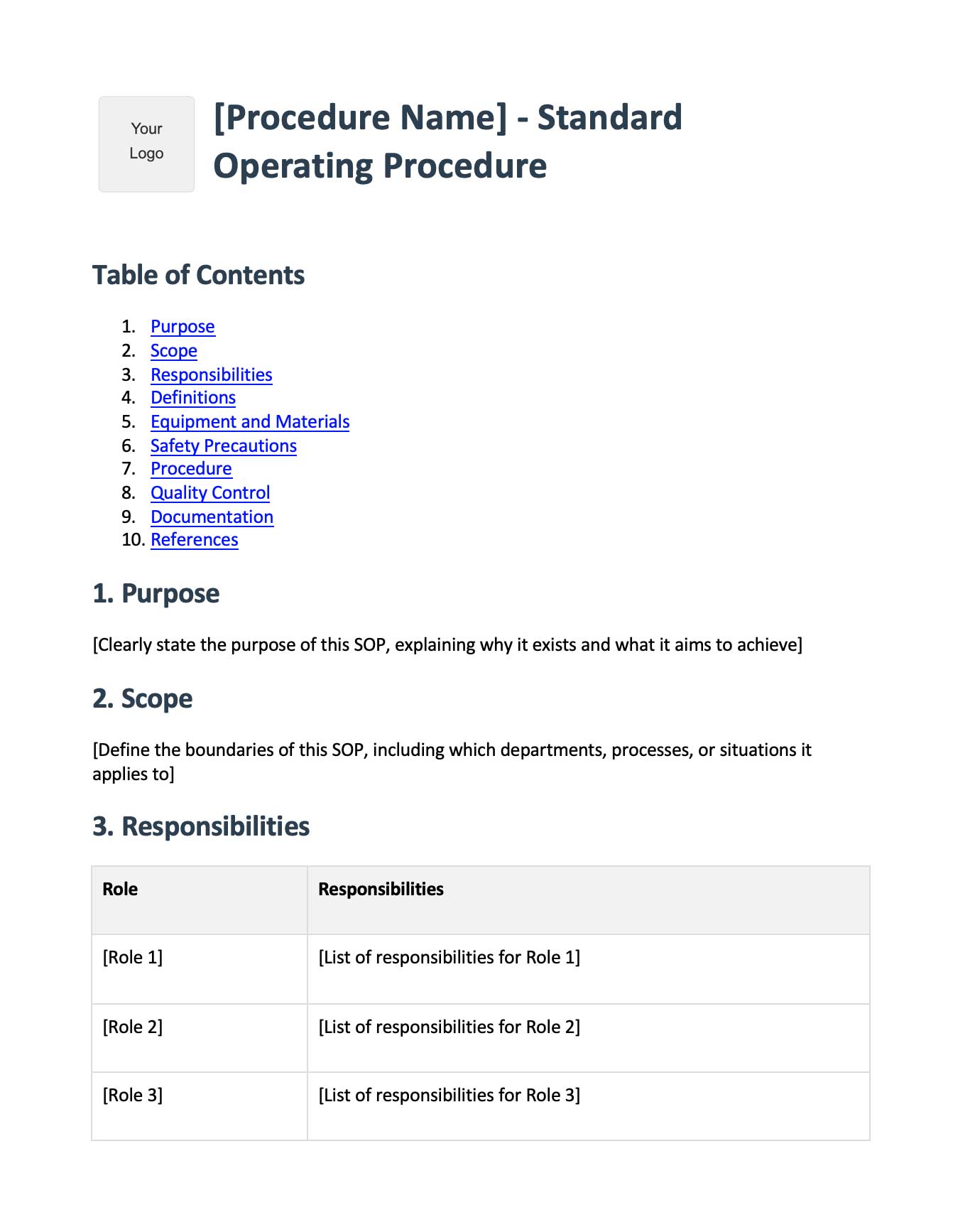
For a step-by-step walkthrough of the core finance processes these SOPs cover, see our guide to the accounts payable process. The companion accounts receivable process guide rounds out the order-to-cash side, and payroll runs on its own documented procedure.
Glitter AI automatically captures your screen and converts your voice into step-by-step documentation