
Read summarized version with
What is a Standard Operating Procedure?
A standard operating procedure (SOP) is a documented set of step-by-step instructions that shows how to perform routine business operations. Organizations write SOPs so employees can carry out complex tasks the same way every time. The goal? Better efficiency, consistent output, and fewer compliance headaches.
SOPs form the backbone of organizational knowledge. They answer the “what” and “why” of a process and create uniform practices across teams. Whether you’re talking about customer service protocols, safety procedures, or a restaurant SOP for the kitchen line, an SOP makes sure everyone follows the same steps. It doesn’t matter who does the task or when they do it.
For businesses, SOPs help maintain quality, cut down on mistakes, and keep the workplace safe. They give employees a reliable reference they can check without hunting down a supervisor. That makes them particularly useful for onboarding new hires and keeping things running smoothly when people leave. Many organizations compile their SOPs into a procedure manual for easy access.
Key Characteristics of a Standard Operating Procedure
- Consistency and Standardization: SOPs create uniform practices by giving everyone a structured framework to follow. When each person or team uses the same procedures, you get fewer errors and more predictable quality.
- Quality Control and Compliance: Good SOPs include specific steps and quality checkpoints. They help organizations meet predetermined standards and stay on the right side of industry regulations.
- Documentation That Covers the Bases: A typical SOP includes a clear title, purpose statement, scope definition, step-by-step instructions, safety measures, troubleshooting tips, and expected outcomes.
- Living Documents: SOPs aren’t meant to sit on a shelf and gather dust. Most organizations review and update them every six to twelve months as processes change and requirements evolve.
- Multiple Formats: You’ll find SOPs presented as PDFs, flowcharts, checklists, videos, or some combination of these. The best format depends on what you’re documenting and who needs to use it.
Standard Operating Procedure Examples
Example 1: Customer Service Escalation
Picture a software company that needs to handle customer escalations consistently. Their SOP spells out when issues should be escalated, who handles each tier, how quickly they need to respond, and what needs to be documented. Every customer service rep now handles escalations the same way. Customers are happier, and nothing slips through the cracks.
Example 2: Equipment Maintenance
A manufacturing facility writes an SOP for daily equipment maintenance. It covers safety protocols, what to inspect, how to clean everything, and what to do when something goes wrong. Line workers can now prevent unexpected downtime, and the facility stays compliant with safety regulations across all shifts.
Standard Operating Procedure vs Work Instruction
Both are important documentation types, but they serve different purposes and speak to different audiences.
| Aspect | Standard Operating Procedure | Work Instruction |
|---|---|---|
| Purpose | High-level overview of entire process | Detailed guide for specific task |
| Scope | Outlines what needs to happen across functions | Explains exactly how to perform one task |
| Audience | Management, supervisors, and cross-functional teams | Frontline workers executing specific tasks |
| Detail Level | General guidelines and best practices | Granular step-by-step instructions |
| When to use | Documenting complete procedures (e.g., quality control) | Explaining single tasks (e.g., assembling a component) |
The simplest way to think about it: SOPs give you the “what” and “why,” while detailed task guides deliver the “how.” These documents work together. When a checklist item in an SOP gets complicated, a work instruction can break down exactly how to perform that specific task.
How Glitter AI Helps with Standard Operating Procedures
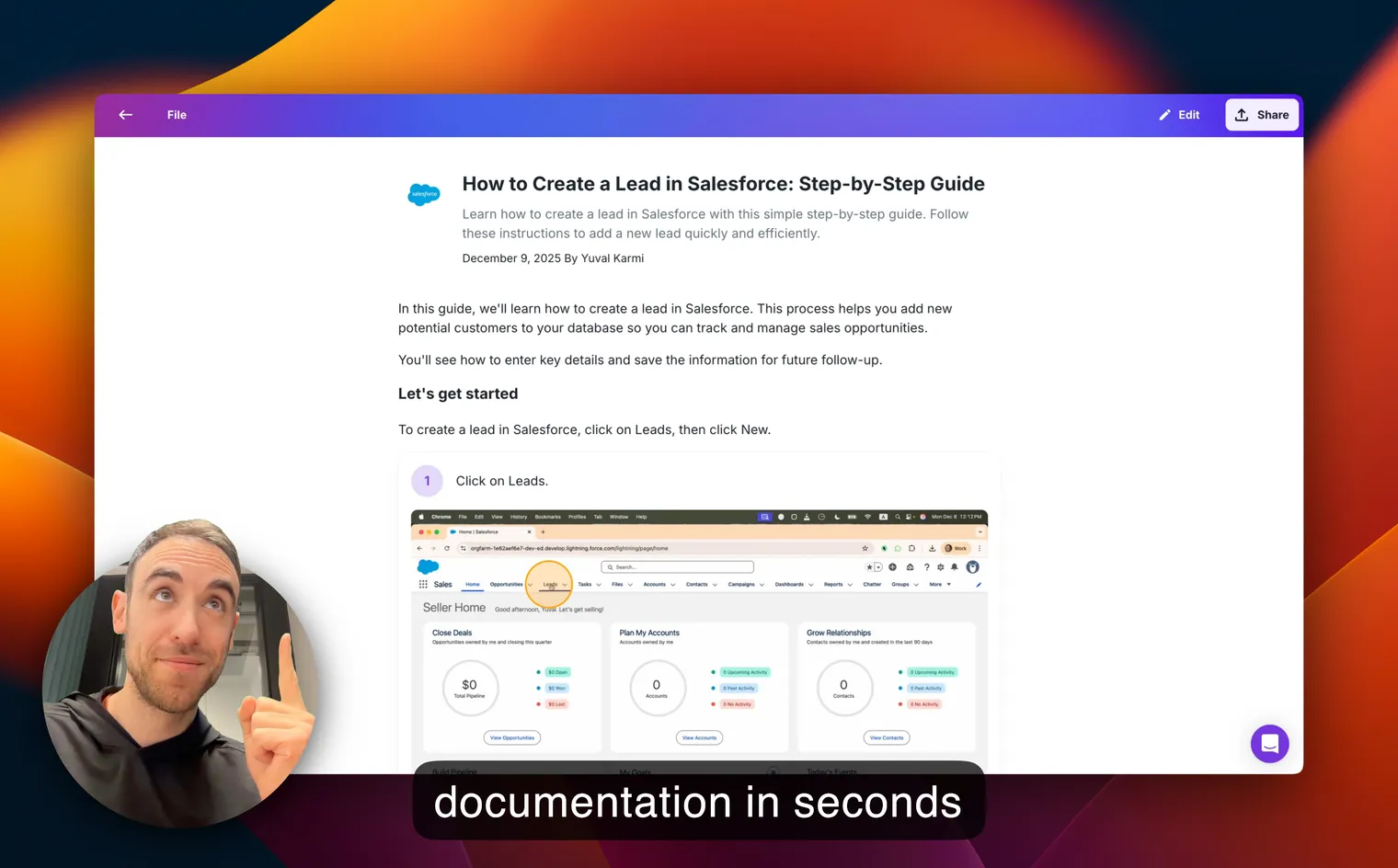
Glitter AI changes how teams create SOPs. Instead of spending hours writing documentation from scratch, subject matter experts can record their screen while performing a workflow, and the automated SOP builder automatically produces step-by-step procedures with screenshots, annotations, and written instructions. With AI transcription of the narration, the whole thing takes minutes.
This approach removes the traditional bottleneck of manual SOP writing and captures how processes actually work in practice, from legal and DevOps procedures to help desk scripts and logistics workflows. It works just as well for a regulated healthcare SOP as it does for routine internal handoffs, and you can sanity-check your drafts against a simple checklist of essentials before publishing. Documentation discipline like this matters most for regulated teams in accounting and financial services, and when procedures change, teams can quickly update their SOPs, track versions, and share interactive guides that new hires follow while onboarding as they work.
Teach your co-workers or customers how to get stuff done – in seconds.

Frequently Asked Questions
What does SOP mean in business?
In business, SOP stands for Standard Operating Procedure. It refers to documented step-by-step instructions that outline how to perform routine operations to ensure consistency, quality, and compliance across the organization.
What is an example of a standard operating procedure?
A common SOP example is a customer service escalation procedure that defines when to escalate issues, who handles each escalation tier, response time requirements, and documentation steps. This ensures every customer service representative handles escalations consistently.
Why are standard operating procedures important?
SOPs are important because they reduce errors, increase efficiency, ensure regulatory compliance, create safe work environments, and maintain quality standards. They also reduce training time for new employees and preserve organizational knowledge when employees leave.
How do you create a standard operating procedure?
To create an SOP, identify the process to document, define its purpose and scope, outline step-by-step instructions, include safety measures and troubleshooting guidance, specify expected outcomes, and review the SOP with stakeholders. Modern tools like Glitter AI can automate much of this process through screen recording.
What is the difference between an SOP and a work instruction?
An SOP provides a high-level overview of an entire process with general guidelines, while a work instruction offers detailed, step-by-step guidance for completing a specific task within that process. SOPs focus on the 'what' and 'why,' while work instructions cover the 'how.'