
Read summarized version with
What is a Visual Work Instruction?
A visual work instruction is a guide that relies on photographs, screenshots, videos, and diagrams to show someone how to complete a specific task. Instead of relying on the walls of text you might find in a traditional instruction manual, these instructions prioritize showing over telling. The result? Complex procedures become easier to grasp, and people don’t have to work as hard to understand what they need to do.
Here’s something interesting: the human brain processes visual information roughly 60,000 times faster than text. Studies suggest that people retain about 65% more information from visual work instructions compared to text-only documentation. That’s why industries like manufacturing, healthcare, and logistics tend to rely heavily on them as part of a wider visual management approach, especially when precision and safety are non-negotiable. Visual work instructions often complement standard operating procedures by making complex task-level instructions easier to follow.
Most visual work instructions mix different formats together, and learning how to create work instructions with practical examples makes the format much easier to get right. You might see annotated screenshots alongside short video clips or GIFs that demonstrate specific movements, plus diagrams showing how components fit together spatially. Comparison images showing the right way versus the wrong way are common too. This variety helps fill in the gaps that text alone often leaves behind. Teams often document these visuals as part of their broader process documentation efforts.
Key Characteristics of Visual Work Instructions
- Image-Driven Content: These instructions put photographs, screenshots, and diagrams front and center. Text takes a back seat, with each step typically featuring a visual that shows exactly what to do.
- Annotated Visuals: Good visual work instructions include callouts, arrows, circles, and labels pointing out critical areas, measurements, or quality checkpoints right on the images themselves.
- Multimedia Integration: The best visual work instructions don’t stop at still images. They bring in short video clips, animated GIFs, or interactive elements to capture movements and sequences that a static photo just can’t convey.
- Reduced Text Burden: Text is kept minimal and to the point. It supplements the visuals rather than replacing them. This approach works well for workers with different literacy levels or language backgrounds.
- Universal Accessibility: Because these instructions rely on visual communication, they naturally bridge language barriers. Teams with members who speak different languages or have varying technical vocabulary can still follow along.
Visual Work Instruction Examples
Example 1: Manufacturing Assembly
Picture an automotive plant where workers install door panel components. Their visual work instruction shows each step with high-resolution photographs. Annotated images highlight the exact torque specifications using colored overlays. A short video clip demonstrates the correct angle for inserting clips (something that’s hard to explain in writing). And comparison images show what a properly seated component looks like next to an improperly seated one. The results speak for themselves: assembly errors dropped by 30% and training time was cut by 40%.
Example 2: Healthcare Equipment Sterilization
A hospital created a visual work instruction for sterilizing surgical instruments. It walks staff through the cleaning process with step-by-step photographs, includes diagrams showing exactly how instruments should be arranged in sterilization trays, and uses annotated images with color-coded labels for temperature checkpoints and timer settings. This visual approach keeps sterilization consistent across all shifts and reduces the risk of contamination or equipment damage.
Visual Work Instruction vs Work Instruction
Both types document specific tasks, but they take very different approaches.
| Aspect | Visual Work Instruction | Traditional Work Instruction |
|---|---|---|
| Primary Format | Images, videos, diagrams with minimal text | Text-based with occasional diagrams |
| Learning Speed | 60,000x faster visual processing | Slower text comprehension |
| Recall Rate | 65% better information retention | Standard text-based retention |
| Language Barriers | Minimal - visuals are universal | Significant - requires language fluency |
| Training Time | Up to 40% reduction | Standard training duration |
| Error Reduction | 23-30% reduction in human error | Varies based on text clarity |
Where do visual work instructions really shine? High-volume operations, training environments, and safety-critical tasks where faster comprehension and fewer errors make a real difference, often working alongside a formal safety manual. Toyota and Airbus have both woven visual work instructions into their production systems. Airbus, for instance, reported a 30% drop in wiring assembly errors after making the switch.
Types of Visual Elements in Work Instructions
Screenshots and Photographs
High-resolution images that capture each step of a process, often annotated to highlight key areas, measurements, or quality criteria. Screenshots work well for software tasks, while photographs are better suited for physical operations.
Videos and GIFs
Short video clips or animated GIFs that show movements, techniques, or sequences in action. Static images just can’t capture certain things. A good rule of thumb: keep clips under 30 seconds so people stay focused.
Diagrams and Flowcharts
These schematic representations show how components connect, how parts fit together spatially, or how decisions branch out. They’re especially useful when you need to map out conditional logic in a process.
Comparison Images
Side-by-side visuals that contrast correct execution with common mistakes. Workers can quickly spot quality issues and understand what “good” looks like versus what to avoid.
Best Practices for Creating Visual Work Instructions
Design Consistency
Keep your formatting, color coding, and annotation styles the same across all visual work instructions. If you circle important elements in red in one step, stick with red circles throughout. This creates a visual language that workers learn to recognize quickly.
One Action Per Step
Each step should focus on a single action or decision. When a step involves multiple movements or a complex sequence, break it apart. You don’t want workers trying to remember five things at once.
Adapt for Skill Levels
New employees need more detail and guidance. Experienced workers? They often prefer something more concise. Tailoring your materials to different skill levels keeps them relevant and actually useful.
Integrate with Workflow Systems
Put your visual work instructions where people need them: tablets at workstations, mobile devices on the factory floor, or embedded directly into digital platforms. When instructions are available at the point of use, compliance goes up and so does efficiency.
Regular Updates and Feedback
Processes change, and your instructions should change with them. Review and update regularly. Also, give operators a way to flag unclear or inaccurate instructions. This feedback loop helps reduce defects and speeds up training over time.
How Glitter AI Helps Create Visual Work Instructions
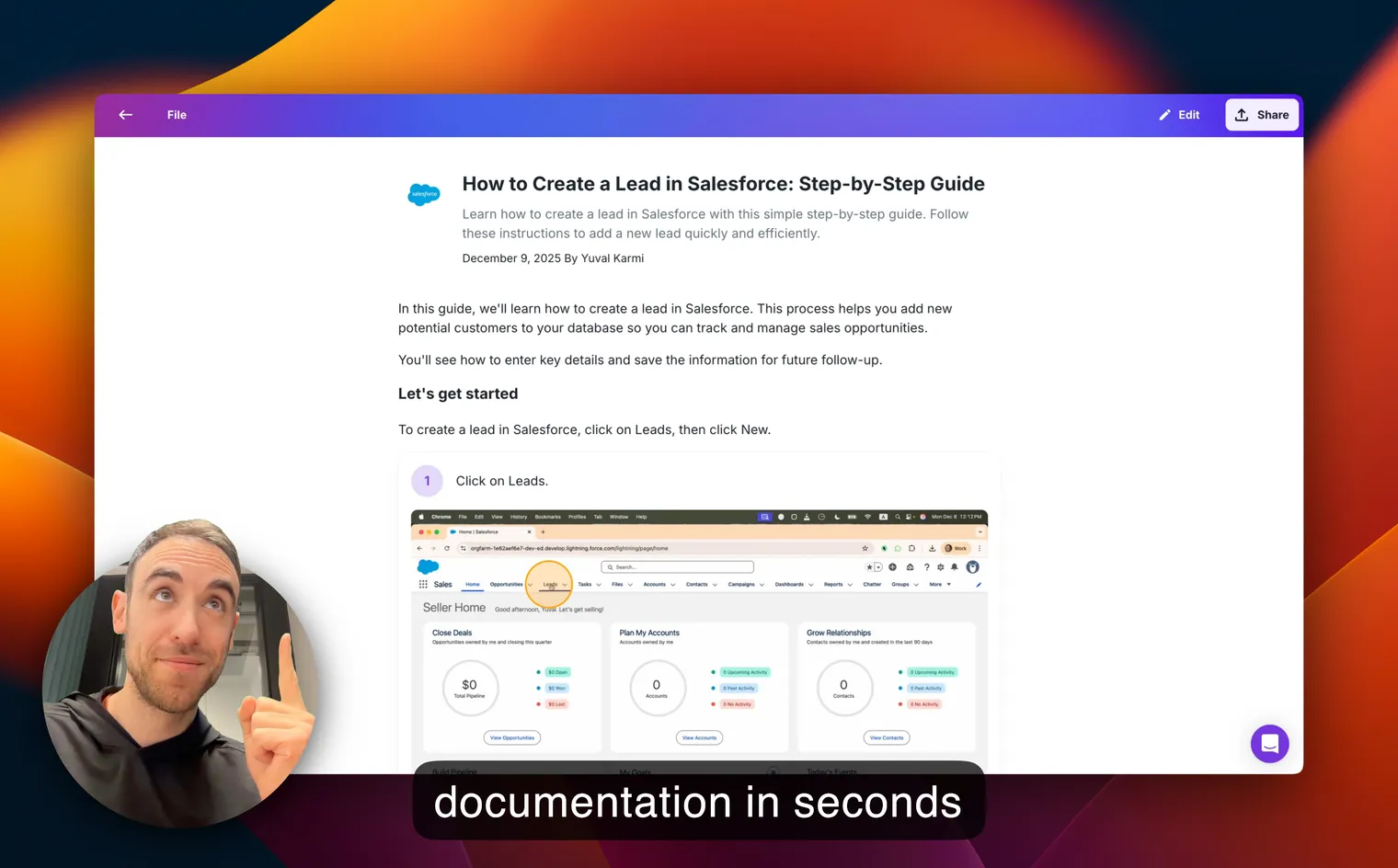
Creating visual work instructions manually is tedious. You have to capture screenshots, write descriptions, format everything. Glitter AI takes that burden off your plate. Subject matter experts just perform a task while Glitter records their screen, captures high-quality screenshots at each key step, and generates annotated visual work instructions with AI-powered descriptions.
The time savings are significant: up to 70% faster than manual methods. And because Glitter captures what actually happens during task execution, the documentation stays accurate. Teams can build out libraries of visual work instructions that workers access on any device. It turns institutional knowledge into visual guides that reduce errors, speed up training, and keep quality consistent across the board.
Teach your co-workers or customers how to get stuff done – in seconds.

Frequently Asked Questions
What is a visual work instruction?
A visual work instruction is a step-by-step guide that uses images, videos, diagrams, and other visual elements to show how to perform a task. It focuses on showing rather than telling, which makes procedures easier to understand and follow compared to text-only instructions.
What is an example of a visual work instruction?
A manufacturing assembly guide is a good example. It might show each step with annotated photographs that highlight torque specifications, include video clips demonstrating the correct installation angles, and provide comparison images so workers can see proper versus improper component placement.
Why use visual work instructions instead of text?
The brain processes visual information about 60,000 times faster than text. Visual work instructions also lead to roughly 65% better information retention, can reduce training time by up to 40%, and work across language barriers. They also cut down on human error, which accounts for about 23% of unplanned manufacturing downtime.
How do I create effective visual work instructions?
Focus on one action per step and keep your formatting and annotations consistent. Mix different visual formats like photos, videos, and diagrams. Keep video clips short. And make sure to update your instructions regularly based on feedback from the people actually using them.
What types of visuals should I include in work instructions?
A good mix includes annotated screenshots or photographs for each step, short video clips or GIFs that demonstrate movements, diagrams that show spatial relationships, and comparison images contrasting correct versus incorrect execution. Using multiple visual formats helps ensure people actually understand what they need to do.