
Read summarized version with
I’ll be straight with you: healthcare documentation is uniquely challenging.
You’re juggling patient safety, regulatory compliance, staff training, and constant updates to medical procedures - all while trying to actually deliver patient care. And if you get the documentation wrong? The consequences range from failed audits to serious patient harm.
I learned about healthcare documentation when I was helping a friend who runs a medical practice get organized. She had patient care protocols scattered across Word docs, staff training materials that were six months outdated, and no clear system for tracking who’d been trained on what. When her practice was selected for a HIPAA compliance audit, she practically had a meltdown.
Here’s what we figured out together: healthcare documentation doesn’t have to be overwhelming. It just needs to be systematic, accessible, and - most importantly - actually used by your staff.
In this guide, I’ll walk you through creating healthcare documentation that meets compliance requirements while actually helping your team deliver better patient care.
Yuval / Founder & CEO, Glitter AI
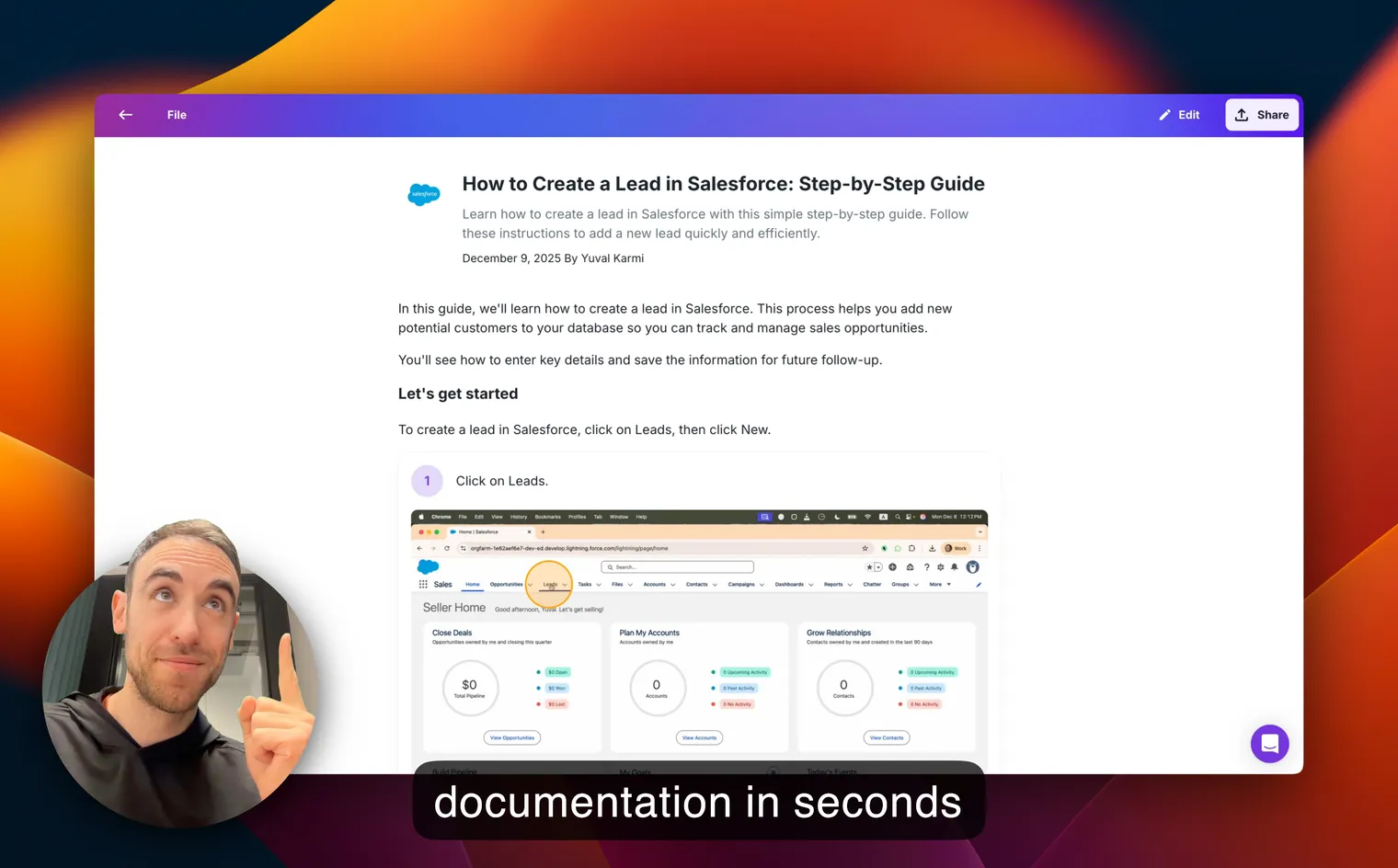
Teach your co-workers or customers how to get stuff done – in seconds.

Why Healthcare Documentation Is Different
Healthcare documentation isn’t like documenting other business processes. The stakes are higher, the regulations are stricter, and the consequences of getting it wrong are more serious.
Patient Safety Depends on It - When a nurse follows an outdated medication administration protocol, someone could get hurt. When a new staff member doesn’t know the proper infection control procedures, patients are at risk.
HIPAA Isn’t Optional - In healthcare, compliance documentation isn’t just about passing audits. HIPAA violations can result in fines up to $50,000 per violation. And if there’s willful neglect? You’re looking at potential criminal charges.
Constant Changes - Medical procedures, medications, and best practices evolve constantly. Your documentation needs to keep pace without creating chaos every time something updates.
Multiple Audiences - You’re documenting for physicians, nurses, administrative staff, and potentially patients themselves. Each group needs different levels of detail.
Legal Evidence - Your documentation can be subpoenaed in malpractice cases. What you write (or don’t write) becomes legal evidence of the care you provided.
The practices that nail healthcare documentation treat it as a core part of patient care, not a checkbox exercise. They understand that good documentation directly improves patient outcomes.
Essential Healthcare Documentation You Need
Not all healthcare documentation is created equal. Here are the critical types you absolutely need to have in place.
Patient Care Protocols
These are your standardized procedures for delivering specific types of care. They ensure every patient gets consistent, evidence-based treatment regardless of which staff member is working.
Examples:
- Medication administration protocols
- Vital signs monitoring procedures
- Emergency response protocols
- Infection control procedures
- Patient intake and assessment procedures
The key with patient care protocols is specificity. “Monitor the patient” isn’t enough. You need “Check vital signs every 4 hours and document in the EHR immediately. Alert attending physician if systolic BP drops below 90 or rises above 180.”
HIPAA Compliance Documentation
HIPAA requires specific documentation to prove you’re protecting patient privacy and data security. This isn’t optional, and auditors know exactly what to look for.
Required HIPAA Documents:
- Privacy policies and procedures
- Security risk assessment
- Audit trail of access to protected health information (PHI)
- Employee training records for HIPAA compliance
- Business associate agreements
- Breach notification procedures
- Patient rights notices
I’ve seen practices get dinged on audits not because they weren’t compliant, but because they couldn’t produce documentation proving they were compliant. The documentation IS the compliance.
Staff Training Materials
Your staff training documentation serves two purposes: it trains employees, and it proves they were trained.
What to Document:
- Onboarding procedures for new clinical staff
- Continuing education requirements
- Competency assessments
- Training completion records with signatures and dates
- Procedure updates and re-training
One thing I learned from my friend: don’t create separate training materials from your procedure documentation. Use the same documents for both. When you update a procedure, the training material is automatically updated too.
Check out our guide on creating effective training programs for more on this approach.
Teach your co-workers or customers how to get stuff done – in seconds.
Medical Procedures Documentation
Every clinical procedure your staff performs should have clear, step-by-step documentation.
Examples:
- Wound care procedures
- IV insertion and maintenance
- Catheter care
- Medication reconciliation
- Diagnostic test protocols
- Equipment operation procedures
The medical procedures I’ve seen work best include photos or screenshots showing each critical step. When you’re documenting how to operate a piece of medical equipment, a picture really is worth a thousand words.
Emergency Protocols
When an emergency happens, staff don’t have time to figure things out. They need clear, practiced procedures they can execute without thinking.
Critical Emergency Documentation:
- Code blue/cardiac arrest response
- Fire evacuation procedures
- Severe allergic reaction protocols
- Missing patient procedures
- Natural disaster response
- Active shooter protocols
These need to be the most accessible documents in your organization. Staff should be able to pull them up in seconds, not minutes.
Quality Assurance Documentation
Healthcare facilities are expected to continuously monitor and improve quality of care. That requires documentation.
QA Documentation Types:
- Incident reports and root cause analysis
- Patient complaint tracking and resolution
- Medication error reports
- Infection control monitoring
- Clinical outcome tracking
- Corrective action plans
This documentation protects you legally while also helping you identify systemic issues before they become serious problems.
How to Create HIPAA-Compliant Documentation
HIPAA compliance isn’t rocket science, but it does require understanding what HIPAA actually requires from your documentation.
Document Access Controls
You need to document exactly who can access protected health information (PHI) and under what circumstances.
What to Document:
- User access levels for your EHR system
- Procedures for granting and revoking access
- Login and access logs (your audit trail)
- Minimum necessary access policies
The key principle: document that you only give staff access to the minimum PHI necessary to do their jobs. A billing clerk shouldn’t have access to clinical notes.
Create Clear Privacy Policies
Your privacy policies need to explain how you use and disclose patient information.
Essential Privacy Policy Components:
- How you use PHI for treatment, payment, and operations
- When you can disclose PHI without patient authorization
- Patient rights regarding their information
- How patients can file complaints
- Your process for handling breaches
Don’t copy-paste generic templates. Your policies should reflect your actual practices. If an auditor asks “Do you actually do this?” the answer needs to be yes.
Maintain Training Records
HIPAA requires that all workforce members receive privacy and security training. You need documentation proving this happened.
What to Track:
- Date of initial HIPAA training for each employee
- Training content and materials used
- Acknowledgment forms signed by employees
- Dates of refresher training (required periodically)
- Training on policy updates
I use a simple spreadsheet for this, but honestly, a proper learning management system makes it way easier. The key is having immediate access to training records when auditors ask.
Document Security Safeguards
You need documented procedures for protecting electronic PHI (ePHI).
Required Security Documentation:
- Security risk assessment (required annually)
- Encryption policies for devices and data transmission
- Password requirements and management
- Physical security for devices containing ePHI
- Incident response procedures for security breaches
The security risk assessment is particularly important. You’re required to identify vulnerabilities and document how you’re addressing them.
Record yourself following a procedure once, and Glitter AI creates compliant documentation automatically.
Best Practices for Patient Care Protocol Documentation
Creating patient care protocols that actually improve outcomes requires thinking beyond compliance.
Involve Clinical Staff in Creation
Don’t let administrators write clinical protocols in isolation. The nurses, physicians, and technicians doing the work need to be involved.
I watched my friend restructure her entire documentation process after realizing her office manager had been writing procedures without input from clinical staff. The procedures were technically correct but missed critical details that frontline staff dealt with daily.
How to Involve Staff:
- Shadow staff performing the procedure
- Ask them to narrate what they’re doing and why
- Identify the common problems and edge cases
- Get their feedback on draft documentation
- Have them test the documentation by following it exactly
Use Clear, Unambiguous Language
Medical terminology is necessary, but documentation should still be clear.
Writing Tips:
- Use active voice: “Check the patient’s blood pressure” not “The patient’s blood pressure should be checked”
- One action per step
- Include specific measurements and thresholds
- Define acronyms on first use
- Explain the “why” for non-obvious steps
For example, don’t write “Maintain sterile technique.” That’s too vague. Instead: “Perform hand hygiene for 20 seconds. Don sterile gloves. Do not touch any non-sterile surfaces after gloving.”
Include Decision Points
Clinical care involves judgment calls. Your documentation should guide those decisions.
Use clear if/then statements:
- “If patient’s temperature exceeds 101.5°F, contact physician immediately”
- “If patient reports pain level above 7, administer prescribed pain medication per order”
- “If bleeding does not stop after 5 minutes of direct pressure, escalate to emergency protocol”
These decision points reduce anxiety for newer staff and ensure consistency in care.
Add Visual Documentation
Screenshots, photos, and diagrams make complex procedures much easier to follow.
Visual Documentation Ideas:
- Equipment setup with parts labeled
- Proper body positioning for procedures
- Wound care progression photos (de-identified)
- Medication storage organization
- Emergency equipment locations
I built Glitter AI specifically to make visual documentation easier. Record yourself performing a procedure while narrating the steps, and the AI captures screenshots and creates the documentation automatically. This is especially useful for training new staff on equipment operation.
Keep It Current
Outdated medical procedures documentation is worse than no documentation. It creates confusion and can lead to patient harm.
Update Procedures When:
- New evidence-based guidelines are published
- Equipment or medications change
- Staff identify problems with current procedures
- Incidents reveal gaps in protocols
- Regulatory requirements change
Set a review schedule (annually at minimum) and assign someone to monitor for changes that require updates. Make sure you track versions and maintain an audit trail of changes.
Staff Training That Actually Sticks
Healthcare staff training isn’t just about meeting compliance requirements. It’s about ensuring your team can deliver safe, effective patient care.
Create Competency-Based Training
Don’t just lecture staff and call it training. Verify they can actually perform procedures correctly.
Competency-Based Training Structure:
- Introduction - Overview of why this procedure matters
- Demonstration - Show the procedure being done correctly
- Guided Practice - Staff performs with supervision
- Independent Practice - Staff performs without assistance
- Competency Assessment - Formal evaluation of skill
Document each stage. If someone struggles at independent practice, they need more guided practice before they’re cleared for patient care.
Make Training Accessible
Staff can’t follow procedures they can’t access. This seems obvious, but I’ve seen practices where procedures are locked in someone’s office.
Accessibility Requirements:
- Available at point of care (tablets, wall-mounted devices, mobile)
- Searchable by procedure name or keyword
- Quick reference cards for emergency protocols
- Offline access for critical procedures
Consider how your staff actually works. If nurses are constantly moving between patient rooms, they need mobile access to documentation.
Track Everything
For compliance and quality purposes, you need detailed records of who was trained on what and when.
Training Records to Maintain:
- Employee name and role
- Training topic and date
- Training method (classroom, hands-on, online)
- Competency assessment results
- Trainer signature
- Next required training date
This documentation proves staff were properly trained if there’s ever a patient incident or compliance audit.
For more on creating training that employees actually remember, check out our guide on employee training best practices.
Teach your co-workers or customers how to get stuff done – in seconds.
Common Healthcare Documentation Mistakes
Even experienced healthcare facilities make these documentation mistakes. Here’s what to avoid.
Mistake 1: Generic Templates That Don’t Reflect Reality
Copy-pasting compliance templates from the internet is tempting. But if your documented procedures don’t match what actually happens in your facility, you’re setting yourself up for trouble.
The Fix: Use templates as starting points, then customize them to reflect your actual workflows, equipment, and staffing.
Mistake 2: Making Documentation Someone’s Side Job
Healthcare documentation is too important to be an afterthought task someone squeezes in between other responsibilities.
The Fix: Assign clear ownership for documentation. Whether it’s a dedicated compliance officer or a clinical manager with protected time, someone needs accountability.
Mistake 3: No Version Control
I’ve seen facilities where multiple versions of the same procedure were floating around. Staff didn’t know which one was current.
The Fix: Implement clear version control. Every document should have a version number, last updated date, and next review date. Retire old versions completely - don’t let them linger.
Mistake 4: Ignoring the Audit Trail
HIPAA requires an audit trail showing who accessed patient information. Many facilities don’t realize they need to review these logs regularly.
The Fix: Set up automated audit trail reporting. Review logs at least monthly for unusual access patterns. Document that you’re monitoring access.
Mistake 5: Training Without Verification
Handing someone a document and saying “read this” isn’t training.
The Fix: Require acknowledgment that training was completed AND verify competency through observation or assessment. Document both.
Organizing Your Healthcare Documentation System
Random folders full of Word docs isn’t a documentation system. Here’s how to actually organize everything.
Create a Clear Hierarchy
Your documentation should be organized logically so staff can find what they need quickly.
Example Structure:
- Clinical Procedures
- Medication Administration
- Patient Care
- Infection Control
- Emergency Protocols
- Compliance
- HIPAA Policies
- Safety Regulations
- Quality Assurance
- Administrative
- Staff Onboarding
- Scheduling Procedures
- Billing Processes
- Training Materials
- New Hire Training
- Continuing Education
- Competency Assessments
Use Consistent Naming
Create a naming convention and stick to it religiously.
Example Convention:
[Category]-[Procedure Name]-[Version]-[Date]
So: CLINICAL-Medication-Administration-v3-2026-12.pdf
This makes it easy to find the latest version and understand what the document covers at a glance.
Implement Access Controls
Different staff need access to different documentation. Administrative staff don’t need clinical protocols, and vice versa.
Access Levels:
- All Staff - Emergency protocols, general safety procedures, HIPAA basics
- Clinical Staff - Patient care protocols, medication procedures
- Administrative Staff - Billing procedures, scheduling, administrative policies
- Management - All documentation plus compliance records, audit reports
This isn’t just about organization - it’s about HIPAA compliance. Limit access to PHI-related documentation to only those who need it.
Make Search Work
Staff shouldn’t have to know the exact file name to find what they need.
Search Optimization:
- Tag documents with relevant keywords
- Include synonyms in document metadata
- Create a searchable index
- Enable full-text search
If someone searches for “IV” they should find intravenous procedures even if the official title is “Intravenous Line Insertion Protocol.”
Keeping Documentation Updated
Creating great healthcare documentation is hard. Keeping it updated is even harder.
Assign Document Owners
Every procedure should have someone responsible for keeping it current.
The document owner monitors for changes (new regulations, updated equipment, revised best practices) and ensures documentation is updated accordingly. They also schedule regular reviews.
Schedule Regular Reviews
Don’t wait for problems to surface before reviewing documentation.
Review Schedule:
- Critical Clinical Procedures - Every 6 months
- HIPAA Compliance Documentation - Annually (or when regulations change)
- Emergency Protocols - Annually
- General Administrative Procedures - Every 1-2 years
Put these reviews on the calendar and treat them as non-negotiable.
Create an Update Process
When procedures change, you need a systematic process for updating documentation.
Update Process:
- Identify what changed and why
- Draft updated documentation
- Review with relevant clinical/administrative staff
- Get formal approval from designated authority
- Replace old version completely
- Notify affected staff of changes
- Provide training on significant changes
- Document the update in your version history
This seems like a lot of steps, but it prevents the chaos of multiple versions floating around.
Track Changes and Communicate Them
When documentation changes, staff need to know about it.
Communication Methods:
- Email notifications for minor updates
- Required training for major procedure changes
- Monthly “what’s new” documentation updates
- Visual indicators for recently updated documents
Don’t assume staff will notice that v2.3 replaced v2.2. Tell them explicitly.
Our guide on keeping process documentation updated has more strategies for maintaining current documentation across your organization.
Tools and Technology for Healthcare Documentation
The right tools make healthcare documentation dramatically easier.
Electronic Health Record (EHR) Integration
Your EHR probably has built-in capabilities for procedure documentation and training tracking. Use them.
EHR Documentation Features:
- Order sets based on protocols
- Clinical decision support linking to procedures
- Training completion tracking
- Access logs for HIPAA compliance
The more you can integrate documentation directly into clinical workflows, the more likely staff will actually use it.
Document Management Systems
A proper document management system beats folders on a shared drive.
Key Features to Look For:
- Version control
- Access controls by role
- Audit trails of who accessed what
- Mobile accessibility
- Search functionality
- Workflow for approval and review
There are healthcare-specific systems designed with HIPAA compliance in mind. They’re worth the investment.
Screen Recording for Procedure Documentation
This is where I’m biased, but screen recording tools specifically designed for documentation make creating procedures so much faster.
Instead of writing out every step manually, you record yourself performing the procedure once while narrating what you’re doing. The tool captures screenshots and transcribes your narration into clear documentation.
For medical software procedures (EHR usage, billing system navigation, etc.), this cuts documentation time from hours to minutes. That’s literally why I built Glitter AI.
Training Management Systems
If you have more than a handful of employees, a learning management system (LMS) is worth it.
What an LMS Handles:
- Training assignment and tracking
- Competency assessments
- Automatic renewal reminders
- Reporting for compliance audits
- Training completion certificates
You can stop chasing people down about overdue training when the system sends automatic reminders.
Create professional healthcare documentation in minutes with AI. HIPAA-compliant, easy to update, and designed for busy clinical teams.
Preparing for Healthcare Compliance Audits
Eventually, you’ll face a compliance audit. Good documentation makes it painless instead of panic-inducing.
What Auditors Look For
Healthcare compliance auditors have specific checklists. Knowing what they want helps you prepare.
Common Audit Areas:
- HIPAA privacy and security policies
- Staff training records
- Access controls and audit logs
- Risk assessments
- Breach notification procedures
- Business associate agreements
- Patient rights documentation
They’re not trying to trick you. They want to verify you’re doing what you say you’re doing.
How to Organize for an Audit
When the auditor asks for documentation, you should be able to produce it in minutes, not days.
Audit Preparation:
- Create an “audit folder” with all required compliance documentation
- Include a table of contents for easy navigation
- Ensure all documents are current versions
- Have training records organized by employee and by topic
- Print or export access logs for the requested timeframe
- Prepare contact information for document owners if auditors have questions
Basically, assume the auditor has zero knowledge of your organization. Your documentation should be self-explanatory.
Common Audit Findings
These are the issues that frequently trip up healthcare facilities.
Typical Findings:
- Incomplete training records
- Outdated policies that don’t reflect current practices
- Insufficient access controls for PHI
- Missing or inadequate risk assessments
- No documented review of audit logs
- Business associate agreements missing required elements
Most of these are documentation issues, not actual non-compliance. You were doing the right things, but you couldn’t prove it.
Responding to Audit Findings
If the auditor identifies issues, how you respond matters.
Response Process:
- Acknowledge the finding without being defensive
- Investigate the root cause
- Develop a corrective action plan
- Document what you’re doing to fix it
- Implement changes
- Follow up to verify the fix worked
Auditors appreciate facilities that take findings seriously and address them systematically.
Making Healthcare Documentation Part of Your Culture
The best healthcare documentation systems work because the entire organization values documentation.
Lead by Example
If leadership treats documentation as bureaucratic nonsense, staff will too. But if leaders consistently refer to documentation, update it when they spot issues, and acknowledge its role in patient safety, staff take it seriously.
Celebrate Documentation Wins
When good documentation prevents an error or helps resolve a patient issue, talk about it.
“Dr. Smith caught a potential medication interaction because the protocol documentation flagged it” is a story worth sharing.
Make It Easy, Not Punitive
If staff are punished for admitting they didn’t follow a procedure, they’ll stop reporting issues. You want a culture where people feel safe saying “I’m confused about this procedure” or “I think this documentation is outdated.”
Connect It to Patient Outcomes
Don’t frame documentation as compliance theater. Frame it as patient safety.
“We document our infection control procedures because it keeps our patients safe from hospital-acquired infections” is more compelling than “We document this because HIPAA says we have to.”
Provide Time and Tools
If you expect staff to maintain documentation, give them protected time to do it and tools that make it efficient.
Asking someone to create detailed procedure documentation during their lunch break with nothing but Microsoft Word is a recipe for bad documentation.
For more on building a culture that values documentation, see our article on creating a documentation culture.
The Bottom Line on Healthcare Documentation
Healthcare documentation feels overwhelming because the stakes are so high. Patient safety, regulatory compliance, legal protection, and staff training all depend on getting it right.
But here’s what I’ve learned from working with healthcare facilities: you don’t need perfect documentation. You need documentation that’s good enough, actually used by staff, and systematically maintained.
Start with the highest-risk procedures and the most critical compliance requirements. Document those thoroughly. Then expand to other areas systematically.
Use tools that make documentation faster. Involve the people doing the work. Keep everything accessible. Update regularly.
Most importantly, treat documentation as a tool for delivering better patient care, not just a compliance checkbox. When your team sees documentation as genuinely helpful rather than bureaucratic overhead, adoption becomes easier.
You’ve got this. One procedure at a time.
Frequently Asked Questions
What are the most critical types of healthcare documentation required for HIPAA compliance?
HIPAA requires several key documents: privacy policies and procedures, security risk assessments, employee training records, business associate agreements, breach notification procedures, audit trails of PHI access, and patient rights notices. Additionally, you need documented access controls showing who can view patient information and under what circumstances. All of these must be current, accurate, and readily accessible during audits.
How often should healthcare procedures and protocols be reviewed and updated?
Critical clinical procedures should be reviewed every 6 months, HIPAA compliance documentation annually or when regulations change, emergency protocols annually, and general administrative procedures every 1-2 years. You should also update documentation immediately when procedures change, new equipment is introduced, or incidents reveal gaps in current protocols. Always assign document owners responsible for monitoring for changes between scheduled reviews.
What's the best way to document medical procedures for staff training purposes?
The most effective medical procedure documentation includes step-by-step instructions written in active voice with one action per step, visual elements like annotated screenshots or photos showing critical steps, clear decision points using if/then statements, and specific measurements or thresholds. Involve clinical staff who perform the procedure in creating the documentation, and verify comprehension through competency assessments rather than just having staff read documents.
How do I maintain an audit trail for HIPAA compliance?
An audit trail for HIPAA requires logging who accessed protected health information, when they accessed it, and what they accessed. Most EHR systems automatically create these logs. Your responsibility is to review them regularly (at least monthly) for unusual access patterns, document that you're monitoring access, maintain logs for at least six years, and have procedures for investigating suspicious access. Set up automated reporting to make this manageable rather than reviewing raw logs manually.
What should I do if our healthcare documentation is outdated or incomplete?
Start by prioritizing critical areas: patient safety protocols, emergency procedures, and required HIPAA documentation. Create a systematic plan to update documentation by assigning owners to each procedure, setting realistic deadlines, involving frontline staff in the revision process, and implementing version control to prevent confusion. Don't try to fix everything at once. Focus on high-risk procedures first, then expand to other areas systematically while putting processes in place to keep documentation current going forward.
How can I get healthcare staff to actually follow documented procedures?
Staff follow procedures when they're easy to access, clearly written, visually supported with screenshots or photos, and actually helpful for doing their jobs. Make documentation searchable and available at point of care on mobile devices or tablets. Involve staff in creating procedures so they reflect real workflows, not theoretical ones. Provide proper training with competency verification, and create a culture where following procedures is expected and supported rather than treated as optional.
What are the biggest mistakes healthcare facilities make with documentation?
The most common mistakes include using generic templates that don't reflect actual practices, lacking version control so multiple outdated versions circulate, treating training as just handing someone a document to read without verifying comprehension, failing to maintain required audit trails of PHI access, and making documentation someone's side job rather than assigning clear ownership. Most healthcare facilities fail audits not because they're non-compliant, but because they can't produce documentation proving they're compliant.
Do I need special software for healthcare documentation, or can I use standard tools?
While you can use standard tools like Microsoft Word and shared drives, specialized healthcare documentation systems make compliance much easier. Look for tools with version control, role-based access controls, audit trails, mobile accessibility, and integration with your EHR. For HIPAA compliance specifically, you need systems that can track and log access to documents containing PHI. The investment in proper tools typically pays for itself in time saved and reduced audit stress.