
Read summarized version with
Three months after we hired our tenth employee, I realized we didn’t have an employee handbook.
No vacation policy. No clear performance review process. No documented HR procedures. Just a collection of Slack messages where I’d answered questions like “how do I request time off?” and “when do performance reviews happen?”
It caught up with me when two employees requested the same week off, I approved both because I forgot about the first one, and suddenly we didn’t have enough people to ship a critical feature.
HR documentation isn’t about bureaucracy. It’s about not making the same mistakes over and over, and actually being fair to your team.
I’m Yuval, founder and CEO of Glitter AI. I’ve learned the hard way that good HR documentation is the difference between “we handle things case by case” (which really means “we’re inconsistent and probably unfair”) and actually having clear, consistent policies that help your team.
Let me show you what actually works.
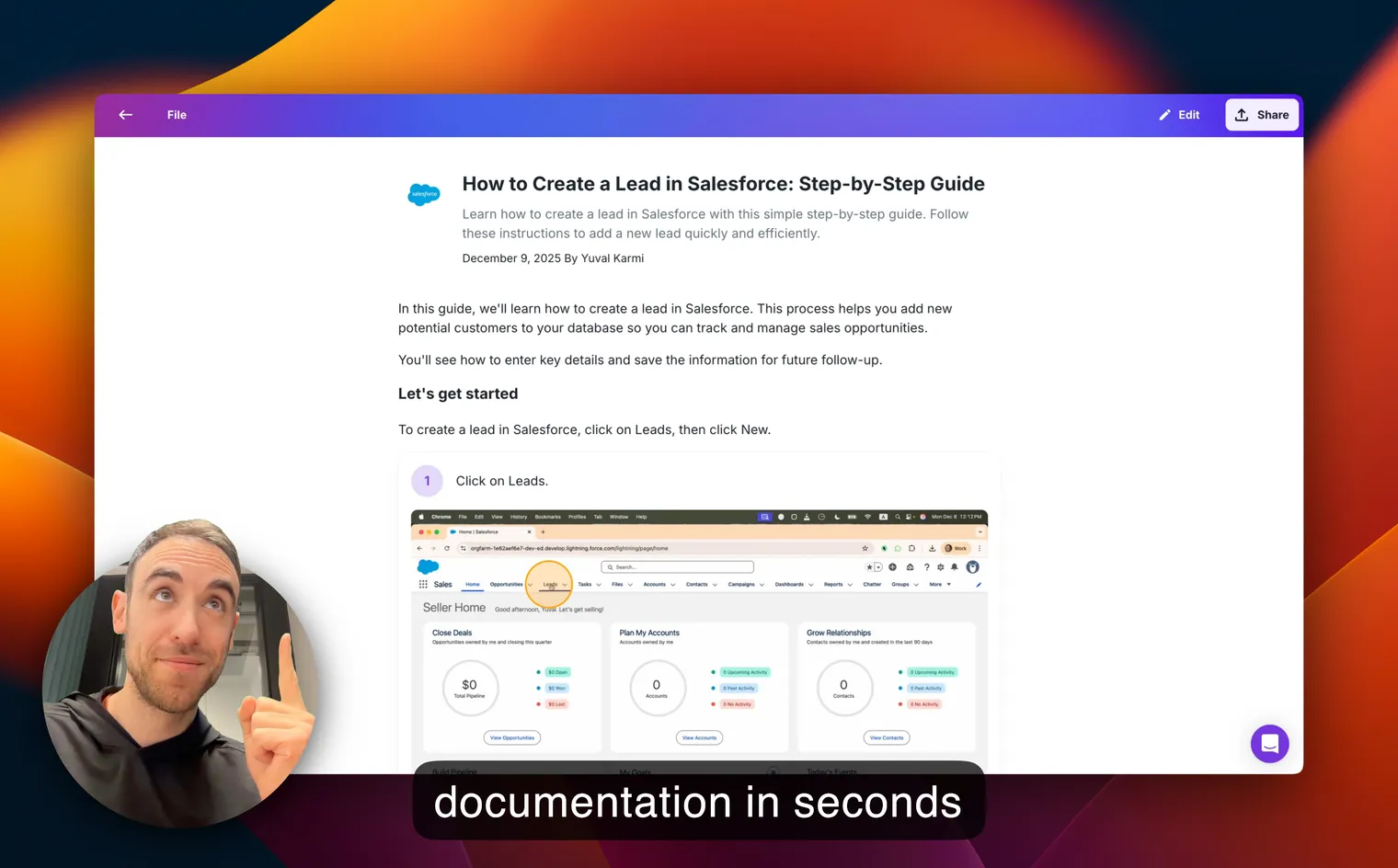
Teach your co-workers or customers how to get stuff done – in seconds.

Why Most HR Documentation Sits Unused in Google Drive
Here’s what I see in most companies: an employee handbook that someone spent weeks creating, formatted beautifully in a PDF, and absolutely nobody reads.
The Common Problems
It’s written in legal language that nobody understands. I’ve read employee handbooks that sound like they were written by lawyers for lawyers. “Employees shall submit requests for approved absence in accordance with company policy.” Cool. Where? How? When?
It’s created once and never updated. Someone writes an employee handbook in 2022. Company changes three policies. Handbook still says the old thing. Now it’s not just useless - it’s actively wrong.
Nobody can find it when they need it. Is it in Google Drive? SharePoint? That onboarding folder? Good luck finding the current version when you actually need to know the vacation policy.
It doesn’t answer the questions people actually have. Employees want to know “how many sick days do I get?” The handbook has three pages about “our commitment to employee wellness” and no clear answer.
What Actually Works
The HR documentation that helped me scale from 5 to 50 employees follows these principles:
It’s written in plain language that anyone can understand. It’s living documentation that gets updated when policies change. It’s searchable and accessible so people can find answers quickly. And it answers actual questions instead of sounding impressive.
That’s what we’re building today.
Record once, share unlimited. Create HR docs your team actually uses.
Employee Handbook: The Foundation of HR Documentation
An employee handbook should be the single source of truth for how your company works. Not a legal document designed to protect the company - a practical guide that helps employees understand policies.
Start With the Questions People Actually Ask
I used to think employee handbooks needed to cover everything comprehensively. Then I realized people only read them when they have specific questions.
Here’s what your handbook actually needs to answer:
How do I request time off? Not your philosophy on work-life balance. The actual process. Where to request it. How much notice. Who approves it. What happens if it’s denied.
When do I get paid and what benefits do I have? Pay schedule. Health insurance enrollment. 401k matching. PTO accrual. The concrete details people need to know.
What are the working hours and remote work policy? Core hours. Remote work expectations. Flexibility policies. Be specific. “Flexible hours” means different things to different people.
What’s the performance review process? When reviews happen. What gets evaluated. How raises work. No surprises.
What’s not okay at this company? Harassment policy. Code of conduct. Consequences. This needs to be crystal clear.
Structure Your Employee Handbook Like This
I learned this from rebuilding our handbook three times. Here’s what finally worked:
Section 1: Welcome and Company Basics. What the company does. Mission and values. But keep it short - one page max. People want to get to the useful stuff.
Section 2: Employment Basics. Employment classification (exempt/non-exempt). Work schedule. Payroll. Benefits overview. The fundamentals.
Section 3: Time Off and Leave Policies. Vacation/PTO policy. Sick leave. Holidays. Parental leave. Bereavement leave. Every type of leave, clearly explained.
Section 4: Workplace Policies. Remote work policy. Expense reimbursement. Technology use. Confidentiality. Everything about day-to-day work.
Section 5: Performance and Development. Performance review process. Promotion criteria. Professional development budget. Learning opportunities.
Section 6: Standards of Conduct. Code of conduct. Anti-harassment policy. Disciplinary procedures. What happens if someone violates policies.
Section 7: Leaving the Company. Resignation process. Final pay. Benefits continuation. Exit interviews. Make offboarding clear too.
I keep each section short. Two to three pages max. If I need more detail, I link to separate policy documents. The handbook is the overview. Detailed procedures live elsewhere.
For more on creating effective onboarding processes, check out my guide on employee onboarding checklists.
Teach your co-workers or customers how to get stuff done – in seconds.
HR Policies and Procedures: Making Decisions Consistent
Policies are your principles. Procedures are how you execute them.
Document the Process, Not Just the Policy
This is where most HR documentation fails. You have a vacation policy that says “employees receive 15 days PTO.” Great. But how do they request it? How far in advance? What happens if two people want the same week? Who approves it?
Policy: What the rule is. “Employees receive 15 days PTO per year, accrued monthly.”
Procedure: How it actually works. “To request PTO: 1) Submit request in BambooHR at least 2 weeks in advance. 2) Manager reviews and approves/denies within 48 hours. 3) If multiple requests for same dates, first submitted request gets priority. 4) Approval confirmation sent via email.”
See the difference? Policy is the principle, procedure is the step-by-step.
The HR Procedures You Actually Need
Here are the procedures that saved me from making inconsistent decisions:
Hiring and recruiting procedure. How job postings get created. Interview process. Who makes hiring decisions. Offer approval process. Background checks. Onboarding steps.
Performance review procedure. Review schedule. Self-assessment process. Manager assessment. Calibration meetings. Delivery of feedback. Compensation adjustments.
Promotion procedure. Promotion criteria. Nomination process. Approval chain. Communication. Compensation changes.
Disciplinary procedure. Progressive discipline steps. Documentation requirements. Who needs to be involved. Termination process.
Expense reimbursement procedure. What’s reimbursable. Approval limits. Submission process. Reimbursement timeline.
Benefits enrollment procedure. Enrollment windows. Required documentation. Dependent verification. Changes during the year.
When I finally documented these procedures, I stopped getting the same questions over and over. More importantly, I started treating employees consistently. Everyone follows the same process.
Our guide on creating SOPs employees actually follow has more on making procedures clear and actionable.
Onboarding Documentation: Getting New Hires Up to Speed
Onboarding documentation is interesting because you’re writing for someone who knows nothing about your company yet.
Create a Week-by-Week Onboarding Checklist
I used to onboard people by memory. “Oh yeah, we should probably get you access to Slack. And did anyone send you the handbook? No? Let me do that now.”
Incredibly professional.
Here’s what actually works:
Pre-start checklist (before day one). Equipment ordered. Accounts created. Desk/space prepared. Welcome email sent. Manager notified.
Week 1 checklist. Company overview meeting. Benefits enrollment. Tool access setup. Team introductions. Initial project assignment.
Week 2-4 checklist. Department training. Key stakeholder meetings. Shadowing sessions. First real project. Check-in with manager.
30-60-90 day milestones. What they should accomplish. Who they should meet. Skills they should develop. When formal reviews happen.
I make the checklist visible to both the new hire and their manager. The manager knows what to prepare. The new hire knows what to expect. Nobody’s scrambling to figure out what comes next.
Document Your Company Knowledge, Not Just Process
This is the sneaky part of onboarding. You need to transfer both explicit knowledge (here’s how to submit an expense report) and tacit knowledge (here’s how things really work around here).
Explicit knowledge documentation. How to use our tools. Where to find things. Who to ask for what. Standard procedures. This is straightforward.
Tacit knowledge documentation. How decisions get made. Communication norms. Unwritten rules. Company culture. This is harder but more valuable.
I document tacit knowledge through examples:
“When proposing a new idea, the norm here is to write a 1-2 page brief first. See example. Get feedback from your manager before bringing it to a wider group. Here’s why we do it this way.”
Not “here’s our innovation process.” But “here’s specifically how you’d actually do this.”
More details in my post about creating effective training programs.
Record your screen while walking through processes. AI generates the guide automatically.
Performance Review Documentation: Making Evaluations Fair
Performance reviews are stressful enough without unclear criteria and inconsistent processes, which is exactly why a documented performance review SOP matters.
Document Your Evaluation Framework
I used to do performance reviews based on vibes. “Sarah’s doing great! Jake seems fine. Alex is crushing it.”
Cool. What does “great” mean? How is “crushing it” different from “fine”? What feedback am I actually giving?
Here’s what I document now:
Performance levels with clear definitions. We use five levels. Each level has a clear definition of what performance looks like at that level. Not vague. Specific.
Evaluation criteria for each role. What we’re evaluating. Core competencies. Role-specific skills. Impact on team. Behavioral expectations.
Rating scale with examples. “Meets expectations” means what specifically? What does that look like for this role? Give examples.
Calibration process. How managers discuss ratings to ensure consistency. How we handle rating distribution. How we prevent bias.
Create a Performance Review Timeline and Process
I document the entire performance review cycle:
Preparation phase (2 weeks before). Self-assessment forms sent. Peer feedback requests. Manager drafts review. Data gathered.
Review phase (review week). Manager completes written review. Calibration meeting with leadership. Compensation decisions. Review scheduled with employee.
Delivery phase (review meeting). 1-on-1 review meeting. Discussion of performance, growth, goals. Delivery of rating and compensation changes. Development plan created.
Follow-up phase (after review). Goals documented. Development plan tracked. Check-ins scheduled. Progress monitored.
I share this timeline with the entire company before review season. No surprises. Everyone knows what’s happening when.
The documentation also includes templates for self-assessments, manager reviews, and development plans. Consistency across the board.
Compliance Documentation: Covering the Legal Stuff
Compliance documentation is the least fun part of HR. It’s also the part that can get you sued or fined if you screw it up.
Know What You’re Required to Document
Here’s what you actually need, depending on your size and location:
Required workplace posters and notices. OSHA, EEOC, FMLA, state labor law posters. These vary by state. Check your requirements.
Anti-harassment and discrimination policies. Not optional. Must be in writing. Must be distributed. Must include reporting procedures.
Safety and emergency procedures. Evacuation plans. Emergency contacts. Incident reporting. OSHA compliance if applicable.
Data privacy and security policies. How you handle employee data. Privacy rights. Security protocols. GDPR compliance if you have EU employees.
Leave policies that comply with law. FMLA if you’re 50+ employees. State sick leave laws. Pregnancy accommodation. Disability accommodation.
Wage and hour policies. Overtime eligibility. Meal breaks. Recording work time. State-specific requirements.
I’m not a lawyer (obviously). I worked with employment counsel to document our compliance requirements properly. But once they’re documented, I can actually implement them consistently.
Creating effective compliance documentation is essential for protecting both your organization and your employees.
Document Your Incident Response Process
When something goes wrong - harassment complaint, safety incident, discrimination allegation - you need a documented process.
Reporting procedures. Multiple ways to report. Who receives reports. Confidentiality protections. Non-retaliation policy.
Investigation procedures. Who investigates. Investigation steps. Documentation requirements. Timeline.
Resolution procedures. Decision-making process. Corrective actions. Communication to parties. Follow-up.
Documentation requirements. What to document. How to document. Where to store. Retention requirements.
I hope I never need this documentation. But if I do, I really need it. Having it documented means we handle incidents consistently and legally.
How to Keep HR Documentation Current Without It Taking Over Your Life
The biggest challenge with HR documentation isn’t creating it. It’s keeping it current.
Build Documentation Updates Into Policy Changes
Here’s what works for me:
Before changing any policy, I ask: “What documentation needs to update?”
Change vacation policy? Update employee handbook, onboarding checklist, and PTO procedure.
Change performance review process? Update review timeline, manager training, and employee handbook.
Change benefits? Update handbook, onboarding docs, benefits enrollment procedure.
I don’t change the policy and then plan to update docs “later.” Later never happens. I update the documentation as part of making the change.
Version Control and Change Tracking
All our HR documentation includes:
Last updated date and by whom. So people know if it’s current.
Version number. Major policy change = new version. Minor clarification = version number update.
Change log. What changed and when. “2026-12-19: Updated PTO policy to increase accrual from 15 to 20 days.”
This takes 30 seconds to add and saves hours of confusion later.
Regular Documentation Audits
Once a quarter, I review all HR documentation:
- Is this still accurate?
- Is this still compliant with current law?
- Is this still how we actually do things?
If documentation doesn’t match reality, I have two choices: update the documentation or change the practice. But they need to match.
I learned this when I realized our employee handbook said managers approve expenses under $500 but we’d actually changed it to $1,000 six months earlier. Someone following the handbook would be wrong. That’s not their fault - that’s my fault for not updating the docs.
More on this in my guide to the reasons documentation falls behind and how to prevent it.
Teach your co-workers or customers how to get stuff done – in seconds.
Making HR Documentation Accessible and Searchable
Documentation that nobody can find might as well not exist.
Store Everything in One Searchable Location
I learned this after finding three different versions of our employee handbook in three different places. Which one was current? Great question.
Here’s what works:
One central location for all HR docs. We use a combination of our HR system for employee-specific stuff and our knowledge base for general policies. One place for policies. One place for personal stuff.
Clear naming conventions. “Employee Handbook 2026” not “handbook_FINAL_v3_really_final.pdf”
Search-optimized titles. “How to Request Time Off” not “Absence Management Procedure.” Use the words employees would search for.
Logical categorization. Group related docs together. Benefits docs in one section. Leave policies in another. Make it intuitive.
Make Critical Docs Easy to Find
The most important HR documentation needs to be impossible to miss:
Pin critical docs at the top. Employee handbook. Code of conduct. Anti-harassment policy. Emergency contacts.
Link from multiple places. Mention PTO in Slack? Link to the PTO policy. Discussing performance reviews? Link to the review process.
Include in onboarding. New hires get the essential docs as part of day one. Not “here’s a link to our Google Drive, good luck.”
Creating a searchable knowledge base makes it easy for employees to find what they need without hunting through folders.
HR Documentation for Remote and Distributed Teams
Remote teams have specific HR documentation needs that in-office teams don’t.
Document What You Can’t Show in Person
In an office, I could show someone where the first aid kit is. Remote? I need to document it.
Remote work policy specifics. Work hours expectations across time zones. Communication norms. Response time expectations. Overlap hours.
Equipment and home office policy. What company provides. What’s reimbursable. Setup instructions. IT support process.
Virtual meeting norms. Camera on/off policy. Recording meetings. Calendar practices. Respect for time zones.
Communication guidelines. When to use Slack vs email vs video call. Response time expectations. Async communication practices.
Remote performance expectations. How we measure productivity remotely. Check-in frequency. Visibility expectations.
I document this because you can’t rely on people picking it up by osmosis when they never see the office.
Our guide on process documentation for remote teams has more on documenting for distributed workforces.
Create Location-Specific Documentation
We have employees in multiple states. That means multiple compliance requirements.
I maintain state-specific documentation for:
State leave laws. California has different sick leave than Texas. Colorado has different requirements than Florida.
State wage and hour laws. Meal break requirements. Overtime rules. Pay frequency.
State-specific benefits. Disability insurance requirements. Paid family leave programs.
I don’t make people wade through 50-state documentation. Each employee gets pointed to their state-specific policies during onboarding.
The Documentation That Scales Your HR Function
Good HR documentation means you’re not making it up as you go.
I think about the chaos before we had proper documentation. Different answers to the same questions. Inconsistent policy application. Employees confused about basic stuff like how to take time off.
Good HR documentation means new managers can make consistent decisions. It means employees know what to expect. It means your policies are actually fair because everyone follows the same process.
Document your employee handbook with clear, plain-language policies. Create procedures that show exactly how policies work in practice. Build onboarding checklists that help new hires succeed. Document your performance review process so evaluations are fair. Cover compliance requirements to avoid legal problems.
Write it for employees, not lawyers. Make it searchable. Keep it current. Test it with new hires.
Because the best HR documentation doesn’t just cover your ass legally. It helps your team understand expectations and helps you scale without chaos.
And with tools like Glitter AI, creating comprehensive HR documentation doesn’t have to take weeks. Walk through your onboarding process or performance review while recording your screen. AI generates the documentation automatically. Update it when policies change.
Your future self - and your team - will thank you.
Frequently Asked Questions
What should be included in HR documentation?
HR documentation should include an employee handbook with company policies, detailed HR procedures for hiring, performance reviews, and promotions, onboarding checklists and training materials, performance evaluation frameworks and review processes, compliance documentation like anti-harassment policies and required workplace posters, leave policies that comply with federal and state law, and incident response procedures. Focus on answering practical questions employees actually have.
How do you create an employee handbook that people actually read?
Write in plain language that anyone can understand, not legal jargon. Organize by the questions employees ask, like how to request time off or when performance reviews happen. Keep sections short - two to three pages max per section. Use specific examples and clear procedures, not vague principles. Make it searchable and accessible in one central location. Update it regularly so it stays accurate and relevant.
What is the difference between HR policies and procedures?
Policies are the principles or rules, like employees receive 15 days PTO per year. Procedures are the step-by-step process for implementing those policies, like how to request PTO, who approves it, how far in advance to submit requests, and what happens if multiple people want the same dates. You need both - policies set expectations, procedures ensure consistency.
How often should HR documentation be updated?
Update HR documentation immediately when you change a policy or procedure, not later. Review all documentation quarterly to verify it's still accurate and compliant. Track changes with version numbers and change logs. If your documentation doesn't match current practice, either update the documentation or change the practice - they must match. Outdated HR docs are worse than no documentation because they create confusion and potential legal issues.
What HR compliance documentation is legally required?
Required documentation varies by company size and location but typically includes workplace posters for OSHA, EEOC, and state labor laws, written anti-harassment and anti-discrimination policies, safety and emergency procedures, data privacy policies, leave policies complying with FMLA and state sick leave laws, and wage and hour policies including overtime and break requirements. Consult employment counsel to ensure you meet federal, state, and local requirements.
How do you make HR documentation searchable and accessible?
Store all HR documentation in one central location, either in your HR system or company knowledge base. Use clear naming conventions and search-optimized titles that match the words employees would actually search for. Pin critical documents like the employee handbook and code of conduct at the top. Link to relevant policies from multiple places. Include essential documentation in new hire onboarding so everyone knows where to find it.
What should be included in an onboarding checklist?
Include a pre-start checklist for equipment and account setup, week-by-week tasks for the first month covering company overview, benefits enrollment, tool access, and team introductions, 30-60-90 day milestones showing what they should accomplish, and documentation of both explicit knowledge like how to submit expenses and tacit knowledge like how decisions are made. Make the checklist visible to both the new hire and their manager.
How do you document performance reviews fairly and consistently?
Document clear performance levels with specific definitions, not vague descriptions. Define evaluation criteria for each role including competencies, skills, and impact. Create a rating scale with concrete examples of what each rating means. Document the entire review cycle timeline including preparation, calibration, delivery, and follow-up. Include templates for self-assessments and manager reviews to ensure consistency across all reviews.