
Read summarized version with
What is Documentation Review?
Documentation review is a structured process for evaluating written materials to make sure they meet quality standards before going live or during routine maintenance. It’s essentially a quality check that looks at whether your docs are accurate, complete, clear, consistent, and compliant with whatever rules apply to your organization.
A typical documentation review process brings together several people, often coordinated by a documentation manager: technical writers, subject matter experts, peer reviewers, and editors. Each brings their own lens to the table. This isn’t the same as a quick proofread. It’s a deliberate activity with checklists and criteria designed to assess whether the documentation actually serves its audience well.
Why bother? Organizations run documentation reviews to catch mistakes early, stop errors from spreading across multiple documents, keep their brand voice consistent, stay compliant with regulations, and frankly, save money. Poor documentation can be expensive when it leads to mistakes, rework, or a process bottleneck that stalls the whole team. Formal review workflows turn documentation from a potential problem into something that genuinely supports how the business operates. This is especially true for documented operational processes where accuracy directly impacts operations.
Key Characteristics of Documentation Review
- Multi-Level Validation: Different experts look at different things. Authors check their own work first, subject matter experts verify technical accuracy, editors polish the language, and peer reviewers catch what everyone else missed.
- Standards-Based Evaluation: Good reviews measure documentation against specific criteria like grammar rules, technical accuracy, formatting guidelines, and usability requirements rather than personal preferences.
- Early Defect Detection: The goal is finding errors where they start, whether in requirements documents, design specs, procedures, or instructions, before problems ripple through everything else.
- Systematic Process: This means structured workflows with assigned reviewers, clear deadlines, formal feedback channels, and tracking systems. Not just “can you take a look at this?”
- Continuous Quality Assurance: Reviews happen before initial publication, sure, but also on a regular schedule afterward. Processes change, systems get updated, requirements evolve. Your documentation needs to keep pace. Good revision history practices help track what changed between reviews.
Documentation Review Examples
Example 1: Technical SOP Review
Consider a pharmaceutical company that runs a five-level review for standard operating procedures. The author starts with a self-review to catch obvious problems. A colleague from the same department then checks for clarity and completeness. Next, a subject matter expert validates whether the technical content is accurate and meets regulatory requirements. Quality assurance reviews formatting and standards compliance. Finally, a compliance officer gives the green light for publication. Each reviewer works from standardized checklists much like an after-action review of the document, logs their findings in the review system, and the author resolves feedback before the document moves forward.
Example 2: Software Documentation Review
A tech company combines automation with human judgment for their API documentation. The CI/CD pipeline catches broken links, runs code examples to verify they work, and flags formatting inconsistencies. Technical writers then review for clarity and whether the content matches what the product actually does. Engineers double-check that code samples and parameter descriptions are technically correct. Product managers confirm the documentation reflects current features. The system tracks feedback, sets deadlines, sends reminders, and keeps a record of how each document changed through the review cycle.
Documentation Review vs Peer Review
These terms get used interchangeably sometimes, but they’re not quite the same thing.
| Aspect | Documentation Review | Peer Review |
|---|---|---|
| Scope | Looks at everything: technical accuracy, compliance, clarity, formatting, the whole package | More focused on catching errors and validating the general approach |
| Reviewers | Involves specialists: SMEs, editors, compliance officers, technical experts | Usually colleagues in the same field or team |
| Formality | Structured with defined workflows, checklists, approval gates, and documentation requirements | More flexible and informal |
| Purpose | Make sure documentation meets standards and regulations while serving its audience | Get a fresh perspective and catch things the author missed |
| When to use | Before publishing or during scheduled maintenance reviews | Throughout development as ongoing quality checks |
How Glitter AI Helps with Documentation Review
Glitter AI makes the documentation review process easier by capturing accurate documentation from real-world processes. When you record what actually happens rather than what you think should happen, the resulting documentation reflects reality, freeing a documentation specialist from manual capture work. That means fewer “this isn’t how we actually do it” comments from reviewers and faster publication cycles.
The platform also supports collaborative review through comments and feedback, suggested edits, and change tracking. Reviewers can see exactly what changed between versions and move approved drafts through a clear publishing workflow, which means they can focus on validating updates instead of re-reading entire documents, and lessons learned can feed straight back into the next revision. Proper document control becomes straightforward with this built-in tracking. By automating capture and enabling structured collaboration, Glitter AI lightens the documentation review workload while improving quality across your knowledge base.
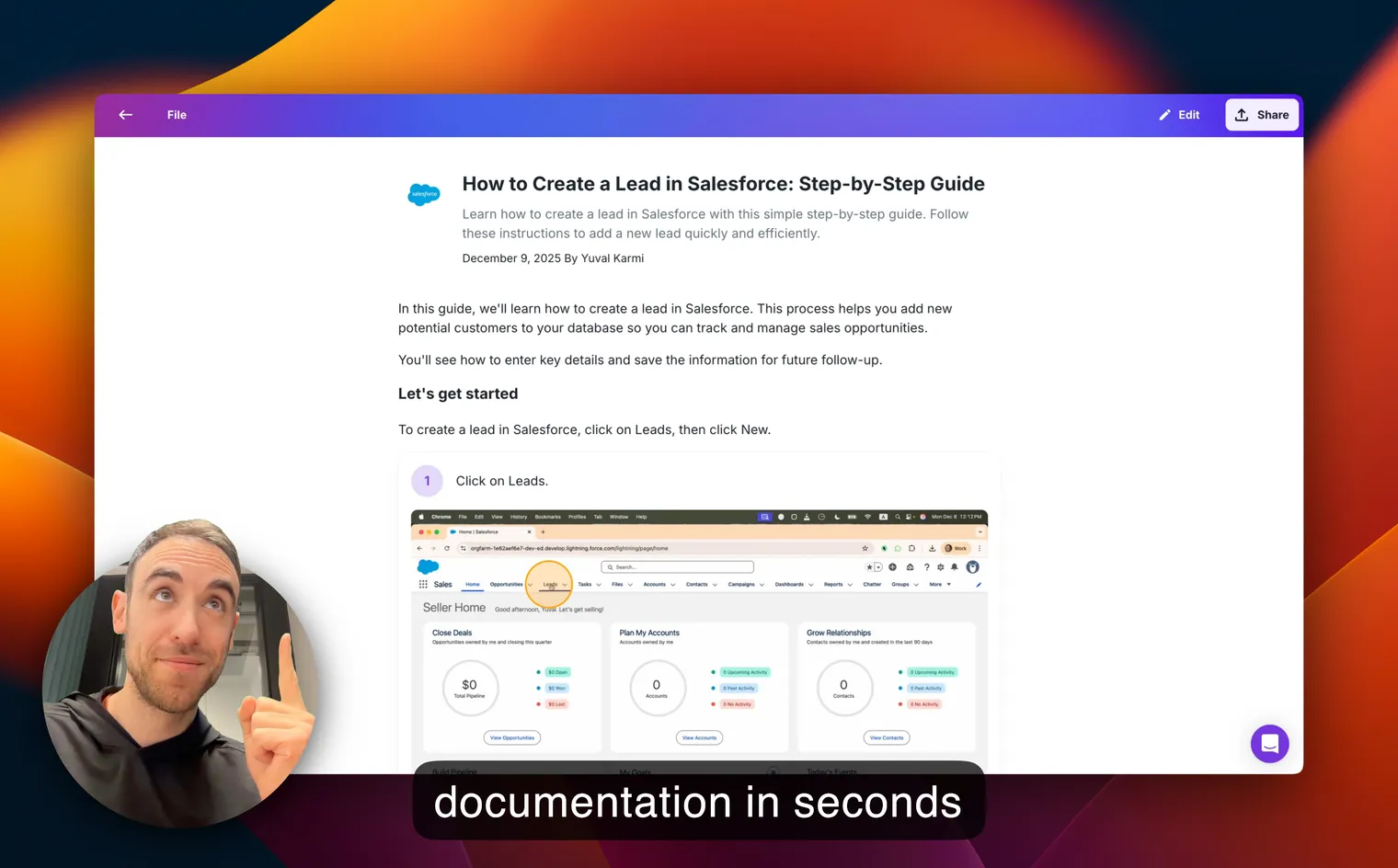
Teach your co-workers or customers how to get stuff done – in seconds.

Frequently Asked Questions
What is documentation review?
Documentation review is a systematic process for evaluating written materials to check accuracy, completeness, clarity, and compliance with standards. It happens before publication and at regular intervals, typically involving multiple stakeholders who each assess different quality aspects.
What is an example of documentation review?
A pharmaceutical company might use a five-level SOP review where the author, a peer reviewer, subject matter expert, QA team, and compliance officer each evaluate the document using standardized checklists before giving final approval.
Why is documentation review important?
Documentation review catches mistakes early before they spread to other documents, ensures you stay compliant with regulations, maintains consistent quality, and reduces the costs and risks that come with inaccurate or incomplete documentation.
Who should be involved in documentation review?
It depends on the document type, but typically: authors for self-review, peer reviewers for a fresh perspective, subject matter experts for technical validation, editors for language and clarity, and compliance officers when regulatory adherence matters.
How often should documentation be reviewed?
Review documentation before initial publication, then at intervals based on regulatory requirements, how often things change, and how critical the content is. High-impact or compliance-sensitive docs may need quarterly or annual reviews.