
Read summarized version with
What is Markdown Export?
Markdown export is a feature you’ll find in documentation tools, content management systems, and knowledge bases that lets you convert content into Markdown format. If you’re not familiar with it, Markdown is a lightweight markup language using plain-text formatting syntax. It’s easy to read, straightforward to write, and converts nicely to HTML and other formats.
The ability to export to markdown has grown more valuable as teams shift toward modern documentation workflows. Markdown files (.md) are portable, play well with version control, and open in any text editor you have lying around. For anyone who wants flexibility in storing, sharing, or republishing content, markdown export becomes something of a necessity.
Teams use markdown export to move content between platforms, back up their documentation, or connect their content with developer tools like GitHub, GitLab, and static site generators. Choosing the right export format depends on your use case.
Key Characteristics of Markdown Export
- Plain-text output: Exported files use readable syntax with simple formatting markers like # for headings and * for lists
- Platform independence: Markdown files work across operating systems and open without specialized software
- Version control compatibility: Because Markdown is text-based, it integrates smoothly with Git and other version control systems
- Preservation of structure: Headings, lists, links, and basic formatting stay intact during export
Markdown Export Examples
Example 1: Documentation Migration
A company stuck on a proprietary documentation platform decides to switch to an open-source knowledge base. By exporting their existing content as Markdown, they can import everything into the new system without manually recreating each document. The plain-text format means nothing stays locked in the old platform.
Example 2: Developer Documentation
A technical writing team exports API documentation as Markdown files to include in their GitHub repository. Now developers can view docs right alongside the codebase, submit pull requests when they spot errors, and the content renders cleanly in GitHub’s interface. Some teams also export to HTML for web publishing.
Markdown Export vs PDF Export
Both export formats serve documentation needs, but they fit different situations. While markdown works best for editable content, PDF export is ideal for fixed-format distribution.
| Aspect | Markdown Export | PDF Export |
|---|---|---|
| Purpose | Editable, portable content | Fixed-format distribution |
| Editability | Fully editable in any text editor | Requires special software to edit |
| Best for | Migration, version control, republishing | Print-ready documents, formal sharing |
| File size | Very small | Larger with formatting and images |
How Glitter AI Helps with Markdown Export
Glitter AI offers markdown export capabilities so you can take automatically generated documentation and use it wherever you need. After capturing a process with Glitter, teams can export their step-by-step guides, SOPs, and training materials to Markdown format for wikis, GitHub repositories, or other documentation systems.
This means content created with Glitter doesn’t get trapped in one place. Whether you’re exporting to PDF, Notion, Confluence and more or a custom documentation site, markdown export gives you a universal format that keeps the structure and clarity of the original content.
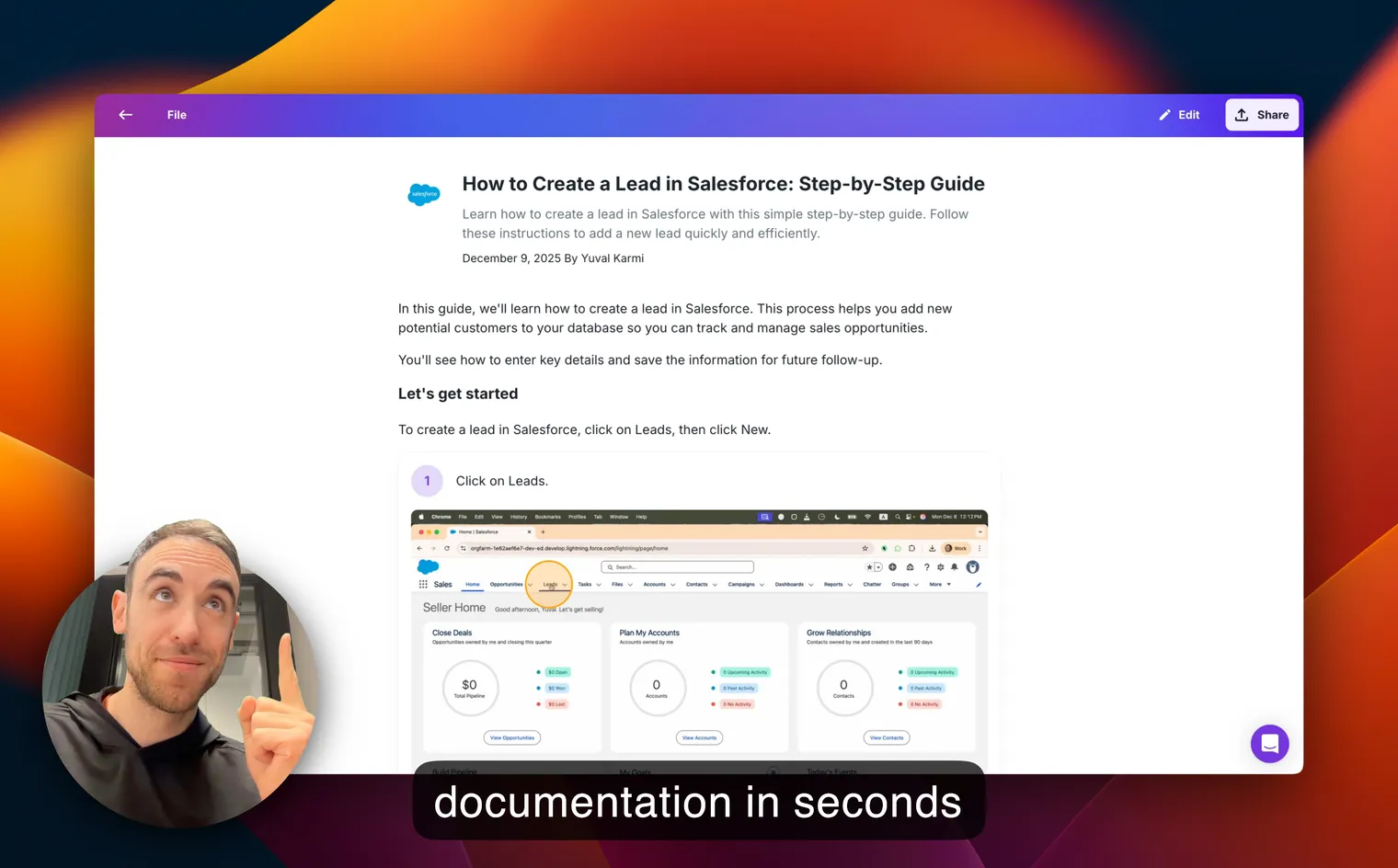
Teach your co-workers or customers how to get stuff done – in seconds.

Frequently Asked Questions
What is markdown export used for?
Markdown export converts documentation into a portable, plain-text format that you can edit, version-control, and import into various platforms and documentation systems.
How do I export to markdown format?
Most documentation tools have an export option in their menu or settings. Pick markdown or .md as the format, select what you want to export, and save it where you need it.
Can I export multiple documents to markdown at once?
Many tools support batch markdown export, so you can export whole folders or knowledge bases as a collection of .md files that keep their organizational structure.
What is the file extension for markdown export?
Markdown files typically use .md as the extension, though you might see .markdown occasionally. Both work the same and markdown editors recognize either one.
Is markdown export the same as md export?
Yes, they're the same thing. MD is just the file extension abbreviation for Markdown files.
What are the benefits of exporting documentation to markdown?
You get platform independence, easy version control with Git, small file sizes, human-readable formatting, and the ability to convert to HTML, PDF, and other formats down the road.
Can markdown export preserve images and formatting?
Markdown export keeps text formatting like headings, lists, and links. Images usually get referenced as links and may be exported in a separate folder alongside the markdown file.
Which tools support markdown export?
Notion, Confluence, GitBook, Glitter AI, Google Docs (with add-ons), and most modern documentation platforms all offer markdown export.
How does markdown export help with documentation migration?
Markdown works as a universal format that most documentation systems can import. This makes it the go-to intermediary when moving content between platforms.
Can I use markdown export for technical documentation?
Markdown export works really well for technical docs. The format handles code blocks and syntax highlighting references, and it integrates naturally with developer tools like GitHub and static site generators.