
Read summarized version with
What is Technical Documentation?
Technical documentation is any written material that describes how to use, build, or understand a product, process, or service. At its core, it takes complex technical information and turns it into something people can actually work with, whether they’re end users trying to figure out a feature, developers building an integration, or internal teams troubleshooting an issue.
The scope here is broader than you might expect. Technical documentation covers everything from user manuals and API references to installation guides and system specs. The common thread? Helping people accomplish specific tasks or understand how something works without having to reverse-engineer it themselves.
Effective technical documentation tends to follow standardized formats and writing conventions. Technical writers frequently rely on structured authoring, which means creating content that’s modular enough to reuse and update as the product changes over time. This documentation often feeds into a company’s centralized information repository, making information accessible to anyone who needs it.
Key Characteristics of Technical Documentation
- Audience-Focused: Every piece of tech docs should have a specific reader in mind. A developer integrating an API has different needs than an end user learning software or a field technician doing maintenance.
- Task-Oriented: Good documentation organizes itself around what people need to do, not around how the product happens to be structured internally.
- Accurate and Current: If the documentation doesn’t match reality, it’s arguably worse than no documentation at all. Updates need to happen whenever the product changes.
- Clearly Structured: Headings, numbered steps, tables, diagrams. These aren’t just nice to have. They make information scannable and help readers find what they need quickly.
- Consistent Format: Style guides and templates keep terminology, tone, and presentation uniform across documents. This matters more than people realize when you’re maintaining dozens or hundreds of docs.
Technical Documentation Examples
Example 1: Software Development
Consider a SaaS company that maintains technical documentation including API reference guides, SDK installation instructions, code samples, and authentication workflows. Their developers can integrate the product into applications without pinging support for every little question. That’s the goal, anyway.
Example 2: Manufacturing
A medical device manufacturer might produce technical documentation covering product specifications, assembly procedures, quality control checklists, and regulatory compliance details. This documentation serves double duty: supporting the production floor and satisfying auditors.
Example 3: IT Operations
IT departments often maintain technical documentation for network architecture diagrams, server configuration procedures, disaster recovery runbooks, and security protocols. Many of these procedures get documented as repeatable step-by-step procedures for consistent handling. When infrastructure goes sideways at 2 AM, these docs can be the difference between a quick fix and a prolonged outage.
Technical Documentation vs User Documentation
These two categories overlap quite a bit, but they serve different purposes.
| Aspect | Technical Documentation | User Documentation |
|---|---|---|
| Audience | Developers, engineers, technical staff | End users with varying technical backgrounds |
| Content | Architecture, APIs, specifications, system internals | How-to guides, tutorials, feature explanations |
| Depth | Deep technical detail including code and configurations | Focuses on tasks without exposing underlying complexity |
While technical documentation dives deep into systems, user manuals typically take that technical information and present it in a more accessible format for end users.
How Glitter AI Helps with Technical Documentation
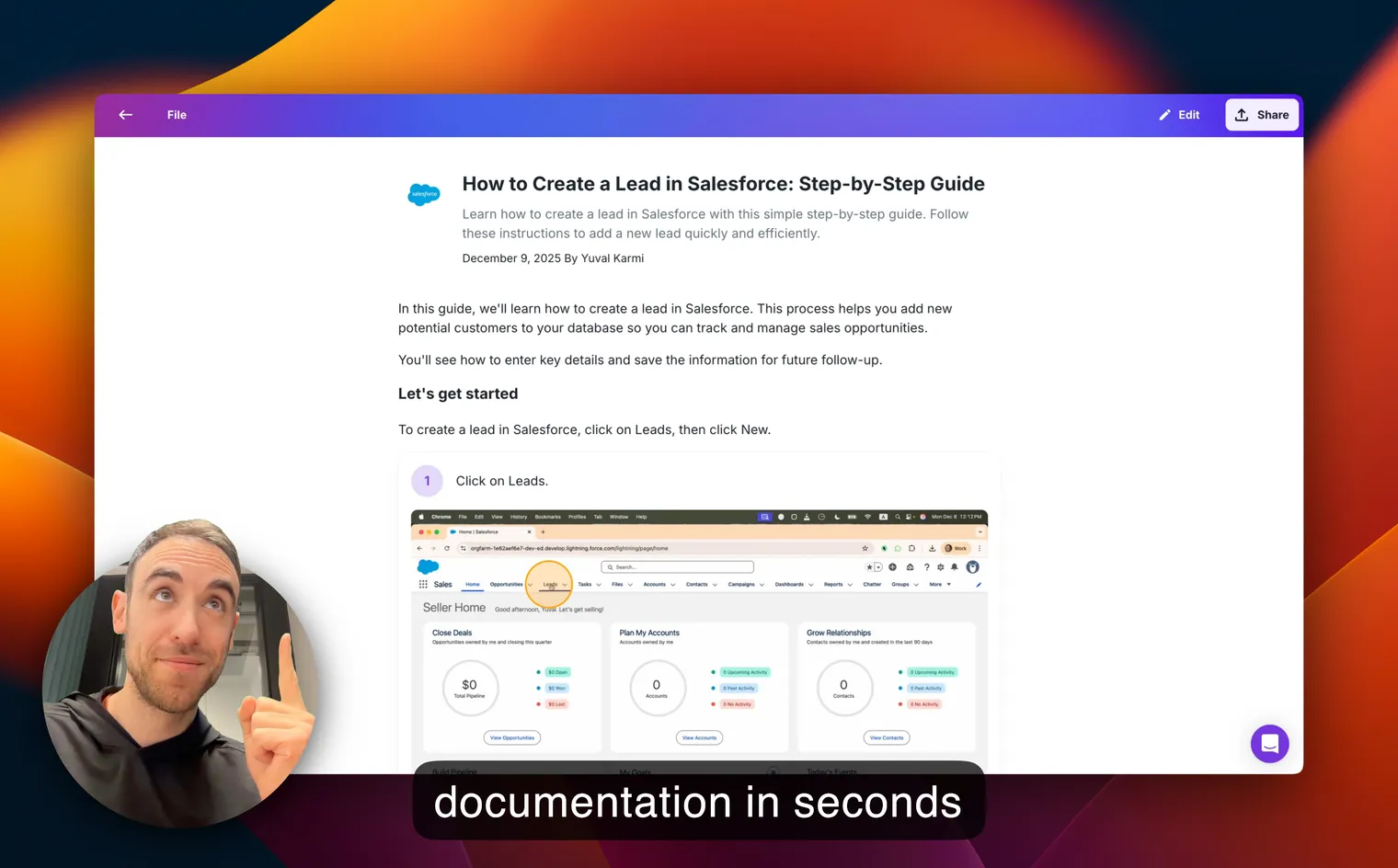
Glitter AI simplifies technical documentation by capturing screen recordings and automatically generating step-by-step guides with annotated screenshots. This works particularly well for documenting software workflows, configuration procedures, and troubleshooting steps, making it a strong SaaS documentation tool for engineering and product teams who can collaborate in real time. Global teams can also reach wider audiences with multi-language output.
Rather than writing documentation from scratch and manually grabbing screenshots, teams can record themselves walking through a process and let Glitter turn that recording into a structured SOP. It captures and annotates screenshots automatically, so you spend less time on the manual parts of technical writing and lean less on a dedicated documentation specialist for routine updates. You can redact sensitive data with the built-in blur tool and publish into your own stack with a clean HTML export. When something changes, just record the new workflow, and keeping documentation current becomes much less painful.
Teach your co-workers or customers how to get stuff done – in seconds.

Frequently Asked Questions
What is technical documentation?
Technical documentation refers to written material explaining the use, functionality, architecture, or specifications of a product, system, or service. Its purpose is helping users understand and work with technical products more effectively.
What are examples of technical documentation?
Examples include user manuals, API documentation, installation guides, system specifications, troubleshooting guides, SDK documentation, and network architecture diagrams. Pretty much anything that explains how technical things work.
What is the difference between technical documentation and user documentation?
Technical documentation is written for developers and technical staff, going deep on systems and code. User documentation targets end users and focuses on helping them complete tasks without needing to understand the underlying technical details.
Why is technical documentation important?
Good technical documentation cuts down on support requests, speeds up onboarding, ensures everyone understands systems the same way, supports compliance requirements, and preserves knowledge when people leave the company.
Who writes technical documentation?
Technical writers typically handle this work, collaborating closely with developers, engineers, and subject matter experts. At smaller companies, developers or product managers often write their own docs.
What should technical documentation include?
Look for clear explanations, step-by-step procedures, code examples when appropriate, visual aids like diagrams and screenshots, troubleshooting sections, and logical structure with easy navigation.
How do you write good technical documentation?
Know your audience, focus on tasks people actually need to complete, use clear and consistent language, add visual aids, structure content logically, keep everything updated, and test your docs with real users when possible.
What is the difference between technical documentation and an SOP?
Technical documentation is a broad category covering how products and systems work. SOPs are a specific subset providing step-by-step instructions for completing routine procedures consistently every time.
How often should technical documentation be updated?
Update it whenever the product or process changes. Beyond that, a regular review schedule, maybe quarterly, helps catch information that's gone stale and keeps everything accurate.
What tools are used for technical documentation?
Common choices include platforms like Confluence and Notion, static site generators like Docusaurus, API documentation tools like Swagger, and video-based solutions like Glitter AI for creating visual documentation.