
Read summarized version with
Appcues has built a solid reputation as a digital adoption platform. It competes with tools like WalkMe and Pendo. Teams rely on it to create in-app onboarding experiences without writing code, and it handles product tours, tooltips, and user flows reasonably well. The “Captain AI” assistant they rolled out recently helps generate copy, analyze flow performance, and plan engagement campaigns, which cuts down on the time it takes to launch something new. Their mobile support covers iOS, Android, React Native, Flutter, and Ionic too.
But here’s the reality. Having spent years working in documentation and onboarding, I’ve watched plenty of teams hit walls with Appcues. The analytics can feel shallow when you’re trying to understand the bigger picture, a complaint that also drives teams toward Userpilot alternatives and similar Chameleon comparisons. Pricing climbs faster than expected once you start scaling. Checklists and other features that seem essential get locked behind pricier tiers. And if you need documentation that people can actually access before they log into your product? You’ll have to look elsewhere.
I’m Yuval, and I founded Glitter AI. Building my own platform meant I had to dig into pretty much every onboarding and documentation tool on the market. So I’ve got a pretty good read on where Appcues shines and where it leaves teams wanting more, the same way I do for Whatfix alternatives.
This guide breaks down the best Appcues alternatives for 2026, with honest comparisons so you can figure out what actually makes sense for your situation.
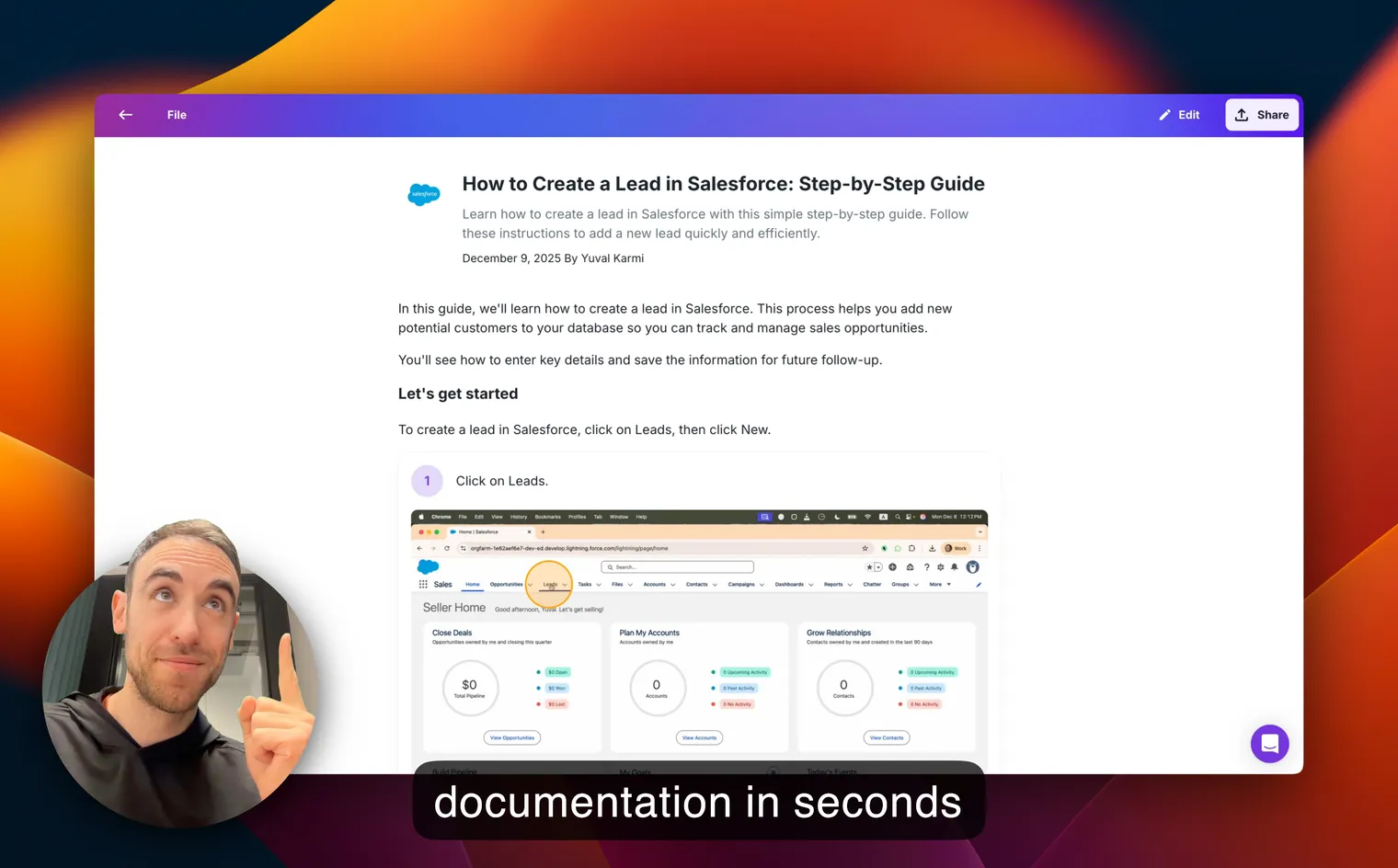
Teach your co-workers or customers how to get stuff done – in seconds.

Top Appcues Alternatives at a Glance
| Tool | Best For | Starting Price | Analytics | Mobile Support |
|---|---|---|---|---|
| Glitter AI | Documentation & training | $16/mo | Basic | Video only |
| Pendo | Product analytics + guidance | Free (500 MAUs) / $7,000/yr | Advanced | Yes |
| Userpilot | Balanced analytics & onboarding | $299/mo | Advanced | No |
| Chameleon | Native-looking experiences | $279/mo | Integrations | No |
| Intercom | Support + onboarding | $29/seat + $99/mo | Basic | Yes |
| WalkMe | Enterprise digital adoption | ~$79,000/yr avg | Advanced | Yes |
| Whatfix | Complex software training | ~$32,000/yr avg | Advanced | Yes |
| Trainual | Internal employee training | $249/mo | Basic | Yes |
Why Look for Appcues Alternatives?
Appcues does straightforward in-app onboarding well enough. But teams bump into limitations more often than you might think, especially when it comes to employee training best practices that go beyond simple in-app tours.
Limited Analytics & Reporting
Connecting goal completions across multiple journeys or building proper funnels just isn’t possible in Appcues. That makes it tough to see whether your onboarding flows actually move the needle on long-term adoption. Data exports are pretty basic, which gets frustrating when you want to dig into survey responses. Some users have mentioned that NPS scores don’t show up in integrations like Heap, and you can’t view survey results directly in the app.
Many teams wind up pairing Appcues with Mixpanel or Amplitude just to piece together the full user journey. That means extra cost, extra complexity, and a nagging feeling that the tool should handle this stuff on its own.
Survey Feature Gaps
The survey functionality lacks conditional branching, so you can’t create dynamic experiences that change based on what users say. People keep asking for more survey types beyond NPS, but the options stay limited. One user pointed out a specific issue: “Can’t invalidate NPS responses” after they’re submitted.
Pricing That Escalates Quickly
Costs add up fast. Appcues starts at $300/month for 1,000 monthly active users on the Start plan (capped at 5 team members and only 5 audience segments). The Grow plan jumps to $750/month. Enterprise pricing needs custom quotes, and users report average costs around $79,000/year for larger deployments. Note that there’s no monthly billing option, only annual.
There’s also been stricter enforcement of team size and segmentation limits lately. As one Reddit user put it: “We’re on a cheaper plan (which costs almost 1000$ monthly anyways), where many valuable features are locked.”
Features locked behind higher tiers include:
- NPS Surveys: Requires Grow ($750/mo), not available on Start
- Resource Center (Launchpad): Grow plan only
- Custom CSS: Need Grow for full styling control
- Unlimited Segments: Start limits you to just 5 segments
- Premium Integrations: Salesforce, HubSpot, Marketo require Grow
- SSO: Enterprise-tier only
- Localization: Automated localization restricted to Enterprise
Teams often find themselves upgrading earlier than planned, sometimes before even hitting MAU limits, just to get features they consider essential. As one user put it: “They’ve gotten insanely expensive. I love the features… But nobody should have to pay $500+/month for this stuff.” Another noted: “Appcues pricing isn’t fully transparent - expect custom quotes after the Growth plan… can scale fast with feature add-ons.”
Developer Dependency Despite “No-Code” Promise
Appcues positions itself as no-code, and for the basics, that’s fair. But real customization needs CSS knowledge and developer help. As one competitor analysis pointed out: “With Appcues, you will need an engineering team to fully customize elements inside using CSS.” Custom CSS is also gated behind the Growth plan, so teams on entry-level plans either accept default styling or pay to upgrade.
Extension Bugs & Testing Challenges
The browser extension crashes sometimes, and there were reported incidents of “Studio Unavailable” and “Analytics Degradation” in late 2025. Element detection can struggle with complex single-page applications, causing inconsistent tooltip placement. Users have also noted that testing flows designed to show only once gets particularly tricky.
Limited Support Hours
Support quality depends heavily on your plan tier. Entry-level plans get email support only, no live chat or priority access. One UK-based reviewer mentioned: “If you’re based in the UK, heads up, their support is only in the US. That means staying up late for email replies that aren’t always simple.”
No Documentation Outside the App
Appcues works inside your product. Only inside your product. Need training materials, help articles, or documentation that users can access before logging in? You’ll have to bring in something else entirely.
TL;DR: Our Top Picks
Best for Documentation & Training: Glitter AI produces searchable documentation and training videos that work outside your app. Solid fit for comprehensive knowledge management.
Best for Analytics-First Teams: Pendo delivers industry-leading product analytics alongside in-app guidance. Expect a steeper learning curve and higher price.
Best for Balanced Approach: Userpilot combines a comprehensive analytics suite with autocapture and session replays, plus full onboarding features at a more accessible price.
Best for Design Flexibility: Chameleon creates native-looking UI patterns with developer-friendly customization and advanced features like embedded cards.
Best for Enterprise: WalkMe offers a full digital adoption platform for complex, multi-system training across large organizations.
1. Glitter AI - Best for Documentation & Training
Best for: Teams who need both in-app training and comprehensive documentation
Full disclosure: I built this company. Glitter came from a gap in the onboarding tools market that kept nagging at me.
How It Works
Appcues centers on in-app experiences. Glitter takes a different path, creating documentation and training videos that live everywhere: your knowledge base, LMS, help center, or internal wikis. You record your screen while talking through what you’re doing, and Glitter automatically generates both written guides and video tutorials.
The real difference is accessibility. Appcues requires users to be inside your product to see anything. Glitter creates resources people can reference before logging in, during onboarding, or months later when they need a refresher.
Key Features
- Voice-powered recording: Talk while you work, get natural documentation automatically (AI voiceover coming soon)
- Dual output: Each recording produces both a searchable text guide and a video tutorial
- Desktop & browser support: Document anything, not just web apps
- AI editing: Polish your documentation with AI assistance
- Multi-format export: PDF, HTML, Markdown, MP4
- Blur sensitive data: Automatically protect confidential information in screenshots and videos (paid plans only)
Pricing
- Free: 10 guides total (not monthly)
- Pro: $16-20/month for unlimited guides
- Enterprise: Starting at $8,000/year for teams
When to Choose Glitter Over Appcues
Glitter makes sense when you need:
- Documentation that exists outside your product
- Training materials for employees learning internal systems
- Knowledge base articles with embedded videos
- Desktop application documentation
- SOPs and process documentation
- Resources users can access without logging in
If you specifically need interactive in-app tooltips and product tours that appear inside your software, Appcues is probably a better fit.
Pros
- Documentation works everywhere, not just in-app
- Voice narration creates context-rich guides 11x faster than traditional methods
- Desktop support included in free tier
- One recording produces both text and video
- More affordable for small teams ($16-20/mo vs $300/mo for Appcues Start plan)
Cons
- No in-app tooltip or modal overlays
- Not built for A/B testing user flows
- No native product analytics
- Focused on documentation over product tours
- Non-Chromium browsers require desktop app
- AI voiceover feature still in development
2. Pendo - Best for Product Analytics
Best for: Teams who want deep product intelligence alongside user guidance
Pendo is a full-stack product experience platform that brings analytics and in-app guidance together. They’ve been around longer than most in this space and have earned a strong reputation for understanding how users interact with products.
How It Works
Pendo tracks every click, page view, and user behavior in your product. You get comprehensive analytics dashboards, and you can layer in-app guides, tooltips, and tours on top of that data to target specific user segments.
Key Features
- Advanced product analytics: Build funnels, run path analysis, understand full product usage
- Session replay: Watch recordings of actual user sessions
- In-app guidance: Create walkthroughs, tooltips, and announcements
- Feedback collection: Capture user sentiment and feature requests
- Product planning: Roadmap features tied to usage data
- Mobile support: iOS and Android SDKs available
Pricing
Pendo doesn’t publish transparent pricing. You’ll need to contact sales for a custom quote based on your use case and user count. Plans typically start around $7,000/year, with enterprise contracts often exceeding $15,000 annually. They do offer a free tier (up to 500 MAUs) for smaller teams getting started.
Key pricing considerations:
- The “Base” tier starts around $7,000/year for limited MAUs
- “Growth” tier with advanced analytics can reach $48,000+/year
- Advanced features like custom roles, AI features, and premium integrations need higher tiers
As one user put it: “Pendo is expensive if you need the full suite of features.” The analytics capabilities are powerful, but teams say you need to invest real time learning the platform to extract full value.
When to Choose Pendo Over Appcues
Pendo works well when you need:
- Deep product analytics and user behavior tracking
- Funnel analysis and conversion optimization
- Session replays to debug user issues
- A single platform for analytics and guidance
- Product planning tied to usage data
Pros
- Industry-leading analytics capabilities
- Comprehensive feature set in one platform
- Session replays give invaluable debugging insights
- Strong integration ecosystem
- Mobile app support
Cons
- Steeper learning curve than Appcues
- Notably more expensive
- Can feel overwhelming for beginners
- Analytics-first approach means onboarding features aren’t as polished
- Only basic triggers for personalizing user journeys
- Advanced flow design needs technical knowledge
3. Userpilot - Best for Balanced Approach
Best for: Teams who want analytics and onboarding without Pendo’s complexity or cost
Userpilot packages product analytics and onboarding tools together. It positions itself as a more accessible alternative to Pendo while offering more depth than Appcues.
How It Works
The no-code approach lets you tag features without developer help, similar to Mixpanel or Heap. You can understand feature usage across different user segments throughout the journey, then build targeted onboarding experiences based on that data.
Key Features
- Autocapture analytics: Automatically track user interactions
- Session replays: See exactly what users are doing
- In-app resource center: Create a help widget inside your product
- Checklists and tours: Build multi-step onboarding flows
- Automatic localization: Support multiple languages
- No-code feature tagging: Track events without engineering
Pricing
- Starter: $299/month (billed annually) for up to 2,000 MAUs
- Growth: $799/month (billed annually) for up to 10,000 MAUs with advanced analytics
- Enterprise: Custom pricing for larger deployments
Note that Userpilot has restructured their pricing and now offers annual billing only. Some users have mentioned that while pricing is more accessible than Pendo, costs can still climb: “Userpilot positions itself as a mid-market alternative starting around $249-299/mo, significantly below WalkMe and Whatfix entry points.”
When to Choose Userpilot Over Appcues
Userpilot is worth considering when you need:
- Built-in analytics without a separate tool
- Session replays to understand user behavior
- No-code event tracking
- Resource center functionality
- Analytics at a better price point than Pendo
Pros
- Comprehensive analytics included
- Session replays at lower price point than Pendo
- Resource center helps users self-serve
- Automatic localization for global teams
- No-code feature tagging
Cons
- No mobile app support (web only)
- Smaller feature library than some competitors
- Less mature than Appcues for pure onboarding
- Analytics not as deep as dedicated tools like Pendo
4. Chameleon - Best for Design Flexibility
Best for: Teams who want native-looking experiences with maximum customization
Chameleon focuses on creating in-app experiences that feel like part of your product, not something tacked on afterward. It offers more UI pattern variety than most competitors and gives developers real control over styling.
How It Works
Chameleon provides a broad range of UI patterns: modals, banners, tooltips, beacons, embedded cards, and more. You can create experiences that match your product’s design language precisely, with full CSS customization available.
Key Features
- Advanced UI patterns: Embedded banners, cards, AI agents
- Demo creation: Build reusable demos for onboarding and support
- Full CSS customization: Match your exact design system
- Launchers and surveys: Trigger experiences from specific UI elements
- Analytics integrations: Connect with Mixpanel, Heap, Amplitude, Segment
- Developer-friendly: API access and webhook support
Pricing
- Startup: $279/month for up to 2,000 MTUs (billed annually)
- Growth: Starting at $1,250/month ($15,000/year) with advanced features
- Enterprise: Custom pricing for larger deployments
Note that Chameleon offers a 14-day free trial but no permanent free tier.
When to Choose Chameleon Over Appcues
Chameleon tends to win when you need:
- Experiences that look completely native to your product
- More UI pattern variety
- Developer-friendly customization options
- Embedded cards and banners (not just modals)
- Reusable demos across different contexts
Pros
- Native-looking experiences with extensive design control
- Wide variety of UI patterns
- Developer-friendly with CSS and API access
- Strong analytics integrations
- Reusable demo functionality
Cons
- Web-only (no mobile app support)
- Steeper learning curve for non-technical users
- Some users mention difficulties configuring Launchers and Surveys
- No standalone checklists
- No video support in resource centers
- Event tagging requires developer involvement
5. Intercom - Best for Support + Onboarding
Best for: Teams already using Intercom for customer support who want to add onboarding
Intercom is primarily a customer communication platform. They’ve layered in product tours and onboarding features through their Proactive Support Plus add-on.
How It Works
Intercom lets you add product tours, checklists, banners, and surveys on top of their messaging platform. The idea is proactively guiding users while also providing reactive support through chat.
Key Features
- Product tours: Multi-step in-app walkthroughs
- Checklists: Guide users through setup tasks
- Posts and banners: Announce new features
- Surveys: Collect user feedback
- Customer messaging: Live chat and email support
- Fin AI Agent: AI-powered support automation
Pricing
Intercom’s pricing gets complicated:
- Essential: $29/seat/month (annual) or $39/seat/month (monthly)
- Advanced: $85/seat/month (annual) or $99/seat/month (monthly)
- Expert: $132/seat/month (annual) or $139/seat/month (monthly)
- Fin AI Agent: $0.99 per resolution (usage-based)
Product Tours require the Proactive Support Plus add-on at $99/month, which includes 500 sends. SSO is only available on the Expert tier.
As one user complained: “Basically, from $119 I’ll now pay them $854 a month… Now they want us to pay based on the number of messages, and who knows what else as it requires a Ph.D. to understand their pricing.” Another noted: “My Intercom billing shot up by 120%, it was because of AI chatbot… I was already spending over $4k/month… Now it’s shot up to $9k.”
When to Choose Intercom Over Appcues
Intercom makes sense if you:
- Already use Intercom for customer support
- Want to consolidate support and onboarding tools
- Need both reactive (chat) and proactive (tours) customer engagement
- Want AI-powered support automation
Pros
- Combines support and onboarding in one platform
- Strong customer communication features
- AI agent can handle repetitive support queries
- Mobile push notifications included
- Familiar interface if already using Intercom
Cons
- Product tours are an expensive add-on
- Usage-based pricing can be unpredictable
- Limited UI elements compared to dedicated onboarding tools
- Can’t target tours using company data yet
- Limited to events Intercom can track (no deep in-app behaviors)
- Features feel bolted on rather than purpose-built
6. WalkMe - Best for Enterprise
Best for: Large enterprises with complex, multi-system training needs
WalkMe is an enterprise-grade digital adoption platform built for organizations going through digital transformation or rolling out complex software across departments.
How It Works
WalkMe overlays guidance on any web-based or desktop application, providing step-by-step walkthroughs, tooltips, and contextual help. It’s designed to help employees navigate complex enterprise software without extensive training programs.
Key Features
- Cross-application guidance: Works across all your software tools
- Desktop and web support: Not limited to browser-based apps
- Advanced analytics: Track adoption across systems
- Automation: Automate repetitive tasks
- Compliance tracking: Ensure employees follow required processes
- Smart Walk-Thrus: Context-aware guidance based on user behavior
Pricing
WalkMe requires custom pricing through their sales team. Third-party data from Vendr suggests:
- Average contract value: ~$79,000/year
- Range: $9,000 to $405,000/year depending on scale and features
- Entry-level “Essentials” package available for single-app deployments (rapid 4-week rollout)
Worth noting: SAP completed their acquisition of WalkMe in September 2024 for approximately $1.5 billion.
As one user noted: “WalkMe feels enterprise-priced even when teams only use a slice of its features.” Another complained: “Support team is extremely slow to respond with resolutions for critical bugs. When I try to contact my client success manager for help, I’m told that if she responds I’ll be billed for professional services hours.”
When to Choose WalkMe Over Appcues
WalkMe fits if you:
- Are a large enterprise (1,000+ employees)
- Need training across multiple complex systems
- Require desktop application support
- Have compliance or regulatory requirements
- Are going through major digital transformation
Pros
- Enterprise-grade capabilities
- Works across all applications, not just your own product
- Strong compliance and audit features
- Desktop application support
- Proven at scale with large organizations
Cons
- Extremely expensive (out of reach for SMBs)
- Complex setup and steep learning curve requiring technical knowledge (CSS, HTML, jQuery often needed)
- Overkill for simple onboarding needs
- Requires dedicated admin resources, often a full-time employee to maintain
- Long implementation timelines (3-6 months typical)
- Some users report performance issues with the overlay causing “page unresponsive” errors
7. Whatfix - Best for Complex Software Training
Best for: Teams training users on complex, multi-step processes
Whatfix is a digital adoption platform that overlays guided walkthroughs and self-serve help directly inside your product. It’s particularly strong for teams wanting to cut support volume through continuous product education.
How It Works
Whatfix creates interactive guidance that appears contextually when users need it. It’s built for large or growing teams that want to onboard users in-app while providing ongoing education as features change.
Key Features
- Interactive walkthroughs: Step-by-step guidance with smart tooltips
- Self-help widget: In-app knowledge base
- Task lists: Guide users through complex processes
- Analytics: Track engagement and completion rates
- Content creation: Build guides, videos, and documentation
- Multi-language support: Serve global users
Pricing
Whatfix doesn’t publish pricing publicly. You’ll need to contact sales for a custom quote. Third-party data suggests:
- Entry-level contracts typically start around $20,000-25,000/year
- Median contract value: ~$32,000/year according to Vendr data
- Enterprise deployments: $40,000-70,000+/year
Important: Whatfix charges per application and per user type, with separate pricing for internal (employee) vs. external (customer) apps. Implementation fees ($5,000-15,000+) are common.
As one Reddit user complained: “We found that the flows were barely used and quite clunky. To me, the flows weren’t usable because they consistently timed out…” Another noted: “It does the job but maintaining it is kind of a pain to me.”
When to Choose Whatfix Over Appcues
Whatfix is worth evaluating when you need:
- Training for complex, multi-step enterprise workflows
- In-app knowledge base with searchable articles
- Strong multi-language support
- Dedicated customer success support
Pros
- Strong for complex workflow training
- In-app help reduces support tickets
- Multi-language support
- Good analytics for tracking adoption
- Dedicated customer success teams
Cons
- Pricing not transparent and complex (per app, per user type)
- Can be expensive for smaller teams ($20k+ minimum)
- Setup requires time and resources (often 1-3 months)
- Better suited for enterprise than SMB
- Steep learning curve, technical knowledge (CSS/JS) often needed for advanced customization
- Flows can break when the underlying application UI changes, requiring frequent maintenance
8. Trainual - Best for Internal Training
Best for: Growing businesses documenting processes and training employees
Trainual isn’t a direct Appcues competitor, but it’s worth mentioning for teams whose main need is employee training and process documentation rather than product-led onboarding.
How It Works
Trainual helps you document every process, policy, and procedure in your business. Employees get step-by-step playbooks, videos, and quizzes to learn their roles.
Key Features
- Process documentation: Document and organize all your SOPs
- Training paths: Create role-specific onboarding journeys
- Quizzes and tests: Verify comprehension
- Version control: Track changes to processes over time
- Delegation: Assign specific processes to team members
Pricing
Trainual has restructured their pricing with a 10-seat minimum on all plans:
- Core: $249/month (billed annually), includes 10 seats, $3/month per additional user
- Pro: $319/month (billed annually), includes 10 seats, $4/month per additional user, adds e-signatures (300/year) and org chart
- Premium: $399/month (billed annually), includes 10 seats, $5/month per additional user, adds SSO and unlimited e-signatures
- Enterprise: Custom pricing with API access and dedicated support
Important: There’s a mandatory $1,000 one-time implementation fee for new accounts.
As one Reddit user noted: “It wasn’t worth it. It’s an empty platform to hold your SOPs for a monthly fee charged per person in your team. It was costly.” Another complained: “You are paying a significant convenience surcharge with them… For a small business, I think their pricing is wild.”
When to Choose Trainual Over Appcues
Trainual fits when you need:
- Employee onboarding and training (not product onboarding)
- Process and policy documentation
- Role-based training paths
- Internal knowledge management for growing teams
Pros
- Purpose-built for employee training
- Easy to create and organize SOPs
- Good for scaling company knowledge
- Role-based access and assignments
Cons
- Not for product-led onboarding
- Can’t create in-app tooltips or tours
- Focused on internal use, not customer-facing
- Requires separate tool for product guidance
- High minimum commitment ($249/month + $1,000 setup fee)
- 10-seat minimum even for smaller teams
- NOT HIPAA compliant, not suitable for healthcare organizations
- Trainual uses aggregated customer data to train their AI models (unlike competitors who don’t)
Feature Comparison Table
| Feature | Appcues | Glitter AI | Pendo | Userpilot | Chameleon | Intercom | WalkMe | Whatfix |
|---|---|---|---|---|---|---|---|---|
| In-App Tours | Yes | No | Yes | Yes | Yes | Yes | Yes | Yes |
| Product Analytics | Basic | No | Advanced | Advanced | Integrations | Basic | Advanced | Good |
| Session Replay | No | No | Yes | Yes | No | No | No | No |
| Mobile Support | iOS/Android | Video only | Yes | No | No | Yes | Yes | Yes |
| Desktop Apps | Pro+ only | Yes | No | No | No | No | Yes | No |
| Documentation | No | Yes | No | Resource center | No | No | No | Yes |
| Survey Features | Basic | No | Yes | Yes | Yes | Yes | Yes | Yes |
| A/B Testing | Yes | No | Yes | Yes | Yes | Limited | Yes | Yes |
| Free Tier | 14-day trial | 10 guides | 500 MAUs | No | 14-day trial | No | No | No |
| Setup Speed | Hours | Minutes | Days | Days | Days | Hours | Weeks | Days |
Pricing Comparison
| Tool | Entry Price | Typical Annual Cost | Notes |
|---|---|---|---|
| Appcues | $300/mo | $3,600 - $9,000+ | Start plan (1,000 MAUs); Grow at $750/mo; annual billing only |
| Glitter AI | $16-20/mo | $192 - $240 | Fixed pricing, not usage-based; no seat minimums |
| Pendo | Custom | $7,000 - $15,000+ | No transparent pricing; free tier up to 500 MAUs |
| Userpilot | $299/mo | $3,588 - $9,588+ | Starter (2,000 MAUs); Growth at $799/mo |
| Chameleon | $279/mo | $3,348 - $15,000+ | Startup (2,000 MTUs); Growth at $1,250/mo |
| Intercom | $29/seat + $99/mo | $1,536+ | Product Tours require $99/mo add-on |
| WalkMe | Custom | $9,000 - $405,000 | Average ~$79,000/year; enterprise only |
| Whatfix | Custom | $20,000 - $70,000+ | Median ~$32,000/year; implementation fees extra |
| Trainual | $249/mo | $2,988 - $4,788+ | 10-seat minimum; $1,000 setup fee |
How to Choose the Right Appcues Alternative
Here’s a straightforward framework based on what matters most to you:
If You Need Documentation & Training Materials
Go with Glitter AI. You need content that lives outside your product, can be shared before users log in, and works for employee training on internal systems.
If Analytics Matter Most
Go with Pendo if you have enterprise budget, or Userpilot if you want better value. Either way, you need to understand user behavior deeply, not just guide them through flows.
If You’re Design-Obsessed
Go with Chameleon. You want experiences that feel native to your product and need full control over styling and customization.
If You Already Use Intercom
Consider Intercom’s Product Tours. Consolidating tools makes sense if you’re already paying for their support platform. Just calculate the add-on costs carefully before committing.
If You’re Enterprise Scale
Evaluate WalkMe or Whatfix. You have complex, multi-system training needs and the budget for enterprise-grade solutions.
If You Just Need Simple, Fast Onboarding
Stick with Appcues. Despite its limitations, it’s still the quickest to implement for basic in-app guidance if you don’t need advanced analytics or external documentation.
Frequently Asked Questions
Is there a free alternative to Appcues?
Glitter AI offers 10 guides free forever, though it focuses on documentation rather than in-app tours. Pendo offers a free tier for up to 500 MAUs, which includes basic in-app guides and analytics, a viable option for very small teams getting started. Most other in-app guidance tools offer free trials (14 days for Appcues and Chameleon) but no permanent free tier. Userpilot requires contacting sales.
What’s the cheapest Appcues alternative?
Glitter AI starts at $16-20/month, considerably less than Appcues’ $300/month entry price. It serves a different use case (documentation vs. in-app tours), but the price gap is substantial. For direct in-app onboarding competitors, Chameleon’s Startup plan at $279/month comes in slightly under Appcues’ Start plan. Userpilot’s Starter plan at $299/month is also competitive.
Can I use these tools for mobile apps?
Appcues supports iOS and Android with native SDKs. Pendo, Intercom, WalkMe, and Whatfix also offer mobile support. Userpilot and Chameleon are web-only. Glitter AI creates video tutorials that work on any device but doesn’t offer in-app mobile overlays.
Do I need developers to set up these alternatives?
Most alternatives market themselves as “no-code,” but reality varies. Appcues is genuinely quick to set up (hours). Userpilot and Chameleon require some technical knowledge for advanced features. Pendo has a steeper learning curve. WalkMe requires significant implementation resources. Glitter AI is truly no-code and works immediately.
Which alternative has the best analytics?
Pendo has the most comprehensive built-in analytics. Userpilot offers strong analytics at a better price point. Appcues and Chameleon have basic analytics and typically require integration with tools like Mixpanel or Amplitude for deeper insights.
Can these tools replace my knowledge base?
Not really. Appcues and most alternatives create in-app experiences, not standalone documentation. Glitter AI creates searchable documentation and videos that can serve as knowledge base content. For a true knowledge base, you’d want tools like Notion, Confluence, or Document360 alongside your onboarding tool.
What about privacy and data security?
All major alternatives are GDPR-compliant and offer SOC 2 certification. Appcues is SOC 2 Type II compliant, GDPR/CCPA compliant, and offers HIPAA compliance as an add-on for Enterprise plans. Importantly, Appcues explicitly states that customer data is not used to train their AI models, and customers can opt out of AI features that send data to OpenAI by contacting support. Data is encrypted at rest (AES-256) and in transit (TLS). Glitter AI includes automatic blur features to protect sensitive data in screenshots and videos (available on paid plans only). When evaluating alternatives, review their security documentation and ensure they meet your industry’s compliance requirements.
How long does implementation take?
- Appcues: Hours to days
- Glitter AI: Minutes (just install and record)
- Userpilot, Chameleon: Days to weeks
- Pendo: 1-2 weeks
- Intercom: Hours if already using it
- WalkMe, Whatfix: Weeks to months
Can I use multiple tools together?
Yes. Many teams use Glitter AI for documentation and training content alongside Appcues, Pendo, or Userpilot for in-app guidance. The tools serve complementary purposes: in-app tours guide users in real-time, while documentation provides reference material they can return to.
Our Verdict
Appcues remains a solid choice for fast, simple in-app onboarding when you don’t need deep analytics or external documentation. It just isn’t the only option anymore.
For most teams, here’s what we’d suggest:
-
If you need documentation and training materials: Start with Glitter AI. At $16-20/month, you can create comprehensive guides and videos that work everywhere, not just in-app. Layer in an in-app tool later if you need interactive tours.
-
If you’re analytics-driven: Go with Userpilot for the best balance of features and price, or Pendo if you have enterprise budget and need industry-leading analytics.
-
If design and customization matter: Pick Chameleon for maximum control over the look and feel of your onboarding experiences.
-
If you’re already using Intercom: Add their Product Tours. Just calculate the true cost including usage overages before committing.
-
If you’re enterprise scale: Evaluate WalkMe or Whatfix for complex, multi-system training needs.
The right alternative really depends on your specific needs, budget, and technical resources. Most offer free trials, so testing 2-3 options with real use cases before making a decision is worth the time.
Looking to create training documentation that complements your onboarding flows? Start for free with Glitter AI and create your first 10 guides on us.