
Read summarized version with
Document360 has earned its reputation as an enterprise-grade knowledge base software. The platform packs AI-powered search through Eddy AI, offers both Markdown and WYSIWYG editors, and handles multi-language content well. It checks the compliance boxes too, with SOC 2 Type 2 and GDPR certifications that larger organizations tend to require.
The interface gets consistent praise from users, and the search actually works pretty well. Having both a Markdown editor and WYSIWYG option is nice since technical folks can stick with Markdown while everyone else uses the visual editor.
But it’s not a fit for every team. Document360 killed off their free plan back in November 2024 and switched to “contact sales” pricing. Features like SSO, API access, and proper analytics now sit behind pricier tiers. And users have been vocal about it: “Very expensive for what they offer” comes up often, especially when you start adding workspaces, languages, or team seats.
I’m Yuval, and I founded Glitter AI. Before I started building visual documentation tools, I ran another startup where evaluating knowledge base software was just part of the job. I’ve seen where Document360 works well and where teams get stuck.
This guide covers the best Document360 alternatives heading into 2026, with honest assessments of each option. If you’re building a knowledge base from scratch, our guide on how to create a knowledge base is a good companion resource.
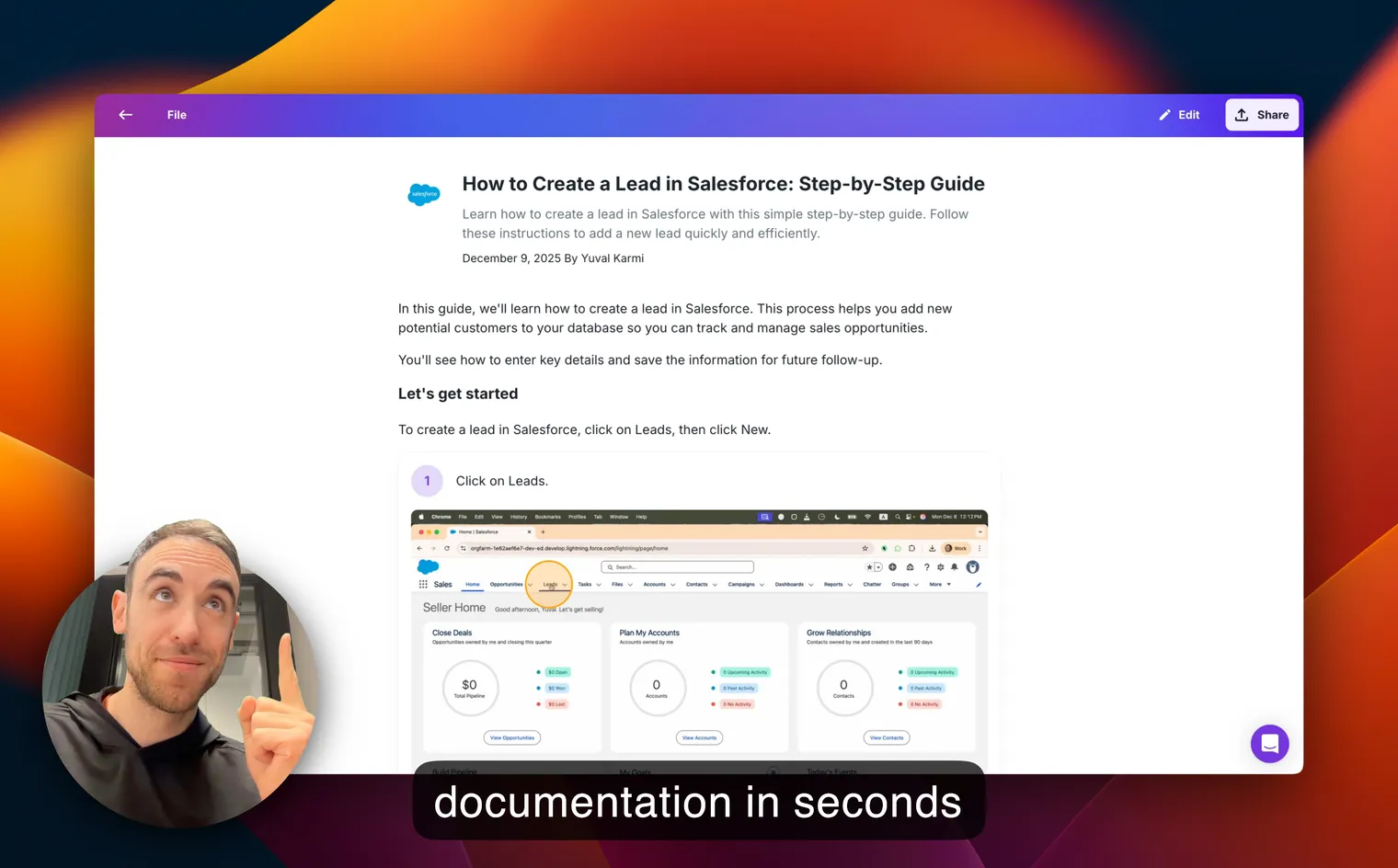
Teach your co-workers or customers how to get stuff done – in seconds.

Top Document360 Alternatives at a Glance
| Tool | Best For | Starting Price | Free Tier | Visual Documentation |
|---|---|---|---|---|
| Glitter AI | Process documentation | $16-20/mo | 10 guides total | Yes (video & screenshots) |
| Confluence | Teams using Atlassian | $5.67/user/mo | Up to 10 users | Limited |
| GitBook | Developer documentation | $65/site + $12/user | 1 user | Limited |
| HelpJuice | Custom branded KBs | $120/mo (4 users) | 14-day trial | No |
| Zendesk Guide | Customer support teams | $55/agent/mo (Suite) | 14-day trial | No |
| Notion | Flexible workspaces | $10/user/mo | Generous free plan | No |
| Nuclino | Real-time collaboration | $6-10/user/mo | Free plan available | No |
| Guru | AI-powered search | Custom pricing | 14-day trial | No |
Why Look for Document360 Alternatives?
Document360 has real power under the hood, but teams often start shopping around for a few common reasons:
The Pricing Adds Up Fast
As of May 2026, Document360’s pricing is “available on request” across all tiers, so you’ll need to talk to their sales team to get a quote tailored to your use case.
Costs can also depend on factors beyond the base plan itself, like extra workspaces, languages, storage, team accounts, and “readers” for private knowledge bases.
Running documentation for multiple products? Your costs could double or triple fast. And if you’re a smaller company that needs SSO or IP restrictions for compliance? Those sit in the Enterprise tier, so you’d be paying for a bunch of features you don’t need.
The Editor Can Feel Clunky
Media handling stands out as a sore point. One Reddit user put it bluntly: “Very bad media handling, can’t simply drag and drop media, have to upload to a drive first and then reference to them.”
Content imports don’t always preserve layouts cleanly, which means extra work fixing things up. A G2 reviewer mentioned: “Interface gets crowded while managing large docs. Importing large content takes time and feels slow.”
The platform also doesn’t handle XML or advanced markdown particularly well, which matters if you’re doing structured authoring.
Customization Has Its Limits
Document360 does let you customize branding, but there’s a ceiling. If your company has specific design requirements or strict UI standards, you’ll probably hit those walls sooner than expected.
The public knowledge base especially has limited customization options, which frustrates teams with detailed design specs.
Large Projects Can Slow Things Down
Once you’re managing hundreds of articles, load times start creeping up. The editor might lag on longer documents, and for teams with extensive documentation, that productivity hit adds up.
Recent Updates: Interactive Demos
Document360 picked up Floik in October 2024, adding interactive demo capabilities. You can now create product walkthroughs alongside regular documentation. That said, it’s a new addition, and the integration is still finding its feet.
Important Features Are Locked Behind Higher Tiers
A G2 reviewer summed it up: “Firstly the prices are higher. Some of the important features are hidden behind the prices.”
Want API access, advanced analytics, or most third-party integrations on Professional? Not available. Need Zendesk or Slack integration? Move up to Business. SSO for security compliance? Enterprise only.
Analytics Blind Spots on Lower Tiers
Users on Professional plans often have no idea how their documentation gets used. One Gartner Peer Insights reviewer noted: “The absence of effective analytics hampers our efforts to determine the level of user engagement… Some additional data would be useful.”
Legacy Plan Lock-In Creates Friction
If you’re on a pricing plan from before August 2024, you can’t change plans through the portal. You have to contact support for any upgrade or downgrade, which creates a natural opportunity for upselling.
Document360’s own docs say: “If you are on a legacy pricing plan… you will not be able to change your plan directly through the portal. Upgrading requires assistance from our support team.”
Occasional Reliability Issues
The platform is generally reliable, though there have been some outages and slowdowns in late 2024/2025 tied to Azure dependencies in the US region. Not frequent, but worth knowing about if uptime is critical for you.
TL;DR: Our Top Picks
Best for Visual Process Documentation: Glitter AI - Creates visual guides with voice narration that walk through processes step by step. Works well for SOPs, training content, and how-to guides.
Best for Atlassian Teams: Confluence - Tight integration with Jira and the rest of the Atlassian stack. Good for internal collaboration with AI-powered knowledge management.
Best for Developer Documentation: GitBook - Git integration, version control, and clean technical docs. Engineering teams tend to love it.
Best for Custom Branding: HelpJuice - They’ll actually design your knowledge base for you, pixel-perfect to your brand standards.
Best Budget Option: Notion - Generous free tier with flexible workspace design. Solid choice for small teams starting out.
1. Glitter AI - Best for Visual Process Documentation
Best for: Teams documenting visual processes, SOPs, and training materials
I should be upfront: this is my company. But I built Glitter because traditional knowledge base software like Document360 wasn’t solving the problem I kept running into.
How It Works
Traditional knowledge bases ask you to write everything from scratch. Glitter takes a completely different approach: you record your screen while explaining what you’re doing, and it automatically builds visual, step-by-step guides.
Instead of walls of text, you end up with documentation that shows and explains processes visually.
Key Features
- Voice-Powered Documentation: Record your screen with narration. Glitter turns your voice into clear written steps.
- Desktop and Browser Recording: Document anything on your computer, not just web apps.
- Automatic Screenshots: Grabs relevant screenshots as you work, with built-in annotation tools.
- AI Enhancements: Cleans up grammar, adds titles, and organizes your steps.
- Multiple Export Formats: Share as web guides, PDFs, or embed in your existing knowledge base.
- Team Collaboration: Share guides internally or publicly with customizable access controls.
Pricing
- Free: 10 guides total (not per month)
- Pro: $16/month (annual) or $20/month for unlimited guides
- Team: $60/month (annual) for 5 users, $12/additional user
- Enterprise: Starts at $8,000/year with transparent pricing
Pros
- Creates documentation about 11x faster than writing it manually
- Guides sound natural since they come from how you actually explain things
- Desktop recording included even on the free tier
- Transparent pricing without hidden fees
- Updating is simple since you just re-record sections
- Built-in blur and redaction for sensitive info (on paid plans)
Cons
- Not a traditional knowledge base (focuses on process documentation)
- Better for “how-to” content than reference material
- Newer product with a smaller user base
- You have to record rather than write directly
- Only works with Chromium browsers (Chrome, Edge, Arc, Brave)
- No GIF export yet
- AI voiceover coming soon (not available yet)
When to Choose Glitter AI
Glitter makes sense if you need visual process documentation, training materials, or SOPs. It shines for documenting software workflows, onboarding processes, and step-by-step procedures.
Probably not the right fit if you mainly need text-based knowledge base articles or API docs.
2. Confluence - Best for Atlassian Teams
Best for: Teams already using Jira, Trello, or other Atlassian products
Confluence has been around forever in knowledge management terms. It’s built for team collaboration and integrates tightly with everything else in the Atlassian world.
Key Features
- AI-Powered Knowledge Management: Premium plans include AI page summaries and search
- Unlimited Pages and Spaces: Flexible content hierarchy
- Real-Time Collaboration: Multiple people can edit at once with change tracking
- Advanced Permissions: Fine-grained control over viewing and editing
- Integrations: Deep ties to Jira, Trello, and 1000+ other tools
- Whiteboards: Visual brainstorming and planning
- Templates: Lots of pre-built page templates
Pricing
- Free: Up to 10 users, 2GB storage, unlimited pages
- Standard: $5.67/user/month (annual) or $6.70/user/month (monthly)
- Premium: $10.83/user/month (annual) or $13.20/user/month (monthly)
- Enterprise: Custom pricing, 99.95% uptime SLA, advanced security
Pros
- Solid knowledge management across the board
- Especially good if you’re already in the Atlassian ecosystem
- Strong collaboration with real-time editing
- Generous free tier for small teams
- Mature platform with extensive integrations
- Advanced permission controls
Cons
- Can feel overwhelming outside the Atlassian context
- Per-user pricing gets expensive as teams scale (one enterprise customer reported costs jumping from $150k to $500k over three years)
- Interface feels cluttered next to newer tools
- Search gets regular criticism. One Reddit user: “The search function on confluence is absolute shit”
- Really built for internal use, not customer-facing docs
When to Choose Confluence
Confluence makes sense if you’re already using Jira or other Atlassian tools. The integration makes project documentation smoother. Also works for larger enterprises needing advanced permissions and security.
Skip it if you want a simple, clean knowledge base for external documentation, or if you’re a small team that doesn’t need enterprise features.
3. GitBook - Best for Developer Documentation
Best for: Engineering teams that want documentation with version control
GitBook is designed around technical documentation with Git at its core. Developer teams like it because docs can live right alongside code.
Key Features
- Git Integration: Sync with GitHub, GitLab, or Bitbucket
- Version Control: Full history with branching and merging
- AI-Powered Answers: ChatGPT-style assistant pulls answers from your docs
- Real-Time Collaboration: Multiple contributors editing at once
- Custom Domains: Host docs on your own domain
- API Documentation: Native support for API references and specs
- Content Hierarchy: Automatic TOC based on structure
Pricing
- Free: 1 user only, gitbook.io subdomain
- Premium: $65/site/month + $12/user/month
- Ultimate: $249/site/month + $12/user/month
One thing to note: GitBook moved from per-user to site-based pricing in 2024. This can actually cost more for small teams but works out better for larger organizations.
Pros
- Excellent for technical and API docs
- Git integration keeps documentation in sync with code
- Clean, professional appearance for public docs
- Strong search
- Full version history
- Markdown support for technical writers
- Discounts for open-source and educational projects
Cons
- Site-based pricing can hurt small teams
- Less customizable than building something from scratch
- Really designed for technical content specifically
- Advanced features require Premium or Ultimate
- Less flexible than general-purpose knowledge bases
When to Choose GitBook
Pick GitBook if you’re an engineering team and want documentation following the same workflow as your code. Great for API docs, technical specs, and developer-facing content.
Skip it if you need a knowledge base for non-technical content, or if the site-based pricing doesn’t work for your budget.
4. HelpJuice - Best for Custom Branded Knowledge Bases
Best for: Teams wanting pixel-perfect branded knowledge bases
HelpJuice positions itself as a premium knowledge base software with white-glove service. They’ll actually build your knowledge base design for you.
Key Features
- Custom Design Service: Their team handcrafts your knowledge base design
- AI Article Translation: One-click translation to 40+ languages
- Powerful Search: Indexes PDFs with AI ranking
- Role-Based Permissions: Granular access control
- Analytics Dashboard: Track article performance and user behavior
- SSO and Security: Enterprise-grade encryption and backups
- Import Tools: Easy migration from other platforms
Pricing
- Starter: $120/month for up to 4 users
- Run Up: $200/month for 16 users
- Premium: $289/month for 60 users
- Unlimited: $659/month for unlimited users
Every plan includes all features, including AI. There’s a 14-day free trial.
Pros
- All-inclusive pricing with no feature tiers
- White-glove design service for custom branding
- Strong search including PDF indexing
- Good analytics and reporting
- Easy setup
- Works well for small to mid-sized teams
- High user satisfaction (94% rating)
Cons
- Pricier than some alternatives for small teams
- Big jumps between pricing tiers
- Starter requires paying for 4 users minimum
- Less flexible than more customizable platforms
- Smaller ecosystem than enterprise tools
When to Choose HelpJuice
HelpJuice works well if you want a beautifully branded knowledge base without handling the design yourself. The white-glove service really helps companies that need a professional look but don’t have design resources.
Skip it if you’re a very small team or need pricing that scales more gradually.
5. Zendesk Guide - Best for Customer Support Teams
Best for: Companies already using Zendesk for support
Zendesk Guide is the knowledge base component of Zendesk Suite. It’s built for support teams trying to reduce ticket volume through self-service.
Key Features
- Help Center Builder: Create customer-facing knowledge bases and FAQs
- Community Forums: Let customers help each other
- Multi-Language Support: Localize content globally
- Content Cues: AI suggests knowledge base articles to agents during tickets
- Analytics Dashboard: Track article performance and searches
- Multiple Help Centers: Manage different brands or products (higher tiers)
- AI Features: Intelligent ticket deflection and AI-powered answers
Pricing
Zendesk Guide comes bundled with Suite plans:
- Suite Team: $55/agent/month (annual), includes 1 help center
- Suite Professional: $115/agent/month, up to 5 help centers
- Suite Enterprise: $169/agent/month, up to 300 help centers
Advanced AI costs an extra $50/agent/month.
Pros
- Deep integration with Zendesk ticketing
- AI ticket deflection can genuinely reduce support volume
- Multi-language support for global teams
- Community forums included
- Solid content analytics
- Enterprise-grade security and reliability
Cons
- Per-agent pricing accumulates
- You’re buying the full Zendesk Suite
- Add-ons can push costs 2-3x above base rates
- Basic Support Team plan doesn’t include the help center
- Only pulls answers from Zendesk content (creates silos)
- Pricing complexity with all the add-ons
When to Choose Zendesk Guide
Zendesk Guide makes sense if you’re already using Zendesk for support and want tight integration between your knowledge base and ticketing. The AI ticket deflection can actually reduce support volume.
Skip it if you just need a standalone knowledge base or if per-agent pricing is too steep.
6. Notion - Best Budget-Friendly Option
Best for: Small teams needing flexible, affordable workspace
Notion is a general-purpose workspace that many teams use as a knowledge base. It’s extremely flexible, though it wasn’t specifically designed for documentation.
Key Features
- Flexible Workspace: Combine wikis, databases, projects, and notes
- Templates Library: Lots of pre-built templates for knowledge bases
- Real-Time Collaboration: Multiple users editing simultaneously
- Database Functionality: Relational databases for content organization
- Permission Management: Control who views and edits
- Web Publishing: Share pages publicly with custom domains
- AI Integration: Included in Business and Enterprise plans
Pricing
- Free: Unlimited blocks for individuals, 5MB upload limit
- Plus: $10/user/month (annual) or $12/user/month (monthly)
- Business: $20/user/month (annual) or $24/user/month (monthly), includes AI
- Enterprise: Custom pricing, advanced security
Annual billing saves roughly 17%.
Pros
- Very generous free tier
- Extremely flexible workspace design
- Clean, attractive interface
- Strong collaboration features
- Affordable as you grow
- Large template library
- Growing integrations ecosystem
Cons
- Search is basic compared to dedicated knowledge bases
- Not purpose-built for external docs
- 5MB upload limit on free tier feels tight
- Can get messy without good structure
- AI features now require Business plan ($20/mo). One Reddit user called it “a ransom… Pay more to keep what you already paid for”
- Not ideal for large-scale documentation
When to Choose Notion
Notion makes sense for small teams needing affordable, flexible workspace for internal documentation. Startups that want to combine project management with knowledge management often find it works well.
Skip it if you need advanced search, dedicated knowledge base features, or customer-facing docs with analytics.
7. Nuclino - Best for Real-Time Team Collaboration
Best for: Small teams valuing simplicity and real-time collaboration
Nuclino aims to be the simplest knowledge base software around. It emphasizes real-time collaboration without enterprise complexity.
Key Features
- Real-Time Collaboration: Multiple team members edit any content simultaneously
- Visual Organization: Graph view shows connections between pages
- Minimal Interface: Clean, distraction-free editing
- Search and Navigation: Fast search across everything
- Import Tools: Easy migration from other platforms
- Templates: Pre-built templates for common uses
- Integrations: Slack, Google Drive, and more
Pricing
- Free: Up to 50 items, 2GB storage
- Starter: $6/user/month (annual) or $8/user/month (monthly)
- Business: $10/user/month (annual) or $12/user/month (monthly)
Straightforward pricing with up to 25% savings on annual billing.
Pros
- Very affordable
- Clean, intuitive interface
- Minimal setup needed
- Works well for internal knowledge sharing
- Real-time collaboration without conflicts
- Fast and lightweight
- Great for teams wanting simplicity
Cons
- Limited features versus enterprise platforms
- Not designed for customer-facing docs
- Search has no typo tolerance. One reviewer: “The search does not handle typos. It will show zero results if you mistype”
- Feature set may limit scalability
- Guests get billed like regular members
- SSO requires Business tier ($10/user/mo)
When to Choose Nuclino
Nuclino works if you want the simplest internal knowledge base possible. Good fit for small teams who find Confluence overwhelming and just need a clean place to organize team knowledge.
Skip it if you need customer-facing docs, advanced features, or enterprise security.
8. Guru - Best for AI-Powered Enterprise Search
Best for: Large enterprises needing AI-powered search across multiple tools
Guru is an AI-powered enterprise search and knowledge management platform. It connects to your tools and provides instant answers from across the company.
Key Features
- AI-Powered Search: Search all connected tools from one interface
- Browser Extension: Access knowledge without leaving your workflow
- Knowledge Verification: Keeps information current and accurate
- Contextual Suggestions: Surfaces relevant knowledge automatically
- Integration Hub: Connects to 100+ tools including Slack, Salesforce, Confluence
- Analytics Dashboard: Track knowledge usage and gaps
- Role-Based Access: Control who sees what
Pricing
Custom pricing based on company size. Contact sales for quotes.
Pros
- Powerful AI search across multiple tools
- Reduces time hunting for information
- Verification workflows keep knowledge accurate
- Strong enterprise integrations
- Helps companies with scattered knowledge
- Browser extension puts knowledge in your workflow
Cons
- Custom pricing usually means expensive
- No published pricing
- Overkill for small teams
- Requires integrations to deliver full value
- Advanced features have a learning curve
- Really meant for enterprise use cases
When to Choose Guru
Guru fits large enterprises with knowledge scattered across multiple tools who need AI-powered search to unify everything. Great for cutting the time people waste searching.
Skip it if you’re a small team or need a straightforward knowledge base rather than enterprise search.
Feature Comparison
| Feature | Document360 | Glitter AI | Confluence | GitBook | HelpJuice | Zendesk Guide | Notion | Nuclino |
|---|---|---|---|---|---|---|---|---|
| Visual Documentation | Limited | Yes | Limited | No | No | No | No | No |
| Voice Recording | No | Yes | No | No | No | No | No | No |
| AI Search | Yes (Eddy AI) | No | Yes (Premium) | Yes | Yes | Yes | No | No |
| AI Writing Assistant | Yes | Yes | Yes (Premium) | Limited | Limited | Yes | Yes (Paid) | Yes (Business) |
| Real-Time Collaboration | Yes | No | Yes | Yes | Yes | Yes | Yes | Yes |
| Version Control | Yes | Yes | Yes | Yes | Limited | Limited | Yes | Limited |
| Custom Domains | Yes | No | Limited | Yes | Yes | Yes | Yes | No |
| Multi-Language | Yes (add-on cost) | Yes (99 langs, all plans) | Yes | Yes | Yes (AI translation) | Yes | No | No |
| API Documentation | Yes | No | Limited | Yes | No | No | No | No |
| Analytics | Yes (higher tiers) | No | Yes | Limited | Yes | Yes | Limited | Limited |
| SSO/SAML | Yes (Enterprise only) | No | Yes | Yes | Yes | Yes | Yes (Business+) | Yes (Business) |
| Interactive Demos | Yes (new) | No | No | No | No | No | No | No |
| Markdown Editor | Yes | No | Yes | Yes | No | No | Yes | Yes |
| WYSIWYG Editor | Yes | No | Yes | Yes | Yes | Yes | Yes | Yes |
| White Labeling | Yes | No | No | Limited | Yes | Yes | Limited | No |
Pricing Comparison
| Tool | Entry Price | What You Get | Best Value For |
|---|---|---|---|
| Document360 | Available on request | All plans (sales-led pricing) | Enterprises needing advanced KB features |
| Glitter AI | $16-20/mo | Unlimited visual guides | Small teams documenting processes |
| Confluence | Free (10 users) / $5.67/user/mo | Unlimited pages, permissions | Small teams in Atlassian ecosystem |
| GitBook | $65/site + $12/user | Premium features, custom domain | Developer documentation teams |
| HelpJuice | $120/mo | 4 users, all features, custom design | Teams wanting branded KBs |
| Zendesk Guide | $55/agent/mo | Full Suite with ticketing | Support teams using Zendesk |
| Notion | Free | Generous free tier | Startups and small teams |
| Nuclino | Free | Basic features | Simple internal wikis |
| Guru | Custom | Enterprise search across tools | Large enterprises |
How to Choose the Right Document360 Alternative
If You’re Documenting Visual Processes
Choose: Glitter AI
If your documentation involves showing people how to use software, complete workflows, or follow step-by-step procedures, text-based knowledge bases often fall short. Glitter creates visual documentation with screenshots and narration about 11x faster than writing manually.
If You’re Already Using Atlassian Tools
Choose: Confluence
The deep integration with Jira, Trello, and other Atlassian products makes documentation flow more naturally. You can link to tickets, embed boards, and keep everything in one place. The free tier for 10 users is generous for small teams.
If You’re Building Developer Documentation
Choose: GitBook
Git integration, version control, and clean technical docs make GitBook the natural choice for engineering teams. Documentation follows the same workflow as code, with branching, merging, and pull requests.
If You Need Custom Branding
Choose: HelpJuice
Their white-glove design service creates pixel-perfect branded knowledge bases without needing design resources on your team. All-inclusive pricing means no surprise costs.
If You Have a Support Team Using Zendesk
Choose: Zendesk Guide
If you’re already paying for Zendesk, adding Guide makes sense. The integration enables AI-powered ticket deflection that can actually reduce support volume.
If You’re a Small Team on a Budget
Choose: Notion
The generous free tier and affordable paid plans make Notion solid for startups and small teams. Not built specifically for documentation, but flexible enough to work as a knowledge base.
If You Want the Simplest Option
Choose: Nuclino
Clean interface, minimal setup, and affordable pricing make Nuclino good for teams who find enterprise tools overwhelming. Real-time collaboration works smoothly for internal wikis.
If You Need Enterprise Search Across Multiple Tools
Choose: Guru
AI-powered search across all your company’s tools solves the scattered knowledge problem. Best for large enterprises with complex tool ecosystems.
Frequently Asked Questions
Is Document360 worth the price?
Document360 can deliver value for large enterprises needing advanced features like custom workflows, multi-language support, and testing environments. But the pricing approach raises concerns.
The shift to “contact sales” pricing, discontinued free tier, and aggressive feature gating frustrate many users. One Reddit user: “I’m using Document360 as my knowledge base provider and I really don’t enjoy them and they are very expensive for what they offer.”
SSO and API access being Enterprise-only, plus add-on costs for workspaces, languages, and team seats piling up, push many teams toward document360 alternatives with transparent pricing.
What is the best free alternative to Document360?
Notion and Confluence both have solid free tiers. Notion provides a full-featured workspace for small teams with basic documentation needs. Confluence gives 10 users unlimited pages and 2GB storage, working well for internal docs.
For visual process documentation, Glitter AI’s free tier includes 10 guides total, which can work for small teams starting out.
Since Document360 dropped their free plan in November 2024, these alternatives offer the main free options in this space.
Can I migrate from Document360 to another platform?
Most knowledge base platforms have import tools for migration. Complexity depends on your Document360 customization and destination platform.
One consideration: Document360’s bulk exporter mainly outputs HTML documents, which may need cleanup when importing elsewhere. Plan for some reformatting time.
Which Document360 alternative is best for technical documentation?
GitBook wins clearly for technical and API documentation. Git integration, version control, and markdown support make it ideal for engineering teams. Developer-focused companies gravitate toward it.
Confluence also works for internal technical docs, especially if you’re using Jira for development already.
Do any alternatives offer better pricing than Document360?
Yes. Glitter AI has transparent pricing starting at $16-20/month. Notion starts at $10/user/month (annual) with a generous free tier. Confluence starts at $5.67/user/month (annual) or $6.70/month (monthly). Nuclino Business runs $10/user/month (annual).
Document360’s pricing is “available on request” across all tiers, so you’ll need to go through their sales team to get a quote. Most document360 alternatives publish their pricing publicly, which makes it easier to budget and compare.
Which alternative is best for customer-facing documentation?
GitBook and HelpJuice both work well for customer-facing knowledge bases. GitBook offers clean, professional docs with custom domains. HelpJuice provides white-glove design services for branded help centers.
Zendesk Guide is another strong option if you run a support operation and need tight integration between knowledge base and tickets.
Can I use these alternatives for internal documentation?
Definitely. Confluence, Notion, and Nuclino all handle internal documentation well. Confluence is built for team collaboration. Notion offers flexible workspaces combining wikis with project management. Nuclino provides the simplest interface for internal wikis.
Glitter AI works for internal process documentation and training where visual guides beat text articles.
How do these alternatives compare for AI features?
Document360, Confluence (Premium), GitBook, HelpJuice, and Zendesk Guide all include AI-powered search and features. Guru specializes in AI-powered enterprise search across tools.
Document360 uses AI for search (Eddy AI) and writing assistance. They state they don’t use customer data to train AI and use OpenAI’s API with zero-retention.
Glitter AI uses AI differently, focusing on transcribing voice narration into steps and cleaning up grammar rather than search.
Notion includes AI in Business and Enterprise plans for content generation and analysis.
What about security and compliance?
Document360 offers SOC 2 Type 2, GDPR compliance, and HIPAA readiness on Enterprise plans. But SSO and IP restrictions being Enterprise-only forces smaller companies with compliance requirements to pay premium prices.
Most document360 alternatives distribute security features better across pricing tiers. Confluence includes SSO on lower tiers, and GitBook offers strong security without Enterprise-only restrictions.
Our Top Pick: Glitter AI for Visual Process Documentation
After comparing these document360 alternatives, here’s my honest assessment.
If you mainly need text-based knowledge base articles, API documentation, or a traditional help center, Glitter AI isn’t the right choice. Go with GitBook for technical docs, Confluence for team collaboration, or HelpJuice for branded customer support.
But if you’re documenting processes, creating training materials, or building SOPs, Glitter AI produces better documentation faster than any traditional knowledge base software.
Here’s the thing: most knowledge bases force you to write documentation manually. Even with AI assistance, you’re typing steps, taking screenshots separately, annotating them, and organizing everything into a coherent guide. And unlike Document360’s opaque pricing and gated features, Glitter offers transparent pricing without hidden fees.
Glitter flips this around. Record your screen while explaining what you’re doing. The AI captures screenshots automatically, transcribes your narration, and organizes it into a clear guide. What takes an hour with traditional tools takes about five minutes. Desktop recording is included even on the free tier, unlike document360 competitors that gate this behind expensive plans.
The documentation sounds natural because it uses your actual explanation, not AI guessing at what you meant.
For visual processes, this approach is roughly 11x faster and produces better results. For traditional knowledge base articles, use the purpose-built tools above.
Final Thoughts
Document360 is a capable enterprise documentation platform, but it’s one option among many. Depending on what you actually need, it may not be the best fit.
Choose based on your real requirements:
- Visual process documentation: Glitter AI
- Teams using Atlassian tools: Confluence
- Developer documentation: GitBook
- Custom branded knowledge base: HelpJuice
- Support teams using Zendesk: Zendesk Guide
- Budget-conscious small teams: Notion
- Simplest internal wiki: Nuclino
- Enterprise AI search: Guru
Most platforms offer free trials. Test 2-3 options with your actual content before committing. What works for one team won’t necessarily work for another. For tips on getting the most out of whichever tool you choose, check out our knowledge base best practices.
Need help creating visual documentation for your processes? Try Glitter AI free, no credit card required.