
Read summarized version with
Notion has become something of a Swiss Army knife for productivity. It handles wikis, databases, project tracking, and note-taking all in one place. With recent additions like AI Agents (September 2025), which can run autonomous tasks across your workspace for up to 20 minutes, and Notion Mail (2025), the platform keeps expanding into new territory.
But all that flexibility comes at a cost. When it comes to documentation specifically, teams often struggle with performance issues in large workspaces. The learning curve can be steep, and many users end up spending more time organizing than actually documenting. Recent pricing changes have also frustrated long-time users, with the May 2025 AI pricing restructure drawing particular criticism.
I’m Yuval, founder of Glitter AI. Before building my own documentation tool, I spent years trying out every option while growing my first startup. I’ve seen where Notion shines for documentation and where teams run into problems.
This guide covers the best Notion alternatives for documentation in 2026, with honest assessments of each. If you’re specifically comparing Notion against Confluence, our Notion vs Confluence comparison breaks down that matchup in detail.
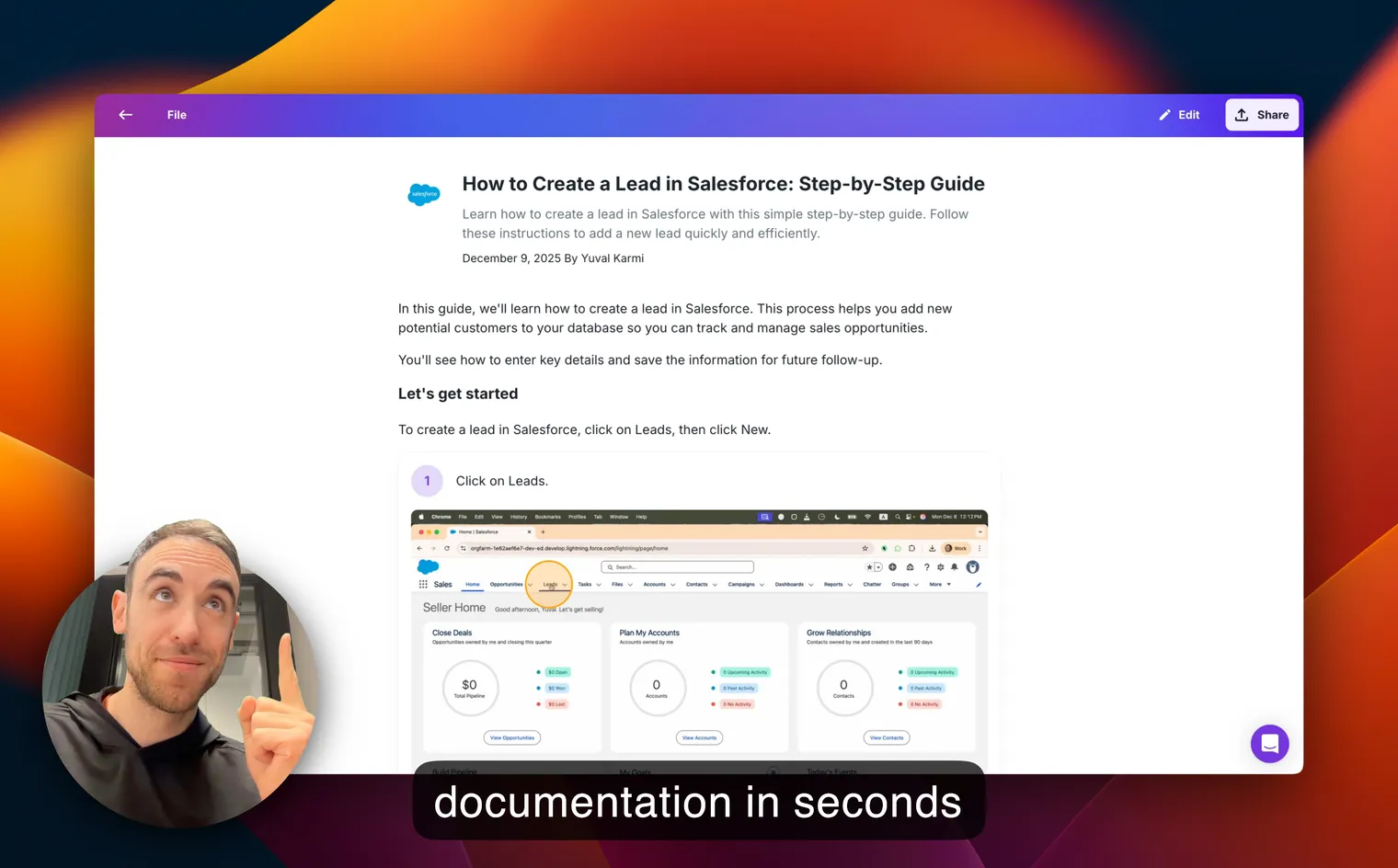
Teach your co-workers or customers how to get stuff done – in seconds.

Top Notion Alternatives for Documentation at a Glance
| Tool | Best For | Starting Price | Desktop Support | Free Tier |
|---|---|---|---|---|
| Glitter AI | Visual process documentation | $16/mo annual | Yes | 10 guides total |
| Confluence | Enterprise documentation | $5.67/user/mo | Yes | 10 users |
| Coda | Document-database hybrid | $10/maker/mo | Yes | Free plan |
| Slite | Team knowledge base | $8/user/mo | Yes | Free plan |
| Scribe | Step-by-step guides | $35/mo monthly | Paid only | Limited |
| Tettra | Internal knowledge management | $8/user/mo | No | 30-day trial |
| ClickUp | All-in-one workspace | $7/user/mo | Yes | Free plan |
If your shortlist also includes other tools, it’s worth comparing across categories. We’ve covered the best Slite alternatives in a dedicated guide. There’s also a separate breakdown of the best Confluence alternatives and a look at where Document360 fits.
Why Look for Notion Alternatives for Documentation?
Notion is powerful and has clear strengths. Its flexible block-based system can replace multiple tools (Trello, Google Docs, Confluence) with a single customizable interface. The recent AI Agents feature (September 2025) is genuinely impressive and can perform autonomous tasks like editing databases and drafting documents for up to 20 minutes without supervision.
That said, teams often hit specific limitations when using it for documentation:
Performance Issues with Large Workspaces
This comes up constantly in user feedback. Notion gets noticeably slower when content piles up, especially with big databases and complex pages. Large workspaces can take forever to load, and even creating new blank pages sometimes lags. For teams with thousands of documentation pages, this becomes a real productivity problem.
Limited Offline Functionality
Notion needs the internet to work properly. There are some offline capabilities, but they’re not reliable enough for many teams. If you’re working from a train, airplane, or anywhere with spotty wifi, Notion gets frustrating quickly. For teams that need dependable access to documentation without connectivity, this is often a dealbreaker.
Steep Learning Curve
Notion can feel overwhelming, especially for new users. The UI isn’t as intuitive as you might hope, and learning the platform takes real time. As one reviewer put it: “Notion is too complex for the simplest needs but still not powerful or seamless enough for the most complex needs.”
Pricing Concerns for Growing Teams
Per-seat pricing adds up quickly, especially after the controversial May 2025 AI pricing restructure. Notion discontinued the standalone AI add-on for new users and bundled AI directly into higher-tier plans. Now, full AI access requires a Business plan at $20/user/month annually ($24/month billed monthly), which gets expensive for larger teams. Enterprise plans reportedly start around $25-26/user/month with typical minimums of 100 seats.
Users on the Plus plan ($10/month annually) who want AI must now pay double to upgrade to Business, even if they don’t need features like SAML SSO or private teamspaces. As one frustrated user put it: “Pretty shameful & untrustworthy imo, AI as a separate sub was a good solution so that only interested customers would pay extra for it, now they’re force feeding it to everyone.”
There’s also no pricing flexibility. Everyone with your domain pays the same tier. No read-only users at a lower price. Teams end up paying full price for people who only occasionally need to view documentation.
Database Limitations
Notion databases are useful, but they hit performance walls around 10,000+ rows and lack the flexibility needed for complex relational workflows. Teams with serious data structure needs often end up needing Airtable or a proper database tool anyway.
Incomplete Features and Bugs
Users frequently report that new features feel about “80% complete” and that the platform has bugs and quality-of-life issues affecting usability. The newly released Notion Mail (2025) has been particularly criticized as feeling like a “Gmail wrapper” with significant limitations:
- No Outlook support (Gmail only)
- No unified inbox
- Limited integration with Notion databases (can’t easily turn emails into tasks)
- Multiple bugs including emails not loading and delete actions failing
One user complained: “Notion Mail sucks big time… It doesn’t even open properly.” Another said: “I reported multiple bugs in the last few weeks and each time it’s a very long back and forth asking me question I already answered… Is this me or Notion is becoming truly littered with bug?”
Mobile App Limitations and Offline Issues
Notion’s mobile version isn’t as user-friendly as the desktop version. The mobile app has historically had slow startup times and a less intuitive UI, making quick note-taking harder than using a simpler app.
While Notion finally released offline mode in August 2025, users describe it as “fake” offline mode. On free plans, you must manually select which pages to make available offline. The offline mode doesn’t support all block types (embeds, AI features, dynamic forms), and you can’t create new databases while offline. Users criticize it for not being “true local-first” software like Obsidian or Anytype.
Copy/Paste and Formatting Issues
If you’re moving to Notion from another application, expect formatting headaches. Copy/paste can create a mess, and formatting can be counterintuitive. Teams migrating existing documentation often spend weeks reformatting content.
Poor Customer Support
Multiple users report being “ghosted” by Notion support or receiving only generic AI-generated responses. Critical issues like account lockouts, data loss, and billing glitches can take days or weeks to resolve. One user reported: “I accidentally deleted my entire notion workspace… I’ve already emailed Notion support about this but haven’t received a response yet.” Others describe support as a “black hole” where tickets receive automated acknowledgments but no human follow-up.
Security and Compliance Limitations
While Notion is SOC 2 Type 2 and ISO 27001 certified, there are important security limitations:
- HIPAA compliance with a Business Associate Agreement (BAA) is only available on Enterprise plans
- SAML SSO is gated to Business and Enterprise plans only (not available on Plus)
- Notion does not offer End-to-End Encryption (E2EE), as Notion holds the encryption keys
- For AI features, Enterprise plans have zero data retention with AI providers (Anthropic, OpenAI), but other plans retain data for up to 30 days for abuse monitoring
On the positive side, Notion states they do not train AI models on customer data and have contractual agreements with AI providers prohibiting use of customer data for training.
Reliability and Vendor Lock-in Concerns
Notion has experienced multiple service disruptions and outages in late 2025, affecting database views, search functionality, and duplication features. As the platform has grown to over 100 million users, these reliability issues have become more noticeable.
Additionally, while Notion supports export to HTML, Markdown, and CSV, complex relationships and proprietary block types often break during export. This makes migrating to other tools difficult and creates significant vendor lock-in.
One Swiss tech company CEO captured the frustration in an open letter about the pricing changes: “Let’s be honest: this isn’t a gift; it’s a ransom. Pay more to keep what you already paid for… These so-called ‘plan adjustments’ are really contract breaches disguised as updates.” This sentiment reflects broader concerns about Notion’s evolving pricing strategy and long-term commitment to existing customers.
TL;DR: Our Top Picks
Best for Visual Documentation: Glitter AI - Record your process once with narration, get searchable step-by-step guides in minutes. Best for documenting actual workflows.
Best for Enterprise: Confluence - Industry standard with solid permissions, version control, and tight Jira integration. Best for large organizations with complex needs.
Best for Flexibility: Coda - Document-database hybrid with powerful formulas and automation. Best for teams that need custom workflows.
Best for Simplicity: Slite - Lightning-fast search with AI-powered answers. Best for teams that want straightforward knowledge management.
Best for Click-Only Browser Capture: Scribe - Automatic screenshot capture for browser workflows. Generates generic ‘Click Submit’ text from UI elements; expect manual cleanup.
1. Glitter AI - Best for Visual Process Documentation
Best for: Teams documenting processes, SOPs, and training materials
I built Glitter AI specifically because Notion (and every other tool) made documenting actual processes way too slow.
How It Works
Instead of writing documentation manually in a text editor, you record yourself doing the process once while narrating. Glitter captures screenshots automatically and transcribes your voice into clear, natural-sounding steps. What takes hours in Notion takes five minutes in Glitter.
The key difference is context. Notion makes you write everything manually. Glitter uses your actual explanation as you perform the task, so the documentation includes the why, not just the what.
Key Features
- Desktop and browser screen recording (both in free tier)
- Voice narration in 99 languages with automatic transcription
- Magic Article: AI transforms guides into comprehensive documentation
- Video-to-guide conversion (upload existing videos, even of physical processes)
- Screenshot editing with blur, annotation, and crop tools
- Multiple export formats (PDF, HTML, Markdown, PowerPoint)
- Embed guides anywhere, with no viewer fees for embedded content
- Embedded playback in Notion, Confluence, Zendesk, and more
Pricing
- Free: 10 guides total (not monthly), 5 min recording time, desktop + web capture, Magic Article
- Pro: $20/month ($16/month annual) - Unlimited guides, 15 min recording time, Magic Editor, sensitive data redaction
- Team: $75/month for 5 users ($60/month annual) - 30 min recording time, team collaboration
- Enterprise: Starting at $8,000/year - SSO, audit trails, custom teams
Pros
- 11x faster than writing documentation manually
- Natural-sounding output because it’s your actual words
- Desktop support in free tier
- Multi-language support (99 languages)
- Can document physical processes by uploading videos
- Export and embed anywhere, including back into Notion
- No viewer fees for embedded guides keeps costs down as teams grow
Cons
- You need to narrate out loud (awkward in open offices)
- Not built for long-form articles or wikis
- Newer product with smaller template library
- Different approach than traditional text editors
- Non-Chromium browsers require desktop app.
- No GIF export
- AI voiceover/narration coming soon
- Sensitive data redaction available on paid plans only
My Take
Notion is great for organizing information you already have. But if you need to document how to actually do something, like onboard new employees, train on software, or create SOPs, you’re manually taking screenshots, uploading them, and writing explanations. Glitter eliminates that entire workflow by capturing everything as you do the task once.
We export to Markdown and HTML specifically so teams can use Glitter for creation, then organize the output in Notion if they want. Best of both worlds.
Your first 10 guides are free - no credit card needed
2. Confluence - Best for Enterprise Documentation
Best for: Large organizations needing structured documentation with enterprise security
How It Works
Confluence is Atlassian’s documentation platform, built for teams that need serious permissions, version control, and integration with Jira. It’s more structured and rigid than Notion, but that’s intentional. It’s designed to scale to thousands of users across multiple departments.
Key Features
- Unlimited pages and spaces for organization
- Confluence databases for structured data
- Up to 3 active whiteboards per user
- 100 automation rule runs per month (Standard plan)
- Native Jira integration for linking docs to tickets
- Page permissions and external collaboration
- Templates for meeting notes, project plans, policies
- SAML SSO and SCIM provisioning (Enterprise)
- Audit logs and data residency options
Pricing
- Free: Up to 10 users, 2GB storage, community support
- Standard: $5.67/user/month (annual) - 250GB storage, 100 automation runs
- Premium: $10.83/user/month (annual) - Unlimited storage, advanced analytics, 24/7 support
- Enterprise: Custom pricing - Data residency, unlimited storage, enterprise security
Pros
- Industry standard with enterprise-grade security
- Tight Jira integration for software teams
- Strong permissions and access controls
- Good version history and audit trails
- Template library for common documentation needs
- Handles thousands of pages without performance issues
- Academic and nonprofit discounts available
Cons
- More complex than Notion, steeper learning curve
- UI feels dated compared to modern tools
- Expensive for smaller teams, with aggressive price increases (one enterprise customer reported costs jumping from $150k to $500k per year over three years)
- Rigid structure can feel limiting
- Not ideal for quick, informal notes
- Requires more setup and configuration
- Search functionality widely criticized: “The search function on confluence is absolute shit” - Reddit user
- Recent stability issues including a December 2025 bug that broke PDF exports for image-heavy documents
My Take
If you’re in a regulated industry (healthcare, finance, government) or need documentation that integrates tightly with Jira, Confluence is the standard. It’s less flexible than Notion, but that rigidity comes with reliability, security, and the ability to scale to thousands of users without performance degradation. When comparing Notion vs Confluence, it really comes down to whether you need enterprise-grade controls or consumer-friendly flexibility.
3. Coda - Best for Document-Database Hybrid
Best for: Teams that need powerful formulas, automation, and custom workflows
How It Works
Coda combines the flexibility of documents with the structure of spreadsheets and the power of apps. It’s similar to Notion but with more capable database functionality, formulas, and automation. You can build custom tools directly inside documents without coding.
Key Features
- Collaborative docs with real-time editing
- Connected tables with relational data
- Powerful formula language (similar to Excel)
- Buttons that trigger actions and workflows
- Automation for repetitive tasks
- Coda AI for content creation and data analysis
- 600+ integrations (Packs) including Google Calendar, Slack, Jira
- Custom domains and branding
- Cross-doc syncing to share data between docs
Pricing
- Free: Unlimited docs (unshared), 1GB storage per doc, Coda AI trial
- Pro: $10/doc maker/month (annual) - Unlimited doc size, 30-day version history, custom domains
- Team: $30/doc maker/month (annual) - Unlimited automations, unlimited version history, cross-doc syncing
- Enterprise: Starting at $12,000/year for 25 users - SSO, admin controls, dedicated support
Note: Only Doc Makers (creators) are charged. Editors and viewers are free.
Pros
- More powerful formulas and automation than Notion
- Only creators pay, no viewer fees for embedded content
- Better for building custom tools and apps
- Strong integrations with 600+ tools
- Handles complex relational data better than Notion
- Active community and template marketplace
Cons
- Similar learning curve to Notion
- Can get expensive for teams with many creators (the Team plan is 3x the price of Pro at $30/maker/mo)
- Documentation-specific features not as polished as dedicated tools
- Formula language requires time to learn
- Performance can lag with very complex docs: “I really really wanted to love CODA, but the delays are essentially making it unusable for me” - Reddit user
- Mobile app widely criticized as “garbage” for editing, slow to load, and unreliable
- Acquisition uncertainty: Grammarly acquired Coda in December 2024, raising questions about the product’s long-term roadmap
My Take
If Notion feels too simple for your database needs but Airtable feels too rigid for documentation, Coda sits right in the middle. It’s particularly good for teams that want to build custom workflows, whether that’s project trackers, CRMs, or approval systems, directly inside their documentation.
4. Slite - Best for Simple, Fast Knowledge Management
Best for: Teams that want straightforward documentation without complexity
How It Works
Slite is designed as the antidote to Notion’s complexity. It’s a knowledge base platform with AI-powered search that finds answers instantly, even if you don’t know which doc has the information. The focus is on speed and simplicity.
Key Features
- AI assistant “Ask” - queries your knowledge base with generative AI
- “Super” - AI search across your entire tech stack, not just Slite
- Doc verification to mark validated sources of truth with validity periods
- Analytics on what your team is reading and searching
- Intuitive, fast editor that doesn’t get in your way
- Real-time document collaboration
- Integrations with GitHub, Google Workspace, Trello, Slack, Asana
- Mobile support for Android, iPad, and iPhone
Pricing
- Free: Basic knowledge base features
- Standard: Starting at $8/user/month - Doc verification, analytics, integrations
- Slite + Super Bundle: Includes enterprise search across all tools
Note: Nonprofit and academic discounts available.
Pros
- Much faster and simpler than Notion
- AI search is genuinely useful for finding information quickly
- Clean, intuitive interface with minimal learning curve
- Affordable pricing for small teams
- Doc verification prevents outdated information
- Good mobile apps
Cons
- Less flexible than Notion for custom setups
- Smaller integration ecosystem
- Not ideal for complex databases or project management
- Limited customization options
- Might feel too simple for power users
- Mobile app criticized as slow: “Notes open so slow that it’s quite annoying, especially when I’m trying to quickly view a resource” - Google Play Review
- The free plan’s 50-document limit is restrictive, and most teams outgrow it quickly
- Pricing jump: The mid-tier “Premium” plan was deprecated, forcing users to pay $20/user/mo for the Knowledge Suite to access features like SSO
My Take
Slite is what you want if Notion feels like overkill. It’s laser-focused on knowledge management: creating, finding, and verifying documentation. If your team spends more time searching for information than organizing it, Slite’s AI search alone might justify the switch.
5. Scribe - Best for Click-Only Browser Capture
Best for: Basic software tutorials and browser-based processes where generic auto-generated step text is sufficient
How It Works
Install the browser extension, click through your process, and Scribe automatically captures screenshots and generates a step-by-step guide. It’s the fastest way to create basic documentation for web applications, though you’ll likely need to edit the AI-generated text.
Key Features
- Automatic screenshot capture with annotations
- Browser extension for Chrome, Edge, Safari
- Desktop recording (Pro and Enterprise only)
- Combine multiple guides into documents
- Export to PDF, HTML (paid plans)
- Custom branding and logo (paid plans)
- Automatic translation to supported languages
- Guide analytics to track usage
Pricing
- Basic: Free - Web apps only, with Scribe branding, no exports
- Pro Personal: $25/mo annual or $35/mo monthly - Desktop capture, exports, custom branding
- Pro Team: $13/seat/month annual or $17/seat/month monthly (minimum 5 seats = $65/mo annual floor, $85/mo monthly floor) - Team collaboration, analytics
- Enterprise: $39/user + $1,300/month - Advanced security, compliance
Pros
- Fastest tool for basic browser documentation
- Generous free tier for trying it out
- Minimal learning curve
- Good for documenting software UI changes
- Integrates with Confluence, Notion, other knowledge bases
Cons
- Desktop recording locked behind paid plans ($35/mo monthly Pro Personal)
- Steps feel generic without narration context, just “Click Submit” without the why
- Limited editing capabilities once captured
- English only on self-serve plans (translations locked to Enterprise)
- Expensive for larger teams: Pro Team requires a 5-seat minimum ($85/mo monthly floor at $17/user), and Enterprise pricing is shocking, with users reporting quotes of “$39 per user plus an additional $1300 per month” (Reddit)
- Desktop app reliability issues: “95% of them show up as a blank scribe with ‘no steps’, even though it showed all steps before hitting complete” - Reddit user
- Support concerns: Multiple reports of sales and support teams “ghosting” customers
- No video output option, screenshots only
My Take
Scribe excels at one specific use case: quick tutorials for browser-based software. Its AI generates text from UI elements alone - think “Click Submit” without the why - so expect manual editing before guides are truly useful. For anything more complex, like desktop apps, processes that need context, or documentation in multiple languages, you’ll hit limitations fast.
6. Tettra - Best for Internal Knowledge Management
Best for: Small teams focused on reducing repetitive Slack questions
How It Works
Tettra is designed specifically for internal knowledge bases, with tight Slack integration that surfaces answers without leaving your chat. It’s simpler than Notion but more focused than a general note-taking app.
Key Features
- AI-powered answers in Slack
- AI page tagging and FAQ generation
- Advanced permissions for sensitive information
- Usage analytics to see what people search for
- API access for custom integrations
- Integration with Slack, Google Workspace, GitHub, Zapier
- 1GB storage per user (Basic), unlimited version history
Pricing
- Basic: $8/user/month (minimum 10 users = $80/month) - Knowledge base, Google Workspace integration
- Scaling: $10/user/month monthly or $8 annual (minimum 10 users, maximum 250) - AI features, Slack bot, analytics
- Professional: Minimum 50 users, custom pricing
Note: No free plan. 30-day free trial available.
Pros
- Excellent Slack integration reduces context switching
- AI answers are surprisingly useful for common questions
- Simple interface, minimal learning curve
- Good analytics on what information is being searched for
- Focused specifically on knowledge management
Cons
- High minimum user requirement: 10 users minimum means a team of 3 pays for 10 (effective cost of $8-16/user instead of advertised rates)
- No free plan, as it was discontinued in mid-2024, forcing immediate paywall after the 30-day trial
- Limited integrations compared to Notion competitors (many workflows require Zapier)
- Not built for complex documentation or databases
- SSO Tax: Single Sign-On requires the Professional plan at $7,200/year minimum
- Editor limitations: “Tettra champions a clean, streamlined approach… it’s not quite as customizable to the needs of individual teams” - G2 Review
- Limited formatting options frustrate users who need visually rich documentation
My Take
Tettra solves a specific problem: reducing “where is that doc?” questions in Slack. If your team constantly asks the same questions in chat, Tettra’s AI bot can surface answers automatically. But it’s not a replacement for comprehensive documentation. Think of it as a layer on top of your existing docs.
7. ClickUp - Best All-in-One Workspace
Best for: Teams wanting project management and documentation in one place
How It Works
ClickUp is primarily a project management tool, but it includes solid documentation features (Docs), wikis, and knowledge bases. If you’re already using ClickUp for tasks, consolidating documentation into the same platform can reduce tool sprawl.
Key Features
- ClickUp Docs with real-time collaboration
- Task lists, Kanban boards, Gantt charts
- Connected to tasks and projects
- Strong automation and goal tracking
- Integrations with Slack, Google Drive, and more
- Templates for various documentation needs
- Customizable dashboards and views
- Time tracking and reporting
Pricing
- Free Forever: Unlimited tasks, 100MB storage, basic docs
- Unlimited: $7/user/month - Unlimited storage, integrations, dashboards
- Business: $12/user/month - Advanced automation, workload management
- Enterprise: Custom pricing - Advanced permissions, enterprise support
Pros
- All-in-one workspace eliminates tool switching
- Highly customizable to fit different workflows
- Docs connect directly to tasks and projects
- Powerful automation capabilities
- Good value for money compared to multiple tools
- Strong integrations ecosystem
Cons
- Overwhelming number of options and features
- Steep learning curve for new users
- Not as polished for pure documentation as dedicated tools
- Can feel like “feature bloat” for simple needs
- Performance can lag with very large workspaces
My Take
ClickUp is for teams that want everything in one place. If you’re using Notion for both project management and documentation, ClickUp might be a better fit because it’s built for tasks first, documentation second. But if you only need documentation, it’s probably overkill.
Feature Comparison Table
| Feature | Glitter AI | Confluence | Coda | Slite | Scribe | Tettra | ClickUp |
|---|---|---|---|---|---|---|---|
| Screen Recording | Yes | No | No | No | Yes | No | No |
| Voice Narration | Yes | No | No | No | No | No | No |
| Desktop Capture | Free tier | N/A | N/A | N/A | Paid only | N/A | N/A |
| AI Features | Magic Article | Summaries | Coda AI | Ask AI | Limited | AI answers | AI assistance |
| Offline Mode | Limited | Limited | Limited | Limited | Limited | No | Limited |
| Multi-language | 99 languages | Yes | Yes | Yes | Enterprise only | Yes | Yes |
| Export Formats | PDF, HTML, MD, PPT | PDF, Word | PDF, HTML | ||||
| Version History | Yes | Extensive | 30-90 days | Yes | 7-30 days | Unlimited | Yes |
| Mobile Apps | No | Yes | Yes | Yes | Yes | Limited | Yes |
| Free Tier | 10 guides | 10 users | Yes | Yes | Limited | Trial only | Yes |
| Min. Users | None | None | None | None | 5 (Team) | 10 | None |
Pricing Comparison
| Tool | Free Plan | Starting Paid | Best Value |
|---|---|---|---|
| Glitter AI | 10 guides total | $16/mo annual | Pro: $16/mo annual |
| Confluence | 10 users, 2GB | $5.67/user/mo annual | Standard for most teams |
| Coda | Unlimited (unshared) | $10/maker/mo annual | Team: $30/maker/mo annual |
| Slite | Basic features | $8/user/mo | Standard plan |
| Scribe | Web only, limited | $35/mo monthly personal | Pro Team: $17/user/mo monthly (5-seat min) |
| Tettra | 30-day trial | $80/mo (10 users) | Scaling: $8/user/mo annual |
| ClickUp | Yes, unlimited tasks | $7/user/mo annual | Unlimited plan |
How to Choose the Right Notion Alternative
Choose Glitter AI if:
- You need to document processes, SOPs, or training materials
- You want 11x faster documentation creation
- You need visual, step-by-step guides with context
- You’re documenting software, tools, or even physical processes
- You want to export and embed in multiple platforms
- You use Chromium browsers (Chrome, Edge, Brave)
Choose Confluence if:
- You’re an enterprise with 100+ employees
- You need enterprise security and compliance features
- You’re already using Jira for project management
- You need strong permissions and audit trails
- You’re in a regulated industry
Choose Coda if:
- You need powerful formulas and automation
- You’re building custom tools and workflows
- You want document-database hybrid capabilities
- You have complex relational data needs
- You prefer charging only creators, not viewers
Choose Slite if:
- You want simplicity and speed over customization
- Your main problem is finding information quickly
- You need AI-powered search across documentation
- Notion feels like overkill for your needs
- You’re a small to mid-sized team
Choose Scribe if:
- You only need basic browser-based tutorials
- You don’t want to narrate out loud
- You need the fastest possible screenshot capture
- Your documentation is simple software UI walkthroughs
- You’re okay with English-only output
Choose Tettra if:
- Your team lives in Slack
- You want to reduce repetitive questions
- You need a simple internal knowledge base
- You have at least 10 users to meet the minimum
- AI-powered answers in chat are valuable to you
Choose ClickUp if:
- You want project management and documentation together
- You’re already using ClickUp for tasks
- You need extensive customization options
- You want to consolidate multiple tools
- You’re willing to invest time in setup and learning
Frequently Asked Questions
Is Notion good for documentation?
Notion works well for basic documentation and wikis, but teams often hit performance issues with large workspaces (10,000+ rows in databases), limited offline access, and a steep learning curve. It’s better for organizing existing information than creating documentation from scratch.
What’s the fastest way to create documentation?
Glitter AI is the fastest for process documentation, clocking in at 11x faster than manual methods. Record yourself doing the task once with narration and get a searchable guide in minutes. Scribe is faster for basic browser tutorials without narration. Traditional text editors like Notion require manual writing and screenshot management.
Can I export from Notion to other tools?
Yes, Notion supports export to Markdown, CSV, and HTML. You can export pages or entire workspaces. That said, formatting may not transfer perfectly, and you’ll likely need to clean up the output when importing to other platforms.
What’s the cheapest Notion alternative?
ClickUp and Coda both offer generous free plans. Glitter AI offers 10 free guides (total, not monthly). For paid plans, Confluence starts at $5.75/user/month annually for the Standard plan. Pricing depends heavily on team size and features needed. Note that Notion itself starts at $10/user/month annually (Plus plan) or $20/user/month annually (Business plan with AI features).
Do I need to migrate all my content from Notion?
Not necessarily. Many teams use multiple tools together. For example, Glitter for creating process documentation, Notion for organizing it. You can export guides from Glitter to Markdown and import into Notion, or embed guides directly in Notion pages.
What’s better than Notion for team documentation?
It depends on your needs:
- Visual processes: Glitter AI
- Enterprise security: Confluence
- Custom workflows: Coda
- Simplicity: Slite
- All-in-one workspace: ClickUp
Can these tools integrate with Notion?
Yes, most tools can export to formats that Notion imports (Markdown, HTML), and many (including Glitter) support embedding directly in Notion pages via public links or embeds.
Is Confluence better than Notion?
Confluence is better for enterprise teams that need security, compliance, Jira integration, and the ability to scale to thousands of users without performance issues. Notion is better for flexibility, modern UI, and teams that want more customization. Neither is universally “better.” It depends on your specific requirements.
Our Verdict: The Best Notion Alternative for Documentation
Here’s the honest truth: there’s no single “best” alternative to Notion because it depends entirely on what kind of documentation you’re creating.
For process documentation and SOPs, Glitter AI is the clear winner. Recording yourself doing the task once with narration is 11x faster than manually writing steps, taking screenshots, and uploading them. The output sounds more natural because it uses your actual words, and you can create guides in minutes instead of hours.
For enterprise documentation with security requirements, Confluence is the industry standard. It’s not as flexible as Notion, but it’s built to handle thousands of users, extensive permissions, audit trails, and integration with Jira. If you’re in healthcare, finance, or government, Confluence is likely your answer.
For teams that need document-database hybrid capabilities, Coda offers more powerful formulas and automation than Notion while maintaining similar flexibility. It’s particularly good for building custom tools and workflows directly inside documents.
For teams overwhelmed by Notion’s complexity, Slite provides the simplicity and speed you’re probably craving. The AI search is genuinely useful, and the interface is clean and fast.
For basic browser tutorials, Scribe is solid if you don’t need narration and only document web applications. But you’ll hit limitations quickly if you need desktop capture, multi-language support, or video output.
The bottom line: Notion is great at being a jack-of-all-trades. But if documentation is a core part of your workflow, a specialized tool will save you significant time and frustration. For more options across the category, see our roundup of the best knowledge sharing tools.
Create your first guide with Glitter AI - free for 10 guides, no credit card needed