
Read summarized version with
Slite has built a solid reputation as a clean, no-fuss knowledge base. Teams use it to document processes, share notes, and create internal wikis. The AI-powered “Ask” feature and document verification system have won over plenty of remote teams who want their company info in one place.
That said, Slite isn’t the only game in town. And honestly, depending on what your team needs, it might not be the best fit.
I’m Yuval, founder of Glitter AI. Before building my own documentation tool, I spent years evaluating knowledge base tools 2026 at my first startup. I’ve seen where Slite works well and where teams run into walls.
This guide covers the best Slite alternatives for 2026, with honest thoughts on what each tool does right and where it stumbles. For a broader perspective on the category, see our roundup of tools that help teams share what they know.
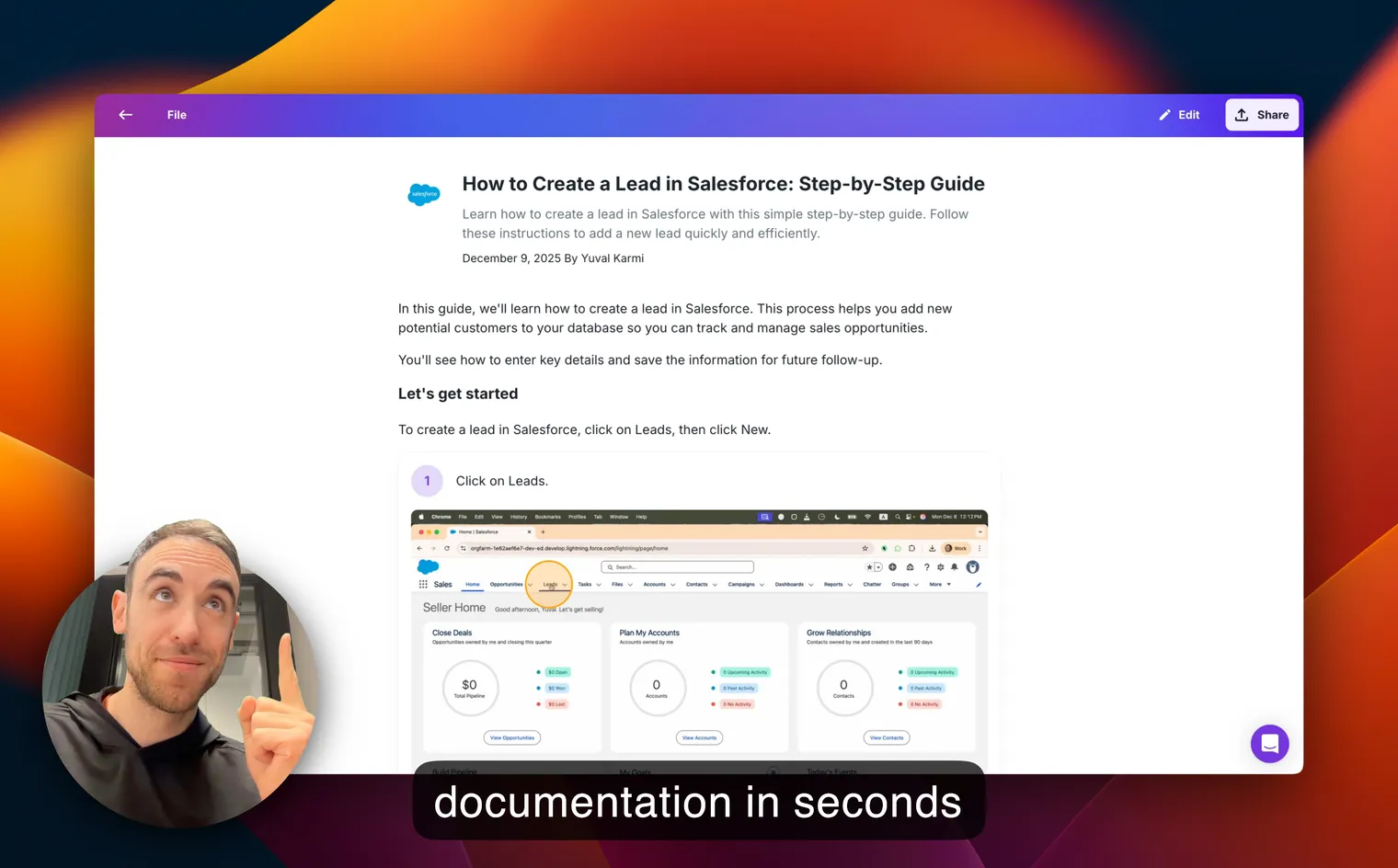
Teach your co-workers or customers how to get stuff done – in seconds.

Top Slite Alternatives at a Glance
| Tool | Best For | Starting Price | AI Features | Free Tier |
|---|---|---|---|---|
| Glitter AI | Visual process documentation | $16/user/mo | Yes | 10 guides total |
| Notion | Flexible databases & wikis (more Notion alternatives) | $10/user/mo | Yes (Business plan) | Yes |
| Confluence | Enterprise teams & Jira users (compare Confluence alternatives) | $5.67/user/mo | Yes (Premium) | Yes (10 users) |
| Tettra | Slack-integrated knowledge | $8/user/mo | Yes | 30-day trial |
| Nuclino | Lightweight real-time docs (see Nuclino alternatives) | $6/user/mo | Yes (Business) | 50 items |
| Coda | Database-powered docs | $10/user/mo | Yes | Yes |
| Document360 | Structured knowledge bases (Document360 alternatives) | Contact Sales | Yes | 14-day trial |
About Slite: Pricing & Key Features
Slite is a collaborative knowledge base built with remote teams in mind. Here’s what their pricing looks like:
| Tier | Price (Annual) | Price (Monthly) | Key Features |
|---|---|---|---|
| Free | $0 | $0 | 50 documents, unlimited members, limited AI “Ask” |
| Standard | $8/user/month | $10/user/month | Unlimited documents, AI Search, document verification, version history |
| Knowledge Suite | $20/user/month | Not disclosed | Everything in Standard + Super Enterprise Search (searches across Slack, Drive, Linear, etc.) |
| Enterprise | Contact Sales | Contact Sales | SSO, SCIM provisioning, audit logs, HIPAA compliance, dedicated success manager |
Note: Slite killed their mid-tier “Premium” plan in favor of the pricier “Knowledge Suite” at $20/user/month. If you need advanced search, you’re now stuck paying more.
What Slite Does Well
Before getting into alternatives, let’s give credit where it’s due:
AI-Powered “Ask” Feature: People really like Slite’s “Ask” feature. It uses AI to answer questions in plain English based on your documentation. Rather than just matching keywords, it pulls together answers and points to specific docs. Saves a lot of time digging around.
Clean, Structured Interface: The interface gets praised for being cleaner than Confluence and less overwhelming than Notion. The “Channels” system keeps things organized without the chaos you sometimes get in more flexible tools.
Document Verification: You can mark docs as “Verified” with expiration dates, which helps with the classic “stale wiki” problem. Owners get pinged when content needs a refresh, so people actually trust the knowledge base.
Strong Security & Compliance: SOC 2 Type II certified, GDPR compliant, HIPAA available for Enterprise. And they’re clear that customer data doesn’t train their AI models.
Why Look for Slite Alternatives?
Even with those strengths, teams often hit these limitations:
Restrictive Free Plan
The free version caps you at 50 documents. Most teams blow through that fast. As one review put it, “The biggest limitation is the 50-document cap, which most teams outgrow very quickly.” Compare that to Notion’s unlimited free pages and you can see why teams often need to upgrade or switch.
Costly Knowledge Suite
Slite restructured pricing recently, pushing advanced features into the “Knowledge Suite” at $20/user/month. The old Premium plan is gone, so there’s a big jump from the $8/month Standard to get enterprise search via “Super.” Small teams who just need one or two advanced features end up paying for the whole bundle.
Terrible Mobile Experience
The mobile app gets consistently criticized for being slow. Users say: “Can be painfully slow… notes open so slow that it’s quite annoying, especially when I’m trying to use it to quickly view a resource.” Missing features, weak offline support, and editing bugs make it a pain. If you have field workers or mobile-first users, this matters a lot.
Limited API Access
Slite did release an MCP Server in 2025, but they still don’t have a solid public API for custom integrations. Teams with specialized workflows or internal tools that need to connect to their knowledge base will find this limiting compared to Notion or Confluence.
No Database or Project Management
Unlike Notion or Coda, there are no structured databases, rollups, or project views like Kanban boards or Gantt charts. You’ll need other tools for task and project tracking, which creates friction between your docs and your actual work.
Poor Offline Access
Offline is basically non-existent. One reviewer said: “The absence of offline access in the mobile app is a bummer and often catches me off guard.” Field teams or anyone with unreliable internet will struggle.
Basic Formatting Options
The clean editor is part of Slite’s appeal, but power users find it limiting. “While Slite is excellent for structured documentation, it can feel limited for more complex workflows… sometimes formatting options feel basic.” If you need rich layouts or custom designs, you’ll feel boxed in.
Isolated AI Knowledge
Before “Super,” Slite’s AI only searched within Slite. Critics pointed out: “It only knows about Slite… Slite’s AI can’t see Google Docs, Confluence, Notion… so it can only ever give you an incomplete answer.” The Knowledge Suite fixes this, but at a steep price.
TL;DR: Our Top Picks
Best for Visual Documentation: Glitter AI - Record your screen, talk through what you’re doing, and get step-by-step guides with screenshots. Great for process documentation.
Best for Flexibility: Notion - The most customizable option out there. Databases, multiple view types, rich formatting. Works well if your team wants one tool for everything.
Best for Enterprise: Confluence - The standard choice for large organizations, especially Atlassian shops. Solid permissions and governance.
Best for Slack Teams: Tettra - The AI assistant answers questions directly in Slack by pulling from your knowledge base and existing conversations.
Best Budget Option: Nuclino - Lightweight, fast, and $6/user/month. The 50-item free tier is pretty generous too.
1. Glitter AI - Best for Visual Process Documentation
Best for: Teams creating step-by-step guides, SOPs, and training materials
I built Glitter AI to solve a different problem than traditional knowledge bases like Slite.
How It Works
Instead of writing documentation from scratch in a wiki, you record your screen while talking through what you’re doing. Glitter grabs screenshots, transcribes your voice, and generates clear step-by-step guides automatically.
The difference comes down to context. With traditional wikis, you write everything by hand and add screenshots one by one. Glitter creates visual documentation roughly 11x faster, with your own explanations built into each step.
Key Features
- Voice-powered capture: Talk while you record to create naturally written steps
- Desktop & browser recording: Document anything on your screen (Chromium browsers only, no Safari)
- AI-generated instructions: Turns your narration into clear, professional text
- Automatic screenshots: Captures images at the right moments, no extra work
- Blur sensitive data: Protect confidential info (paid plans)
- Multiple export formats: PDF, HTML, video, or shareable links
- Team collaboration: Share, edit, and organize guides in workspaces
- AI voiceover: Coming soon
Pricing
- Free: 10 guides total (not monthly), desktop recording included
- Pro: $16-20/user/month for unlimited guides
- Enterprise: Starting at $8,000/year with SSO, custom branding, API access
Pros
- Creates documentation roughly 11x faster than writing manually
- Desktop support even on the free tier
- Steps sound natural since they come from voice narration
- No character limits or field restrictions
- Export to multiple formats
- Built-in blur tools for sensitive data (paid plans)
Cons
- Different approach than traditional internal wiki software (recording vs. writing)
- Not ideal for long-form articles or database-style content
- Newer tool with a smaller user base than established alternatives
- Chromium browsers only (no Safari)
- No GIF export
- Sensitive data redaction needs a paid plan
When to Choose Glitter AI
Choose Glitter if you’re creating:
- Standard operating procedures
- Training documentation
- Software tutorials
- Process walkthroughs
- Onboarding guides
Works well for teams tired of spending hours piecing together screenshot-based documentation by hand.
2. Notion - Best for Flexibility
Best for: Teams wanting databases, wikis, and project management in one tool
Notion is basically the Swiss Army knife of knowledge management. Docs, databases, kanban boards, calendars, wikis - it combines everything into a workspace you can customize almost endlessly.
Key Features
- Flexible databases: Tables, boards, galleries, timelines, calendars
- Rich content blocks: Embed 50+ content types including code, files, and integrations
- AI writing assistant: Built into Business and Enterprise plans
- Template gallery: Thousands of pre-built templates for nearly every use case
- Customizable views: Filter, sort, and display data your way
- Real-time collaboration: Work with unlimited guests at once
- API access: Build custom integrations and automations
Pricing
- Free: Unlimited pages for individuals, 7-day history
- Plus: $10/user/month (annual), $12/user/month (monthly) - 30-day history, unlimited guests
- Business: $20/user/month (annual), $24/user/month (monthly) - AI included, advanced permissions
- Enterprise: Custom pricing - SAML SSO, advanced security
Note: Notion raised prices in May 2025 and bundled AI into Business/Enterprise. Free and Plus users just get an AI trial now.
Pros
- Extremely flexible and customizable
- Clean interface that’s easy to pick up
- Active community with lots of templates
- Powerful database features
- Unlimited pages on free tier
- Good for combining docs with project management
Cons
- Learning curve is steeper than simpler wikis
- Can get overwhelming with too many options
- AI features need the pricier Business plan
- Mobile app isn’t as capable as desktop
- Performance slows down with very large databases
When to Choose Notion
Choose Notion if you want:
- One tool for documentation, projects, and databases
- Highly customizable workspaces
- A modern, visual interface
- Flexibility to build custom workflows
Good fit for teams that have outgrown simple wikis and need more structure.
3. Confluence - Best for Enterprise Teams
Best for: Large organizations, especially those using Atlassian products
Confluence is the enterprise standard for knowledge management. Works particularly well for teams already on Jira since the two integrate tightly.
Key Features
- Spaces and pages: Organize knowledge in hierarchical structures
- Native Jira integration: Link tickets, view project status directly in docs
- Advanced permissions: Fine-grained control over who sees what
- 75+ templates: Pre-built structures for different team needs
- Confluence databases: Organize and display data with custom views
- Real-time collaboration: Multiple contributors with instant syncing
- Automation: Up to 1,000 automation rules per user (Premium)
- 24/7 support: Premium and Enterprise plans include SLA
Pricing
- Free: Up to 10 users, basic templates and storage
- Standard: $5.67/user/month (annual), $6.80/user/month (monthly) - page permissions, more storage
- Premium: $10.83/user/month (annual), $13.01/user/month (monthly) - AI features, unlimited whiteboards, automation
- Enterprise: Custom pricing - unlimited storage, enterprise security
Pros
- Industry standard with a proven track record
- Best-in-class Jira integration
- Solid permissions and governance
- 99.9% uptime SLA (Premium+)
- Scales to thousands of users
- Large integration ecosystem
Cons
- Complex interface with a learning curve
- Feels dated compared to modern tools
- Costs add up fast as your team grows
- Needs plugins for many features
- Can feel heavy and slow
- Overkill for small teams
When to Choose Confluence
Choose Confluence if you:
- Use Jira or other Atlassian products
- Need enterprise-grade security and compliance
- Have complex permission requirements
- Value reliability and uptime guarantees
- Are a large organization with budget for per-user licensing
The safe, established choice for bigger teams that care more about stability than cutting-edge features.
4. Tettra - Best for Slack-Integrated Knowledge
Best for: Teams that live in Slack and need quick answers to repetitive questions
Tettra positions itself as an AI-powered knowledge base that surfaces answers where your team already hangs out, which is mostly Slack.
Key Features
- Kai AI assistant: Answers questions in Slack DMs and channels
- Q&A workflow: Capture questions and route to subject matter experts
- Slack integration: AI summarizes threads, mines answers from existing conversations
- Google Docs training: AI learns from your existing docs
- Version histories: Track changes and roll back when needed
- Permission controls: Manage who can access and edit content
- Usage analytics: See what content people actually read
- Custom domains: Brand your knowledge base
Pricing
- Free: Gone (discontinued mid-2024), but there’s a 30-day trial
- Scaling: $8/user/month (annual), $10/user/month (monthly) - minimum 10 users required ($80/month minimum)
- Enterprise: Custom pricing - SSO, SCIM, dedicated support
Note: All plans require a 10-user minimum, which hits small teams hard. As one analysis noted: “Even if your team is smaller than 10, Tettra’s paid plans require you to pay for the 10-user minimum.” A team of 4 ends up paying $25/user effectively, not $10.
Pros
- Excellent Slack integration
- AI pulls answers from existing Slack conversations
- Simple, focused interface
- Strong Q&A workflow for capturing tribal knowledge
- Nudges you to keep content fresh
- 91% user satisfaction rating
Cons
- No free plan (trial only)
- 10-user minimum bumps costs for small teams
- More limited than full-featured wikis
- Most of its value depends on Slack
- Limited formatting - users note: “Text formatting is very weak, need more options”
- SSO locked behind expensive Enterprise tier
When to Choose Tettra
Choose Tettra if you:
- Use Slack as your main communication tool
- Want to cut down on repetitive questions
- Need a simple, focused knowledge base
- Have at least 10 team members
- Want AI-powered answer retrieval
Natural fit for Slack-centric teams that care more about quick answers than comprehensive documentation.
5. Nuclino - Best Budget Option
Best for: Small teams wanting a lightweight, fast wiki without the complexity
Nuclino calls itself a “collective brain,” which is really just a fancy way of saying it’s a simple, fast tool for organizing knowledge without the mess of files and folders.
Key Features
- Multiple views: Kanban board, hierarchical list, or visual graph
- Real-time collaboration: Simultaneous editing without conflicts
- Visual graph view: See how items connect to each other
- Rich content embedding: Videos, PDFs, diagrams
- Tagging system: Flexible organization beyond hierarchies
- Task management: To-do lists and assignments within items
- Search functionality: Find content quickly
- Cross-platform: Web, desktop, and mobile apps
Pricing
- Free: 50 items, 2GB total storage
- Starter: $6/user/month (annual), $8/user/month (monthly) - unlimited items, 10GB per user
- Business: $10/user/month (annual), $12/user/month (monthly) - AI (Sidekick), SSO, audit log
Pros
- Very affordable at $6/user/month
- Generous free tier (50 items)
- Clean, intuitive interface
- Fast performance
- Almost no learning curve
- Flexible organization (hierarchy, tags, or graph)
- Straightforward pricing, no hidden tiers
Cons
- Missing advanced features like Gantt charts
- No offline access
- Search doesn’t handle typos - one reviewer noted: “The search does not handle typos. It will show zero results if you mistype.”
- Limited export formats (PDF and Markdown only)
- AI locked behind $10/user Business tier
- Guests are billed as regular members (unlike Notion’s free guests)
When to Choose Nuclino
Choose Nuclino if you:
- Prefer simplicity over advanced features
- Have a small team or tight budget
- Value speed and ease of use
- Need basic wiki functionality without complexity
- Like the visual graph view for seeing connections
Solid pick for startups and small teams that need a knowledge base without enterprise-level complexity.
6. Coda - Best for Database-Powered Docs
Best for: Teams building custom workflows and interactive documents
Coda blends documents and spreadsheets, letting you create interactive docs with tables, automations, and integrations. Think Notion, but with more focus on building custom tools.
Key Features
- Docs that do things: Buttons that trigger actions, forms that write to tables
- Connected tables: Build relational databases within documents
- Automations: Time-based and row-change triggers
- Packs: Pre-built integrations with 500+ tools
- Coda AI: Built-in AI for content generation (included with Doc Maker seat)
- Custom domains: Brand your published docs
- Version history: Track changes (30 days on Pro, unlimited on Team)
- Access controls: Granular permissions for pages and sections
Pricing
Pricing is based on “Doc Makers” (people who can create/edit docs). Editors can edit existing docs free.
- Free: 1GB per doc, limited automations
- Pro: $10/Doc Maker/month (annual), $12/Doc Maker/month (monthly) - unlimited doc size, 30-day history, Pro Packs
- Team: $30/Doc Maker/month (annual), $36/Doc Maker/month (monthly) - unlimited automations, cross-doc syncing
- Enterprise: Custom pricing - SAML SSO, advanced security, Enterprise Packs
Pros
- Powerful for building custom tools and workflows
- Combines docs and databases naturally
- Excellent automation capabilities
- Only pay for Doc Makers, not all users
- Strong integration ecosystem (Packs)
- AI included with Doc Maker seats
Cons
- Steeper learning curve than traditional wikis
- Overkill for simple documentation needs
- Gets expensive with multiple Doc Makers ($30/Doc Maker on Team)
- Mobile app is widely criticized - users say: “The Coda mobile app is garbage… slow, buggy and doesn’t feel native”
- Performance lags with complex docs
- No offline mode, needs active internet
When to Choose Coda
Choose Coda if you:
- Want to build custom tools and workflows
- Need interactive, database-driven documentation
- Value automation and integrations
- Have a small number of power users (Doc Makers)
- Want one tool for docs, databases, and project management
Good match for technical teams that want more than a static knowledge base.
7. Document360 - Best for Structured Knowledge Bases
Best for: Teams building formal internal or external knowledge bases
Document360 is purpose-built for knowledge base management. Features are designed specifically for structured documentation, version control, and analytics.
Key Features
- Internal and external knowledge bases: Keep customer-facing and internal docs separate
- AI-powered features: Article summarization, SEO meta generation
- Advanced search: Instant search with analytics
- Version control: Track changes with full history
- Analytics dashboard: See what content people access
- Custom branding: White-label your knowledge base
- Enterprise security: SSO, role-based access control
- API access: Build custom integrations
Pricing
Document360 positions itself as an enterprise solution with opaque pricing:
- Free: Discontinued for new users as of November 2024
- Professional, Business, Enterprise: All plans require contacting sales
- Historical pricing (before late 2024): Professional ~$199/month, Business ~$399/month
- 14-day free trial available
Note: Document360 moved to a “contact sales” model in late 2024, hiding public pricing. Users have noted: “I’m using Document360 as my knowledge base provider and they are very expensive for what they offer.” SSO and API access are gated to higher tiers.
Pros
- Purpose-built for knowledge base management
- Strong version control and audit features
- Good for compliance-heavy industries
- Excellent analytics and reporting
- AI-powered content optimization
- Supports both internal and external knowledge bases
Cons
- Much more expensive than general-purpose wikis
- No free plan (trial only), free tier was discontinued in late 2024
- Opaque pricing, have to contact sales for all plans
- SSO and API access gated to expensive Enterprise tier
- Per-project pricing can double costs if you need multiple knowledge bases
When to Choose Document360
Choose Document360 if you:
- Need a formal, structured knowledge base
- Want both internal and customer-facing documentation
- Require serious version control and compliance features
- Value analytics and content optimization
- Have budget for a specialized solution
Ideal for teams that prioritize formal knowledge management over flexibility.
Feature Comparison Table
| Feature | Glitter AI | Notion | Confluence | Tettra | Nuclino | Coda | Document360 |
|---|---|---|---|---|---|---|---|
| Desktop Recording | Yes | No | No | No | No | No | No |
| AI Writing | Yes | Yes (Business+) | Yes (Premium+) | Yes (Scaling+) | Yes (Business) | Yes | Yes |
| Real-time Collab | Yes | Yes | Yes | Yes | Yes | Yes | Yes |
| Databases | No | Yes | Yes | No | No | Yes | No |
| Version Control | Yes | Basic | Yes | Yes | Basic | Yes | Advanced |
| API Access | Yes (Enterprise) | Yes | Yes | Yes | No | Yes | Yes |
| Custom Branding | Yes | Limited | Yes | Yes | No | Yes | Yes |
| Offline Access | No | Limited | Limited | No | No | No | No |
| Mobile Apps | No | Yes | Yes | Yes | Yes | Yes | Limited |
| Task Management | No | Yes | Limited | No | Yes | Yes | No |
| Advanced Permissions | Yes | Yes | Yes | Yes | Basic | Yes | Yes |
| Free Tier | 10 guides | Unlimited pages | 10 users | No | 50 items | Yes | No |
Pricing Comparison
| Tool | Starting Price (Annual) | Monthly Price | Free Tier | Enterprise Pricing |
|---|---|---|---|---|
| Glitter AI | $16/user/month | $20/user/month | 10 guides | $8,000/year starting |
| Notion | $10/user/month | $12/user/month | Yes, unlimited pages | Custom |
| Confluence | $5.67/user/month | $6.80/user/month | 10 users | Custom |
| Tettra | $8/user/month (10 min) | $10/user/month | No (trial only) | Custom |
| Nuclino | $6/user/month | $8/user/month | 50 items | Volume discounts |
| Coda | $10/Doc Maker/month | $12/Doc Maker/month | Yes | Custom |
| Document360 | Contact Sales | Contact Sales | No (discontinued) | Custom |
How to Choose the Right Slite Alternative
Here’s a quick decision framework based on what matters most:
If You Create Process Documentation
Pick Glitter AI. Recording your screen while talking creates step-by-step guides roughly 11x faster than writing by hand.
If You Want Maximum Flexibility
Pick Notion. Databases, multiple views, and deep customization let you build exactly the workflow you need.
If You’re an Enterprise Using Jira
Pick Confluence. The native integration and enterprise features make it the natural choice.
If Your Team Lives in Slack
Pick Tettra. The AI assistant finds answers right in Slack so you don’t have to switch contexts.
If Budget Is Your Top Priority
Pick Nuclino. At $6/user/month with a solid free tier, it’s the most affordable full-featured option among slite competitors.
If You Build Custom Workflows
Pick Coda. Interactive docs with automations let you create tools, not just documentation.
If You Need Formal Knowledge Management
Pick Document360. Its purpose-built features handle version control, compliance, and structured knowledge bases well.
FAQ
What is the best free alternative to Slite?
Notion has the most generous free tier with unlimited pages for individuals. Nuclino’s free plan gives you 50 items, which works for small teams. Glitter AI offers 10 guides free, which suits teams focused on process documentation.
Does Slite have an API?
No, Slite doesn’t have a developer API. If you need custom integrations, look at Notion, Confluence, or Coda, all of which provide solid APIs.
Can I migrate from Slite to another tool?
Most modern knowledge base tools support importing from Slite. Notion and Confluence both have import tools that can bring over your content. Check your chosen alternative’s docs for specific migration steps.
Which Slite alternative has the best AI features?
Notion (Business plan) and Coda have the most comprehensive AI for content generation and writing help. Tettra’s AI is particularly good at answering questions from your knowledge base. Glitter AI uses AI to turn voice narration into written steps.
Is there a Slite alternative that works offline?
Cloud-based knowledge bases all have limited offline functionality. If offline matters, consider tools with desktop apps like Notion or Confluence, though both still need internet to sync periodically.
What’s the best Slite alternative for small teams?
Nuclino hits the sweet spot between features and affordability at $6/user/month. Notion’s free tier works well for small teams that don’t need advanced features. Glitter AI is a strong choice for small teams creating visual process documentation.
Can these alternatives handle both internal and external documentation?
Document360 is specifically designed for both internal and external knowledge bases. Notion and Confluence can also do both with the right permission settings, though they need more manual setup.
Which tool is best for compliance and audit requirements?
Document360 and Confluence have the strongest version control, audit trails, and compliance features. Both support scheduled content reviews and detailed change tracking that regulated industries require.
Our Verdict
There’s no single best Slite alternative. It really depends on what you’re trying to do.
For process documentation and visual guides, Glitter AI creates content roughly 11x faster than traditional wikis by recording screen + voice instead of writing by hand.
For maximum flexibility and customization, Notion gives you databases, multiple views, and the power to build exactly what you need.
For enterprise teams with complex needs, Confluence remains the industry standard with solid permissions, governance, and Jira integration.
For Slack-centric teams, Tettra’s AI assistant surfaces answers where you already work, cutting down on context switching.
For budget-conscious small teams, Nuclino delivers essential wiki functionality at the lowest price.
The key is matching your tool to how your team actually works. Teams creating step-by-step guides will get more out of Glitter’s recording approach. Teams building custom workflows will thrive in Coda. Enterprises with compliance needs will want Document360 or Confluence. And if you want to get the most out of whichever tool you pick, read up on building a documentation culture that actually sticks.
Try the free tiers or trials of 2-3 options that seem promising. Your team will quickly figure out which one feels right.
Get started with Glitter AI - Create your first 10 guides free, no credit card required.