
Read summarized version with
Here’s a painful truth I learned at my first startup, Simpo: you can have all the knowledge in the world, but if nobody can find it when they need it, you might as well have nothing.
I watched this play out in real-time. We’d spend hours documenting a process. Someone would ask how to do that exact thing two weeks later. And instead of checking our documentation, they’d just… ask someone. Again.
The documentation existed. It just wasn’t useful.
I’m Yuval, founder and CEO of Glitter AI. After building knowledge bases that nobody used, and watching how much smoother things ran once knowledge became part of everyday team collaboration, I finally figured out what makes the difference between a knowledge base that sits there collecting digital dust and one that becomes your team’s go-to resource.
Let me share what I learned the hard way.
Teach your co-workers or customers how to get stuff done – in seconds.

The Difference Between a Knowledge Base That Works and One That Doesn’t
Before we get into the how, let’s talk about why most knowledge bases fail. Because I’ve built both kinds.
Failed Knowledge Bases Share These Traits
They’re organized for the creator, not the user. I once built a knowledge base organized by department. Made perfect sense to me. But when someone in sales needed to know how to handle a refund request (which involved finance, customer success, AND operations), they had no idea where to look.
They’re full of outdated information. Nothing kills trust faster than following documentation that’s wrong. After the third time someone followed old instructions and broke something, they stopped trusting the knowledge base entirely.
They’re hard to search. I’ve seen knowledge bases with no search function. Others with search that was so bad you needed to know the exact title of the article to find anything. If finding information takes longer than asking someone, people will ask.
They’re written in “documentation speak.” You know what I mean - passive voice, corporate jargon, no personality. Reading them feels like reading a legal document. So people don’t.
Successful Knowledge Bases Do This Differently
The knowledge bases that actually get used? They’re the complete opposite.
They’re organized around questions, not organizational charts. They stay current because updating is built into the workflow. They’re easy to search because someone put thought into how people actually look for information. And they’re written like a human talking to another human.
That’s the knowledge base I’m going to help you build. If you’re starting from zero, our step-by-step guide to building a knowledge base from scratch walks you through the full setup process.
Turn your screen recordings into searchable knowledge base articles automatically.
How to Organize Your Knowledge Base for Findability
Organization is everything. You can have brilliant content, but if people can’t find it, it doesn’t matter.
Start With How People Actually Search
Here’s what I do now: before organizing anything, I spend time watching how people search for information.
What questions do they ask in Slack? What do they type into the search bar? What patterns emerge?
I discovered that people rarely search by department or topic category. They search by task (“how do I…”) or problem (“why isn’t… working”).
So that’s how I organize.
Use a Task-Based Structure
Instead of organizing by topic, build your information architecture around what people are trying to accomplish.
Bad structure:
- Finance
- Accounts Payable
- Vendor Management
- How to Process Invoice
- Vendor Management
- Accounts Payable
Good structure:
- How to Process a Vendor Invoice
- How to Add a New Vendor
- What to Do When an Invoice Is Rejected
See the difference? The second structure uses the exact language someone would search for.
Create Multiple Paths to the Same Content
Here’s something that took me forever to realize: there’s no single “right” way to categorize information.
Different people will look for the same information in different ways. Someone might search for “onboarding” while another person searches for “new hire setup.”
The solution? Tag articles with multiple categories and create multiple entry points to the same content.
Your knowledge base should work like a city with multiple routes to the same destination. Not a single highway with one exit.
Keep the Structure Shallow
I used to create these elaborate hierarchies. Categories within subcategories within sub-subcategories. It felt organized.
It was terrible.
People don’t want to click through four levels to find information. They want it fast. Aim for no more than three clicks from the homepage to any article.
My rule: If I can’t get to any article in two clicks, the structure needs work.
Writing Knowledge Base Articles That Actually Help
Content is where most knowledge bases fall apart. Even with perfect organization, bad content = useless knowledge base.
Write Like You’re Explaining to a Friend
This completely changed my approach: write like you’re sitting across from someone explaining how to do something.
Not formal documentation. Not an academic paper. Just clear, straightforward explanation.
Instead of: “The system should be accessed via the designated URL, wherein credentials must be entered into the appropriate fields.”
Write: “Go to the login page and enter your username and password.”
Active voice. Simple words. No jargon (unless you explain it).
Lead With the Answer
People scanning your knowledge base want answers immediately. Don’t make them read six paragraphs of context first.
Bad article structure:
- Background on the system
- Why this process exists
- Historical context
- Finally, the actual steps
Good article structure:
- Quick answer or steps
- Additional details for those who need them
- Context and troubleshooting at the end
I learned this after watching someone scroll frantically through an article I’d written, looking for the actual answer buried on page two. Now I put the answer first. Always.
Use Visuals Extensively
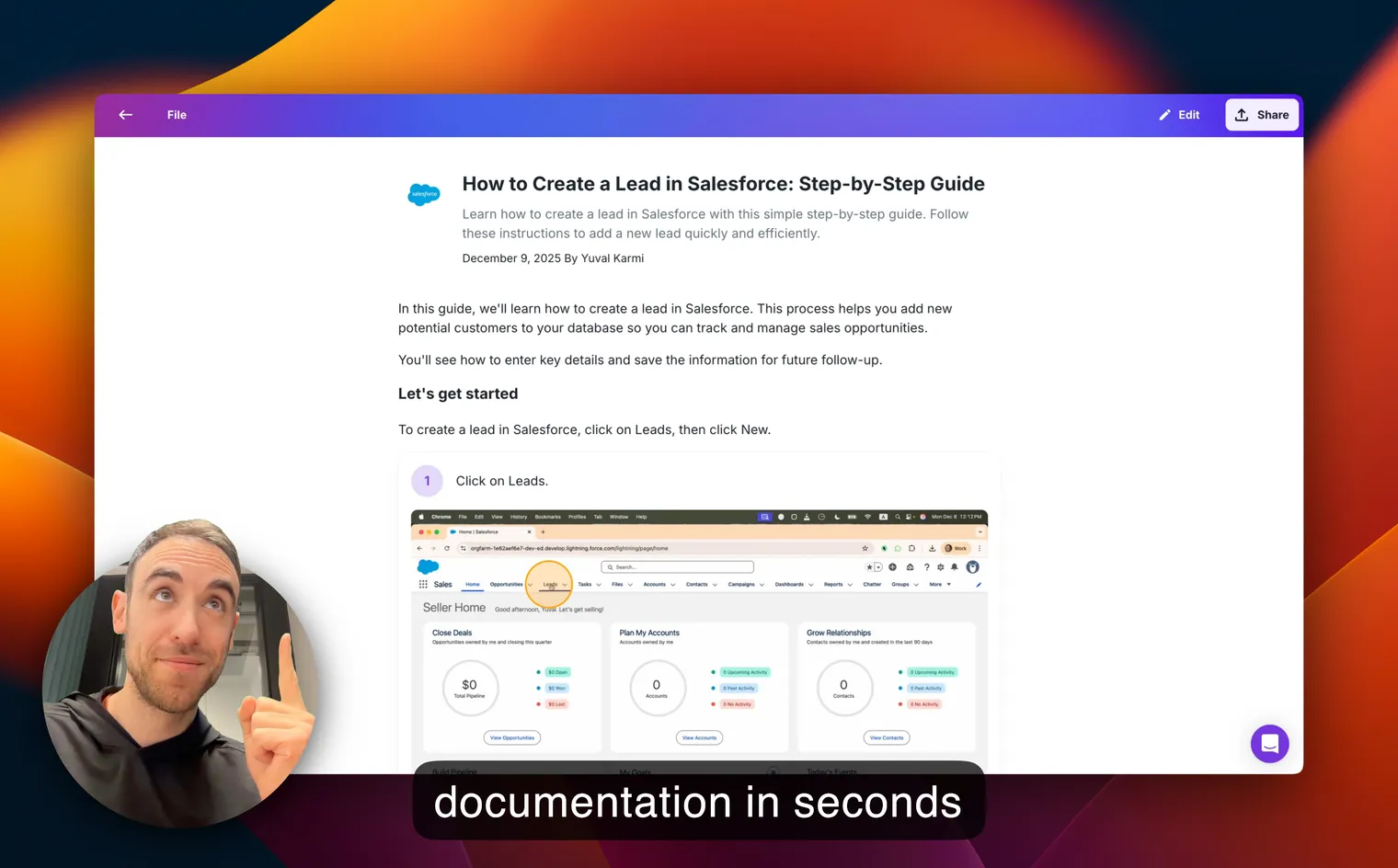
Text alone is hard to follow. Screenshots, annotated images, and short videos make everything clearer.
When I started adding screenshots to every significant step, our “this didn’t help” ratings dropped by half. Half.
This is actually a big part of why I built Glitter AI. Manually creating documentation with screenshots is incredibly time-consuming. Now I just record my screen while doing the task, and the tool automatically generates the article with all the screenshots in the right places.
Break Content Into Scannable Chunks
Nobody reads word-for-word anymore. We scan.
Make your content scannable:
- Use descriptive headings
- Keep paragraphs short (2-4 sentences max)
- Use bullet points for lists
- Bold important concepts
- Add plenty of white space
If someone can’t scan your article in 10 seconds and know whether it answers their question, it needs restructuring.
Teach your co-workers or customers how to get stuff done – in seconds.
Maintaining and Updating Your Knowledge Base
This is where most knowledge bases die. They start great and slowly become obsolete.
Build Updates Into Your Workflow
You can’t rely on someone remembering to update documentation. It needs to happen automatically as part of the process that changed.
My system: Whenever we change a process, updating the knowledge base is literally part of the change checklist. Not optional. Not “when someone has time.” Part of the change.
Example change checklist:
- Update the system
- Test the change
- Update knowledge base article
- Notify affected teams
- Mark old article as outdated (if applicable)
If updating the knowledge base isn’t part of the workflow, it won’t happen consistently.
Use Version Dates and Review Cycles
Every article should show when it was last updated. This builds trust - people can see that the information is current.
I also set review cycles. Critical articles get reviewed quarterly. Less critical ones, annually. When a review comes up, someone actually checks whether the information is still accurate.
This prevents the slow drift into obsolescence that kills knowledge bases.
Make It Easy to Report Issues
Even with good maintenance, things slip through. You need a way for users to flag problems.
I add a simple feedback option at the bottom of every article: “Was this helpful?” with a way to report issues.
When someone says no, I want to know why. Is the article outdated? Unclear? Missing information? That feedback loop is essential for keeping quality high.
Archive, Don’t Delete
When a process changes completely, don’t delete the old article. Archive it with a note explaining what changed and linking to the new process.
Why? Because someone might be searching for the old process trying to understand what happened. Or you might need to reference historical procedures.
Plus, if you’re maintaining a single source of truth for your organization, that historical context matters.
Measuring Knowledge Base Effectiveness
You can’t improve what you don’t measure. Here’s what actually matters.
Track Usage Metrics
The most important question: are people actually using this?
Metrics that matter:
- Page views (which articles get traffic)
- Search queries (what are people looking for)
- Search success rate (do searches lead to article views)
- Time on page (are they reading or bouncing)
- Repeat visits (do they come back to this article)
If your most critical processes have low page views, that’s a red flag. Either the content isn’t useful, or people can’t find it.
Monitor Support Ticket Deflection
One of the biggest benefits of a good knowledge base: fewer repetitive support questions.
Track how many support tickets you get about topics covered in your knowledge base. If you’re still getting lots of tickets about something well-documented, that tells you something.
Either people can’t find the article, or the article doesn’t actually solve their problem.
Measure Helpfulness Scores
At the end of each article, I ask: “Was this helpful?”
Simple yes/no with optional comments. The quantitative data shows which articles work. The qualitative feedback shows why.
Target: 80%+ “yes” responses. Below that, the article needs work.
Track Time-to-Competency
For new hires, measure how long it takes them to get up to speed with your knowledge base versus without it.
When I finally built a solid knowledge base, our onboarding time dropped from three weeks to one. That’s measurable impact.
Look at Contribution Rates
How many people are contributing to and updating the knowledge base? If it’s just one person, you’ve got a problem.
A healthy knowledge base is collaborative. Multiple people adding articles, updating content, and maintaining accuracy. When the entire burden falls on one person, the knowledge base will decay.
Common Mistakes That Kill Knowledge Base Adoption
Let me save you some pain by sharing the mistakes I’ve made (so you don’t have to).
Mistake 1: Building It Before You Need It
I built an elaborate knowledge base structure at Simpo before we had much to document. Spent weeks setting up the perfect system.
Then our actual needs didn’t match my perfect structure. I had to rebuild everything.
Better approach: Start simple. Document the things people are asking about now. Let the structure emerge from actual usage rather than planning everything up front.
Mistake 2: Making It Read-Only
Some knowledge bases have gatekeepers. Want to add an article? Submit it for review. Want to update something? Request access.
This kills momentum. By the time the article gets approved, the person who needed it has moved on.
Make it easy for people to contribute. Yes, you need quality control, but friction-free contribution matters more than perfect polish.
Mistake 3: Treating It Like a Finished Project
I used to think: “Great, the knowledge base is done!”
It’s never done. A knowledge base is a living system that needs constant attention. The moment you treat it as finished, it starts dying.
Mistake 4: No Clear Owner
“Everyone’s responsible” means nobody’s responsible. Your knowledge base needs an owner - someone whose job includes maintaining it.
This doesn’t mean they create all the content. But they ensure standards are met, dead links get fixed, and the structure makes sense.
Mistake 5: Not Training People to Use It
You can’t just build a knowledge base and assume people will use it. You need to actively train your team on:
- How to search effectively
- Where different types of information live
- How to contribute and update articles
- Why using the knowledge base matters
At every company I’ve worked with, usage skyrocketed after we did a simple 15-minute training on “how to actually use our knowledge base.”
Mistake 6: Ignoring Mobile Users
If you have field teams, support staff, or anyone who doesn’t sit at a desk all day, your knowledge base needs to work on mobile.
I learned this the hard way when our operations team just… stopped using our knowledge base. Turns out, they were always on their phones or tablets, and our desktop-only knowledge base was useless to them.
Practical Implementation Tips
Let me give you some actionable next steps based on what’s worked for me.
Start Small and Focused
Don’t try to document everything at once. Start with:
Your top 10 most-asked questions. Go through your support tickets, Slack messages, and emails. What do people ask about repeatedly? Document those first.
That alone will probably cut repetitive questions by half.
Use Templates for Consistency
Create templates for different types of articles:
- How-to guides
- Troubleshooting articles
- Reference documentation
- Concept explanations
Templates ensure consistency and make it faster to create new content. I spent an hour creating templates, and it’s saved me dozens of hours since.
Implement a Style Guide
Decide on standards:
- Tone and voice (formal vs. casual)
- How to format steps (numbered vs. bullets)
- When to use screenshots
- How to handle technical terms
This prevents your knowledge base from feeling like a patchwork of different writing styles.
Make Knowledge Transfer Part of Offboarding
When someone leaves, their knowledge leaves with them - unless you capture it first.
I now build knowledge transfer into the offboarding process. Departing employees document their key processes before leaving. It’s not perfect, but it’s better than losing that knowledge transfer entirely.
Leverage AI for Initial Drafts
This is where tools like Glitter AI make a huge difference, and it helps to weigh how AI guide generators stack up before you commit. Instead of writing documentation from scratch, I record myself doing the process once. The AI generates the article with screenshots automatically.
I still review and refine it, but starting with a solid first draft cuts creation time by 75%.
Create a Feedback Loop
Set up a regular review cycle:
- Weekly: Review user feedback on articles
- Monthly: Check which articles have high bounce rates or low helpfulness scores
- Quarterly: Audit your most-viewed articles for accuracy
- Annually: Review overall structure and organization
This consistent attention prevents decay.
Building a Knowledge Base Culture
The technology and organization matter, but culture matters more. Choosing the right platform also helps – see our roundup of the top platforms for sharing team knowledge for options.
Make It the Official Source
Leadership needs to consistently direct people to the knowledge base. When someone asks a question that’s documented, the answer should be: “Check the knowledge base - here’s the link.”
This trains everyone to check there first.
Celebrate Contributors
Recognize people who add valuable content. In our team meetings, I call out great articles people have created.
This reinforces that contributing to the knowledge base is valued work, not just extra busywork.
Lead by Example
As a founder, I make a point of adding to and using the knowledge base visibly. When I document something or update an article, I mention it.
If leadership doesn’t use it, why would anyone else?
Make It Part of Performance Reviews
I’m serious about this. Contributing to knowledge management is part of our team expectations. Not heavily weighted, but it’s there.
This signals that knowledge sharing isn’t optional - it’s part of how we work.
Build your knowledge base faster with AI-powered documentation from screen recordings.
The Bottom Line
Building a knowledge base that people actually use isn’t about the software you choose (though that matters). It’s about:
Organization: Structure it around how people search, not how you think about the information.
Content quality: Write like a human, use visuals, lead with answers.
Maintenance: Build updates into your workflow, not as an afterthought.
Measurement: Track what matters and improve based on data.
Culture: Make knowledge sharing a core part of how your team works.
I’ve built knowledge bases that failed spectacularly and ones that became indispensable. The difference wasn’t luck - it was following these principles.
Start small. Focus on being useful rather than comprehensive. Make it easy to find, easy to read, and easy to update.
Your team will actually use it. And you’ll stop answering the same questions over and over again.
Trust me, future you will be grateful.
Frequently Asked Questions
What is a knowledge base?
A knowledge base is a centralized repository of information that helps teams find answers to common questions and learn how to complete tasks. It typically includes how-to guides, troubleshooting articles, FAQs, and process documentation organized in a searchable format.
How do I organize a knowledge base effectively?
Organize your knowledge base around tasks and questions rather than departments or topics. Use a shallow structure (no more than 3 clicks to any article), implement robust search functionality, and create multiple paths to the same content through tagging. Start with your top 10 most-asked questions.
What makes employees actually use a knowledge base?
Employees use knowledge bases that are easy to search, contain current and accurate information, and provide answers quickly. Key factors include mobile accessibility, visual content like screenshots, clear writing without jargon, and leadership consistently directing people to use it as the official source of information.
How often should I update my knowledge base?
Update your knowledge base whenever processes change by making documentation updates part of the change workflow. Set up regular review cycles: quarterly for critical articles and annually for others. Every article should display its last-updated date to build trust.
What metrics should I track for knowledge base effectiveness?
Track page views, search success rates, helpfulness scores (target 80%+ positive), support ticket deflection, and time-to-competency for new hires. Monitor which articles have high bounce rates or low scores, and review user feedback regularly to identify content that needs improvement.
Should I use AI to help build my knowledge base?
Yes, AI tools can significantly speed up knowledge base creation by generating initial drafts from screen recordings or existing content. However, always review and refine AI-generated content to ensure accuracy, clarity, and alignment with your organization's tone. AI works best for creating first drafts, not final documentation.
How do I prevent my knowledge base from becoming outdated?
Build knowledge base updates directly into your process change workflow as a required step. Implement regular review cycles, use version dates on all articles, make it easy for users to report issues, and assign a clear owner responsible for maintaining overall quality and structure.
What's the difference between an internal knowledge base and external documentation?
An internal knowledge base serves your employees with process documentation, troubleshooting guides, and company-specific information. External documentation serves customers with product help, user guides, and support content. Internal knowledge bases typically use more casual language and include proprietary processes not meant for public consumption.