
Read summarized version with
Loom became the default choice for async video communication. Record your screen, drop a link, let teammates watch whenever they can.
But the landscape has shifted. Loom isn’t your only option anymore, and depending on what you need, it might not even be your best one, as our Loom vs Scribe breakdown shows.
I’m Yuval, founder of Glitter AI. I spent years testing pretty much every video and documentation tool out there while running my first startup. I’ve seen where Loom shines and where teams start running into friction.
This guide covers the best Loom alternatives for 2026. For a direct head-to-head breakdown, see our Loom vs Glitter AI comparison. I’ll be upfront about the strengths and weaknesses of each.
Teach your co-workers or customers how to get stuff done – in seconds.

Top Loom Alternatives at a Glance
| Tool | Best For | Starting Price | Desktop Support | Free Tier |
|---|---|---|---|---|
| Glitter AI | Documentation that lasts | $16/mo (annual) | Yes | 10 guides |
| Vidyard | Sales teams | $29/mo | Yes | Yes (unlimited) |
| Descript | Professional editing | $15/mo | Yes | 1 hr/month |
| Guidde | AI-narrated video guides | $18/mo (annual) | Business plan | 25 videos |
| Vimeo | High-quality video | $9/mo | Yes | Yes (limited) |
| ClickUp Clip | Project teams | Free | Yes | Unlimited |
| Tango | In-app guidance | $22/user/mo (annual) | Pro plan | Yes (15 workflows) |
| Claap | Meeting recordings | $10/user/mo | Yes | 10 videos/user |
Why Look for Loom Alternatives?
Loom handles quick video messages reasonably well. That said, teams tend to bump into the same frustrations:
5-Minute Limit on Free Plan
Five minutes per video on the free plan sounds fine until you actually try explaining something. Any walkthrough of meaningful length means chopping content into awkward segments or upgrading to a paid plan.
25 Video Storage Cap
The free tier caps you at 25 videos total. Not per month. Lifetime. Once you hit that limit, deleting old videos becomes the only way to create new ones. If you’re trying to build any kind of knowledge base or documentation library, this cap pretty much forces an upgrade right away.
Videos Aren’t Documentation
Here’s the thing: Loom produces videos, not searchable guides. Transcription helps somewhat, but finding a specific piece of information still means scrubbing through footage or scanning transcripts line by line. You can’t just skim for a single step or grab the exact instructions you need.
Limited Editing Capabilities
Make a mistake on the free plan? Re-record the whole thing. There are no editing tools whatsoever. Even paid tiers offer only basic trimming compared to what dedicated video editors provide.
Audio/Video Sync Issues
This one comes up constantly. Audio drifts out of sync with video, sometimes lagging several seconds behind during playback. As one Reddit user mentioned: “Loom video quality goes fuzzy after using the ‘pause’ feature… Using the recording feature in ‘window’ with screen+camera, the camera has to be manually added…” Static, background noise, and general audio quality issues pop up frequently in reviews.
Reliability Concerns
Loom has had stability problems throughout 2025. Users report crashes mid-edit, recordings that won’t save, and the app getting stuck in loops. Multiple outages in October and November locked people out of their recordings for hours. One frustrated user put it this way: “The only issue I have is that their customer service support seems to be out in space somewhere, totally unreachable.”
No Local Storage
Everything uploads to the cloud the moment you hit record. You can’t download complete video files as you go. If your upload fails, those recordings are gone. The real-time upload approach also struggles with slower connections.
Pricing Has Increased
Since Atlassian acquired Loom, pricing has become harder to predict. The Business plan runs $15/user/month (billed annually) or $18/month (billed monthly). Want AI features like filler word removal and auto-summaries? That’s another tier at $20/user/month annually or $24/month billed monthly. Those per-seat costs add up with larger teams.
Privacy Concerns
Good news on this front: Loom states they don’t use customer content to train generative AI models. OpenAI (which powers Loom’s AI features) doesn’t use data submitted through their API for training. That said, Loom’s analytics policy does mention using “aggregated and/or deidentified data for machine learning and training” for internal optimization.
Account Migration Headaches
The forced migration to Atlassian accounts has created significant friction. Users report “login loops,” forced Google logins, and difficulty merging legacy accounts. One December 2025 review states: “Everything was great until Loom switched to Atlassian’s login system. I used to sign in with my Google account and it worked perfectly. Now I can’t log in anymore because Atlassian blocked…” This remains an ongoing issue for many users.
Customer Support Issues
Support quality is a frequent complaint. Users describe it as “unreachable,” “automated,” or “terrible.” As one Trustpilot reviewer shared: “We cancelled our account and we continued to be charged and we had to continue to call them every month to confirm the account was no longer active. We finally put a block on our card.” Getting responses for billing issues or technical bugs can take weeks.
Security & Compliance
On the positive side, Loom is SOC 2 Type 2, GDPR, and CCPA compliant. However, SSO/SAML authentication is only available on the Enterprise plan, which can be a sticking point for mid-sized companies wanting security without enterprise-level pricing. Enterprise customers can also access custom data retention policies and Salesforce integration, though specific data residency options (like EU-only storage) aren’t clearly detailed for self-serve plans.
TL;DR: Our Top Picks
Best Overall Alternative: Glitter AI - You get searchable documentation AND video from a single recording. Talk through what you’re doing, and it becomes guides that actually stick around and stay useful.
Best for Sales Teams: Vidyard - Built from the ground up for video prospecting. Strong viewer tracking and CRM integrations that sales teams actually need.
Best for Professional Editing: Descript - Edit video by editing text. Voice cloning, filler word removal, the whole package.
Best Free Alternative: ClickUp Clip - Unlimited recordings with no time cap. Comes free with ClickUp’s project management suite.
Best for Video Marketing: Vimeo - For when quality matters. 4K support, webinars, proper marketing analytics.
1. Glitter AI - Best for Documentation That Lasts
Best for: Teams who need searchable documentation, not just video messages
Full transparency: this is my company. I built Glitter because I kept running into the same problem that Loom doesn’t really address: creating documentation that people can actually search through, keep updated, and reference months or years later.
How It Works
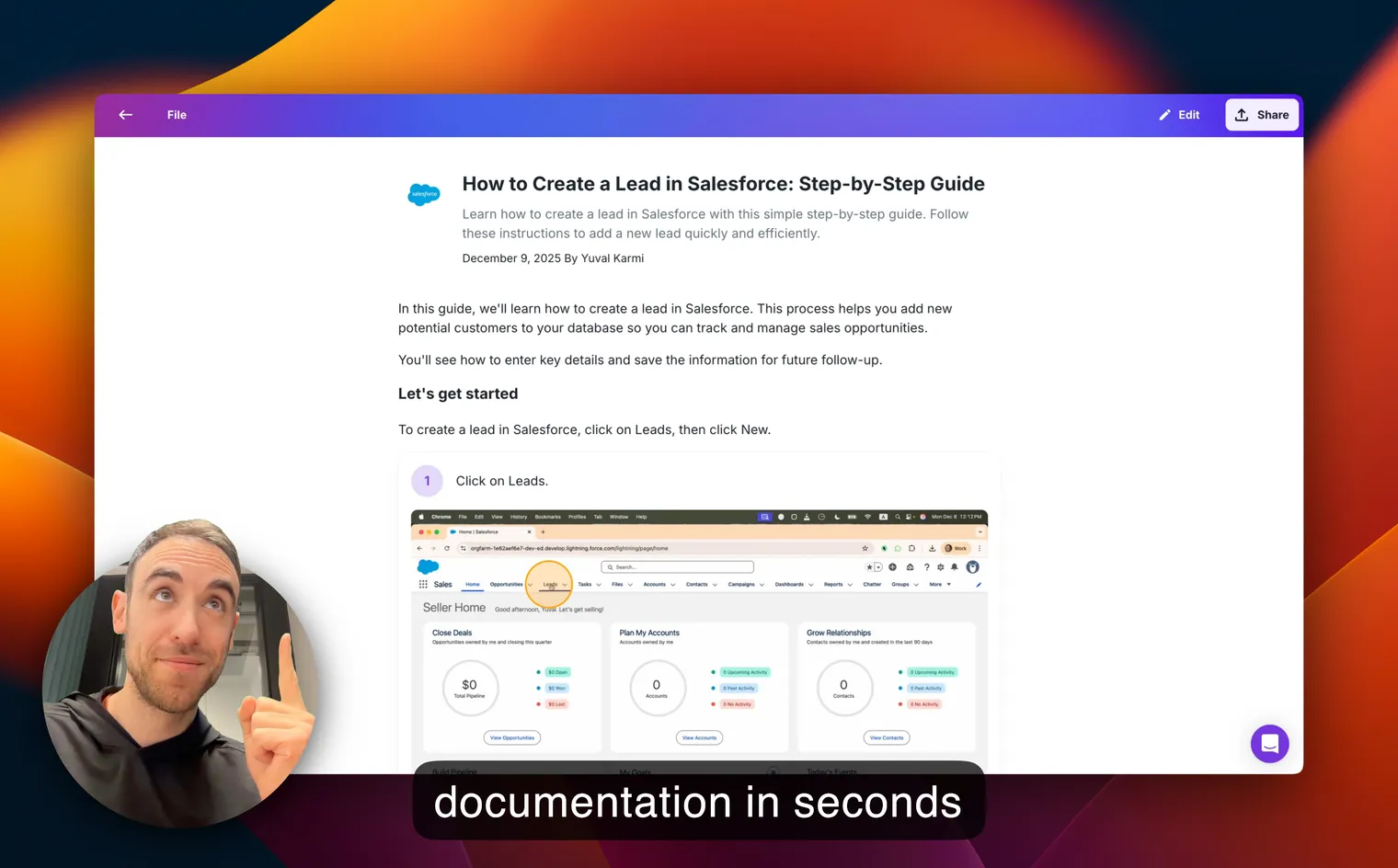
Record your screen while talking through what you’re doing. Glitter captures screenshots automatically at every click and turns your voice into clear, step-by-step documentation. You end up with both a written guide AND the original video.
What sets this apart from Loom? Glitter builds searchable, structured documentation. Your teammates don’t have to sit through a 10-minute video hunting for one detail. They scan the guide, search for what they need, or jump straight to the relevant screenshot.
Key Features
- Desktop and browser capture (both available in free tier)
- Voice narration transcribed in 99 languages
- Magic Article: AI transforms guides into full documentation
- Video-to-guide conversion (upload your existing Loom videos)
- On-device screenshot editing with blur and annotations
- Multiple export formats (PDF, HTML, Markdown, PowerPoint)
- Embed guides anywhere with no viewer fees
- Full-text search across all guides
- Update individual steps without re-recording
Pricing
- Free: 10 guides, 5 min recording time, desktop + web capture, Magic Article
- Pro: $20/month ($16/month annual) - Unlimited guides, 15 min recording time
- Team: $75/month for 5 users ($60/month annual) - 30 min recording time, team collaboration
- Enterprise: Starting at $500/month - SSO, audit trails, custom teams
Pros
- Creates searchable documentation, not just video
- Desktop support in free tier (Loom puts this behind their Business plan)
- Multi-language support (99 languages vs Loom’s 50)
- No viewer fees for embedded guides keeps costs manageable
- Video-to-guide converts existing Loom recordings
- Never trains AI on your data
- Update guides without re-recording everything
- Export to whatever format you need
Cons
- You have to narrate out loud (not ideal in open offices)
- Non-Chromium browsers require desktop app
- No GIF export
- AI voiceover/narration is coming soon (not yet available)
- Sensitive data redaction on paid plans only
- Serves a different purpose than quick async video messages
My Take
Loom excels at quick video messages. But once you need documentation that teams can search, reference, and update over time, video-only solutions fall short. Glitter gives you both: video for visual learners and searchable docs for everyone else.
If you’re using Loom for training materials, SOPs, or product documentation, Glitter’s approach creates guides 11x faster than manual documentation and saves you hours of digging through old recordings. For more on choosing the right documentation approach, see our guide to the best process documentation software.
Your first 10 guides are free - no credit card needed
2. Vidyard - Best for Sales Teams
Best for: Sales and success teams doing video prospecting
How It Works
Record personalized video messages for prospects, see exactly who watches them and for how long, connect everything to your CRM. Vidyard was built specifically for sales outreach, not general team communication.
Key Features
- Screen and camera recording
- Detailed viewer tracking (who watched, how long, which parts)
- CRM integrations (Salesforce, HubSpot)
- Video landing pages
- Personalization at scale
- A/B testing for videos
- AI-powered scriptwriting
- Password-protected videos
Pricing
- Free: Unlimited videos with basic features
- Pro: $29/month per user - Advanced analytics, custom branding
- Business: $99/month per user - CRM integrations, video hubs
- Enterprise: Custom pricing - Advanced security, dedicated support
Pros
- Built specifically for sales workflows
- The viewer analytics are genuinely useful
- CRM integrations that actually work
- Unlimited videos on free tier
- Good for understanding prospect engagement
- Video landing pages tend to convert well
Cons
- Sales-focused features won’t help other teams much
- More expensive than general video tools
- Takes time to learn the advanced features
- Not great for internal documentation
- Per-seat pricing adds up
My Take
If you’re doing sales outreach and need to know exactly who’s watching your videos and how they’re engaging, Vidyard was purpose-built for this. For general team communication or documentation, it’s probably overkill and pricey.
3. Descript - Best for Professional Video Editing
Best for: Teams who need polished, edited video content
How It Works
Record or upload video, then edit it like you’re editing a Word doc. Descript transcribes everything, and you edit the video by editing the transcript. Delete some text, and the corresponding video gets cut. It’s a genuinely clever approach.
Key Features
- Text-based video editing
- AI voice cloning (Overdub)
- Automatic filler word removal
- AI eye contact correction
- Studio-quality audio enhancement
- AI green screen background removal
- Multi-track recording
- Up to 2 screens recorded at once
- Templates and stock media library
Pricing
- Free: 1 hour transcription/month, 720p export, 5GB storage
- Creator: $15/month per user - 10 hours transcription, unlimited Overdub
- Pro: $30/month per user ($24 annually) - 30 hours transcription, 1TB storage
- Enterprise: Custom pricing - SSO, unlimited storage
Pros
- The text-based editing is actually game-changing
- AI features that deliver real value (voice cloning, filler removal)
- Professional-quality output
- Great for podcasts and polished videos
- Multi-track recording for complex projects
- Studio Sound makes rough audio sound clean
Cons
- Steeper learning curve than Loom
- AI credits and media minutes can get used up fast
- Gets expensive for heavy users
- Way more than you need for simple screen recordings
- Takes longer to produce videos than Loom
My Take
Descript is fantastic if you’re creating polished content. But if you just want to quickly share your screen with your team, it’s more tool than you need. The text-based editing works brilliantly for podcasters and content creators, less so for everyday async communication.
Teach your co-workers or customers how to get stuff done – in seconds.
4. Guidde - Best for AI-Narrated Video Guides
Best for: Teams who want AI-generated voiceover videos
How It Works
A Chrome extension or desktop app records your workflow, then AI generates a video with voiceover AND a step-by-step knowledge base article. One recording, two outputs.
Key Features
- Creates video AND text guides at the same time
- AI-generated voiceovers in 25+ languages
- Branded video player with custom themes
- Desktop and browser recording
- Screenshot blur tools for sensitive data
- Workspace libraries for organization
- Embeds for Notion, Confluence, knowledge bases
- Interactive elements in guides
Pricing
- Free: Up to 25 videos total
- Pro: $25/month ($18/month annual) - Unlimited videos, watermark removal
- Business: $55/month ($39/month annual) - Desktop capture, up to 5 creators
- Enterprise: Custom pricing - PII redaction, studio voices, SSO
Pros
- Gets you both video and text from one recording
- The AI voiceovers sound pretty natural
- Desktop capture is available
- Works well for customer-facing docs
- 14-day Business plan trial
Cons
- Free plan tops out at 25 videos total
- Desktop capture requires Business plan ($39/mo annual)
- Less searchable than pure text documentation
- Per-creator pricing for teams
- As one Reddit user noted: “Decent for teams, but let’s be real - UI updates will have you re-recording often”
My Take
Guidde generates AI voiceover videos - useful for customer-facing walkthroughs. If you also need a written step-by-step guide alongside the video, Glitter records both formats from a single recording. Keep in mind that video documentation still has those built-in search and update limitations.
5. Vimeo - Best for High-Quality Video
Best for: Creators and businesses needing polished video content
How It Works
A professional video hosting and creation platform. 4K support, deep playback customization, marketing features. More capable than Loom when you’re serious about video quality.
Key Features
- 4K video quality
- Deep video player customization
- Video marketing analytics
- Webinar capabilities
- Live streaming
- Password protection
- Lead capture forms
- Detailed viewer analytics
- Custom player branding
Pricing
- Free: 10 videos/day, 500MB/week storage, 720p
- Starter: $9/month per user - 5GB/month upload, HD quality
- Standard: $20/month per user - 250GB/year, 4K quality
- Advanced: Custom pricing - Advanced analytics, live events
Pros
- Superior video quality (4K vs Loom’s 1080p max)
- Professional video marketing features
- Great for brand content
- Webinar and live streaming built right in
- Excellent player customization
- Works beautifully embedded on websites
Cons
- Higher tiers get expensive
- Not really designed for quick async communication
- Learning curve for the advanced features
- Less integrated with communication workflows
- Overkill for internal team videos
My Take
Vimeo is for polished, public-facing content. If you’re creating marketing videos, webinars, or customer-facing material, the quality and features justify the cost. For internal team communication, it’s more platform than most people need.
6. ClickUp Clip - Best Free Alternative
Best for: Teams already using ClickUp for project management
How It Works
Screen recording baked directly into ClickUp’s project management platform. Record your screen, get automatic transcription, attach it to tasks or share via link.
Key Features
- Unlimited screen recordings
- No time limits (up to 45 minutes per clip)
- Automatic transcription
- Comment directly on clips
- Create tasks from recordings
- Browser and desktop recording
- Automatic organization in Clip hub
- Share via link or embed
Pricing
- Free: Unlimited Clips included in ClickUp’s free plan
- Unlimited: $7/month per user - Unlimited everything
- Business: $12/month per user - Advanced features
- Enterprise: $19/month per user - White labeling, SSO
Pros
- Completely free with no recording limits
- No 5-minute cap like Loom
- Automatic transcription
- Direct integration with tasks
- Unlimited members on free plan
- No storage limits on recordings
Cons
- Requires ClickUp account
- Not standalone (embedded in project management)
- Guests can’t create Clips
- No webcam-only recording
- No built-in editing tools
- Not as feature-rich as dedicated tools
My Take
If you’re already in ClickUp, Clip is an obvious replacement for Loom’s free tier. Unlimited recordings with no time limits beats Loom’s 5-minute cap every time. As a standalone tool though, it lacks the polish and feature depth of dedicated video platforms.
7. Tango - Best for In-App Guidance
Best for: Teams who need interactive in-app training
How It Works
A browser extension captures your clicks and auto-generates step-by-step guides. The standout feature is Tango Guidance, which overlays visual prompts directly on your actual software.
Key Features
- Screenshot-based guide creation
- Tango Guidance (in-app overlay prompts)
- Browser extension for Chrome, Edge
- Export to PDF, HTML, Markdown
- Integration with Slack, Microsoft Teams
- Analytics to track guide usage (Pro)
- Desktop capture (Pro plan)
Pricing
- Free: Up to 15 workflows, 10 users max
- Pro: $26/month per user ($22/month annual) - Desktop capture, unlimited workflows, branding
- Enterprise: Custom pricing - SSO, SCIM, interactive walkthroughs
Pros
- In-app guidance overlays are genuinely useful
- Clean, intuitive interface
- Good for software onboarding
- Creates text guides, not just video
- Up to 10 users on free plan
Cons
- Desktop capture requires Pro plan ($22-26/mo)
- Steps can feel generic without narration
- Free tier limited to just 15 workflows
- Not video-focused like Loom
- As one G2 reviewer noted: “There is not much option for the user to edit the photo that is captured”
My Take
Tango tackles a different problem than Loom. If you need in-app guidance overlays for software training, it’s excellent at that. But it’s not a direct Loom replacement since video isn’t really its focus.
8. Claap - Best for Meeting Recordings
Best for: Teams who record meetings and need AI summaries
How It Works
Records meetings and screen shares, then uses AI to generate transcripts, summaries, and action items. Built around async feedback on recordings.
Key Features
- Meeting and screen recording
- AI-generated transcripts and notes
- Automatic summaries
- Action item extraction
- Easy feedback collection on videos
- Integration with calendar
- Video annotation and comments
- Topic detection in recordings
Pricing
- Free: 10 videos per user
- Pro: $10/month per user - Unlimited recordings
- Business: Custom pricing - Advanced integrations
Pros
- The AI summaries are actually good
- Great for meeting recordings
- Collaborative feedback features
- More affordable than competitors
- Calendar integrations work well
Cons
- Free tier limited to 10 videos
- Focused on meetings, not general screen recording
- Smaller feature set than Loom
- Newer product with smaller community
My Take
If your main use case is recording meetings and getting AI summaries, Claap handles this better than Loom. For general-purpose screen recording and async communication though, Loom has more going on.
Feature Comparison: Loom vs Top Alternatives
| Feature | Loom | Glitter AI | Vidyard | Descript | Guidde | Vimeo |
|---|---|---|---|---|---|---|
| Free Tier Time Limit | 5 min | 5 min | Unlimited | 1 hr/month | N/A | N/A |
| Free Tier Storage | 25 videos | 10 guides | Unlimited | 5GB | 25 videos | 500MB/week |
| Text Guides | No | Yes | No | No | Yes | No |
| Voice Narration | Yes | Yes (99 langs) | Yes | Yes | AI voiceover (25+ langs) | Yes |
| Transcription | 50+ languages | 99 languages | Yes | Yes | 25+ languages | Limited |
| Desktop Capture | Business plan ($15/mo) | Yes (free) | Yes | Yes | Business plan ($39/mo) | Yes |
| Video Editing | Basic trim | No | Basic | Advanced | Basic | Advanced |
| Search Guides | Transcript only | Full-text search | No | Transcript | Limited | No |
| Export Formats | Video only | PDF, HTML, Markdown, PPT, Video | Video | Video | Video + text | Video |
| AI Features | Business + AI ($20/mo) | Included | Limited | Extensive | Voice generation | Limited |
| Compliance | SOC 2, GDPR, CCPA | SOC 2, GDPR | SOC 2 | SOC 2 | SOC 2 | SOC 2 |
| SSO/SAML | Enterprise only | Enterprise | Enterprise | Enterprise | Enterprise | Enterprise |
| Best Use Case | Async video | Documentation | Sales videos | Professional editing | Video + text guides | Marketing video |
How to Choose the Right Loom Alternative
Here’s a straightforward way to think about it:
Choose Glitter AI if…
- You need searchable documentation, not just video
- Desktop support matters (free tier includes it vs Loom’s Business plan)
- Updating guides without re-recording is important to you
- You work in multiple languages (99 supported vs Loom’s 50)
- You want to create documentation 11x faster than manual methods
- You’re using Chromium browsers. Non-Chromium browsers require desktop app
- Growing team with no viewer fees for embedded guides saves money
Choose Vidyard if…
- You’re on a sales team doing video prospecting
- CRM integration is non-negotiable
- Viewer tracking and analytics drive your workflow
- Budget can handle $29+/month per user
Choose Descript if…
- You need professional video editing
- Text-based editing sounds appealing
- AI features like voice cloning would help
- You’re creating polished content, not quick messages
Choose Guidde if…
- You need both video and text from one recording
- AI voiceovers in multiple languages matter to you
- Customer-facing documentation is a priority
- Your audience prefers video format
Choose Vimeo if…
- Video quality matters (4K)
- You need webinar and live streaming capabilities
- Marketing analytics are important
- Public-facing, branded content is the goal
Choose ClickUp Clip if…
- You already use ClickUp
- Budget is zero
- Unlimited recordings without time limits matter
- Simple integration with tasks would help
Choose Tango if…
- You specifically need in-app guidance overlays
- Text guides matter more than video
- You’re okay with desktop capture on paid plan only
- You can work within the 15-workflow free tier limit
Choose Claap if…
- Meeting recordings are your primary use case
- AI summaries and action items would help
- Collaborative feedback on recordings matters
- You want affordable pricing
Stay with Loom if…
- It’s working well for what you need
- Quick async video messages are your main use case
- You’re comfortable with the pricing and limitations
- Video-only format works for your team
- The limitations aren’t getting in your way
Don’t switch just for the sake of switching. Change tools when they solve an actual problem you’re facing.
Common Questions About Switching from Loom
Can I import my existing Loom videos?
Most Loom alternatives let you upload video files. Glitter AI specifically supports video-to-guide conversion, which takes your existing Loom recordings and turns them into searchable documentation. The easiest approach: keep your existing videos in Loom while creating new content in whatever tool you pick.
How long does it take to learn a new tool?
Most Loom alternatives take 10-15 minutes to figure out. Glitter AI, Vidyard, and ClickUp Clip are particularly easy to pick up. Descript has a steeper learning curve due to all the advanced editing features.
Will I lose features I currently use?
Depends on what you rely on. Loom’s main features (screen recording, sharing, transcription) show up in most alternatives. Some tools add features Loom doesn’t have (searchable documentation, advanced editing, in-app guidance). Take another look at the comparison table above.
What about team migration?
Start with a pilot. Create a few recordings in the new tool, get feedback from your team, then commit fully. Most teams run both tools in parallel for 2-4 weeks during the transition.
Do I need to wait for my Loom subscription to end?
Not necessarily. If Loom’s limitations are costing you real time (teams searching through old videos, re-recording instead of updating), switching mid-contract might actually save money. Calculate the hours spent on workarounds vs the cost of subscription overlap.
What happens if Loom has an outage?
Loom experienced outages in October and November 2025, with some incidents lasting several hours and locking users out of their recordings. Having an alternative tool ready (or using a tool with offline recording capabilities) means your team can keep working during downtime.
Frequently Asked Questions
What is the best free Loom alternative?
ClickUp Clip offers unlimited screen recordings with no time limits, completely free when you use ClickUp's project management platform. Their free plan includes unlimited tasks, members, and Clip recordings with no 5-minute cap like Loom. Glitter AI also offers a generous free tier with 10 guides including desktop support and voice narration. For video-only needs, Vidyard's free tier provides unlimited videos with basic features.
How is Glitter AI different from Loom?
Loom creates videos for async communication. Glitter AI creates searchable, step-by-step documentation PLUS video. When you record with Glitter, it captures screenshots at every click and transcribes your narration into structured guides. This means teammates can search for specific steps, copy-paste instructions, and update individual sections without re-recording. Loom requires watching entire videos to find information. Glitter also supports 99 languages vs Loom's 50, includes desktop recording in the free tier, and never trains AI on your data.
Which Loom alternative is best for sales teams?
Vidyard is purpose-built for sales teams. It offers advanced viewer tracking (who watched, for how long), direct CRM integrations with Salesforce and HubSpot, personalized video landing pages, and AI-powered scriptwriting. While Loom works for sales, Vidyard's analytics and sales-specific features provide more value for prospecting and outreach workflows. The free tier includes unlimited videos, with paid plans starting at $29/month for advanced features.
Can I use Loom alternatives without paying monthly subscriptions?
Yes. ClickUp Clip is completely free with unlimited recordings when you use ClickUp (which also has a free tier). Vidyard's free tier provides unlimited videos with basic features. Glitter AI offers 10 free guides with full features including desktop recording. If you already pay for project management software like ClickUp, the screen recording capability comes at no additional cost, saving you $15-20/month compared to Loom's paid plans.
What's the best Loom alternative for creating documentation?
Glitter AI is specifically designed for creating documentation that teams can search and reference long-term. Unlike Loom's video-only approach, Glitter creates searchable text guides with screenshots AND preserves the video. You can update individual steps without re-recording, export to multiple formats (PDF, Markdown, HTML, PowerPoint), and search across all guides. Guidde also creates both video and text, though with less focus on searchability and editing flexibility.
Can I switch from Loom without losing my existing videos?
Yes. Most alternatives allow you to upload existing video files. Glitter AI offers video-to-guide conversion, which transforms your Loom recordings into searchable documentation automatically. The recommended approach: keep existing Loom videos accessible while creating new content in your chosen alternative. Gradually convert high-priority recordings as needed. Since many alternatives offer free tiers, you can test before fully committing.
Which Loom alternative has the best video quality?
Vimeo offers the highest video quality with 4K support, compared to Loom's 1080p maximum. Vimeo is designed for professional video content, marketing videos, and webinars where quality matters. However, for internal team communication and quick screen recordings, Loom's quality is typically sufficient. Choose Vimeo if you're creating public-facing content or need broadcast-quality video. For documentation purposes, video quality matters less than searchability and structure.
Our Verdict
I built Glitter AI, so take this recommendation with the appropriate grain of salt.
Here’s the honest truth: The best tool depends on what you’re actually trying to do.
Loom works for plenty of teams. If it’s solving your problems and the limitations aren’t bothering you, keep using it.
But if you’re reading this, you’re probably hitting one of Loom’s walls. The 5-minute limit. Video-only format making documentation impossible to search. Storage caps. Reliability headaches.
For teams who need documentation, not just video messages, Glitter AI is the best alternative because:
- Creates searchable, structured documentation AND preserves video
- Desktop support in free tier (Loom puts this behind their $15/month Business plan)
- 99-language support vs Loom’s 50
- Update guides without re-recording everything
- Full-text search across all documentation
- Never trains AI on your data
- Creates guides 11x faster than manual documentation
Vidyard wins for sales teams who need advanced viewer tracking and CRM integrations.
Descript is best for professional video creators who need advanced editing and polished output.
ClickUp Clip is the best free alternative with unlimited recordings and no time limits.
Vimeo wins for marketing teams who need 4K quality, webinars, and professional video hosting.
The right tool removes friction instead of adding to it. Glitter’s free tier (10 guides, no credit card required) lets you test whether documentation-focused recording works for you in about 15 minutes.
Try it on a real project, not a throwaway example. See if your team actually uses the searchable guides. Check if creating guides 11x faster and updating one step beats re-recording entire videos.
Start for free: www.glitter.io
Your first 10 guides are free - see why teams are switching from Loom