
Read summarized version with
I’ve seen it happen dozens of times. A company spends weeks creating detailed standard operating procedures. Beautiful documents with every step meticulously outlined. They distribute them to the team with great fanfare.
And then? Nobody uses them.
The SOPs sit in a shared drive, gathering digital dust while employees continue doing things “their way.” Sound familiar?
I’m Yuval, founder and CEO of Glitter AI. Before building Glitter, I ran a company called Simpo where I learned this lesson the hard way. I created SOPs that I thought were perfect - comprehensive, detailed, covering every edge case. Yet my team barely glanced at them.
Here’s what I figured out: the problem isn’t that employees don’t want to follow SOPs. It’s that most SOPs are created for auditors, not actual humans.
Let me show you how to create SOPs that your team will actually use, the same approach I cover in our complete guide to SOPs that get used. For ready-made formats to get started quickly, check out our collection of ready-to-use SOP templates.
Teach your co-workers or customers how to get stuff done – in seconds.

Why Most SOPs Fail (And It’s Not Your Team’s Fault)
Before I dive into solutions, let me be honest about why traditional SOPs don’t work.
They’re Written by the Wrong People
When leadership writes SOPs in isolation, they miss what’s actually happening on the ground. I used to sit in my office documenting processes I thought I understood. Turns out, my team had developed workarounds and shortcuts I never knew about.
The people doing the work every day know the real process. They know the gotchas, the exceptions, and the things that actually trip people up.
They’re Too Long and Dense
I once inherited an SOP that was 47 pages long. Forty-seven pages! For a process that took 20 minutes to complete. Nobody read past page three.
If your SOP looks like a legal document, people will treat it like one - they’ll sign it without reading it.
They’re Hard to Find
Even great SOPs are useless if no one can find them. I’ve worked with companies where process docs were scattered across PDFs, Word files, SharePoint, and random Google Drives. Employees spent more time hunting for documentation than actually following it.
They Go Stale
Here’s something that drove me crazy: outdated SOPs that nobody updated. The process changed six months ago, but the documentation still described the old way. Now employees have a choice - follow the outdated SOP or do it the “right” way that’s undocumented.
The Framework for SOPs People Actually Follow
After years of trial and error, I developed a framework that actually works. It’s not complicated, but it requires thinking differently about documentation.
1. Start With the People Doing the Work
This is non-negotiable. Before you write a single word, sit down with the employees who perform the process daily.
Ask them:
- How do you actually do this task? (Not how you’re supposed to - how you really do it)
- What parts are confusing or frustrating?
- Where do things typically go wrong?
- What do you wish you’d known when you started?
I’ve found that 30 minutes with a frontline employee reveals more than weeks of observing from the outside. If you want a repeatable structure for those conversations, walking through how to interview a subject matter expert step by step makes it far less awkward than winging it.
2. Write for Someone Who’s Never Done This Before
Imagine someone walked in off the street and needed to complete this process, which is really an exercise in setting the SOP scope clearly. What would they need to know?
Practical tips:
- Use simple, everyday language (no acronyms without explanation)
- Write in active voice: “Click the submit button” not “The submit button should be clicked”
- Keep sentences short - one action per step
- Include the “why” for steps that might seem arbitrary
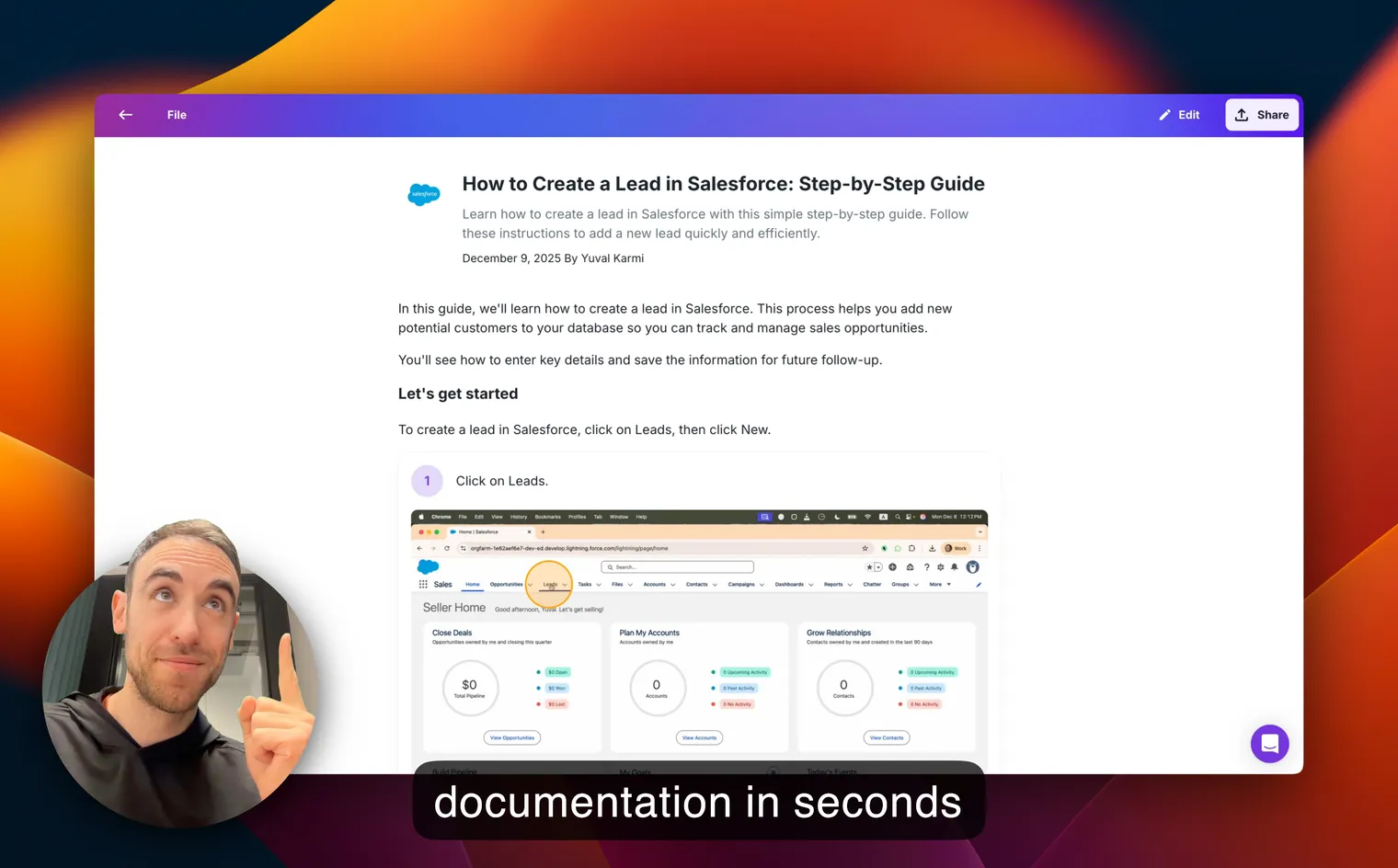
Record yourself doing the process once, and Glitter AI writes the SOP for you - with screenshots.
3. Make It Visual
Here’s something I’ve learned: people remember images better than text. A screenshot showing exactly where to click beats a paragraph explaining the same thing, a principle our step-by-step guide to writing an SOP leans on heavily.
When I started including visuals in my SOPs, adoption went up dramatically, which is exactly the case for visual SOPs over text-only documentation. Employees could quickly scan for the relevant screenshot instead of reading through blocks of text, and for complex procedures a video SOP works even better.
Types of visuals that work:
- Screenshots with annotations (arrows, highlights, numbered steps)
- Short video clips for complex procedures
- Flowcharts for decision trees
- Before/after examples
This is actually why I built Glitter AI. I wanted a way to create visual SOPs without the hassle of manually capturing screenshots and writing everything out. Now I just record myself doing the process, and the tool creates the documentation automatically.
4. Choose the Right Format
Not every process needs the same format. Match the complexity of the format to the complexity of the task.
Simple steps format works for routine, straightforward procedures:
- Step 1: Do this
- Step 2: Then this
- Step 3: Finally this
Hierarchical format works when you have main steps with sub-steps:
- Log into the system
- Navigate to login page
- Enter credentials
- Complete two-factor authentication
Flowchart format works when decisions lead to different paths:
- If X happens, do Y
- If Z happens, do W
I’ve found that most SOPs should be in simple steps format. If you need a flowchart, you might actually need multiple simpler SOPs.
5. Make Accessibility a Priority
Your SOP needs to be findable in under 30 seconds. If it takes longer than that, people will just wing it.
What works:
- Centralized location (one system, not five)
- Clear naming conventions
- Good search functionality
- Mobile access for field teams
- Quick access from the tools people already use
Check out our standard operating procedures guide for more on organizing your SOP library.
Getting Your Team to Actually Use SOPs
Creating good SOPs is only half the battle. You also need to get your team on board.
Make It Policy (But Don’t Be a Jerk About It)
Here’s the reality: if following SOPs is optional, many people won’t do it. You need to make adherence expected - not as a gotcha, but as a professional standard.
Frame it positively: “Following our documented processes ensures consistency and protects everyone from mistakes.”
Train in a No-Risk Environment
When you introduce new SOPs, run training sessions where people can practice without fear of screwing up. Our guide on SOP training covers how to structure these sessions effectively. I’ve seen too many companies just email out new documentation and expect compliance.
Let people ask questions. Let them point out where the SOP is confusing. This isn’t just good training - it’s also valuable feedback.
Start With Quick Wins
Don’t try to document every process at once. Start with:
- High-frequency tasks that vary person to person
- Processes where mistakes are costly
- Tasks that new hires always struggle with
Get wins with these first. When people see that SOPs actually help them, they’ll be more receptive to additional documentation.
Teach your co-workers or customers how to get stuff done – in seconds.
Keeping SOPs Current (The Part Everyone Forgets)
Creating SOPs is a one-time effort. Maintaining them is forever.
Build in Review Cycles
Every SOP should have an owner and a review date. Quarterly reviews work well for most processes - enough to catch changes without being burdensome.
Make Updates Easy
If updating an SOP requires opening Word, editing, exporting to PDF, uploading somewhere, and notifying everyone… it won’t happen. Make the update process as frictionless as possible.
Encourage Feedback
Your team should feel empowered to flag when an SOP is wrong or unclear. Create a simple way for people to say “hey, step 3 doesn’t work anymore.”
I built a feedback loop into our documentation at Glitter. When someone spots an issue, they can flag it instantly. Then we can re-record that section and update the SOP in minutes.
Real Results: What Good SOPs Actually Achieve
When you get SOPs right, the impact is significant:
- Faster onboarding: New hires become productive in days, not weeks
- Consistent quality: Everyone does things the same (right) way
- Fewer mistakes: Clear instructions reduce errors
- Knowledge preservation: When someone leaves, their knowledge stays
- Scalability: You can grow without chaos
I’ve seen companies reduce training time by 50% simply by improving their SOPs. That’s not magic - that’s the power of clear, usable documentation.
The Bottom Line
Creating SOPs that employees actually follow isn’t about being stricter or more detailed. It’s about being more human.
Write SOPs for the people who will use them. Make them findable, visual, and easy to follow. Update them regularly. And involve your team in the process.
If you’re spending hours creating documentation that nobody uses, something needs to change. Start with one process, apply these principles, and see what happens.
You might be surprised how much your team actually wants good documentation - they just haven’t had it before.
Want to create SOPs faster? Glitter AI turns screen recordings into step-by-step guides with screenshots. Record once, get documentation automatically. Try it free.
Frequently Asked Questions
How long should an SOP be?
Most effective SOPs are 1-3 pages. If your SOP is longer than 5 pages, consider breaking it into multiple smaller SOPs. The goal is quick reference, not comprehensive documentation.
How often should SOPs be updated?
Review SOPs quarterly at minimum, and update immediately when processes change. Outdated SOPs are worse than no SOPs because they create confusion and distrust.
Who should write SOPs?
The people who actually perform the process should be heavily involved in creating the SOP. They know the real workflow, common problems, and practical workarounds that management often misses.
How do I get employees to follow SOPs?
Make SOPs easy to find and use, involve employees in creating them, train in low-pressure environments, and make compliance a clear expectation. Most resistance comes from poorly written or hard-to-access documentation.
What's the best format for SOPs?
Visual SOPs with screenshots and short steps work best for most processes. Use simple bullet points for straightforward tasks and flowcharts only when decisions lead to different paths.
Should SOPs include screenshots?
Yes. Visual SOPs are significantly more effective than text-only documentation. Screenshots with annotations help employees quickly identify where to click and what to look for.