
Read summarized version with
I still remember the moment I realized our SOPs were useless.
We’d spent three months documenting every critical process at Simpo. Beautiful step-by-step guides with screenshots. Clear instructions. The whole nine yards. I felt pretty proud of what we’d built.
Then six months later, a new hire asked me why the documentation didn’t match what was actually happening in the system. I pulled up one of our flagship SOPs and… she was right. It was completely outdated.
The process had changed. The software interface had updated. Half the screenshots showed buttons that no longer existed. And nobody - including me - had bothered to update the documentation.
I’m Yuval, founder and CEO of Glitter AI. Before building Glitter, I learned the hard way that creating SOPs is only 20% of the battle. The other 80%? Keeping them current.
Here’s the thing that shocked me: companies spend thousands of dollars and hundreds of hours creating SOPs, then let them rot within months. Outdated documentation is worse than no documentation at all because it destroys trust in your entire system, which is why creating SOPs employees actually follow matters just as much as the maintenance work I cover below.
Let me show you how to actually manage SOPs so they stay useful - not just when you create them, but months and years down the line. For a deeper look at why this problem is so common, read our article on keeping process documentation updated.
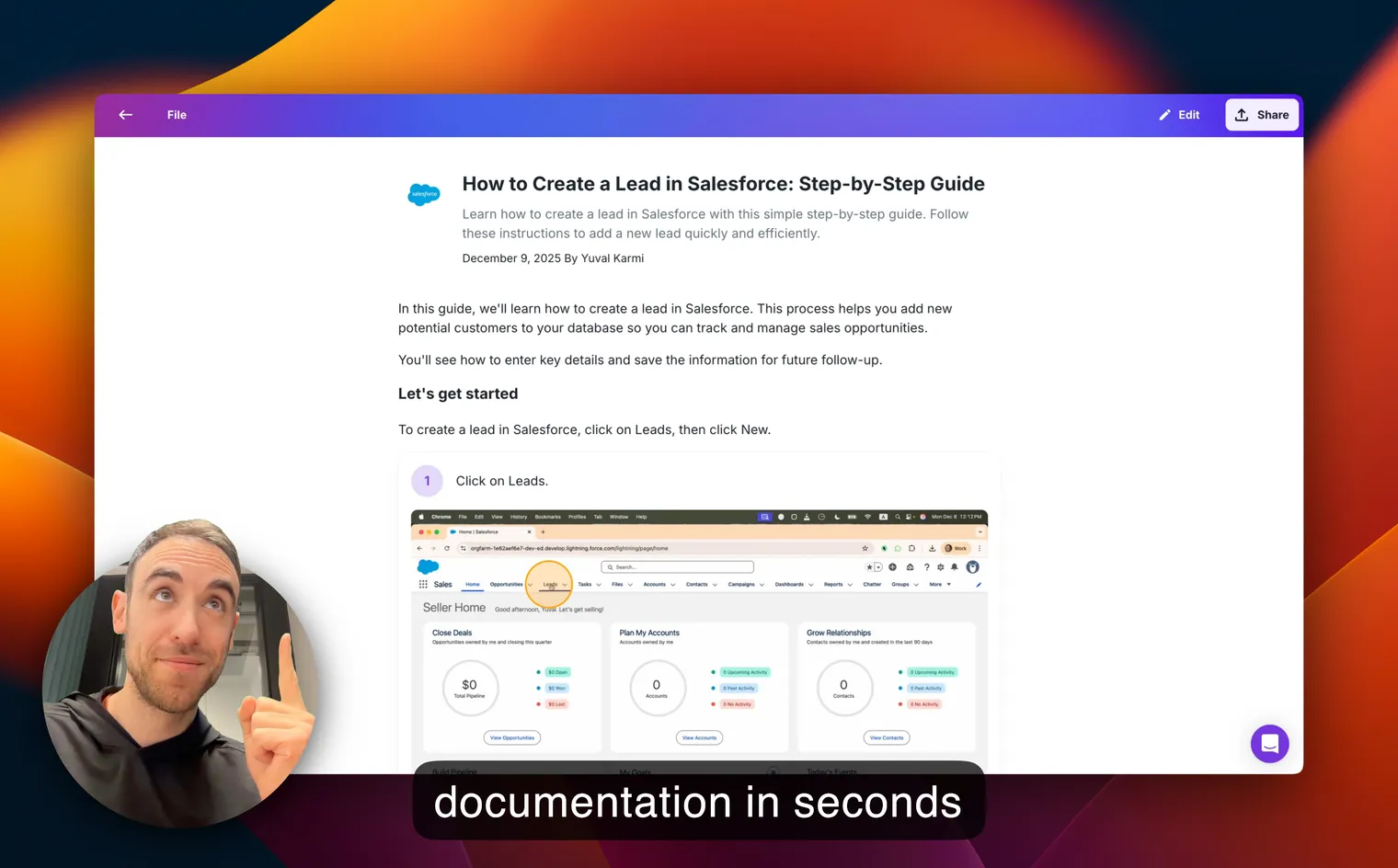
Teach your co-workers or customers how to get stuff done – in seconds.

Why SOPs Go Stale (And Why It Matters)
Before I get into solutions, let me be honest about why this happens to everyone - including companies that should know better.
Nobody Owns the Documentation
This was my biggest mistake at Simpo. We created SOPs as a team project, which sounds collaborative and great. But when something needs updating, who’s responsible? Everyone and no one.
When everyone owns something, nobody owns it.
I’ve watched this pattern repeat across dozens of companies. A process changes on Tuesday. Someone thinks “I should update the SOP” but assumes someone else will do it. Three months later, the documentation is still wrong.
Updating Feels Like Busywork
Here’s what I used to think: “The process is only slightly different. People will figure it out.”
That’s how you end up with death by a thousand cuts. Each small change seems too minor to justify updating documentation. But after ten small changes? Your SOP describes a process that barely resembles reality.
The truth is, updating documentation feels less urgent than shipping features, closing deals, or putting out fires. So it gets pushed to “someday.”
The Tools Make It Too Hard
Let me tell you about the worst documentation update process I ever experienced.
To update a single SOP, I had to:
- Open a Word document
- Take new screenshots
- Crop and annotate them
- Copy-paste into the document (breaking formatting every time)
- Export to PDF
- Upload to SharePoint
- Update the link in our wiki
- Notify everyone via email
Twenty-five minutes for what should have taken three. After doing that once, I stopped updating docs entirely.
If your update process is painful, it won’t happen.
Nobody Knows Documentation Is Wrong
This one’s insidious. You can’t fix what you don’t know is broken.
At Simpo, we’d sometimes go months without realizing an SOP was outdated because the people using it were experienced enough to work around the discrepancies. Only when we onboarded someone new did we discover the problem.
By then, they’d already lost trust in our documentation system.
Re-record the changed section and Glitter AI updates your documentation automatically with fresh screenshots.
The SOP Management Framework That Actually Works
After years of trial and error (mostly error), I built a framework for SOP management that keeps documentation current without consuming your entire team’s time.
Here’s what works.
1. Assign Clear Ownership
Every single SOP needs an owner. Not a department. Not a team. A specific person who is responsible for keeping it current.
How I do this:
- The person who performs the process most frequently owns its documentation
- If multiple people do it, the most senior person owns it
- Ownership is documented right in the SOP header
Example SOP header:
- Process Name: Monthly Financial Close
- Owner: Sarah Chen, Controller
- Last Reviewed: December 15, 2026
- Next Review Date: March 15, 2027
When I implemented this at Simpo, accountability improved immediately. Sarah knows that if the monthly close process changes, she’s responsible for updating the doc. No ambiguity.
2. Build Review Schedules Into Your Calendar
Here’s a rule I learned from one of the best operations managers I know, and it’s the same logic behind a recurring performance review SOP: If it’s not on your calendar, it won’t happen.
Quarterly reviews work for most SOPs, though the right cadence depends on how often you should review SOPs for that specific process. Set up recurring calendar invites for each process owner to review their documentation.
What a review involves:
- Walk through the SOP while performing the actual process
- Check if screenshots match current interfaces
- Verify every step is still accurate
- Note any workarounds that have developed
- Update immediately if anything has changed
Takes about 15 minutes per SOP. Do this quarterly, and you’ll never have documentation drift six months out of date.
3. Trigger Updates on Process Changes
Reviews catch gradual drift. But what about when something changes right now?
I implemented a simple rule: If you change a process, you update the documentation before the change goes live. Not after. Before.
This became part of our definition of “done” for any project:
- Code deployed? ✓
- Tests passing? ✓
- Documentation updated? ✓
If the SOP isn’t current, the project isn’t finished. For guidance on writing SOPs that are worth maintaining in the first place, see our complete guide to building SOPs.
Pro tip: Make this a required field in your project management system. At Simpo, we couldn’t close a ticket in Jira without checking the “documentation updated” box.
4. Make Feedback Easy
Your team knows when documentation is wrong. The question is: do they have an easy way to tell you?
I’ve seen companies with elaborate “documentation feedback processes” that require filling out forms and sending emails. Nobody uses them.
What actually works:
- A “Report an issue” button right on the SOP
- A Slack channel dedicated to doc feedback
- Monthly team check-ins where people can flag problems
- Making it okay to say “this doc is wrong”
At Glitter AI, we built feedback right into our documentation viewer. See something wrong? One click to flag it. The owner gets notified immediately.
Teach your co-workers or customers how to get stuff done – in seconds.
Version Control for Documentation (Without the Complexity)
Here’s something most companies get wrong: they treat SOPs like static documents instead of living resources.
You need version control, but it doesn’t have to be complicated.
The Three-Level System
I use a simple three-level system for tracking SOP versions:
Level 1: Minor updates (typo fixes, clarifications, formatting)
- Update the doc
- Note the change in a revision log
- Don’t change the version number
Level 2: Moderate updates (new steps, process tweaks, updated screenshots)
- Increment the minor version (1.1 → 1.2)
- Document what changed
- Notify people who use this SOP regularly
Level 3: Major overhauls (process fundamentally changed)
- Increment the major version (1.x → 2.0)
- Document extensively what changed and why
- Hold a training session for everyone affected
- Keep the old version archived for reference
The Revision Log
Every SOP should have a simple revision log at the bottom:
Revision History:
- v2.1 - Dec 18, 2026: Updated screenshots for new dashboard interface (sections 3-5)
- v2.0 - Oct 3, 2026: Complete rewrite for new CRM system
- v1.4 - Aug 15, 2026: Added troubleshooting section for common errors
- v1.3 - June 22, 2026: Clarified approval workflow in step 7
This takes 30 seconds to update but provides crucial context for anyone reviewing the documentation.
Archive Old Versions
Don’t delete old versions. Archive them.
Why? Because sometimes you need to reference how you used to do things. Maybe a client is still on an older version of your product. Maybe you need to understand when and why a change was made.
I keep archived versions in a dedicated folder, clearly labeled with dates and version numbers. They’re not front and center, but they’re accessible if needed.
Change Management: Getting Your Team On Board
Documentation is only valuable if people actually use it. And people won’t use documentation they don’t trust.
Here’s how to build - and maintain - that trust.
Communicate Changes Clearly
When you update an SOP, don’t just silently change the doc and hope people notice. That’s how you end up with half your team following the old process and half following the new one.
My notification template:
📢 SOP Update: [Process Name]
What changed: [Brief description]Why it changed: [Context]What you need to do: [Action items]Questions? Ask [Owner name]
Updated SOP: [link]
Send this to everyone affected by the change. Post it in relevant Slack channels. Make it impossible to miss.
Train on Significant Changes
For major updates (version 2.0+), don’t just send a notification. Hold a training session.
This doesn’t have to be formal. A 15-minute Zoom call where you walk through what changed and answer questions is enough.
I’ve found that people are much more likely to adopt changes when they understand the “why” behind them. Use training as an opportunity to explain the reasoning.
Make the Old Way Impossible
This sounds harsh, but it works.
If your process changed because the software updated, great - the old way is already impossible. But what about process changes that are policy-based?
Examples:
- Remove access to tools that represent the old process
- Update forms to reflect the new workflow
- Set up automated reminders about the new process
- Make approval conditional on following the new documented process
At Simpo, when we updated our invoice approval process, I removed the old approval form entirely. People couldn’t follow the old process even if they wanted to. Forced everyone to learn the new way.
Celebrate Good Documentation Practices
Recognition matters. When someone keeps their SOPs pristine, acknowledge it publicly.
I started a monthly “Documentation Champion” award at Simpo. Winner got a $50 gift card and a shoutout in our all-hands meeting. Silly? Maybe. But it worked.
People started taking pride in their documentation. Updating SOPs became something you bragged about, not something you avoided.
Tools and Systems for SOP Management
Let me save you some time by sharing what actually works - and what’s a waste of money.
What Doesn’t Work
I’ve tried them all. Here’s what I don’t recommend:
Static documents (Word, PDF):
- Hard to update
- No version history
- Can’t track who read what
- Screenshots break constantly
Over-engineered solutions:
- Complex knowledge management systems with 47 features you’ll never use
- Tools that require training just to update a doc
- Anything that takes more than 3 clicks to update
Email-based distribution:
- No way to know if people read it
- Old versions floating around
- Updates get lost in inboxes
What Does Work
The best documentation systems are simple, accessible, and easy to update.
For creating SOPs: This is why I built Glitter AI. Record yourself doing the process while narrating. The tool captures screenshots and generates the documentation. When something changes, re-record just that section. Update takes 5 minutes instead of 30.
For organizing SOPs: Notion, Confluence, or any searchable wiki works great. Key features you need:
- Good search functionality
- Clear hierarchy and organization
- Version history built-in
- Easy to update (web-based, no special software)
- Mobile accessible
For tracking changes: A simple spreadsheet works fine:
- SOP name
- Owner
- Last review date
- Next review date
- Status (current/needs update/in progress)
I review this spreadsheet in our weekly ops meeting. Takes five minutes. Keeps everything on track.
The Integration That Changed Everything
Here’s what made the biggest difference for us: integrating documentation into our existing workflows.
Instead of making documentation a separate system, we embedded it everywhere:
- Links to relevant SOPs in our project management tool
- Documentation references in our CRM for customer-facing processes
- SOP links in Slack channel descriptions
- Quick access shortcuts in the tools people use daily
When documentation lives where people already work, they actually use it.
Keep your documentation current without the hassle. Update SOPs in minutes with Glitter AI.
The Monthly SOP Management Checklist
Want a practical framework? Here’s what I do every month to keep our SOPs current.
Week 1: Review the Tracker
Check the SOP tracking spreadsheet:
- What’s due for quarterly review this month?
- What’s been flagged by the team as needing updates?
- What’s been sitting in “in progress” too long?
Assign or follow up on anything that needs attention.
Week 2: Spot Check High-Use SOPs
Pick 3-5 SOPs that get used most frequently. Actually walk through them while performing the process. Are they still accurate?
These are your highest-risk docs because any inaccuracies affect the most people. Keep them pristine.
Week 3: Process Feedback
Review all documentation feedback from the past month:
- Which SOPs were flagged as incorrect?
- What questions came up repeatedly?
- What new processes need documentation?
Act on this feedback. People stop reporting issues if they see nothing happens.
Week 4: Look Ahead
Check your product roadmap, upcoming changes, and planned initiatives. What documentation will need updating in the next 1-3 months?
Give owners a heads-up: “Hey Sarah, we’re launching the new dashboard in February. Flag a few hours to update the relevant SOPs before launch.”
Proactive beats reactive every time.
Getting Leadership Buy-In
Let’s be real: SOP management takes time and resources. If leadership doesn’t support it, it won’t happen consistently.
Here’s how I convinced skeptical executives that this matters.
Speak Their Language: Show the ROI
Executives care about money and risk. Give them numbers:
Cost of outdated SOPs:
- Extended onboarding time (calculate the hourly cost)
- Repeated training and explanations
- Errors from following wrong procedures
- Compliance risks in regulated industries
- Lost productivity from hunting for correct information
ROI of good SOP management:
- Faster onboarding (50-70% reduction in time-to-productivity)
- Fewer errors (measurable in rework costs)
- Reduced compliance risk (quantify potential fines)
- Scalability (can grow without chaos)
I calculated that outdated documentation was costing Simpo about $85,000 per year in lost productivity and errors. Spending $15,000 on better documentation management was an easy sell.
Start Small, Show Results
Don’t ask for budget to overhaul everything at once. Start with a pilot.
Pick one critical process. Implement proper SOP management for just that one thing. Track the results:
- How much time did it save?
- How many questions decreased?
- What errors were eliminated?
Use those results to justify expanding the program.
Make It Someone’s Job
The biggest mistake I see: making SOP management “everyone’s responsibility” without giving anyone dedicated time.
You don’t need a full-time documentation manager (though that’s nice if you can afford it). But you need someone who has “maintain documentation system” as an explicit part of their role.
At Simpo, this was 20% of our operations manager’s time. She owned the tracking spreadsheet, followed up on overdue reviews, and kept the system running.
Without that explicit ownership, documentation management dies within three months. Guaranteed.
Common Pitfalls and How to Avoid Them
I’ve made every mistake possible with SOP management. Learn from my pain.
Pitfall 1: Perfectionism
I used to think SOPs needed to be perfect before publishing. Cover every edge case. Answer every possible question. Look gorgeous.
Result: Nothing ever got published.
The fix: Done is better than perfect. Publish a 70% version and improve it based on real user feedback. You’ll create better documentation faster.
Pitfall 2: Over-Complicating the Process
Early on, I built an elaborate documentation approval workflow. Changes needed review by three people, then final approval from me.
Result: Updates took weeks. People stopped trying.
The fix: Trust your process owners. If Sarah owns the financial close SOP, she can update it without my approval. I review it in the quarterly check, not on every tiny change.
Pitfall 3: Ignoring User Feedback
When people told me documentation was wrong, I’d sometimes think “well, they’re just doing it the old way” or “they must have misunderstood.”
Result: My documentation became divorced from reality.
The fix: When someone says an SOP is wrong, assume they’re right until proven otherwise. Investigate immediately.
Pitfall 4: Letting SOPs Live in Silos
Different departments creating documentation in different formats, different tools, different standards.
Result: Chaos. Nobody could find anything.
The fix: One system for all SOPs. One format standard. One tracking mechanism. Consistency matters more than having the “perfect” tool.
Pitfall 5: No Consequences for Outdated Docs
If there’s no penalty for letting documentation go stale, it will go stale.
The fix: Make SOP maintenance part of performance reviews. If you own a critical process and its documentation is six months out of date, that’s a problem worth discussing.
Real-World Example: The Monthly Close
Let me show you what good SOP management looks like in practice.
The Process: Our monthly financial close at Simpo
The Owner: Sarah Chen, Controller
How we managed it:
Initial creation (October 2023):
- Sarah recorded herself doing the entire monthly close while explaining each step
- Used Glitter AI to generate the documentation with screenshots
- Added a troubleshooting section for common issues
- Published as version 1.0
Quarterly reviews:
- January 2024: No changes needed
- April 2024: Updated section 7 (new bank reconciliation tool)
- July 2024: Added clarification to step 12 based on team feedback
- October 2024: Major update (v2.0) when we switched accounting systems
Change management:
- When we switched accounting systems, Sarah scheduled a 30-minute training session
- Walked the team through the new process before go-live
- Old version archived as “Monthly Close v1.0 (Legacy - pre-Oct 2024)”
- Sent team notification with summary of changes
Ongoing maintenance:
- Sarah reviews the doc every quarter on her calendar
- Team can flag issues via a Slack channel
- Sarah updates within 48 hours of any process change
- Takes her about 10 minutes per month on average
Results:
- Zero confusion during leadership transitions
- New team members can close the month with minimal supervision
- Audit trail for compliance (important for us)
- Process has been running smoothly for 2+ years
This is what sustainable SOP management looks like. Not perfect, but consistent and effective.
The Long-Term View
Here’s what I’ve learned about SOP management after doing it for years: it’s not about documentation. It’s about building a learning organization.
Companies with great documentation systems aren’t just more efficient. They’re more adaptable. They can:
- Scale faster: New people come up to speed quickly
- Pivot more easily: When strategy changes, everyone knows how to execute the new way
- Preserve knowledge: People can leave without taking critical information with them
- Maintain quality: Everyone does things the right way, consistently
- Stay compliant: Clear processes mean clear audit trails
The companies that win long-term are the ones that can learn and adapt quickly. Documentation is how you institutionalize that learning.
Your Next Steps
Don’t let this be another article you read and forget about.
Here’s what to do this week:
Day 1: Audit your current state
- How many SOPs do you have?
- When were they last updated?
- Who owns each one?
Day 2: Pick your 5 most critical SOPs
- These are high-use processes where mistakes are costly
- Assign or confirm owners
- Schedule quarterly reviews
Day 3: Create your tracking system
- Start with a simple spreadsheet
- List all SOPs, owners, review dates
- Set up calendar reminders
Day 4: Fix your worst offender
- Update the most outdated SOP
- Use this as practice for your new workflow
- Time how long it takes (probably less than you think)
Day 5: Share the plan
- Get leadership buy-in
- Communicate to SOP owners what you’re doing
- Set expectations for ongoing maintenance
That’s it. Don’t try to fix everything at once. Build the system, then expand it gradually.
The best time to start managing your SOPs properly was when you created them. The second best time is right now.
Ready to make SOP updates painless? Glitter AI lets you update documentation by simply re-recording the changed section. No manual screenshots, no reformatting. Try it free.
Frequently Asked Questions
How often should SOPs be reviewed and updated?
Review critical SOPs quarterly and standard SOPs annually at minimum. However, update immediately when processes change - don't wait for the scheduled review. Set calendar reminders for reviews and assign specific owners to ensure accountability.
Who should be responsible for maintaining SOPs?
Each SOP needs a specific owner - the person who performs the process most frequently or the most senior person on that process. Avoid assigning ownership to teams or departments. Clear individual accountability is essential for keeping documentation current.
What is SOP version control and why does it matter?
SOP version control tracks changes to documentation over time. Use a simple system: minor updates for typos, moderate updates (version 1.1→1.2) for process changes, and major versions (2.0) for complete overhauls. Keep a revision log and archive old versions for reference and compliance.
How do I know when an SOP needs updating?
Update SOPs when: the process changes, software interfaces update, team members report inaccuracies, new steps are added or removed, or during quarterly reviews. Make it easy for your team to flag issues by adding a simple feedback mechanism right in the documentation.
What's the best way to communicate SOP changes to the team?
For minor changes, update the revision log and notify relevant team members via email or Slack. For moderate changes, send a structured notification explaining what changed and why. For major updates, hold a training session to walk through changes and answer questions before the new process goes live.
How can I make updating SOPs less time-consuming?
Use tools that make updates easy - avoid static Word docs and PDFs. Modern documentation tools like Glitter AI let you re-record just the changed section instead of manually updating screenshots and text. Choose systems with version history built-in and web-based editing that requires no special software.
Should I keep old versions of SOPs after updating them?
Yes, archive old versions rather than deleting them. You may need to reference previous processes for compliance audits, clients on older system versions, or understanding when and why changes were made. Keep archived versions clearly labeled with dates and version numbers in a separate folder.
How do I get leadership buy-in for SOP management?
Show ROI with concrete numbers: calculate costs of outdated SOPs (extended onboarding, errors, compliance risks) versus investment in proper management. Start with a pilot on one critical process, demonstrate results, then expand. Request dedicated time for someone to own the documentation system - making it everyone's job means it's nobody's job.