
Read summarized version with
I’m going to be brutally honest with you: most documentation is already outdated by the time it’s published.
I’ve seen this pattern play out dozens of times. Someone spends hours creating a detailed process guide. They celebrate the completion. Then three weeks later, the product team ships an update. The button moved. The workflow changed. And that beautiful documentation? Instantly obsolete.
Here’s what I’ve learned after building documentation tools for years: the problem isn’t that people don’t care about keeping docs updated. The problem is that we’ve built documentation systems that make updates unreasonably hard.
I’m Yuval, founder of Glitter AI. I spent years watching teams struggle with outdated documentation, and I’ll show you exactly why it happens and the practical tips for keeping process documentation up to date that actually work.
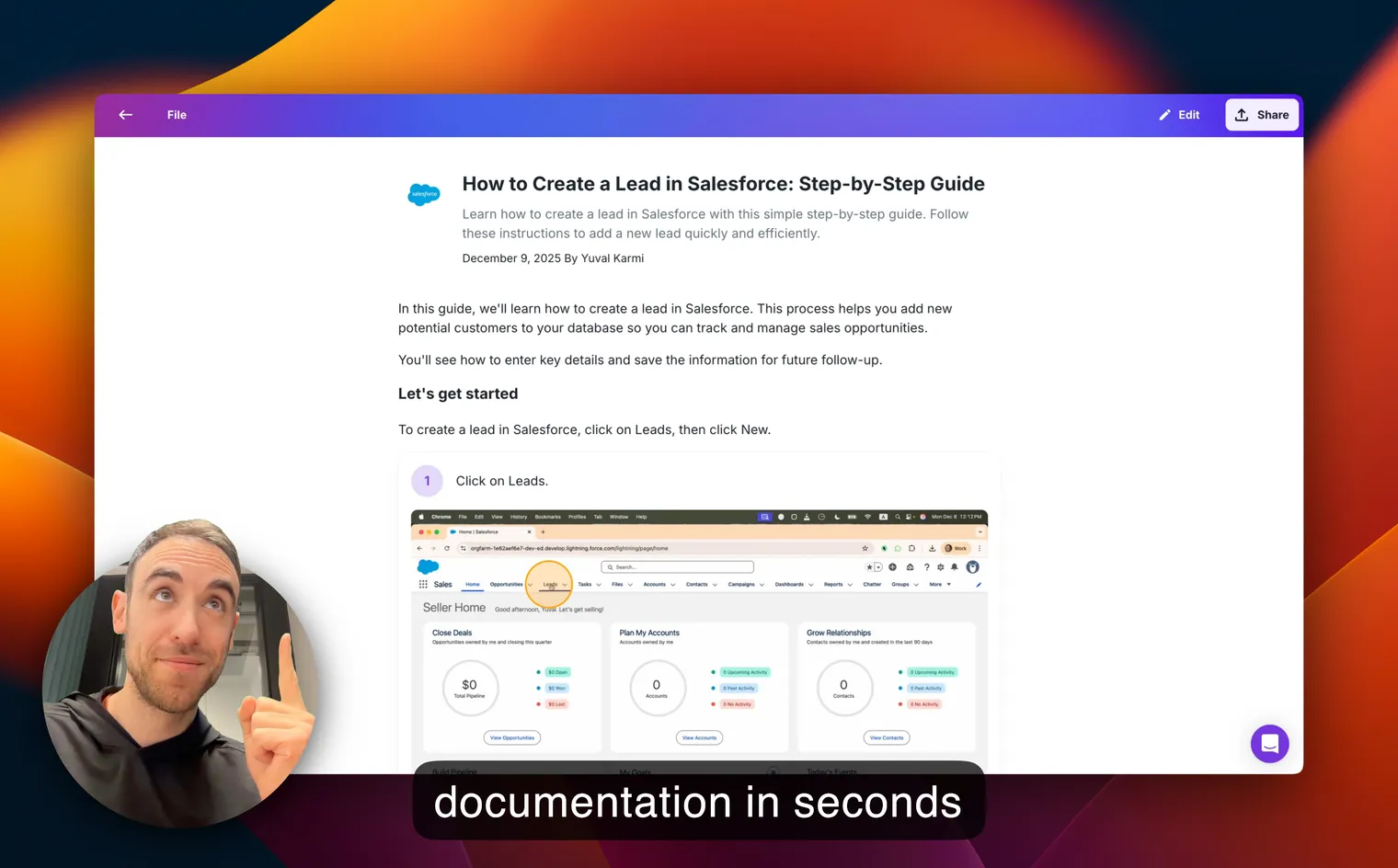
Teach your co-workers or customers how to get stuff done – in seconds.

The Real Cost of Outdated Documentation
Before we dig into solutions, let’s talk about what outdated documentation actually costs you.
When your team follows an outdated SOP, they waste time troubleshooting steps that don’t exist anymore. They lose confidence in your documentation system, so they stop checking it entirely. New hires get confused during onboarding, which extends their ramp-up time by weeks.
I’ve watched support teams field the same questions repeatedly because the help articles still reference the old UI. I’ve seen operations managers manually update dozens of people because they can’t trust the written process.
The cost compounds. Every outdated doc erodes trust. And once your team stops trusting the documentation, they stop using it. That’s when you’ve completely lost the battle.
Why Documentation Goes Stale: The Root Causes
Let me walk you through the four main reasons documentation becomes outdated.
1. Documentation Is Disconnected from the Change Process
This is the big one. In most organizations, documentation lives in a completely separate workflow from the actual changes being made.
The product team ships a feature update. The engineering team modifies a workflow. The operations team adjusts a process. And somehow, magically, the documentation is supposed to get updated too? It doesn’t happen.
I saw this constantly at my previous startup. We’d ship changes on Thursday. By Monday, support tickets would spike because the help docs still showed the old flow. The disconnect was built into our system.
The fix: Documentation updates need to be part of the definition of done. A feature isn’t shipped until the docs are updated. A process isn’t changed until the SOP reflects it.
2. Updates Are Painful and Time-Consuming
Here’s a scenario I bet you’ve experienced: you need to update a process guide because one step changed. But that guide has screenshots. Lots of screenshots.
Now you need to retake every single screenshot. Then you need to re-annotate them. Then you need to update the text to match. What should be a 5-minute update turns into a 45-minute project. So you put it off. And it never happens.
The friction is the killer. When updating documentation is painful, updates don’t get made.
The fix: Use tools and systems that make updates fast. Screen recordings that you can quickly re-record. Templates that reduce manual work. Automated screenshot updates.
Glitter AI lets you quickly re-record and update guides with new screen recordings
3. Nobody Owns the Documentation
I’ll ask you a simple question: who is responsible for keeping your documentation updated?
If your answer is “everyone” or “the documentation team,” you’ve identified the problem. When everyone owns something, nobody owns it.
Documentation without clear ownership becomes orphaned. Changes happen. Nobody knows who’s supposed to update the docs. Everyone assumes someone else will handle it. The docs rot.
I learned this lesson the hard way. We created detailed process documentation at Simpo, but we never assigned owners. Six months later, I couldn’t trust a single guide because I had no idea what was still accurate.
The fix: Every piece of documentation needs a specific owner. One person who’s accountable for keeping it current. One throat to choke, as they say in the military.
4. No System for Detecting Staleness
How do you know when documentation is outdated? In most organizations, you find out when someone complains. That’s too late.
You need proactive systems that catch documentation drift before it becomes a problem. Most teams don’t have this.
The fix: Build review triggers into your workflow. Set calendar reminders. Tag docs with “last reviewed” dates. Create alerts when processes change.
Building Update Triggers Into Your Workflow
Let me share the framework I use for keeping documentation current. I call it the “triggered update system.”
The core idea: updates should be triggered automatically by specific events, not left to people’s memory or goodwill.
Change-Based Triggers
These triggers fire when something changes:
- Product releases: Feature updates trigger doc reviews
- Process modifications: SOP changes trigger guide updates
- Tool switches: New software triggers workflow documentation updates
- Role changes: New team member in a role triggers training doc reviews
Here’s how this works in practice. When your product team uses a release management tool like Jira or Linear, configure a webhook so it creates a documentation ticket for every feature release. The feature isn’t considered “shipped” until that doc ticket is closed.
Time-Based Triggers
These triggers fire on a schedule:
- Quarterly reviews: Every doc gets reviewed every 90 days
- Monthly spot checks: Sample random docs monthly to verify accuracy
- Annual audits: Deep dive on all documentation once per year
I use a simple spreadsheet with three columns: Document Name, Owner, Next Review Date. Every Monday, I check what’s due for review that week. Takes five minutes.
Event-Based Triggers
These triggers fire when specific events occur:
- Support ticket spikes: High volume on a topic triggers doc review
- Onboarding confusion: New hire struggles trigger training doc updates
- Customer complaints: Negative feedback triggers help article reviews
The key is making these triggers automatic. If you rely on people remembering to check, it won’t happen consistently.
Teach your co-workers or customers how to get stuff done – in seconds.
Assigning Ownership and Accountability
Let’s talk about how to assign documentation ownership in a way that actually works.
The RACI Model for Documentation
I use a modified RACI framework for documentation:
- Responsible: One person who updates the doc (the owner)
- Accountable: One person who ensures it happens (usually a manager)
- Consulted: SMEs who review for accuracy
- Informed: Teams who need to know about changes
Every single document should have all four roles clearly defined. Write them directly into the doc metadata or in a central registry.
Ownership by Domain, Not by Team
Here’s a mistake I see constantly: assigning all documentation to the “documentation team” or “technical writing team.”
This doesn’t scale. The writers don’t know when processes change. They’re not close enough to the work.
Instead, assign ownership by domain:
- Product features: Product managers own feature docs
- Technical workflows: Engineering leads own technical guides
- Business processes: Operations managers own process SOPs
- Customer-facing help: Support team leads own help articles
The people closest to the work should own the documentation for that work.
Making Ownership Visible
Put owner names directly in the documentation. At the top of every guide, include:
- Owner: [Name]
- Last Updated: [Date]
- Next Review: [Date]
This creates accountability. If the doc is wrong, everyone knows who to talk to. If the review date is overdue, it’s obvious.
Tools and Systems That Keep Docs Current
Let me share the specific tools and systems I’ve seen work well.
Documentation Platforms with Version Control
Use platforms that track changes over time. This lets you see what changed, when, and who changed it.
Tools like Notion, Confluence, and GitBook all offer version history. But more importantly, they show you the last modified date prominently. This makes it obvious when docs haven’t been touched in six months.
Automated Screenshot Tools
Screenshots are often the biggest pain point in documentation updates. Tools like Tango, which we compare against Glitter AI automatically capture screenshots as you click through a workflow, which is faster than doing it manually. If you also want voice narration captured alongside the screenshots, tools like Glitter AI record both in a single pass - so your written guide reflects not just what you clicked but what you said about each step.
For more control, use tools that let you quickly retake screenshots without rebuilding the entire guide.
Documentation Analytics
If your documentation platform has analytics, use them. Track which docs get the most views. Look for docs with high bounce rates or short time-on-page, which often indicate outdated or unclear content.
At Glitter AI, I check our most-viewed help articles monthly. If something’s getting tons of traffic, I make sure it’s 100% accurate.
Review Reminders
Set up automated reminders for documentation reviews. Here are three approaches that work:
Calendar reminders: Add recurring calendar events for quarterly doc reviews. Block the time. Make it non-negotiable.
Tool-based reminders: Some platforms like Confluence have built-in review reminders. Turn them on.
Task management integration: Create recurring tasks in your project management tool for documentation reviews.
I personally use a combination. I have a quarterly calendar block for doc reviews, plus specific reminders in Linear for high-priority documentation.
Making Updates Easy: Reducing Friction
Here’s the truth: if updating documentation takes 2 hours, it won’t happen. If it takes 15 minutes, it will.
Let me show you how to reduce the friction.
Use Templates
Create standardized templates for common documentation types. SOPs, feature guides, troubleshooting docs, onboarding materials.
Templates cut creation time by 60-70% in my experience. They also make updates faster because you’re not figuring out structure each time.
Embrace Modular Documentation
Break large documents into smaller, reusable chunks. Instead of one massive 50-page process manual, create 20 focused 2-page guides.
When you need to update something, you’re editing 2 pages, not finding the right section in a 50-page document. The psychological difference is huge.
Use Video + Text Approaches
Here’s something I learned building Glitter: screen recordings are way faster to update than text with screenshots.
If a workflow changes, I can re-record a 3-minute screen capture in 5 minutes. Updating a text guide with 15 screenshots takes 45 minutes.
The hybrid approach works best: keep both video and text versions. Update whichever is faster for the specific change.
Keep a Documentation Changelog
Maintain a visible changelog showing what docs were updated and when. This serves two purposes:
First, it creates accountability. People can see whether updates are actually happening.
Second, it helps teams know what’s safe to reference. If you see a doc was updated last week, you can trust it. If it hasn’t been touched in 18 months, you know to verify before using it.
Create and update guides in minutes with screen recordings
Building a Documentation Maintenance Culture
Tools and systems only work if your team culture supports them. Let me share how to build that culture.
Make Documentation Updates Part of Performance Reviews
If you want people to prioritize documentation, measure it. Include “keeps documentation current” as a criterion in performance reviews.
I don’t mean this in a punitive way. I mean recognizing and rewarding people who keep their docs updated.
Celebrate Documentation Wins
When someone updates an outdated doc, acknowledge it publicly. In Slack, in team meetings, wherever.
Make documentation maintenance visible and valued. This sounds silly, but it works. People do what gets recognized.
Share Documentation Horror Stories
I’m serious about this one. When outdated documentation causes a problem, talk about it openly.
“Sarah spent 2 hours following the old deployment guide before realizing it was outdated. We need to keep our docs current.”
Make the pain visible. Help people understand the real cost of neglect.
Allocate Time for Documentation Maintenance
Don’t expect documentation updates to happen “whenever there’s time.” There’s never time.
Block dedicated time for documentation work. I recommend 10% of team capacity. For a team of 10, that’s one person’s worth of time per week.
Practical Systems and Frameworks
Let me give you three frameworks you can implement immediately.
The 3-Month Review Cycle
Every document gets reviewed every 3 months. Set a recurring calendar reminder. Block 2 hours every quarter.
During the review:
- Read through the entire document
- Verify each step still works as described
- Update screenshots if anything changed
- Check all links still work
- Update the “last reviewed” date
If nothing changed, the review takes 10 minutes. If things changed, fix them immediately.
The “Touch It, Update It” Rule
Whenever you personally use a piece of documentation, check if it’s still accurate. If you find something wrong, fix it immediately.
This distributes maintenance across the entire team. No single person is responsible for everything.
The rule is simple: if you touch it, you update it.
The Documentation Dashboard
Create a simple dashboard tracking documentation health. Include:
- Total number of documents
- Number reviewed in last 30 days
- Number reviewed in last 90 days
- Number older than 90 days (these need attention)
- Average time since last update
Review this dashboard monthly in team meetings. Make documentation health a key metric, just like sprint velocity or customer satisfaction.
What to Do Right Now
You don’t need to implement everything at once. Here’s what I recommend you do in the next 24 hours:
First: Make a list of your 10 most critical documents. These are the guides your team uses daily or that onboard new hires.
Second: Assign an owner to each of those 10 documents. One specific person. Email them to confirm they accept ownership.
Third: Add “last updated” and “next review” dates to each document. Set the next review for 30 days from now.
Fourth: Create a recurring calendar reminder for yourself to check documentation health monthly.
Start small. Get those 10 critical docs under control. Then expand the system to more documentation.
The goal isn’t perfection. The goal is progress.
Frequently Asked Questions
How often should documentation be updated?
Critical documentation should be reviewed every 3 months at minimum. High-traffic or frequently-changing docs may need monthly reviews. The key is building a regular review schedule rather than waiting for docs to become obviously outdated.
Who should be responsible for keeping documentation updated?
The person closest to the work should own the documentation. Product managers own feature docs, operations managers own process SOPs, and support leads own help articles. Avoid assigning all docs to a central documentation team, as they're too far from the actual changes.
What's the biggest mistake teams make with documentation maintenance?
Making updates too painful and time-consuming. If updating a guide takes hours because of screenshots and formatting, those updates won't happen. Use tools and templates that make updates fast and friction-free.
How can I tell if documentation is outdated without reading every single doc?
Look for warning signs like high support ticket volume on documented topics, new hire confusion during onboarding, or docs with 'last updated' dates older than 6 months. Set up analytics to track which docs get the most views but highest bounce rates.
Should we delete outdated documentation or try to update it?
If a document is actively used or covers a critical process, update it. If it's rarely accessed and the process no longer exists, delete it. Outdated documentation is worse than no documentation because it erodes trust in your entire system.
What tools help keep documentation from getting outdated?
Use documentation platforms with version control like Notion or Confluence. Set up automated review reminders. Consider tools that make updates faster, like automated screenshot tools or screen recording platforms that let you quickly re-record changed workflows.
How do I get my team to prioritize documentation updates?
Make documentation updates part of your definition of done for any change. Include documentation maintenance in performance reviews. Allocate dedicated time for documentation work, don't expect it to happen whenever there's time. Celebrate when people keep docs current.