
Read summarized version with
I used to think work instructions were just boring documents nobody read.
Then I watched a new hire at my first startup spend 45 minutes trying to process a customer refund. She clicked around desperately, opened five different tabs, and finally messaged our busiest developer for help.
The process should have taken three minutes. We had documentation somewhere. But nobody could find it, and even when you did find it, it was just a wall of text that didn’t match what was actually on the screen.
That’s when I realized: work instructions aren’t boring. Bad work instructions are boring. Good ones? They’re lifesavers.
I’m Yuval, founder of Glitter AI. After years of creating documentation at my first startup and now helping thousands of teams document their processes, I’ve seen what separates work instructions people actually use from the ones collecting digital dust.
In this post, I’ll show you real work instruction examples across different industries, break down what makes them effective, and give you templates you can use today. For the wider context, our complete guide to process documentation shows where work instructions fit in the bigger picture.
Teach your co-workers or customers how to get stuff done – in seconds.

What Are Work Instructions?
A detailed how-to for a single task is a step-by-step guide that shows someone exactly how to complete a specific task. Unlike a standard operating procedure, which tends to be more formal and compliance-focused, work instructions are practical, detailed guides focused on getting a job done.
Think of it this way:
- SOP: The formal procedure for handling customer refunds, or the warehouse SOP governing picking and shipping (includes policies, approval workflows, compliance requirements)
- Work instruction: The exact steps to process a refund in your payment system (click here, enter this, confirm that)
If the distinction still feels fuzzy, the same logic that separates a procedure from a process applies here, because work instructions answer the question: “How do I actually do this thing right now?”
The best work instructions share five characteristics:
- Visual - Screenshots, photos, or diagrams for every step
- Specific - Clear about exactly what to click, type, or do
- Sequential - Steps in the exact order you need to follow
- Concise - No unnecessary background or theory
- Accurate - Matches the current version of your tools and processes
Why Most Work Instructions Fail
Before we look at good examples, let’s talk about why most work instructions suck, especially the ones that skip the discipline of true standard work instructions.
I’ve seen all of these mistakes:
No screenshots. Someone writes “Click the settings menu” but there are three settings menus on the page. Which one? A screenshot would answer that instantly.
Out of date. Your software updated six months ago. The work instruction still references the old interface. Now people don’t trust any of your documentation.
Too much fluff. Nobody needs three paragraphs explaining the history and importance of processing refunds. They need to know where to click.
Impossible to find. You have work instructions somewhere. SharePoint? Google Drive? That one person’s desktop? Who knows.
Written by people who don’t do the work. A manager who hasn’t processed a refund in three years writes the instruction. It misses all the real-world gotchas.
The solution? Let the people who do the work create the instructions. Add a screenshot for every step. Keep it short. Put it somewhere people can actually find it. The same discipline applies to procedures generally, which our complete guide to writing effective SOPs breaks down.
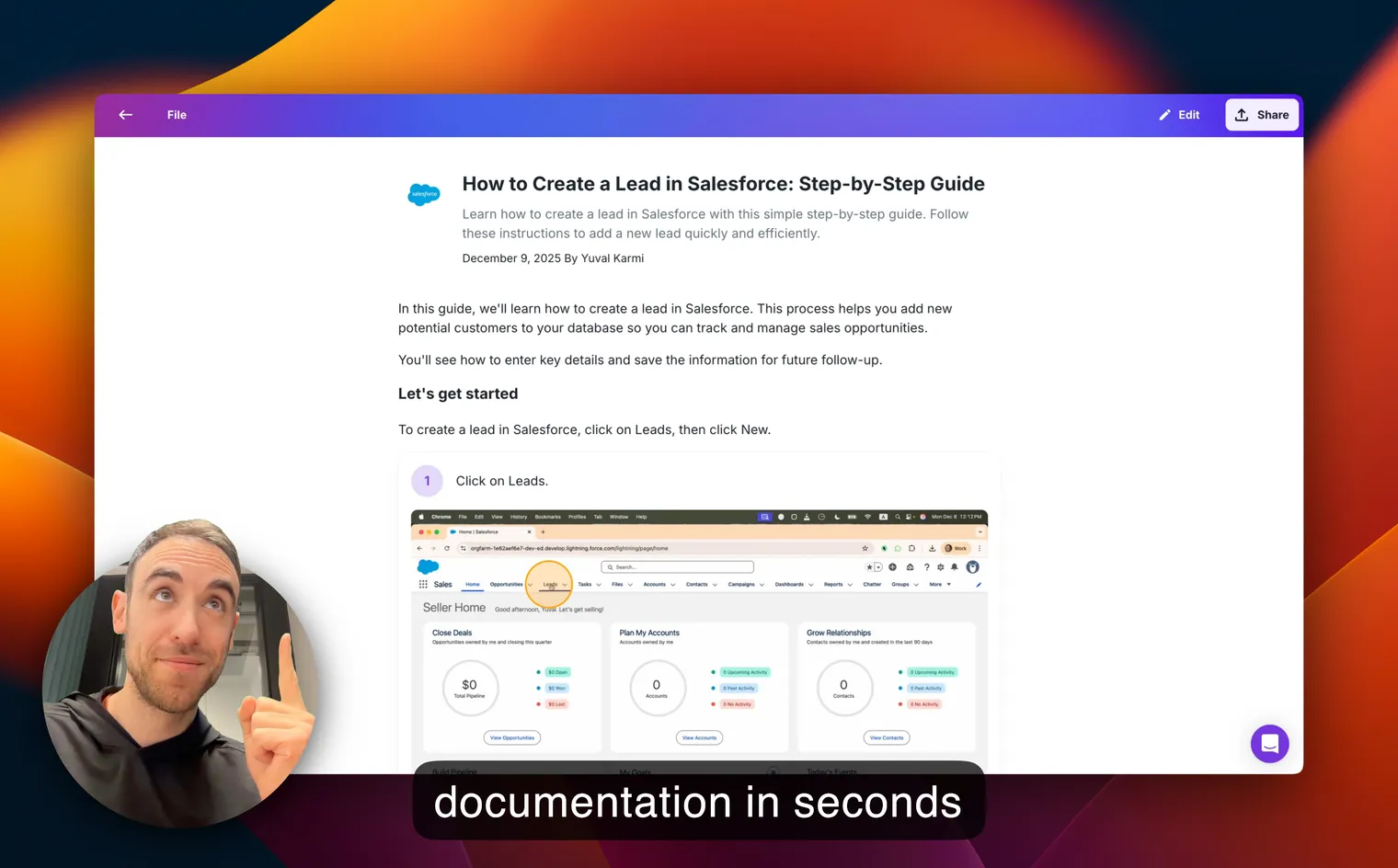
Glitter AI captures your screen and voice to create visual work instructions automatically
Work Instruction Examples by Industry
Let me show you what good work instructions actually look like across different scenarios.
Example 1: Customer Service - Processing a Refund
Task: Process a customer refund in Shopify
Good work instruction format:
Title: How to Process a Full Refund in Shopify
When to use this: Customer requests a full refund for an order they’ve already received
Prerequisites:
- Access to Shopify admin
- Approval from customer service manager for refunds over $500
Steps:
-
Log into Shopify admin at admin.shopify.com
- Screenshot showing Shopify login page
-
Click “Orders” in the left sidebar
- Screenshot with “Orders” highlighted
-
Search for the order number using the search bar at the top
- Screenshot showing search bar with example order number
-
Click on the order from the results
- Screenshot showing search results
-
Scroll down to the “Refund” section and click “Refund”
- Screenshot showing where the Refund button is located
-
Enter the refund amount (should match the order total for full refunds)
- Screenshot showing refund amount field filled in
-
Select “Refund to original payment method”
- Screenshot showing this option selected
-
Enter a reason in the “Reason for refund” field (this is for internal tracking)
- Screenshot showing reason field with example text
-
Click “Refund $XX.XX”
- Screenshot showing final refund button
-
Wait for confirmation message “Refund successful”
- Screenshot showing success message
-
Copy the refund confirmation number and paste it into the support ticket
- Screenshot showing where to find the confirmation number
What makes this work instruction effective:
- Every step has a screenshot
- One action per step
- Includes prerequisites up front
- Brief explanations in parentheses when needed
- Shows the success confirmation so you know it worked
Example 2: IT Security - Setting Up Two-Factor Authentication
Task: Enable 2FA for a new employee’s work account
Title: Enable Two-Factor Authentication for Google Workspace Accounts
Who needs this: IT administrators onboarding new employees
Time required: 5 minutes
Steps:
-
Go to admin.google.com and sign in with your admin account
- Screenshot of Google Admin console login
-
Click “Users” from the main menu
- Screenshot highlighting Users menu item
-
Find the employee’s account using the search bar
- Screenshot showing search
-
Click on the employee’s name to open their account settings
- Screenshot of search results
-
Click “Security” in the left sidebar
- Screenshot showing Security tab
-
Scroll to “2-Step Verification” section
- Screenshot showing this section
-
Click “Enroll user in 2-Step Verification”
- Screenshot showing button
-
Click “Save” at the bottom of the page
- Screenshot showing Save button
-
The employee will receive an email with setup instructions
- Screenshot of the email they’ll receive
-
Follow up with the employee to confirm they’ve completed setup within 24 hours
Troubleshooting:
- If “Enroll” button is grayed out: Check that 2FA is enabled org-wide in Security settings
- If employee doesn’t receive email: Check their spam folder, then try re-sending from the admin console
What makes this effective:
- Clear audience definition
- Time estimate upfront
- Includes troubleshooting section
- Follow-up reminder at the end
- Shows what the end user will see
Example 3: Manufacturing - Quality Control Inspection
Task: Inspect finished product before packaging
Title: Final Quality Inspection - Widget Assembly Line
Safety requirements:
- Wear safety glasses
- Use anti-static wrist strap
Equipment needed:
- Digital caliper (calibrated within last 30 days)
- Inspection checklist form
- Red/Green tag labels
Inspection steps:
-
Put on safety glasses and anti-static wrist strap
- Photo showing proper equipment
-
Remove one widget from the completed batch (take from the middle, not the ends)
- Photo showing where to select from
-
Measure the main shaft diameter using the digital caliper
- Photo showing correct caliper placement
- Acceptable range: 12.0mm - 12.2mm
-
Record measurement on inspection form
- Photo of completed form
-
Check all four mounting holes visually for burrs or damage
- Photo showing what good holes look like
- Photo showing what damaged holes look like
-
Test the rotation mechanism - should complete full rotation smoothly
- Photo demonstrating the test
-
If ALL checks pass: attach GREEN tag and return to batch
- Photo of green tag placement
-
If ANY check fails: attach RED tag and move to rework area
- Photo of red tag and rework bin location
-
Complete inspection form and place in supervisor’s inbox
- Photo showing inbox location
Frequency: Every 50th unit or once per hour, whichever comes first
What makes this effective:
- Safety requirements up front
- Equipment specifications included
- Photos showing both correct and incorrect examples
- Clear pass/fail criteria with specific measurements
- Frequency clearly stated
Example 4: Restaurant - Opening Procedures
Task: Opening checklist for shift manager
Title: Morning Opening Procedure - Front of House
Completion time: 6:00 AM - 6:45 AM (must be complete before 7:00 AM opening)
Steps:
-
6:00 AM - Unlock and disarm alarm (Code: [manager-specific])
- Photo of alarm panel location
-
6:05 AM - Turn on all lights using master switch panel
- Photo of switch panel with labels
-
6:10 AM - Check dining room temperature
- Should be 68-72°F
- Photo of thermostat location
- If outside range: Adjust and note in shift log
-
6:15 AM - Inspect all tables and chairs
- Wipe down any dirty surfaces
- Check chair stability (replace wobbly chairs)
- Photo showing supply cart location
-
6:20 AM - Stock and organize host stand
- Menus (50 regular, 10 kids)
- Crayons (check all boxes have at least 6 colors)
- Reservation list printed
- Photo of fully stocked host stand
-
6:25 AM - Test POS system
- Log in to one terminal
- Process a test transaction ($0.01)
- Void the test transaction
- Screenshot of successful test
-
6:30 AM - Fill and start coffee makers (3 pots)
- Photo showing coffee setup
-
6:35 AM - Unlock entrance doors and place “OPEN” sign
- Photo of sign placement
-
6:40 AM - Final walk-through
- Check restrooms (clean, stocked, lights on)
- Photo of restroom checklist
-
6:45 AM - Sign off on opening checklist and place in manager folder
- Photo of completed checklist
What makes this effective:
- Time stamps for each task
- Clear deadline (must finish by 6:45 AM)
- Specific quantities (50 menus, not “enough menus”)
- Check and replace criteria
- Final walk-through to catch anything missed
Teach your co-workers or customers how to get stuff done – in seconds.
Example 5: Healthcare - Patient Check-in
Task: Check in a patient for their appointment
Title: Patient Check-In Procedure - Front Desk
Compliance note: This process must comply with HIPAA. Verify patient identity before discussing any information.
Steps:
-
Greet patient and ask for their full name and date of birth
- Screenshot of patient lookup screen
-
Look up patient in system using name and DOB
- Screenshot showing search fields
-
VERIFY IDENTITY: Ask patient to confirm their address
- This is required for HIPAA compliance
- If address doesn’t match, follow ID verification protocol (see linked SOP)
-
Ask: “Are you here for [appointment type] with [doctor name]?”
- Confirms correct appointment
- Screenshot showing appointment details
-
Ask: “Has anything changed with your insurance since your last visit?”
- If YES: Request insurance card and proceed to step 6
- If NO: Skip to step 9
-
Click “Update Insurance” button
- Screenshot showing button location
-
Scan insurance card (front and back)
- Screenshot showing scanner icon
-
Verify insurance information appears correctly in system
- Screenshot of insurance details screen
-
Ask: “Have any of your medications changed?”
- Note response in “Check-in notes” field
- Screenshot showing where to enter notes
-
Hand patient the iPad with forms and say: “Please review and sign the forms on this iPad”
- Screenshot of form screen
-
Click “Check-in Complete” when patient returns iPad
- Screenshot of check-in button
-
Say: “Please have a seat. We’ll call you back shortly.”
Average time: 3-5 minutes per patient
What makes this effective:
- Compliance requirements highlighted
- Exact scripts provided for consistency
- Conditional logic (If/Then) for insurance updates
- HIPAA verification step emphasized
- Average time expectation set
Example 6: Sales - Exporting Leads from CRM
Task: Export qualified leads from Salesforce to Excel for weekly sales meeting
Title: Weekly Lead Export from Salesforce
When to do this: Every Friday by 3 PM for Monday’s sales meeting
Steps:
-
Log into Salesforce at yourcompany.salesforce.com
- Screenshot of login page
-
Click “Leads” tab at the top
- Screenshot highlighting Leads tab
-
From the “View” dropdown, select “This Week’s Qualified Leads”
- Screenshot showing dropdown with option highlighted
-
Click the gear icon in the top right and select “Export”
- Screenshot showing gear icon menu
-
In the export dialog:
- Format: “Excel (.xlsx)”
- Fields: “All fields”
- Screenshot of these settings
-
Click “Export Now”
- Screenshot of Export button
-
Wait for download to complete (usually 10-15 seconds)
- Screenshot of browser download notification
-
Open the downloaded file and verify it contains data
- Should have at least columns: Name, Company, Email, Phone, Lead Score, Owner
- Screenshot of opened Excel file
-
Save file to shared drive: Sales Team > Weekly Meetings > [Date]
- Name format: “Qualified_Leads_YYYY-MM-DD.xlsx”
- Screenshot showing save location
-
Post in #sales-team Slack: “Friday lead export complete: [link to file]”
- Screenshot of Slack message template
Troubleshooting:
- No data in export: Check that date range in view is set to current week
- Export button is grayed out: Contact admin for export permissions
- File won’t open: Try exporting again, may have been corrupted
What makes this effective:
- Clear schedule (every Friday by 3 PM)
- Verification step to ensure export worked
- Specific file naming convention
- Communication step at the end
- Troubleshooting for common issues
Example 7: Software Development - Deploying to Staging
Task: Deploy code changes to staging environment
Title: Deploy to Staging Environment
Prerequisites:
- Pull request has been approved by at least 2 reviewers
- All CI/CD tests are passing (green checkmark)
- Database migrations have been reviewed (if applicable)
Steps:
-
Go to GitHub repository at github.com/company/product
- Screenshot of repo
-
Click “Actions” tab
- Screenshot highlighting Actions
-
Click “Deploy to Staging” in the left sidebar
- Screenshot showing workflows
-
Click “Run workflow” button (top right)
- Screenshot showing button
-
Select the branch you want to deploy from the dropdown
- Usually “main” for scheduled deploys
- Screenshot showing branch selection
-
Click green “Run workflow” button to confirm
- Screenshot of confirmation
-
Wait for workflow to complete (typically 5-8 minutes)
- Screenshot showing running workflow
-
Verify all steps show green checkmarks
- Screenshot of successful workflow
-
Go to staging environment: staging.product.company.com
- Screenshot of staging site
-
Perform smoke test:
- Log in with test account (credentials in 1Password)
- Navigate to main feature you changed
- Verify it works as expected
- Screenshot showing successful test
-
Post in #deployments Slack: “Staging deployed: [PR link] - smoke test ✅”
- Screenshot of message format
If deployment fails:
- Check workflow logs for error messages
- Screenshot showing where to find logs
- If you can’t resolve within 15 minutes, post in #dev-help with error screenshot
What makes this effective:
- Prerequisites clearly listed
- Time expectations (5-8 minutes)
- Verification steps included
- Communication protocol
- Failure escalation path
How to Write Effective Work Instructions
Based on these examples, here’s my formula for creating work instructions that people actually use:
Start with the User
Before writing anything, ask:
- Who will use this work instruction?
- What’s their skill level?
- What do they already know vs. what needs explaining?
A work instruction for experienced developers looks different from one for new customer service reps.
Use the Active Voice
Bad: “The refund button should be clicked” Good: “Click the refund button”
Active voice is clearer and more direct. You’re telling someone what to do, not describing what should happen.
One Action Per Step
Bad: “Open the customer record, verify their email address, and update the status field to ‘Contacted’”
Good:
- Open the customer record
- Verify the email address matches the one in the ticket
- Update the status field to “Contacted”
Breaking it down makes each step easier to follow and easier to troubleshoot when something goes wrong.
Add a Screenshot for Every Step
This is non-negotiable for software work instructions.
Screenshots serve two purposes:
- Show exactly where to click
- Confirm you’re in the right place
The person following your instruction should be able to look at the screenshot and say “Yes, my screen looks like that.”
This is actually why I built Glitter AI. Taking screenshots manually is painful. Glitter captures them automatically as you work, which makes creating visual work instructions much faster.
Include Prerequisites Up Front
Don’t make people read through 10 steps only to discover they need access they don’t have.
List prerequisites at the top:
- Required access or permissions
- Tools or equipment needed
- Information that should be gathered first
Add Time Estimates
“This takes 5 minutes” sets expectations.
It also helps people identify when something’s gone wrong. If a 5-minute task is taking 20 minutes, they know to ask for help.
Write for Skimmers
People don’t read work instructions top to bottom. They skim.
Use:
- Bold for important warnings or key information
- Bullet points for lists
- Short paragraphs (2-3 sentences max)
- Descriptive headings
Test It
This is the step everyone skips and shouldn’t.
Find someone who has never done this task. Give them your work instruction. Watch them try to follow it. Don’t help unless they’re completely stuck.
You’ll immediately see:
- Steps you forgot to include
- Instructions that seemed clear but aren’t
- Screenshots that don’t match their screen
- Jargon they don’t understand
Fix those things. Then test again.
Glitter AI makes creating visual work instructions as easy as doing the task yourself
Work Instruction Template
Here’s a template you can copy and customize:
TITLE: [Specific, actionable title]
WHEN TO USE THIS: [Brief description of the scenario]
PREREQUISITES:- [Access needed]- [Tools required]- [Information to gather first]
TIME REQUIRED: [Estimate]
STEPS:
1. [First action - be specific]   - [Screenshot]   - [Brief clarification if needed]
2. [Second action]   - [Screenshot]   - [Any important notes]
[Continue for each step...]
VERIFICATION: [How do you know it worked?]- [What should you see?]- [Screenshot of success state]
TROUBLESHOOTING:- [Common issue]: [Solution]- [Another issue]: [Solution]- If you can't resolve: [Who to contact]
RELATED WORK INSTRUCTIONS:- [Link to related procedure]
Common Mistakes to Avoid
After reviewing hundreds of work instructions, I keep seeing the same mistakes:
Assuming Knowledge
Don’t assume people know where things are or what terms mean. Your “obvious” might be someone else’s “what does that mean?”
When in doubt, add a screenshot or brief explanation.
Skipping the “Why”
Sometimes a brief explanation prevents shortcuts that cause problems.
Example: “Save as PDF (this ensures formatting is preserved when clients open it)”
That one-sentence “why” prevents someone from thinking “Word doc is fine, right?”
Writing and Forgetting
Work instructions need owners and scheduled reviews.
Software updates. Processes change. When work instructions don’t keep up, people stop trusting them.
Assign someone to review each work instruction quarterly. Put it on their calendar.
Making Them Impossible to Find
Your beautiful work instruction is useless if nobody can find it when they need it.
Put work instructions somewhere:
- Everyone can access
- Has a search function
- Is organized logically
- People already go for information
At Glitter AI, we see teams use shared drives, knowledge bases, internal wikis, or documentation platforms. What matters is that it’s accessible and searchable.
Not Including What to Do When Things Go Wrong
Things go wrong. Buttons don’t appear. Error messages pop up. Systems are down.
Include a troubleshooting section with common issues and solutions. And always include who to contact if someone can’t figure it out.
Tools for Creating Work Instructions
The traditional way to create work instructions is painful:
- Open a doc
- Perform each step
- Stop and take a screenshot
- Crop and annotate the screenshot
- Insert it into the doc
- Write the instruction text
- Repeat for every single step
This is why so many work instructions don’t have screenshots. It’s too tedious.
Modern approaches make this much easier:
Screen recording tools like Loom, which we put head to head with Glitter AI let you record yourself doing the task, then go back and grab screenshots from the video. Better than the manual approach, but you still have to pause, capture, crop, and insert - and Loom gives you a video file, not a step-by-step guide with numbered screenshots already in place.
AI documentation tools like Glitter AI capture screenshots automatically as you work. You just do the task normally and narrate what you’re doing. Glitter captures your screen, transcribes your voice, and creates a step-by-step guide with all the screenshots in place.
I built Glitter specifically because I was frustrated with how long it took to create good visual documentation. What used to take an hour now takes 5 minutes.
Whatever tool you use, the key is making it easy enough that people actually do it. The best work instruction system is the one your team will actually maintain.
Frequently Asked Questions
What is the difference between work instructions and standard operating procedures?
Work instructions are detailed, step-by-step guides focused on exactly how to complete a specific task (like "how to process a refund in Shopify"). SOPs are more formal documents that describe policies, compliance requirements, and overall procedures. Think of it this way: the SOP describes the formal refund policy and approval workflow, while the work instruction shows exactly which buttons to click in your system. Work instructions are typically more visual and granular than SOPs.
How long should a work instruction be?
Work instructions should be as long as necessary but no longer. Most effective work instructions are 5-15 steps. If you find yourself writing 30+ steps, consider breaking it into multiple work instructions for sub-tasks. The key is keeping each instruction focused on one specific task. Nobody wants to scroll through pages of documentation when they just need to know how to export a report.
Should every work instruction have screenshots?
For software-based tasks, absolutely yes. Every step should have a screenshot showing exactly what the user should see and where to click. For physical tasks (like manufacturing or food service), photos or diagrams serve the same purpose. Visual aids aren't just nice to have - they're essential for effective work instructions. Screenshots confirm you're in the right place and eliminate ambiguity about which button or option to select.
Who should write work instructions?
Work instructions should be written by (or with heavy input from) the people who actually perform the task daily. They know the real-world gotchas, shortcuts, and common problems that aren't obvious to managers or people who don't do the work. The best approach: have an experienced team member perform the task while narrating their actions, then review and refine the resulting documentation together.
How often should work instructions be updated?
Update work instructions immediately when the underlying process or software changes. Also schedule regular reviews - quarterly for most work instructions, monthly for processes that change frequently. Outdated work instructions are worse than no instructions at all because they erode trust in your entire documentation system. Assign an owner to each work instruction who's responsible for keeping it current.
What makes a good work instruction template?
A good work instruction template includes: a specific title, clear prerequisites (access, tools, information needed), estimated time to complete, numbered steps with one action each, screenshots or photos for every step, verification section showing what success looks like, and troubleshooting guidance for common issues. The template should be consistent across all your work instructions so people know what to expect and where to find information.
How do you make work instructions that people actually use?
The secret is making work instructions visual, specific, and easy to find. Add a screenshot for every step. Use active voice and one action per step. Test the instruction with someone who's never done the task before and fix anything they struggle with. Most importantly, keep work instructions updated - outdated documentation destroys trust and people will stop checking. Store them somewhere accessible with good search functionality.
Getting Started with Work Instructions
Here’s your action plan:
Week 1: Pick three tasks that new hires or team members frequently ask about. These are your best candidates for work instructions.
Week 2: For each task, have your best performer walk through it while you document. Use screen recording or an AI tool like Glitter AI to capture it.
Week 3: Test each work instruction with someone who’s never done the task. Revise based on what they struggled with.
Week 4: Publish the work instructions somewhere everyone can access and announce where to find them.
That’s it. Four weeks to go from zero work instructions to three solid, tested guides.
Once you see the impact - fewer questions, faster onboarding, more consistent results - you’ll be motivated to document more processes.
The best time to start creating work instructions was when you first developed those processes. The second best time is today.
Whether you do it manually or use Glitter AI to automate the process, just start. One good work instruction is infinitely better than zero.
Glitter AI creates visual work instructions while you work - just speak and click