
Read summarized version with
What is AI Transcription?
AI transcription is software that turns spoken words into written text using artificial intelligence. Instead of having someone sit and type out what they hear, AI transcription uses automatic speech recognition (ASR) and natural language processing (NLP) to get the job done in minutes rather than hours.
Here’s how it actually works: the technology analyzes audio signals and matches them against language models trained on huge amounts of speech data. Today’s AI transcription tools can handle various accents, filter background noise, tell speakers apart, and sometimes even pick up on emotion or intent. Accuracy usually falls somewhere between 85% and 99%, though this depends heavily on audio quality and the sophistication of the AI model being used.
Companies rely on AI transcription for meetings, interviews, podcasts, training videos, and customer support calls. Tasks that once required dedicated transcriptionists or hours of tedious work now happen almost instantly. An hour of audio? You’re looking at 2-10 minutes to transcribe it. This makes it realistic to document conversations that would have gone unrecorded in the past.
Key Characteristics of AI Transcription
- Speed: Processes audio far faster than real-time, typically handling an hour of content in under 10 minutes
- Speaker Identification: Recognizes and labels different speakers in a conversation, which makes transcripts much easier to follow
- Continuous Learning: Machine learning models get better over time as they learn from corrections and new data
- Custom Vocabulary: Many tools let you add industry-specific terms, jargon, or proper nouns so the AI recognizes them correctly
- Multi-Language Support: Most AI transcription software handles multiple languages and can often figure out which language is being spoken
AI Transcription Examples
Example 1: Meeting Documentation
A product team records their weekly sprint planning meetings and runs them through AI transcription. The text becomes searchable documentation that anyone on the team can reference when questions pop up about past decisions. No more relying on someone’s notes or trying to remember what was said. They have a complete record of the actual conversation, who said what, and when.
Example 2: Training Content Creation
Subject matter experts at a company record informal walkthroughs of complex processes. AI transcription turns these recordings into rough drafts of material for training new hires. Writers then clean up the transcripts and add structure, transforming casual explanations into polished how-to guides much faster than writing from scratch would take.
Example 3: Customer Support Analysis
A SaaS company transcribes all their customer support calls automatically. The team analyzes these transcripts to spot common pain points, frequently asked questions, and opportunities to improve the product. These transcripts also help train new support reps, serve as the foundation for process documentation, and feed into their knowledge base.
AI Transcription vs Manual Transcription
Both methods turn audio into text, but they differ quite a bit in cost, speed, and when each one makes sense.
| Aspect | AI Transcription | Manual Transcription |
|---|---|---|
| Speed | Minutes per hour of audio | Hours per hour of audio |
| Cost | Usage-based pricing, often cents per minute | Hourly rates or per-minute fees, significantly higher |
| Accuracy | 85-99% depending on audio quality | 99%+ with skilled transcriptionists |
| Best For | High-volume content, internal documentation, searchable archives | Legal proceedings, medical records, content requiring perfect accuracy |
| Turnaround | Near-instant | Hours to days |
| Editing Needed | Usually requires cleanup | Minimal editing if quality is good |
For most business purposes, AI transcription’s speed and cost benefits outweigh the need for some post-processing cleanup. That said, legal, medical, and compliance-heavy situations may still call for human review to meet accuracy standards.
How Glitter AI Uses AI Transcription
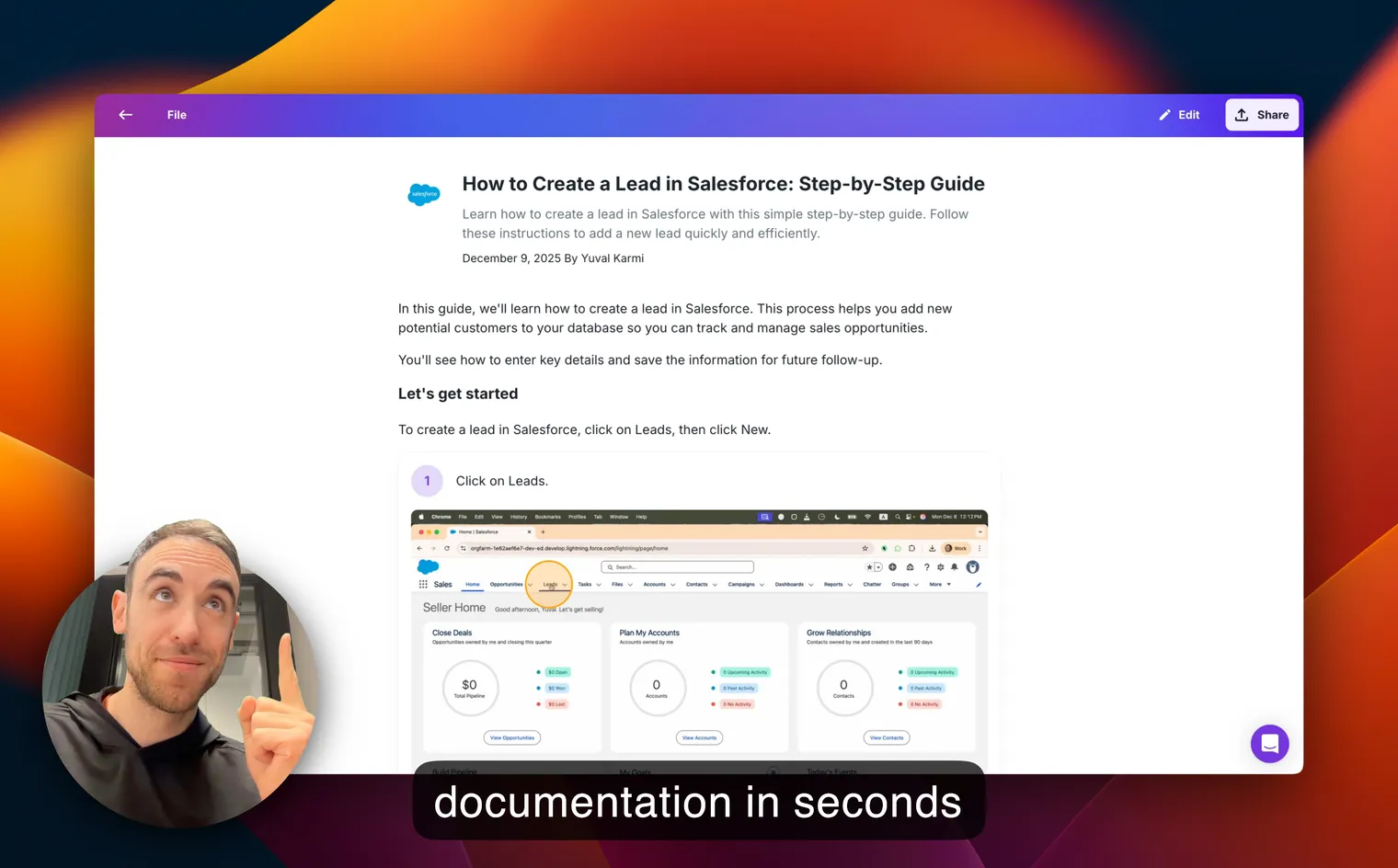
Glitter AI builds AI transcription directly into its documentation workflow. When you record your screen to document a process, Glitter uses speech-to-text to transcribe your narration automatically and pairs it with what’s happening on screen, even reading on-screen labels with OCR when needed. You end up with synchronized, searchable documentation where the written steps match the visual demonstration.
This solves a frustrating problem with training videos: they’re great for showing how something works, but terrible for finding specific information later. With transcription baked in, teams can search their video content just as easily as text documents, effectively turning video to text you can scan and reference. The AI also uses the transcript to generate step-by-step instructions, the same voice-to-text capture across 99 languages that turns recorded walkthroughs into structured process documentation without extra effort.
Teach your co-workers or customers how to get stuff done – in seconds.

Frequently Asked Questions
What is AI transcription?
AI transcription is software that automatically converts spoken audio into written text using artificial intelligence, machine learning, and speech recognition technology. It can process hours of audio in minutes rather than the hours required for manual transcription.
How accurate is AI transcription software?
Modern AI transcription software typically achieves 85-99% accuracy, depending on audio quality, background noise levels, speaker accents, and how advanced the AI model is. Clear audio with minimal background noise produces the best results.
What's the difference between AI transcription and manual transcription?
AI transcription uses software to convert speech to text automatically in minutes, while manual transcription requires a person to listen and type, which takes hours. AI is faster and cheaper but often needs some cleanup; manual transcription is slower but more accurate for specialized content.
How does AI audio transcription work?
AI audio transcription works by using automatic speech recognition (ASR) to convert sound waves into text, then natural language processing (NLP) to understand context, grammar, and meaning. The AI compares audio against trained language models to produce accurate text.
What are the best use cases for automatic transcription?
Common use cases include meeting documentation, podcast transcription, interview processing, training video creation, customer support call analysis, and content repurposing. Any situation where you have audio that needs to become searchable, editable text benefits from automatic transcription.
Can AI transcription identify different speakers?
Yes, most AI transcription software includes speaker diarization, which identifies and labels different speakers in a conversation. This makes transcripts of meetings and interviews much easier to follow and helps attribute quotes correctly.
How long does AI transcription take?
AI transcription typically processes one hour of audio in 2-10 minutes, depending on the service and audio complexity. That's dramatically faster than manual transcription, which takes 3-4 hours to transcribe one hour of audio.
What affects AI transcription accuracy?
Audio quality matters most. Clear recordings with minimal background noise, speakers who enunciate well, and standard accents tend to produce the best results. Technical jargon, overlapping speakers, and poor audio quality will reduce accuracy.
Is AI transcription good for business documentation?
Absolutely. AI transcription works well for creating searchable documentation from meetings, training sessions, and recorded procedures. It captures institutional knowledge that might otherwise be lost and makes audio content as searchable as written documents.
How does AI transcription help with training content?
AI transcription turns recorded training sessions and expert walkthroughs into written documentation automatically. This speeds up creating training manuals, makes video content accessible to people who prefer reading, and lets you search within video content.