
Read summarized version with
What is a Business Process?
A business process is essentially a series of connected activities and decision points that take specific inputs and turn them into something valuable. ISO 9000:2015 puts it this way: a process is a set of interrelated activities that use inputs to deliver an intended result. Stakeholders, resources, and systems all work together within a business process to hit organizational goals while keeping quality and efficiency on track.
Think of business processes as the backbone of how work actually gets done. They give teams a repeatable way to produce consistent outcomes and cut down on mistakes. Processing customer orders, bringing on new hires, running the bookkeeping process, managing inventory. These all rely on well-defined business processes that create predictability and clear accountability through solid documentation practices.
The numbers back this up. Organizations with documented business processes see about 42 percent fewer compliance issues and get products to market roughly 25 percent faster. Clear procedures and workflows let companies scale without sacrificing quality, and they make it easier to pivot when market conditions shift.
Key Characteristics of Business Process
- Finite and Defined: Every business process has a clear start and end point. You know what goes in, what comes out, and who receives the result. The transformation happening in between should add real value for the customer.
- Repeatable and Consistent: Run the process multiple times and you should get the same result. Different employees, different days. The outcome stays reliable.
- Value-Adding: Each step in the process should actually contribute to the final outcome. No wasted effort, materials, or time. What you do transforms inputs into something customers or stakeholders genuinely care about.
- Flexible and Adaptable: Good business processes are standardized but not rigid. They can bend and evolve as needs change without throwing everything into chaos.
- Measurable and Optimizable: You can track how well a business process performs through metrics and KPIs. This visibility helps teams spot bottlenecks and make improvements over time.
Business Process Examples
Example 1: Order-to-Cash Process
Picture a retail company’s order-to-cash process. It kicks off when someone places an order online and wraps up once payment hits the books. In between? Order entry, checking inventory, picking and packing, shipping, generating the invoice, collecting payment, and reconciling the account. Each step has its own systems, people involved, and quality checks that keep orders accurate and payments on time.
Example 2: Employee Onboarding Process
An HR department’s onboarding process starts the moment a candidate says yes to a job offer. It ends after their first week of orientation. During that time, there’s paperwork to complete, system access to set up, a workspace to prepare, training schedules to coordinate, team introductions to make, and initial goals to set. This structure means every new hire gets the same solid foundation, regardless of who’s handling their onboarding.
Business Process vs Workflow vs Procedure
People often use these terms interchangeably, but they actually describe different levels of how work gets organized.
| Aspect | Business Process | Workflow | Procedure |
|---|---|---|---|
| Scope | Broad framework containing multiple workflows | Specific sequence for a single task | Detailed step-by-step instructions |
| Focus | Strategic “what” and “why” | Tactical “how” | Granular execution details |
| Purpose | Achieve broader business outcomes | Complete recurring tasks efficiently | Ensure consistency in task execution |
| Flexibility | More flexible and adaptable | Moderately specific | Rigid and prescriptive |
Here’s the relationship: a business process is the big-picture framework that ties multiple workflows together toward a goal. Workflows zoom in on the specific sequence of activities needed for particular tasks. Procedures go even further, spelling out exactly how to execute each individual activity step by step through standard operating procedures.
How Glitter AI Helps with Business Process
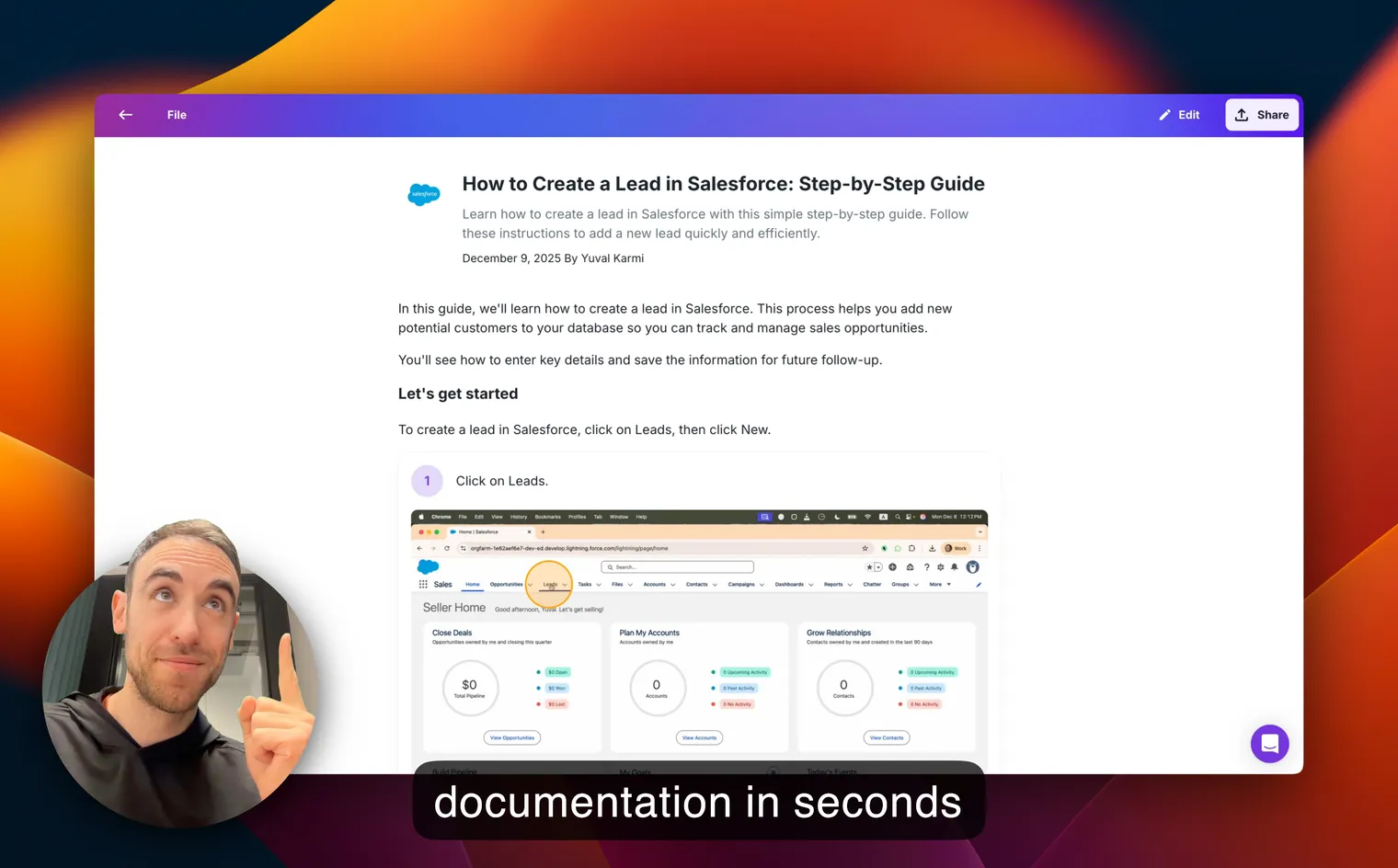
Glitter AI takes the pain out of documenting business processes. Instead of sitting down to write out lengthy process documents by hand, teams just do their work while Glitter records the screen and captures each step automatically, the kind of capture workflow people size up when they compare WizardShot and Glitter AI. The result is clear, visual documentation with screenshots, annotations, and written instructions, whether you are mapping a simple workflow or something as detailed as the general ledger process. No extra effort required. It also beats shadowing someone else’s process, where you can see every click but miss the reasoning behind each one.
This makes process documentation faster and way easier to keep current, which matters for compliance-heavy accounting and financial services teams running something as detailed as the financial reporting process. Captured recordings also give you an accurate as-is baseline before you design the to-be process, make it easier to spot a bottleneck slowing the work down, and feed naturally into process mining or value stream reviews. When a business process changes, or you take on a full reengineering effort, you can record the updated workflow and share it in minutes, exactly the ongoing discipline that business process management depends on. The visual format helps people understand what they’re supposed to do, which tends to cut training time and boost how consistently new hires follow the process during onboarding.
Teach your co-workers or customers how to get stuff done – in seconds.

Frequently Asked Questions
What does business process mean?
A business process is a series of connected activities that turn inputs into outputs to achieve a specific goal. Tasks, people, and resources work together to deliver value in a consistent, repeatable way.
What is an example of a business process?
The order-to-cash process is a classic example. It starts when a customer places an order and ends when you receive payment. Along the way: order entry, inventory check, fulfillment, shipping, invoicing, and payment collection. Each step moves toward completing the sale.
Why are business processes important?
They bring structure and predictability to how work gets done. Companies with documented business processes see around 42% fewer compliance issues and ship products 25% faster. Fewer errors, better efficiency, easier scaling.
How do you document a business process?
Start by identifying what goes in and what comes out. Then map each step in order, define who does what, and note where decisions get made. Tools like Glitter AI can speed this up by recording your screen as you work and automatically generating documentation with screenshots and instructions.
What are the three types of business processes?
Core processes deliver direct value to customers (think product development, sales). Support processes help core processes run (HR, IT). Management processes oversee everything (strategic planning, performance monitoring).