
Read summarized version with
What is a Workflow?
A workflow is a repeatable sequence of tasks, activities, and decision points arranged in a specific order to achieve a defined objective. Put simply, workflows are how people and organizations actually get things done. Whether you’re manufacturing a product, delivering a service, or processing information, there’s probably a workflow behind it.
What sets workflows apart from broader organizational processes? Scope, mainly. Business processes often span multiple departments and tie into strategic goals. Workflows, on the other hand, stay focused on executing specific tasks. They map out how work moves between people, systems, and touchpoints to get things done consistently. The best workflows blend human judgment with automation, turning inputs into outputs while following clear rules and decision logic.
Why bother formalizing your workflows? The numbers tell an interesting story. Industry research suggests workflow automation could save businesses over one trillion dollars annually by 2025, and roughly 80 percent of organizations are now adopting some form of intelligent automation. When you establish clear workflows, often with the help of a dedicated platform like one of these Tallyfy alternatives, you cut down on errors, remove bottlenecks, and free your team to focus on work that actually requires their expertise.
Key Characteristics of Workflow
- Repeatable and Predictable: Workflows follow the same sequence every time, producing consistent outcomes regardless of who executes them or when.
- Sequential or Conditional: Tasks move in a defined order. Sometimes that order is fixed; other times it adapts based on triggers, conditions, or decisions made along the way.
- Role-Defined: Each step assigns clear responsibility to someone or something, whether that’s an individual, a team, or an automated system. No ambiguity about who owns what.
- Measurable and Optimizable: Good workflows include milestones and metrics you can track. This lets you spot inefficiencies and make improvements over time.
- Purpose-Driven: Every workflow exists to accomplish something specific, be it approving a purchase, fulfilling an order, or resolving a support ticket.
Workflow Examples
Example 1: Invoice Approval Workflow
Consider how a company handles invoice approvals. It starts when a vendor submits an invoice and ends when payment gets authorized. Along the way, someone enters the data into the accounting system, a manager reviews it, the budget gets verified, and then it’s either approved or rejected. If approved, payment processing kicks off, followed by final documentation. Each step triggers the next, creating a consistent, auditable process that keeps unauthorized payments from slipping through.
Example 2: Content Publishing Workflow
A marketing team’s content workflow typically begins with a writer drafting an article and concludes when that article goes live. In between, the draft goes through peer review, editorial feedback, revisions, SEO adjustments, and design work. The content manager gives final approval, it gets scheduled in the CMS, and then it publishes. This structure helps ensure nothing goes out the door that doesn’t meet quality standards or brand guidelines.
Workflow vs Business Process vs Procedure
Workflows, business processes, and procedures all organize work, but they operate at different levels.
| Aspect | Workflow | Business Process | Procedure |
|---|---|---|---|
| Scope | Single task or objective | Cross-departmental framework | Granular step-by-step instructions |
| Focus | Sequence and flow of tasks | Strategic value delivery | Exact execution details |
| Complexity | Moderate, task-specific | High, end-to-end operations | Low, individual actions |
| Flexibility | Adapts based on conditions | Strategic framework | Rigid and prescriptive |
Think of it this way: a business process gives you the strategic overview and defines business logic. A workflow executes that logic by managing specific tasks at the operational level. Documented task procedures then spell out exactly how to perform individual activities within those workflows, while process documentation ensures knowledge is captured and shared.
How Glitter AI Helps with Workflow
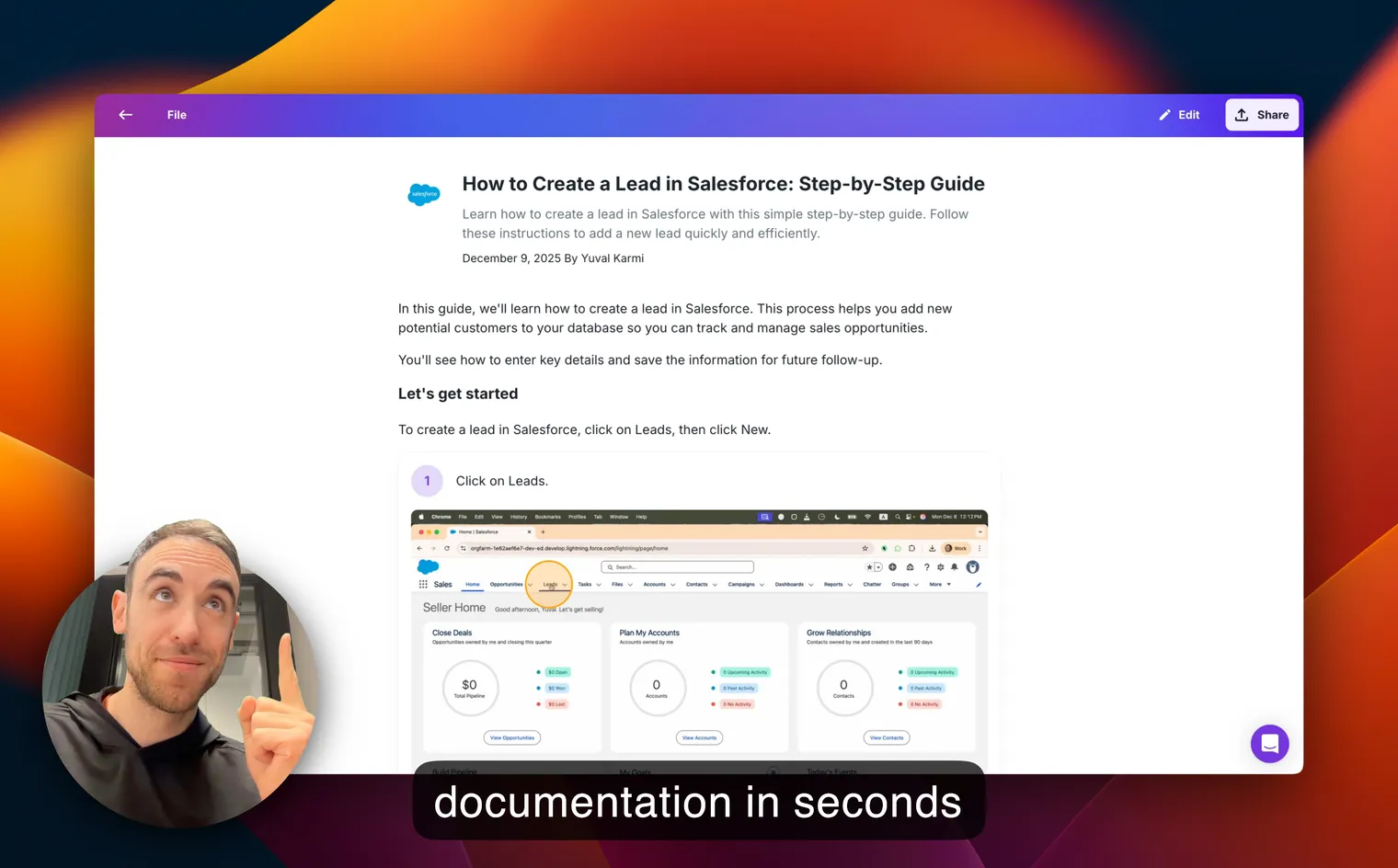
Documenting workflows used to mean spending hours creating diagrams and writing instructions. Glitter AI changes that. Instead of manually documenting everything, you just do your work while Glitter records it. The tool captures every action and generates step-by-step SOPs automatically, complete with screenshots, annotations, and clear guidance. It works the same way you’d capture a desktop procedure.
The time savings are substantial, and you get better accuracy too, especially when you follow proven approaches to documenting operations. When a workflow changes, you don’t have to rewrite everything from scratch. Just re-record the process and share the updated documentation with your team. The visual format makes even complicated workflows easy to follow, from a content publishing workflow to an automated chain triggered by a webhook, which means less training time and more consistent execution across your organization.
Teach your co-workers or customers how to get stuff done – in seconds.

Frequently Asked Questions
What does workflow mean?
A workflow is a repeatable sequence of tasks and activities organized in a specific order to accomplish a defined objective. It defines how work moves through people, systems, and decision points to complete operations efficiently and consistently.
What is an example of a workflow?
A common example is an invoice approval workflow, which begins when a vendor submits an invoice and ends when payment is authorized. It includes steps like data entry, manager review, budget verification, approval decisions, and payment processing, with each step triggering the next in sequence.
Why are workflows important?
Workflows provide structure and consistency to business operations, reducing errors and eliminating inefficiencies. Organizations implementing workflow automation can save significant resources, with research showing potential annual savings exceeding one trillion dollars by 2025 across businesses globally.
How do I create an effective workflow?
Create effective workflows by identifying the objective, mapping all required tasks in sequence, defining clear roles and responsibilities, establishing decision points and triggers, and implementing tracking mechanisms. Modern tools like Glitter AI can automatically document workflows through screen recording and visual capture.
What is the difference between a workflow and a process?
A business process is a comprehensive framework spanning departments and strategic goals, while a workflow focuses on the tactical execution of specific tasks within that process. Workflows are the operational mechanisms that execute the logic defined by broader business processes.