
Read summarized version with
What is a Desktop Procedure?
A desktop procedure is a document that walks someone through a specific task from start to finish. It lives at an employee’s workstation, either as a physical binder sitting next to their keyboard or a digital file they can pull up on screen, and serves as a go-to reference during everyday work.
Where a documented operating procedure might sketch out a process at a high level, a desktop procedure gets into the weeds. We’re talking which buttons to click, what fields to fill in, and what to do when the system throws an error you’ve never seen before. They’re written for the person actually sitting at the desk doing the work.
Finance, accounting, and operations teams tend to rely on desktop procedures heavily, often pairing them with software-specific onboarding like training staff on Sage Paperless. When someone takes a two-week vacation or unexpectedly leaves, these documents let others pick up the work without scrambling to figure things out from scratch.
Key Characteristics of Desktop Procedures
- Task-Specific Detail: A desktop procedure documents exactly how to perform one task or a tight cluster of related tasks. Expect screenshots, field-by-field instructions, and precise system navigation paths.
- User-Focused Format: These documents speak directly to the employee. They use “you” language and mirror the exact sequence someone would follow at their desk.
- Standalone Usability: A well-written desktop procedure works on its own. Someone completely unfamiliar with the task should be able to follow it without needing to ask questions.
- Workstation Accessibility: Whether printed or digital, desktop procedures stay within arm’s reach. Many organizations keep them as PDFs in SharePoint or their knowledge management system, often alongside a quick reference guide for common tasks.
- Regular Updates: Since they reflect real system workflows, desktop procedures need refreshing whenever software gets updated or processes shift.
Desktop Procedure Examples
Example 1: Month-End Journal Entry
A finance team puts together a desktop procedure for processing month-end journal entries. The document walks through logging into the accounting software, navigating to the journal entry screen, entering data field by field, routing it for approval, and troubleshooting the errors that pop up most often. Now any team member can handle the task consistently.
Example 2: Customer Account Setup
A customer service department documents how to set up new accounts in their CRM. The desktop procedure spells out data entry requirements, validation checks, what triggers notifications, and how to confirm everything went through correctly. Every new account gets configured the same way, no matter who handles it.
Desktop Procedure vs Work Instruction
People sometimes use these terms interchangeably, and honestly, the line between them can get blurry. But there are differences worth knowing.
| Aspect | Desktop Procedure | Work Instruction |
|---|---|---|
| Focus | Office and knowledge work tasks | Often manufacturing or physical tasks |
| Setting | Computer or desk-based activities | Shop floor or production environment |
| Format | Screen-by-screen navigation | Step-by-step physical actions |
| Common use | Finance, HR, administrative roles | Manufacturing, assembly, maintenance |
Both serve the same fundamental purpose: telling someone exactly how to do something. The distinction mostly comes down to context. Desktop procedures are typically for computer-based work, while task-level work guides tend to show up in operational or production environments. Some organizations also use job aids as quick reminders that complement full desktop procedures.
How Glitter AI Helps with Desktop Procedures
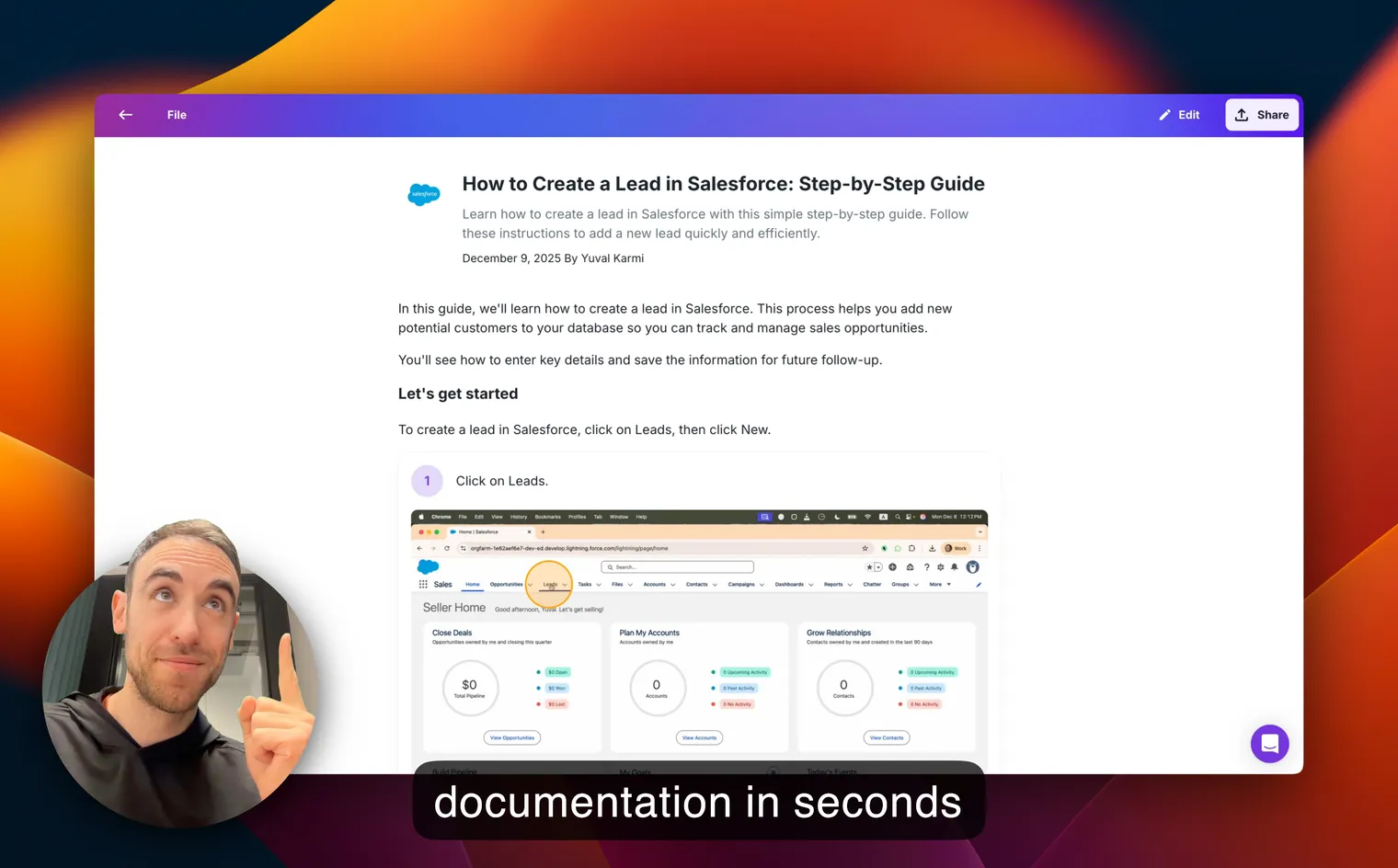
Glitter AI takes the tedium out of creating desktop procedures by turning screen recordings into polished documentation. Rather than manually grabbing screenshots and typing out instructions, employees just record themselves performing a task using the desktop app. Glitter then generates the step-by-step procedure, complete with annotated screenshots and clear written guidance, which works well for repeatable tasks like the general ledger process.
What makes this valuable is that it captures how work actually happens, not how someone thinks it should happen, which is exactly what finance teams need when building out accounting and finance SOPs or documenting the financial reporting process. When procedures need updating, teams can re-record the workflow and produce fresh documentation in minutes instead of hours. For a deeper walkthrough with a ready-made template, see our complete guide to desktop procedures.
Teach your co-workers or customers how to get stuff done – in seconds.

Frequently Asked Questions
What is a desktop procedure?
A desktop procedure is a detailed document providing step-by-step instructions for completing specific tasks at a workstation. It typically includes screenshots, field-by-field guidance, and navigation paths for computer-based work.
What is the difference between a desktop procedure and an SOP?
A desktop procedure provides detailed, task-level instructions for individual workstation activities, while an SOP offers higher-level process guidance. Desktop procedures often support specific steps referenced in broader SOPs.
Why are desktop procedures important in finance and accounting?
Desktop procedures help ensure consistency in financial processes like journal entries, reconciliations, and reporting. They reduce errors, support compliance requirements, enable cross-training, and make covering for absent team members much easier.
How do you create an effective desktop procedure?
Start by performing the task while documenting each step. Include screenshots, specific field names, navigation paths, and expected results. Write in second person, test with someone unfamiliar with the task, and update regularly as systems change.
What should be included in a desktop procedure template?
A desktop procedure template should include the procedure title, purpose, prerequisites, step-by-step instructions with screenshots, expected outcomes, troubleshooting tips, related procedures, and version history.
How often should desktop procedures be updated?
Desktop procedures should be reviewed and updated whenever software systems change, processes are modified, or errors are discovered. Many organizations schedule formal reviews quarterly or annually to keep documentation current.
What is the best format for desktop procedures?
PDF works well for printable reference, but many organizations now use digital formats stored in SharePoint, knowledge bases, or documentation platforms. The best format depends on how employees actually access and use the procedures.
Who is responsible for writing desktop procedures?
The person who performs the task regularly is often best positioned to write the desktop procedure. That said, documentation specialists or managers may format and maintain the final documents.
How do desktop procedures support audit and compliance?
Desktop procedures create a documented record of how tasks should be performed, giving auditors something to review against actual practices. They demonstrate that controls exist and are consistently followed.
Can desktop procedures be automated?
Yes, tools like Glitter AI can automatically generate desktop procedures from screen recordings. This captures actual workflows and produces documentation with screenshots and written instructions in minutes.