
Read summarized version with
What is Documentation Culture?
Documentation culture is the practice of weaving thorough, accessible documentation into the fabric of how an organization operates. It’s not about creating the occasional guide or jotting down notes when you remember to. It’s about making documentation part of every process, decision, and project so knowledge management actually happens.
In organizations with strong documentation culture, knowledge sharing isn’t someone else’s job. Critical information doesn’t live only in people’s heads or get buried in disconnected systems. Instead, employees naturally document their work because that’s just how things get done. Over time, this approach turns individual knowledge into institutional memory that anyone can access when they need it.
Three pillars tend to underpin successful documentation culture: realization (acknowledging that missing documentation creates real business problems), facilitation (giving people tools and processes that make documenting easy), and subscription (getting actual buy-in across the organization). When all three click into place, documentation stops feeling like a chore and starts functioning as something genuinely useful. Our complete guide to building a documentation culture goes deeper on making each pillar stick, with practical tactics for your team.
Key Characteristics of Documentation Culture
- Standardization: Consistent formats, templates, and structures help documentation stay clear and understandable across teams. This streamlines processes and cuts down on misunderstandings.
- Collective Ownership: Everyone contributes. Documentation isn’t dumped on one person or team. People across all roles actively create and improve what’s there, which builds collaboration and accountability.
- Leadership Commitment: Executives and managers need to walk the talk. They champion documentation, document their own work, and back up their words with resources and priorities.
- Continuous Improvement: Documentation is never really “done.” It evolves with the organization through regular reviews and updates to keep information current.
Signs of Strong vs Weak Documentation Culture
Strong Documentation Culture Indicators
You can usually spot organizations with strong documentation culture by watching how people work. Documentation is baked into daily workflows. Employees document processes as they complete them without being reminded. Knowledge repositories stay organized, get updated regularly, and people actually use them.
New hires can find their footing quickly using existing documentation. The same questions don’t get asked over and over. There’s less need for detailed policies and bureaucracy because “the way things are done” is already captured somewhere. Teams update documentation when processes change, and knowledge sharing gets recognized. Customer-facing docs stay current, which tends to reduce support ticket volume.
Weak Documentation Culture Indicators
Weak documentation culture shows up differently. Everyone has “their own way of doing things” and resists creating shared processes. Undocumented institutional know-how stays trapped in email inboxes, chat threads, or someone’s head. Documentation sites fill up with stale content that confuses people and actually increases support tickets.
Without clearly defined processes, behavior becomes inconsistent. Customer experiences vary wildly. Organizations end up needing more bureaucracy and oversight just to get things done because institutional knowledge isn’t captured anywhere useful, creating a knowledge bottleneck around the few people who do know. And when key employees leave? Critical knowledge walks out the door with them.
Building a Documentation Culture
Start with Leadership Buy-In
Documentation culture has to start at the top. Leaders need to champion these initiatives, allocate real resources to proper tools, and demonstrate documentation practices themselves. When documentation shows up in performance reviews and team goals, people take it seriously.
Invest in the Right Tools
The right platform can make creating and maintaining documentation, from a quick how-to to a full technical manual, feel almost effortless. Look for tools that fit into existing workflows, support collaborative editing, offer solid search capabilities, and work across devices. Screen recording and AI-powered documentation tools can cut documentation time from hours to minutes, which removes a lot of friction.
Make Documentation Part of the Workflow
Documentation should happen while work happens, not as an afterthought you dread. Build documentation steps into project workflows, code reviews, and process changes, the way a strong software documentation guide for developers treats writing as part of shipping. When documenting becomes a checkbox in processes people already follow, adoption goes up dramatically.
Recognize and Reward Contributors
Call out employees who create valuable documentation. Track things like most-viewed documents, documentation quality, and knowledge base usage. Celebrate the people who contribute. Recognition reinforces why documentation matters and keeps people motivated.
Start Small and Scale
Don’t try to document everything at once. Begin with the most critical and frequently-asked-about processes. Build momentum with quick wins, then expand from there. Documentation culture takes time to develop. Expect months and years of consistent effort and gradual improvement.
Documentation Culture Examples
Example 1: Tech Startup Knowledge Sharing
A fast-growing software company adopted a documentation-first approach. All product decisions, engineering changes, and customer insights had to be documented in a central wiki before implementation. Months later, team members could reference why decisions were made. New hires could understand the reasoning behind system designs. Cross-functional teams stayed on the same page. Meeting time dropped by 30%, and onboarding went from six weeks to three.
Example 2: Manufacturing Process Excellence
A manufacturing company built documentation culture by training line workers to update visual work instructions whenever they found process improvements. They put tablets on the factory floor and gave workers screen recording tools that made documentation simple. Six months in, workers had contributed over 200 process improvements. Quality defects fell by 45%, and training time for new operators dropped by 60%.
How Glitter AI Helps Foster Documentation Culture
Glitter AI tackles the biggest barrier to documentation culture: the time and effort it takes to document processes. Teams can create visual documentation through simple screen recording, which turns documentation from a tedious writing task into something quick and natural. Record your process in real-time, and Glitter automatically generates step-by-step guides that capture details (including context that usually gets lost when people try to write things out).
This approach opens documentation to everyone, not just skilled technical writers. Subject matter experts can share what they know without spending hours writing. Visual formats make documentation easier to follow. By cutting documentation time from hours to minutes, Glitter makes it possible to build documentation culture at scale and ensure critical knowledge actually gets captured and shared across the organization.
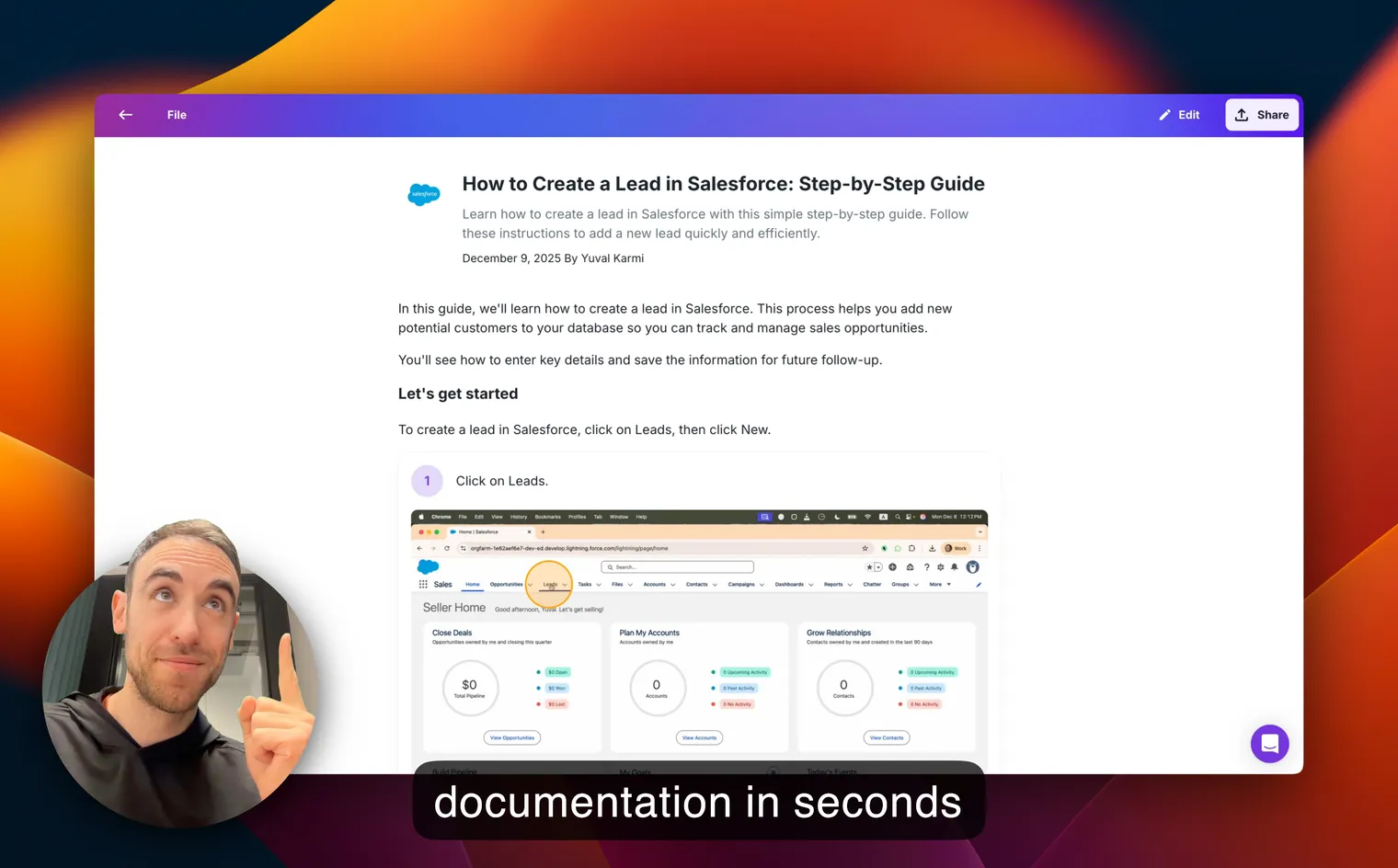
Teach your co-workers or customers how to get stuff done – in seconds.

Frequently Asked Questions
What is documentation culture?
Documentation culture is the organizational practice of making thorough documentation a core part of daily operations. Knowledge capture and sharing get embedded into every process, decision, and project across the organization.
Why is documentation culture important for organizations?
It prevents knowledge loss when employees leave, reduces time wasted searching for information, ensures processes get executed consistently, speeds up onboarding, and improves decision-making by making institutional knowledge accessible to everyone.
What are signs of a strong documentation culture?
Employees naturally document work as part of their workflow. Knowledge repositories stay organized and get updated regularly. New hires get up to speed quickly using existing documentation. People don't have to ask the same questions repeatedly.
How do you build a documentation culture in an organization?
Get leadership buy-in first. Invest in user-friendly documentation tools. Integrate documentation into existing workflows. Recognize and reward contributors. Start by documenting the most critical processes, then scale from there.
What is the difference between documentation culture and knowledge management?
Documentation culture is the organizational mindset and practices that prioritize documentation as part of daily work. Knowledge management is the broader strategic framework for capturing, organizing, and using organizational knowledge. Documentation culture enables effective knowledge management.