
Read summarized version with
What is Explicit Knowledge?
Explicit knowledge refers to information you can readily put into words, write down, and pass along to someone else. Think of it as knowledge that lives in a tangible format such as documents, videos, diagrams, or one of the knowledge base platforms covered in this Tettra alternatives guide. The key distinction here is that it doesn’t stay trapped in someone’s head. Once captured, anyone who needs it can access it.
Most organizations depend heavily on explicit knowledge to keep things running smoothly. It’s what allows a company to create consistent training programs, build out standard operating procedures, and maintain a central repository of documented answers that teams can actually use. Without it, every new hire would essentially start from scratch.
There’s also a practical continuity angle worth noting. Because explicit knowledge can be stored and retrieved, it sticks around even after people move on to other jobs. That matters quite a bit for onboarding, maintaining quality, and just keeping the lights on operationally. The opposite is tacit knowledge, which lives only in people’s heads and can easily walk out the door. Related to this is unwritten institutional know-how, the undocumented expertise that often gets lost when experienced employees leave.
Key Characteristics of Explicit Knowledge
- Codifiable: You can write it down, record it, or document it in some tangible way
- Transferable: Straightforward to share through guides, training materials, databases, or video walkthroughs
- Structured: Typically organized in a logical manner so people can search and find what they need
- Permanent: Exists as a reference resource that doesn’t disappear when someone leaves the company
Explicit Knowledge Examples
Example 1: Software Company
A development team puts together thorough API documentation covering every endpoint, parameter, and response format. When a new developer joins, they can read through it and figure out how to integrate with the system on their own. No need to bug a senior engineer every five minutes.
Example 2: Manufacturing Facility
A factory maintains detailed step-by-step procedures for running their equipment, complete with photos and safety callouts. Any trained operator can follow along and get consistent results, shift after shift.
Explicit Knowledge vs Tacit Knowledge
Explicit knowledge and tacit knowledge sit at opposite ends of the spectrum when it comes to how organizations handle what they know.
| Aspect | Explicit Knowledge | Tacit Knowledge |
|---|---|---|
| Purpose | Document and share formal information | Capture experiential wisdom and intuition |
| Scope | Structured facts, procedures, and data | Personal insights, skills, and expertise |
| When to use | Training, compliance, standardization | Problem-solving, innovation, judgment calls |
How Glitter AI Helps with Explicit Knowledge
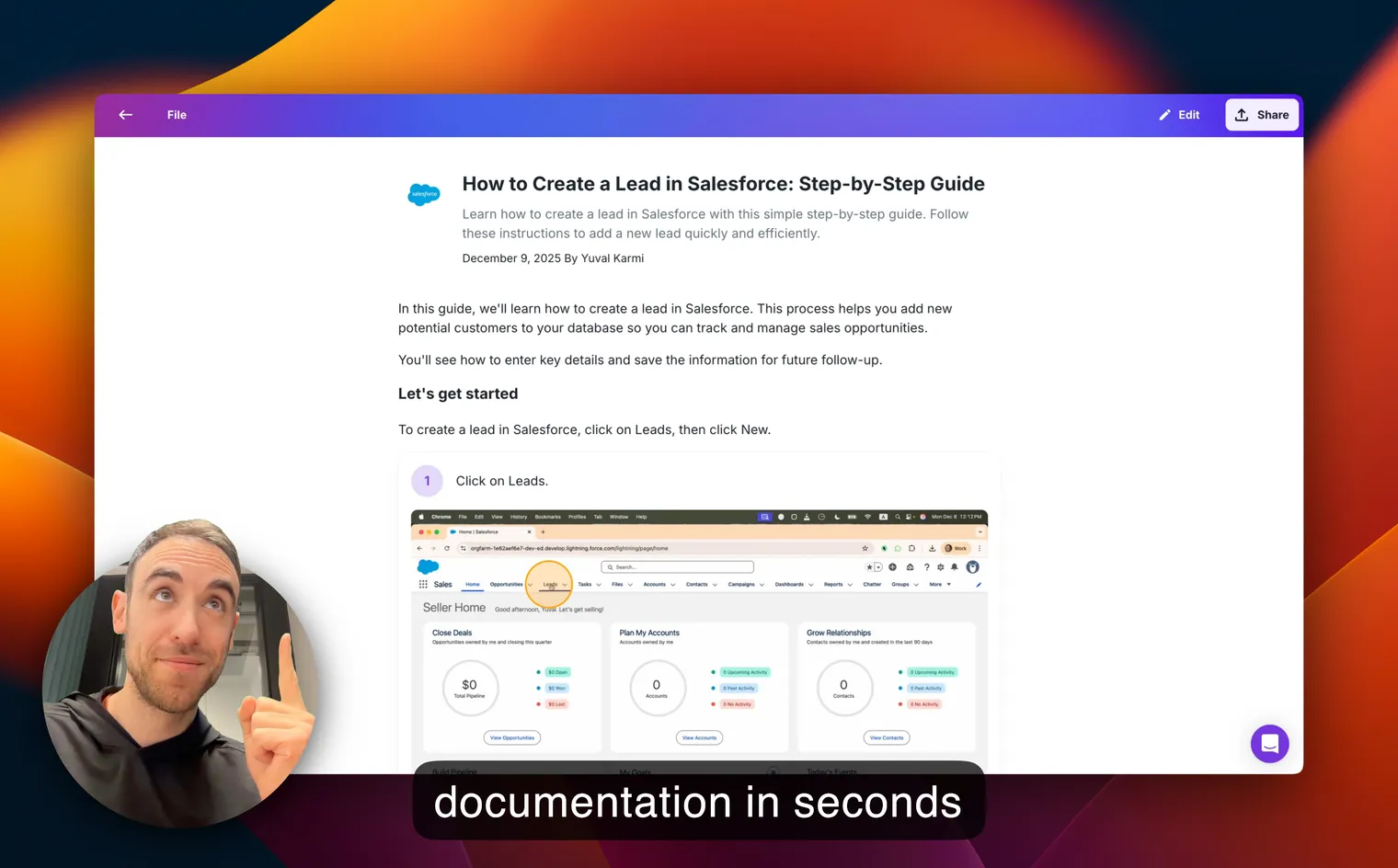
Glitter AI simplifies the process of capturing explicit knowledge and turning it into polished documentation. Record your screen while you work through a task, and Glitter automatically produces step-by-step guides with screenshots and clear descriptions. This cuts out the tedious work of manually writing everything up, so subject matter experts can quickly share what they know.
Teams using Glitter tend to build out their knowledge bases much faster, whether that’s an external knowledge base for customers or an internal wiki for staff. They also keep documentation current and make explicit knowledge available to everyone who needs it through stronger knowledge management practices. The platform essentially transforms routine workflows into reusable resources that improve training, cut down on support tickets, and preserve what the organization has learned over time.
Teach your co-workers or customers how to get stuff done – in seconds.

Frequently Asked Questions
What does explicit knowledge mean?
Explicit knowledge is information you can easily write down, document, and share with others through manuals, databases, videos, or other recorded formats. It's the kind of knowledge that doesn't require personal explanation to understand.
What is an example of explicit knowledge?
Common examples include employee handbooks, standard operating procedures, training manuals, API documentation, and how-to videos. Basically, any resource someone can reference on their own to learn a specific task or process.
Why is explicit knowledge important?
It protects business continuity by preserving critical information separately from any single employee. Organizations with strong explicit knowledge practices can train people consistently, reduce reliance on key individuals, and keep important information accessible to everyone.
How do I create explicit knowledge?
Start by documenting processes, procedures, and important information in written guides, video tutorials, databases, or a knowledge base. Tools like Glitter AI can speed this up significantly by converting screen recordings into professional documentation automatically.