
Read summarized version with
What is In-App Guidance?
In-app guidance is help that shows up right inside the software you’re using. Instead of making you dig through a help center or search for documentation somewhere else, it pops up exactly where and when you need it.
Think tooltips, interactive walkthroughs, product tours, task checklists, pop-ups, and slide-out panels. These elements appear within the app itself to walk users through features and tasks. The numbers back this up: businesses that implement in-app guidance typically see support tickets drop by 15 to 60 percent, and adoption rates can climb by around 32 percent when users get contextual help at the right moment.
Why does this matter? People learn best by doing. Asking someone to read a 20-page manual before they can use your software is a recipe for frustration. In-app guidance flips that around by providing just-in-time training within the natural workflow, which eases the mental load and builds user confidence as they go.
Key Characteristics of In-App Guidance
- Context-Sensitive Delivery: The guidance knows where you are in the app. It shows up based on your current screen, what you’re trying to do, or actions you’ve already taken.
- Embedded in Workflow: You don’t have to leave what you’re doing. Help appears right there in the interface, no context-switching or documentation hunting required.
- Interactive and Actionable: These aren’t passive instructions. Users get step-by-step prompts with visual highlights showing exactly where to click or what to type, letting them learn hands-on.
- Triggered by User Behavior: The system can kick off guidance automatically when users hit certain milestones, take specific actions, or seem stuck. Proactive support beats reactive troubleshooting.
- Reduces Time to Value: When users can find and use key features quickly, they see results faster. That’s the whole point of in-app guidance.
In-App Guidance Examples
Example 1: SaaS Onboarding Product Tour
Picture this: someone logs into a project management app for the first time. An interactive product tour kicks off automatically. Sequential tooltips guide them through creating their first project, inviting teammates, and building out a task board. Each tooltip spotlights the relevant button or field, gives clear directions, and has a “Next” button to move forward. Within a few minutes, the user understands the basics without having read a single documentation page.
Example 2: E-Commerce Admin Panel Tooltips
A store owner is configuring shipping settings on their e-commerce platform and hovers over an option they don’t recognize. A tooltip pops up immediately, explaining what the setting does and when you might actually use it. Later, when they start editing shipping zones, a slide-out panel shows a quick video on best practices. The answers come right when they’re needed, and the workflow keeps moving.
Example 3: Banking App Feature Announcement
A mobile banking app rolls out a new bill-pay feature. The next time users open the app, a modal introduces the feature with a short description and preview. They can jump into a guided walkthrough or dismiss it for later. Those who opt for the walkthrough get step-by-step in-app guidance on setting up automatic payments, with each screen element highlighted along the way.
In-App Guidance vs Performance Support
Both in-app guidance and performance support provide on-demand help, but they serve different purposes and work at different scales.
| Aspect | In-App Guidance | Performance Support |
|---|---|---|
| Purpose | Walk users through software features and workflows | Help people complete tasks with on-demand information |
| Scope | Lives inside a single application | Spans documentation, job aids, and multiple resource types |
| When to use | Software onboarding, feature discovery, tricky workflows | Any task where someone needs reference info or step-by-step procedures |
| Format | Tooltips, product tours, interactive walkthroughs in the UI | Job aids, guides, videos, EPSS, plus in-app guidance |
| Primary benefit | Drives software adoption and flattens the learning curve | Cuts reliance on training and memorization |
How Glitter AI Helps with In-App Guidance
Glitter AI makes it easier to build the resources that go hand-in-hand with in-app guidance. While in-app guidance tools handle tooltips and walkthroughs inside your software, Glitter helps teams document the underlying processes users need to understand. Screen recording plus AI-powered documentation generation means you can quickly produce visual guides, a user guide, and training videos that work alongside your in-app guidance, which makes Glitter a practical SaaS documentation tool for product teams. It works differently from a dedicated digital adoption platform, a contrast we cover in our Gyde and Supademo comparisons for teams weighing the two approaches.
Here’s how it typically plays out: before you can design effective in-app guidance, you need to map out your workflows and figure out where users are likely to get stuck. Glitter simplifies that documentation work by capturing steps automatically with a free Chrome extension, generating clear instructions, and producing visual references with a built-in annotation tool that works as a lighter-weight alternative to heavier platforms. You can use these materials to inform what goes into your in-app guidance elements, or link them as supplementary resources from within the app itself.
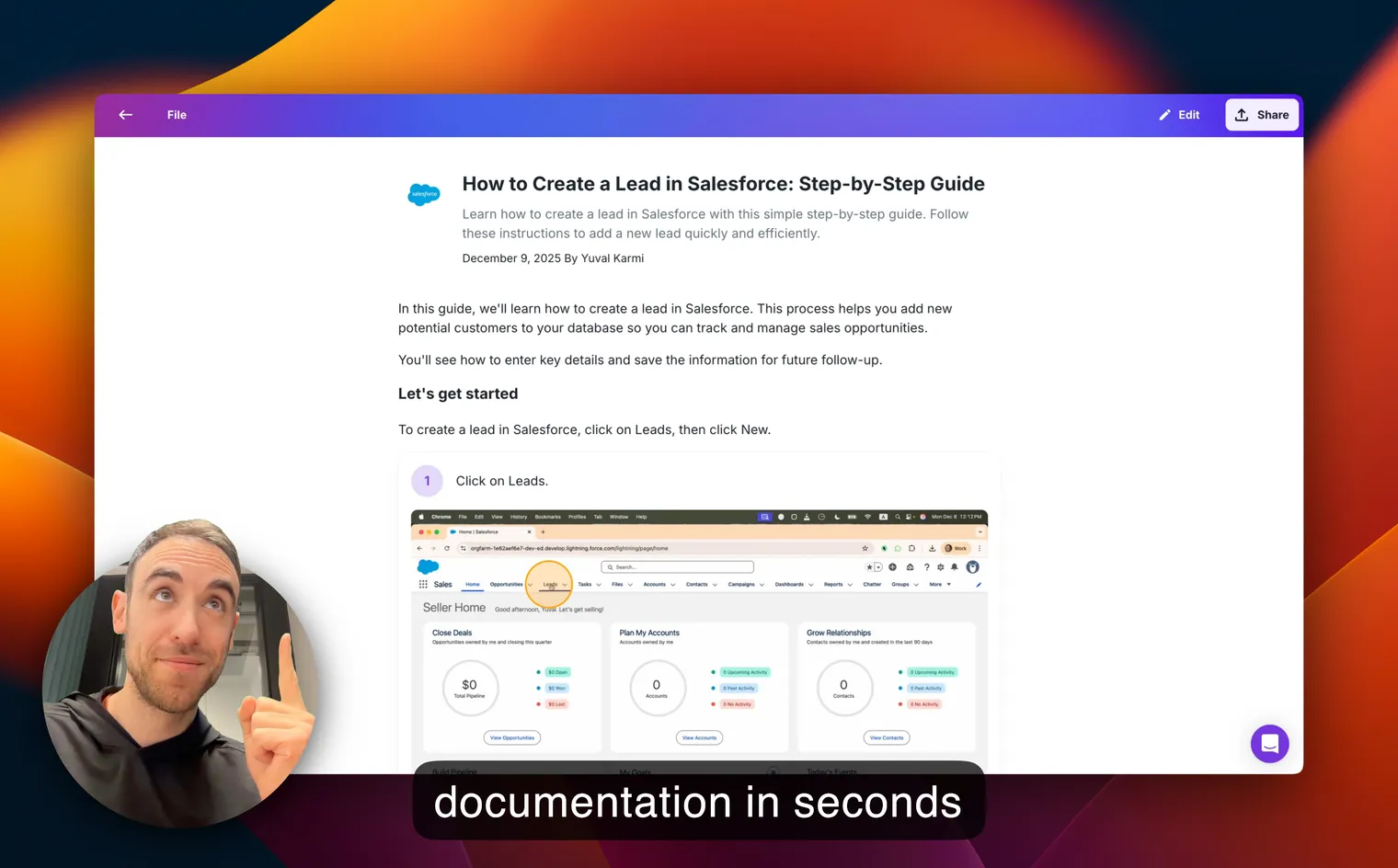
Teach your co-workers or customers how to get stuff done – in seconds.

Frequently Asked Questions
What does in-app guidance mean?
In-app guidance is contextual help and interactive instructions that show up directly inside a software application. It guides users through tasks and features without making them leave the app or dig through external documentation.
What is an example of in-app guidance?
A classic example is a product tour that launches when someone first logs into a software application. It uses sequential tooltips to highlight key features and walk users through their first task, like creating a project or inviting team members.
Why is in-app guidance important?
It shortens the learning curve, cuts support tickets by 15-60 percent, and can boost adoption rates by up to 32 percent. Users discover value faster because help appears exactly when and where they need it.
How do I create in-app guidance?
Most teams use digital adoption platforms or specialized tools to build tooltips, product tours, and interactive walkthroughs. The process usually starts with identifying where users get stuck, then creating contextual help that appears at those friction points.
What is the difference between in-app guidance and a help center?
In-app guidance delivers contextual help right inside the application at the point of need. A help center, on the other hand, is a separate documentation repository that users have to search and navigate outside their workflow.