
Read summarized version with
What is an Internal Process?
An internal process refers to a series of connected activities, tasks, and decision points happening entirely within an organization. Unlike a business process involving customers, vendors, or other external parties, internal processes are managed by employees and systems inside the company. They tend to form the operational backbone keeping the business running on a daily basis.
You might think of internal processes as the behind-the-scenes work making everything else possible. Approving expense reports, onboarding new employees, conducting performance reviews, managing IT support tickets. None of these directly touch customers, yet without them, customer-facing work would likely fall apart. Internal processes help ensure resources get allocated properly, decisions happen consistently, and teams remain aligned.
Organizations with well-documented internal processes generally operate more efficiently and consistently. When employees understand exactly how things work internally, they spend less time asking questions or figuring things out from scratch. Clearly written-down procedures for internal processes also make training new hires easier and help maintain regulatory compliance.
Key Characteristics of Internal Process
- Contained Within the Organization: Internal processes don’t involve external parties like customers, suppliers, or partners. All activities occur inside the company, handled by employees and internal systems.
- Supporting Core Operations: While these processes don’t directly generate revenue, they enable the people and systems that do. They serve as the infrastructure keeping everything else running.
- Standardizable and Repeatable: Internal processes follow consistent patterns, which makes them suitable for documentation and automation. Formalizing them into a documented, step-by-step procedure ensures the same steps get repeated regularly, whether daily, weekly, or triggered by specific events.
- Cross-Departmental Reach: Many internal processes span multiple teams. Employee onboarding, for instance, involves HR, IT, the hiring manager, and sometimes finance. Coordination becomes essential.
- Improvable Over Time: Because internal processes remain under the organization’s control, teams can refine and optimize them without external approval. This makes continuous improvement more practical.
Internal Process Examples
Example 1: Expense Reimbursement Process
An employee submits an expense report with receipts through the company’s expense management system. Their manager reviews and approves (or rejects) the request. Finance then validates the submission for policy compliance, processes the reimbursement, and updates accounting records. The employee receives payment through payroll. Every step happens internally, following documented procedures that maintain consistency and proper controls.
Example 2: IT Access Request Process
When someone needs access to a new software system, they submit a request through the IT ticketing system. Their manager approves based on job requirements. IT security reviews the access level for compliance with security policies. The IT team provisions the account and notifies the employee. Finally, the access grant gets logged for audit purposes. This internal process protects the organization while ensuring people get the tools they need.
Internal Process vs External Process
These terms describe where and with whom processes happen.
| Aspect | Internal Process | External Process |
|---|---|---|
| Participants | Employees and internal systems only | Involves customers, vendors, or partners |
| Control | Fully controlled by the organization | Requires coordination with outside parties |
| Visibility | Typically not visible to outsiders | Often visible to customers or partners |
| Examples | Expense approval, performance reviews, IT support | Order fulfillment, customer support, vendor payments |
The key distinction comes down to whether external parties are involved. An internal process like budget approval stays entirely within the company. An external process like processing a customer order requires interaction with someone outside the organization. Many business operations actually combine both: customer-facing parts are external processes, while behind-the-scenes coordination remains internal.
How Glitter AI Helps with Internal Process
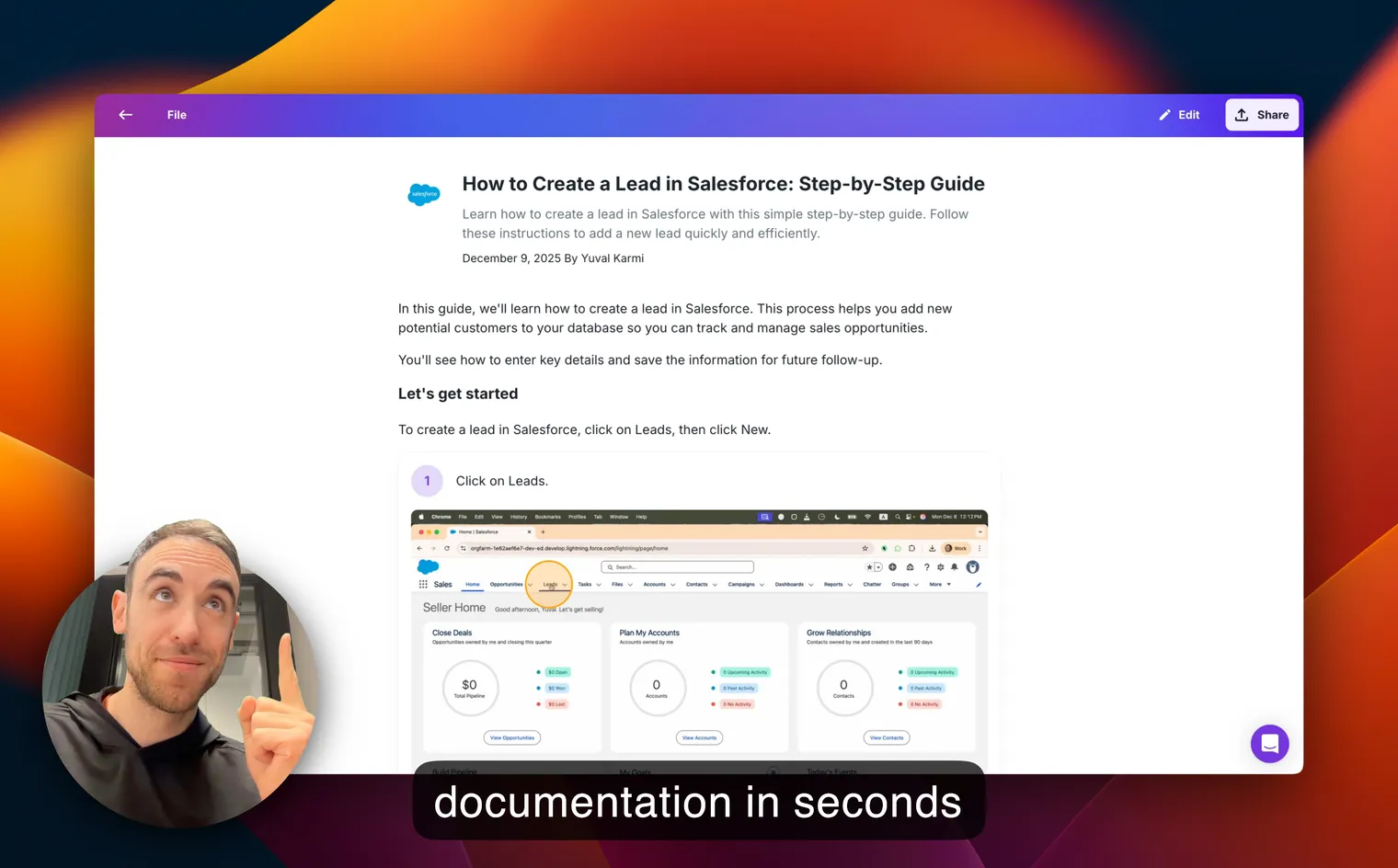
Glitter AI makes documenting internal processes fast and straightforward. Instead of writing out step-by-step instructions manually, team members simply perform their tasks while Glitter records the screen. The tool then automatically generates visual documentation with screenshots, annotations, and written instructions anyone can follow.
This approach works especially well for internal processes because they often involve multiple systems and steps that prove difficult to describe in text alone, so even non-writers can produce something usable. It also helps when documenting a process someone else owns, since the recording captures the real steps instead of a secondhand description. When a process changes, whether due to a new software tool, updated policy, or improved workflow, teams can quickly re-record and share updated documentation across remote teams. The result is internal process documentation that stays current and actually gets used, helping maintain consistency across departments, surfacing where a process bottleneck slows work down, and making onboarding new employees considerably smoother.
Teach your co-workers or customers how to get stuff done – in seconds.

Frequently Asked Questions
What is an internal process?
An internal process is a sequence of activities and decisions happening entirely within an organization, without involving external parties like customers or vendors. Examples include expense approvals, employee onboarding, IT support requests, and performance reviews.
What are examples of internal business processes?
Common internal business processes include hiring and onboarding new employees, approving expenses and purchase requests, conducting performance reviews, managing IT access and support, processing payroll, and handling internal communications and approvals.
What is the difference between internal and external processes?
Internal processes happen entirely within the organization and involve only employees and internal systems. External processes involve parties outside the company, like customers, suppliers, or partners. Internal processes support operations while external processes often drive revenue.
Why are internal processes important?
Internal processes keep organizations running smoothly by ensuring consistent operations, proper resource allocation, and clear decision-making. Well-documented internal processes reduce confusion, speed up training, improve compliance, and free up time for customer-facing work.
How do you document internal processes?
Start by mapping each step from trigger to completion, identifying who handles what, and noting any decision points. Tools like Glitter AI can automate this by recording your screen as you perform the process and generating visual documentation with screenshots and instructions.
What are the four types of internal processes?
Internal business processes typically fall into four categories: operation management (daily tasks), customer management (internal customer service activities), regulatory compliance (meeting legal requirements), and innovation (improving products and services).
How can you improve internal processes?
Improve internal processes by first documenting how things currently work, identifying bottlenecks and pain points, eliminating unnecessary steps, automating repetitive tasks, and regularly reviewing performance. Getting input from people who actually do the work proves essential.
What is the difference between formal and informal internal processes?
Formal internal processes are standardized, documented, and followed consistently across the organization. Informal processes are unwritten and may vary between employees or teams. Critical processes should be formalized while routine tasks may remain informal.
Who owns internal processes in an organization?
Internal processes are typically owned by a process owner or department manager accountable for how the process performs. This person ensures the process is documented, followed consistently, and improved over time. Cross-functional processes may have shared ownership.
How do internal processes affect employee productivity?
Clear, well-documented internal processes boost productivity by reducing confusion and eliminating time spent figuring out how things work. Employees can focus on their actual tasks instead of asking questions or recreating steps. Poorly designed processes create frustration and wasted effort.