
Read summarized version with
What is Process Automation?
Process automation is, at its core, about letting technology handle the repetitive stuff so people can focus on work that actually requires thinking. Rather than having employees manually perform the same tasks over and over, organizations set up software and rule-based systems to take care of these workflows automatically.
The shift can be pretty significant for how a company runs day-to-day. Think about all those manual touchpoints in routine workflows: routing customer inquiries, generating invoices when orders go out, keeping data in sync across different systems. Process automation removes that busywork and cuts down on both the time spent and the inevitable mistakes that come with repetitive manual entry. When you pair automation with solid written process records, things get even better because everyone actually understands what’s being automated and the reasoning behind it.
Companies that get process automation right tend to see real gains in speed, accuracy, and cost. Tasks that used to take hours finish in seconds. Those pesky data entry errors? Gone. And employees can finally spend their time on problem-solving and strategic work instead of mindless repetition.
Key Characteristics of Process Automation
- Rule-Based Execution: Automated processes follow predefined rules and logic to decide when and how tasks run, which means you get consistent results every time.
- Reduced Human Intervention: Once you’ve set things up, processes run on their own. People only step in for exceptions or decisions that genuinely need human judgment.
- Integration Across Systems: Automation connects your various applications, databases, and platforms so data flows smoothly and actions stay coordinated.
- Scalability: As volumes increase, automated processes can handle the load without requiring proportionally more resources. Growth becomes more manageable.
- Measurable Performance: You get detailed logs and metrics, making it straightforward to track efficiency gains, spot bottlenecks, and fine-tune things over time.
Process Automation Examples
Example 1: Customer Support Ticket Routing
Consider a software company dealing with hundreds of support tickets every day coming through email, chat, and web forms. Their process automation setup categorizes each incoming request based on keywords, urgency signals, and the customer’s account type. Enterprise customers with high-priority issues get routed straight to senior engineers, complete with SMS alerts. Billing questions head to finance. Technical problems are assigned based on which team handles that particular product. The system also fires off acknowledgment emails automatically, starts SLA timers, and escalates any ticket that sits unresolved past its deadline. What used to require a small team doing manual triage now happens instantly, and customers get faster help from people who can actually solve their problem.
Example 2: Employee Expense Reimbursement
A consulting firm decided to automate their expense reimbursement end-to-end process. Here’s how it works: employees submit expense reports through a mobile app, and the system validates receipts using OCR, checks amounts against company policy limits, and routes requests to the right approver based on department and dollar thresholds. Once approved, expenses flow directly into accounting for payment. The automation catches policy violations, flags duplicate submissions, and keeps employees updated on where things stand in real time. Finance spends less time on data entry and policy policing, while employees get paid back faster and can actually see the status of their submissions.
Process Automation vs Process Documentation
These two work well together, but they’re solving different problems.
| Aspect | Process Automation | Process Documentation |
|---|---|---|
| Purpose | Runs tasks automatically to boost speed and accuracy | Records how processes work so people understand and follow them consistently |
| Focus | Cutting out manual effort through technology | Preserving institutional knowledge and standardizing how work gets done |
| When to use | For repetitive, rule-based tasks with predictable patterns | When you need to keep knowledge from walking out the door, train new people, or map out workflows |
| Primary Benefit | Speed and scale through operational efficiency | Knowledge retention and consistent execution across the organization |
| Relationship | Works best when you’ve documented the process first | Helps you figure out what’s worth automating |
How Glitter AI Helps with Process Automation
You can’t automate what you don’t understand. Before any automation project, organizations need a clear picture of how their current process actually works. This is where Glitter AI comes in handy. Teams use Glitter to document their existing workflows by recording them as they happen, which doubles as process discovery and a first step toward streamlining business processes before any workflow automation is built.
That documentation becomes the blueprint for automation. Teams can look at it and identify which steps are repetitive and rule-based (great automation candidates, as covered in our accounting automation guide) versus which ones genuinely need human judgment. When building the automation, Glitter documentation serves as requirements for developers or configuration guides if you’re using no-code tools. And once automation is live, teams can update their Glitter docs to show the new workflow, so everyone knows how things operate now and when they might still need to step in.
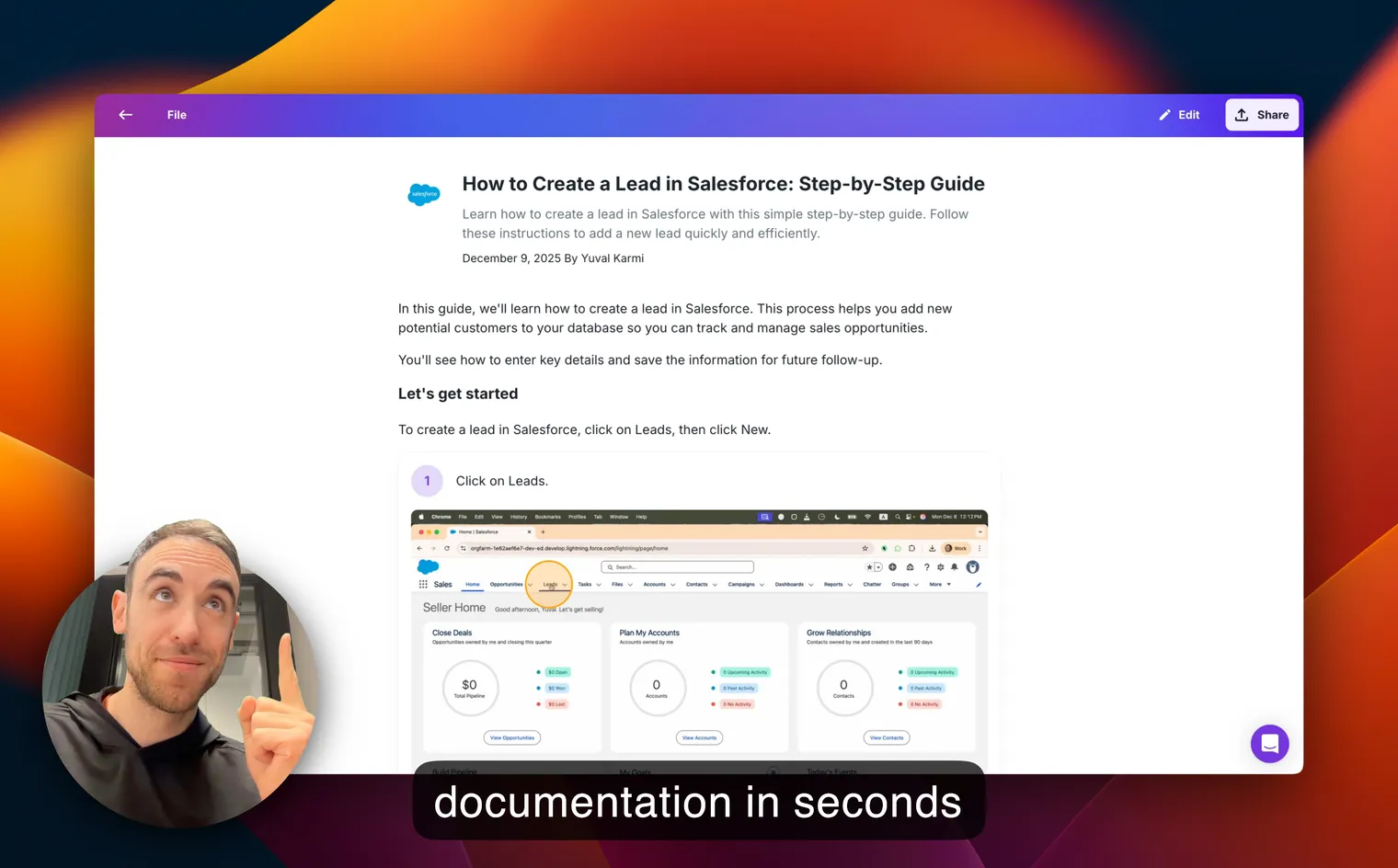
Teach your co-workers or customers how to get stuff done – in seconds.

Frequently Asked Questions
What is process automation?
Process automation uses technology to run recurring business processes or workflows without much human involvement. It improves efficiency, cuts down on errors, and lets employees spend their time on work that actually requires human judgment and creativity.
What is an example of process automation?
A customer support ticket routing system that automatically categorizes incoming requests, assigns them to the right specialists based on issue type and priority, sends acknowledgment emails, and escalates unresolved issues, all without anyone on the support team having to do it manually.
Why is process automation important?
Process automation makes operations run faster and more accurately by handling repetitive tasks that humans would otherwise slog through. It reduces labor costs for routine work, eliminates data entry mistakes, and frees up employees to focus on strategic initiatives that actually move the business forward.
How do you implement process automation?
Start by documenting your existing processes so you understand how work currently flows. Then identify the repetitive, rule-based tasks that would benefit from automation. Pick the right tools for the job, configure your automation logic, test everything thoroughly, and keep monitoring and tweaking once it's live.