
Read summarized version with
I remember the exact moment I realized I needed a proper training program for my team at Simpo.
I’d just hired three new people in the span of two weeks. Each one asked me the same questions. Each one made the same mistakes. And each one required me to drop everything and walk them through processes I’d already explained to the person before them.
I was spending 15-20 hours a week on training. That’s basically a part-time job just getting people up to speed.
The worst part? I knew I wasn’t doing a great job. My “training” consisted of me frantically explaining things while jumping between tools, hoping they’d remember everything. Spoiler alert: they didn’t.
I needed an actual training program. Not just random instruction here and there, but a systematic way to get people from “first day” to “productive team member” without burning myself out.
Here’s what I learned about creating training programs that actually work. Not theoretical BS from management textbooks, but practical stuff I wish someone had told me from day one. If you also need to build supporting materials, our guide on how to create a training manual is a solid companion piece.
Yuval / Founder & CEO, Glitter AI
Teach your co-workers or customers how to get stuff done – in seconds.

Step 1: Assess Your Training Needs (What Do People Actually Need to Learn?)
Before you create any training materials, you need to figure out what people actually need to know. This seems obvious, but I got it wrong the first time.
I made detailed training about features I thought were important. Turns out, my team needed help with completely different things - the edge cases, the gotchas, the stuff that only comes up when you’re actually doing the work.
Talk to Your Team
Here’s how I do needs assessment now: I talk to the people who are already doing the job.
Questions I ask:
- What did you find most confusing when you started?
- What do new team members consistently ask you about?
- What mistakes do you see people make repeatedly?
- What do you wish someone had taught you on day one?
- What processes do people struggle with most?
I usually get better insights from a 30-minute conversation with a frontline employee than from a week of theorizing on my own.
Identify Skills vs. Knowledge Gaps
There’s a big difference between a gap in what someone knows and not knowing how to do something.
Knowledge gaps: Things people need to know (company policies, product features, system names)
Skills gaps: Things people need to do (troubleshoot issues, handle customer objections, use specific software)
I found that most training focuses too much on knowledge (“here’s information about our product”) and not enough on skills (“here’s how to actually use our product to solve customer problems”).
Your training program needs both, but skills training is what actually moves the needle.
Prioritize What Matters Most
You can’t train everyone on everything at once. I learned this the hard way by creating a 40-hour onboarding program that overwhelmed new hires.
I now prioritize based on:
- Critical skills: What do they need to do their job on day one?
- Common tasks: What will they do most frequently?
- High-impact skills: What makes the biggest difference in performance?
- Nice-to-haves: What can wait until they’re settled in?
Start with the critical stuff. Everything else can come later through a structured learning path.
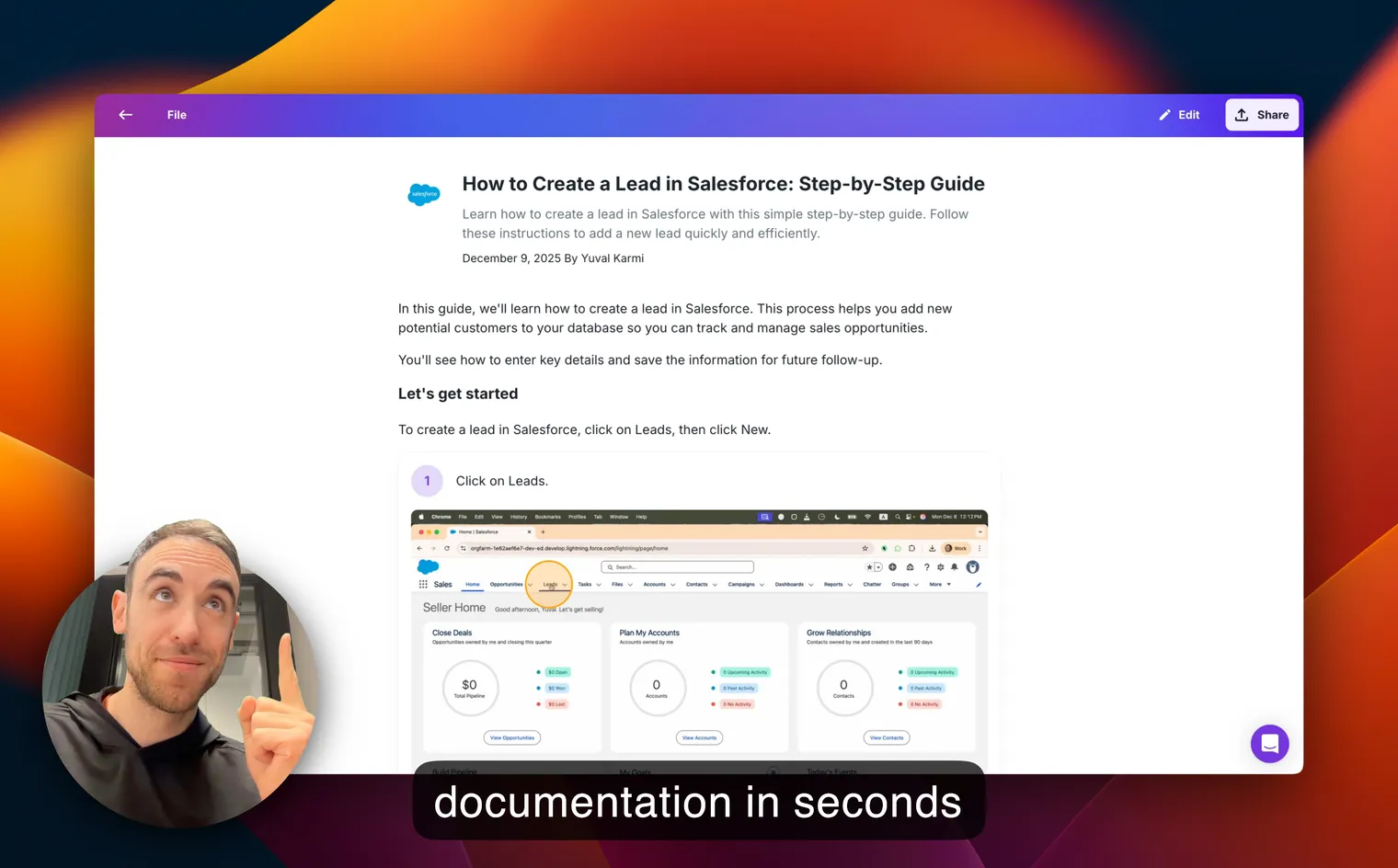
Record yourself doing the process once. Glitter AI creates step-by-step training guides with screenshots automatically.
Step 2: Set Clear Learning Objectives
This is where most training programs get fuzzy. They describe what they’ll cover, but not what learners will actually be able to do after training.
I used to write objectives like: “Understand our customer service process.” Sounds good, right?
Wrong. That’s not measurable. How do you know if someone “understands” something?
Write Observable, Measurable Objectives
Now I write objectives that start with action verbs:
Instead of:
- “Understand how to process refunds”
- “Learn about our ticketing system”
- “Know the escalation procedure”
I write:
- “Process standard refund requests in under 5 minutes”
- “Create, assign, and close tickets in our system”
- “Identify when to escalate issues and follow proper escalation procedure”
See the difference? The second version tells you exactly what someone should be able to do, and you can actually test whether they can do it.
Connect Objectives to Real Work
Every learning objective should connect directly to something people need to do in their actual job.
I ask myself: “If someone masters this objective, what specific task can they now perform?” If I can’t answer that clearly, the objective needs work.
Keep Objectives Focused
Each training session should have 3-5 main objectives, max. I tried cramming 12 objectives into one training session once. Nobody retained anything.
Better to have people master 3 things than barely remember 12.
Step 3: Choose Your Training Formats
There’s no one perfect training format. The right approach depends on what you’re teaching, who you’re teaching, and what resources you have.
Here’s what I’ve learned works for different situations:
Video Training
Best for: Demonstrating processes, showing how to use software, providing overview content
Pros:
- People can pause, rewind, and rewatch
- Shows exactly how things are done
- Can be consumed asynchronously
- Great for visual learners
Cons:
- Takes time to produce quality videos
- Hard to update when processes change
- Can feel impersonal
- No way to ask questions in the moment
I use video for training documentation that needs to be repeated often - like software walkthroughs or standard procedures. But I keep videos short (5-10 minutes max). Nobody wants to watch a 45-minute training video.
Written Documentation
Best for: Reference materials, step-by-step processes, quick guides
Pros:
- Easy to search and reference later
- Can be updated quickly
- Accessible for different learning paces
- Works great as job aids
Cons:
- Can be boring if not well-written
- Harder to demonstrate complex visual tasks
- Requires good writing skills
- Easy to make too long or dense
I create written guides for anything people might need to reference while doing the work. My rule: if someone might need to look this up mid-task, it should be written down.
Hands-On Practice
Best for: Learning new skills, mastering tools, building confidence
Pros:
- Highest retention and skill development
- Reveals gaps in understanding immediately
- Builds muscle memory
- Increases confidence
Cons:
- Takes more time and planning
- Requires access to practice environments
- Harder to scale
- May need supervision
This is the most effective format for actual skill building. I always include hands-on components for any critical skills training. Reading about how to do something is not the same as actually doing it.
Live Training Sessions
Best for: Complex topics, collaborative learning, Q&A, culture building
Pros:
- Interactive and engaging
- Can address questions in real-time
- Builds team connections
- Adaptable to learner needs
Cons:
- Scheduling challenges
- Doesn’t scale easily
- Quality depends on trainer
- Not self-paced
I use live sessions for onboarding new cohorts and for topics that typically generate lots of questions. But I always record them and create follow-up documentation for people to reference later.
Blended Approach
Here’s what actually works: combining multiple formats.
For most training programs, I use this framework:
- Pre-work: Written overview or short video to introduce concepts
- Live session: Interactive workshop to practice and discuss
- Follow-up: Written guide and resources for ongoing reference
- Practice: Hands-on exercises or real work with support
This hits different learning styles and reinforces the content through multiple touchpoints.
Teach your co-workers or customers how to get stuff done – in seconds.
Step 4: Create Your Training Content
This is where the rubber meets the road. You know what to teach and how to teach it - now you need to actually create the content.
Start With the End in Mind
Before I create any training content, I ask: “What will someone be able to do after completing this training?”
Then I work backwards from that outcome. Every piece of content should move learners closer to that goal.
I skip:
- Background info they don’t need
- Exhaustive feature lists they won’t use
- Nice-to-know tangents
- My personal war stories (unless they’re actually relevant)
Follow a Consistent Structure
People learn better when content follows a predictable pattern. Here’s the structure I use for most training modules:
1. Context: Why this matters and when they’ll use it (2 minutes)
2. Overview: Big picture of what they’re learning (3 minutes)
3. Step-by-step walkthrough: How to actually do it (10-15 minutes)
4. Common issues: What typically goes wrong and how to fix it (5 minutes)
5. Practice: Hands-on exercise or example (10-15 minutes)
6. Resources: Where to find help and additional info (2 minutes)
This pattern works whether you’re creating videos, written guides, or live training sessions.
Use Real Examples
Generic, made-up examples are boring and forgettable. I use real scenarios from actual work.
Instead of: “Let’s say a customer contacts you with a question…”
I use: “Last week, Sarah got a ticket from a customer who couldn’t reset their password. Here’s exactly what she did…”
Real examples show people what the work actually looks like, including all the messy details that textbook examples skip.
Include Visuals
I used to create training that was just walls of text. Adoption was terrible.
Now I include visuals for anything that involves:
- Software interfaces (screenshots with annotations)
- Multi-step processes (flowcharts or diagrams)
- Decision trees (visual guides for “if this, then that”)
- Before/after examples (showing the result)
People learn faster and retain more when they can see what you’re talking about. I use Glitter AI to automatically capture screenshots while I record myself doing a process - saves me hours of screenshot-taking and annotating.
Keep It Scannable
People don’t read training materials word-for-word. They scan.
I make content scannable by using:
- Short paragraphs (2-3 sentences max)
- Bullet points and numbered lists
- Bold text for key concepts
- Clear headings and subheadings
- White space to break up dense sections
If your training guide looks like a legal document, people won’t read it.
Test It With Real People
Before rolling out training to your whole team, test it with 2-3 people who represent your target audience.
I ask them:
- Were any steps confusing?
- What questions came up?
- How long did it take?
- What’s missing?
- What could be removed?
Every time I test training materials, I find things that made perfect sense to me but confused everyone else. Better to catch that before you train 50 people.
Step 5: Deliver and Facilitate Training
Creating great content is only half the battle. How you deliver that training makes a huge difference in whether people actually learn.
Set Expectations Upfront
I start every training by being crystal clear about:
- What we’re covering (and what we’re not)
- How long it will take
- What they’ll be able to do afterward
- When they’ll have time to practice
- Where to find resources later
People learn better when they know what to expect.
Make It Interactive
The fastest way to lose people in training is to lecture at them for an hour.
Instead, I:
- Ask questions every 5-10 minutes
- Include discussion prompts
- Do live demonstrations
- Have people practice while I watch
- Encourage them to share experiences
- Build in Q&A time
Even in recorded or written training, I include reflection questions or practice exercises to keep people engaged.
Create a Safe Learning Environment
People won’t ask “stupid questions” if they’re worried about looking dumb.
I explicitly tell new team members:
- There are no stupid questions
- Everyone struggles with this at first
- Making mistakes during training is expected and encouraged
- I’d rather you ask now than guess wrong later
When someone asks a question, I thank them because I know five other people probably had the same question.
Pace Appropriately
I used to rush through training because I already knew the material. Big mistake.
Now I:
- Pause after each major concept
- Check for understanding before moving on
- Slow down for complicated parts
- Speed up for simple review
- Watch for confused faces
- Ask “does this make sense?” regularly
If people are lost on step 3, rushing through steps 4-10 doesn’t help anyone.
Provide Immediate Feedback
When people practice during training, I give them feedback right away.
Good feedback is:
- Specific (“Great job identifying the customer’s real issue”)
- Actionable (“Next time, check the order history first”)
- Balanced (both what they did well and what to improve)
- Timely (right after the practice, not next week)
Immediate feedback accelerates learning way more than delayed feedback.
Make Resources Accessible
During training, I show people exactly where to find resources they’ll need:
- Where the written guides are stored
- How to search for specific procedures
- Who to ask for help
- What tools they’ll use
I literally walk them through opening, searching, and bookmarking the resources. Sounds basic, but if people can’t find the help they need later, your training won’t stick.
Create visual step-by-step guides that employees can reference while working. No more forgetting what they learned.
Step 6: Measure Training Effectiveness
Here’s where most training programs fall apart. You deliver the training, everyone nods along, and then… you have no idea if it actually worked.
I used to think training was successful if people showed up and seemed engaged. Then I realized people can be engaged and still not learn anything useful.
Measure What Matters
Forget completion rates and satisfaction surveys. Those don’t tell you if people actually learned anything.
I focus on:
1. Can they do the thing?
- Performance on hands-on exercises
- Ability to complete real tasks independently
- Time to proficiency for new skills
- Error rates on trained procedures
2. Are they doing the thing?
- Actual behavior changes on the job
- Usage of new skills or tools
- Compliance with trained procedures
- Quality of work outputs
3. Does it impact business results?
- Reduction in errors or rework
- Faster task completion
- Better customer outcomes
- Fewer support escalations
These metrics actually tell you if your training worked.
Test Knowledge and Skills
I include assessments in my training programs, but not the multiple-choice quiz variety that just tests memory.
Instead, I use:
- Practical demonstrations (“Show me how you’d handle this situation”)
- Real work samples (“Complete this actual task”)
- Scenario-based questions (“A customer says X, what would you do?”)
- On-the-job observations (watching them work)
These show whether someone can actually apply what they learned, not just repeat it back.
Track Long-Term Retention
Someone passing a test right after training doesn’t mean they’ll remember it a month later.
I check in after:
- 1 week: Can they still do it without help?
- 1 month: Are they doing it consistently?
- 3 months: Has the skill become automatic?
If people are forgetting within a week, your training needs work. Either the content wasn’t clear, there wasn’t enough practice, or they’re not using the skill enough to retain it.
Gather Feedback (The Right Way)
I don’t just ask “Did you like the training?” That tells me nothing useful.
Better questions:
- What concepts were still unclear after training?
- What took longer than expected to learn?
- What’s missing from the training materials?
- When you tried to do this on the job, what problems came up?
- What would make this training more helpful?
Specific feedback helps me improve the training for the next cohort.
Watch for Early Warning Signs
Some signals tell me training isn’t working:
Red flags:
- People keep asking the same questions
- Lots of errors on trained procedures
- Team members reverting to old ways of doing things
- High frustration or complaints
- Bottlenecks in workflow for newly trained tasks
When I see these, I don’t blame the learners. I fix the training.
Step 7: Iterate and Improve Your Training
No training program is perfect on the first try. Hell, mine still aren’t perfect and I’ve been doing this for years.
The key is continuous improvement.
Collect Data Systematically
I track:
- Which modules generate the most questions
- Where people consistently struggle
- What takes longer than expected
- Which resources get used most
- What content people skip
This data shows me where to focus my improvement efforts.
Update for Process Changes
This is critical. When your processes change, your training needs to change too.
I learned this lesson when we updated our software and forgot to update the training materials. New team members kept following the old process from the training, then got confused when it didn’t work.
Now I have a rule: any process change automatically triggers a training update. No exceptions.
Refresh Outdated Content
Even if the process hasn’t changed, training content can become stale.
I review and refresh training when:
- Screenshots show old interface versions
- Examples reference discontinued products or tools
- Language sounds dated or uses old terminology
- Better tools or methods are now available
- Team feedback suggests confusion
Outdated training is sometimes worse than no training because it teaches people the wrong things.
Test New Approaches
I experiment with different training methods to see what works best.
Recent experiments:
- Switching from 2-hour sessions to 30-minute microlearning modules
- Adding peer learning components where experienced team members train newbies
- Creating video walkthroughs for visual processes
- Using AI to generate first drafts of training content
Some experiments fail. That’s fine. The ones that work make training significantly better.
Document What Works
When I figure out something that works well, I document it so I can replicate it.
This includes:
- Effective training structures or templates
- Analogies or explanations that really click for people
- Great examples or scenarios
- Successful delivery techniques
Building a library of “what works” makes creating new training faster and more effective.
Common Training Program Mistakes to Avoid
Let me save you some headaches by sharing mistakes I’ve made (so you don’t have to):
Mistake 1: Creating Training Before Understanding the Need
I once spent weeks building a comprehensive training program for a new tool. Turns out, the team only used 3 features of that tool. 90% of my training was wasted effort.
Always start with needs assessment. Don’t create training for stuff people don’t need to know.
Mistake 2: Making It Too Long
My first employee onboarding program was 40 hours of training. People were drowning in information.
Now I focus on critical skills first, then layer in additional training over time. People can only absorb so much at once.
Mistake 3: Training Without Practice
Reading or watching training without actually doing the thing doesn’t create competence.
People need to practice while learning. Every training session should include hands-on time.
Mistake 4: Forgetting Follow-Up Support
Training ends, people go back to work, hit roadblocks, and have no idea what to do.
I now build in follow-up support: office hours, peer buddies, easily accessible reference guides, and Slack channels for questions.
Mistake 5: Not Involving Subject Matter Experts
I tried creating training for processes I only partially understood. The training was mediocre at best.
Now I always involve the people who actually do the work. They know the gotchas, the edge cases, and the real challenges better than I ever will.
Mistake 6: Using Generic Templates
I downloaded an “employee training program template” once and tried to adapt it. It felt stiff, corporate, and nothing like our actual culture.
Templates can provide structure, but your training needs to reflect your actual team, processes, and culture.
Mistake 7: Ignoring Different Learning Styles
Some people learn best by reading. Others need to watch. Some have to do it themselves to understand.
Mix your formats to accommodate different learning preferences.
Teach your co-workers or customers how to get stuff done – in seconds.
Building Your Training Program: Getting Started
Look, I get it. Creating a training program from scratch feels overwhelming. Where do you even start?
Here’s what I’d do if I were starting today:
Week 1: Talk to your team. Identify the 3-5 most critical skills people need. Write clear learning objectives.
Week 2: Create training for the #1 most important skill. Just that one. Make it good. Test it with one person.
Week 3: Revise based on feedback. Roll it out to more people. Document what works and what doesn’t.
Week 4: Create training for skill #2. Use what you learned from skill #1.
Don’t try to build the entire program at once. Start small, learn, improve, and build from there.
The goal isn’t to create perfect training. The goal is to create training that helps people actually learn what they need to know. For more strategies on getting this right, see our guide to running training programs that actually work.
And honestly? A simple, clear training program that covers the essentials beats a comprehensive program that’s too complex to follow.
Start with the basics. Make them work. Build from there.
By the way, if you’re creating training that involves software or processes, Glitter AI can save you hours. I record myself doing the process once while talking through it, and Glitter automatically creates step-by-step guides with screenshots and descriptions. It’s how I create most of my training materials now.
Frequently Asked Questions
How long should an employee training program be?
It depends on job complexity, but focus on critical skills first. I recommend breaking training into digestible modules: 30-60 minutes for each topic, spread over days or weeks. Avoid overwhelming people with 40+ hours of training upfront. Better to train on essentials first, then layer in additional training over time as people gain experience.
What's the best format for employee training?
There's no single best format. Effective training uses a blended approach: written guides for reference, videos for demonstrations, hands-on practice for skill building, and live sessions for Q&A. The format should match what you're teaching. Software skills need visual demonstrations and practice. Processes need step-by-step guides. Complex topics benefit from interactive discussion.
How do I measure if training is actually working?
Measure performance, not just completion. Track whether people can actually do the task independently, how quickly they reach proficiency, error rates on trained procedures, and whether new skills improve business outcomes. Test knowledge through practical demonstrations and real work samples, not just multiple-choice quizzes. Check retention at 1 week, 1 month, and 3 months.
What should I include in a training needs assessment?
Talk to employees doing the work to identify what they find confusing, what questions new team members consistently ask, common mistakes, and what they wish they'd known when starting. Distinguish between knowledge gaps (things people need to know) and skills gaps (things people need to do). Prioritize training based on critical day-one skills, frequent tasks, and high-impact abilities.
How often should I update training materials?
Update training immediately when processes change. Review and refresh materials at least quarterly, or whenever screenshots show outdated interfaces, examples reference discontinued tools, or team feedback indicates confusion. Outdated training teaches people the wrong things. Set a rule: any process change automatically triggers a training update.
Can I create effective training without being a professional trainer?
Absolutely. The best training often comes from people who actually do the work, not professional trainers. Focus on clear learning objectives, step-by-step demonstrations, real examples, and hands-on practice. Involve subject matter experts who know the edge cases and common pitfalls. Test your training with a few people before rolling it out widely.
What's the difference between training and documentation?
Training is about building skills - teaching people how to do something through instruction, practice, and feedback. Documentation is reference material people consult while working. Good training programs use both: structured learning to build initial competence, plus accessible documentation for ongoing support and reference when performing tasks.
How do I get employees to actually complete training?
Make training relevant, practical, and not a waste of time. Show how it helps them do their job better. Keep modules short and focused. Include hands-on practice with real work scenarios. Provide time during work hours for training. Make it interactive, not just passive watching or reading. Most importantly, ensure training actually improves their ability to do their job.