
Read summarized version with
I remember the first time I tried to train my team on a set of new SOPs at my previous startup.
I spent weeks writing these detailed standard operating procedures. Every step documented. Every edge case covered. I was proud of the work.
Then I sat down with the team to walk them through it all. Two hours into the training session, I could see the glazed-over looks. One person was clearly checking their phone under the table. Another kept asking when we’d be done.
The worst part? A week later, almost nobody was actually following the SOPs I’d spent so much time creating.
Here’s the thing: writing SOPs is only half the battle. The other half is training your team to actually use them. And that’s where most of us get it wrong.
I’m Yuval, founder and CEO of Glitter AI. I’ve created SOPs for multiple companies, trained dozens of employees on standard operating procedures, and learned the hard way what works and what doesn’t when it comes to SOP training. Let me share what I’ve figured out.
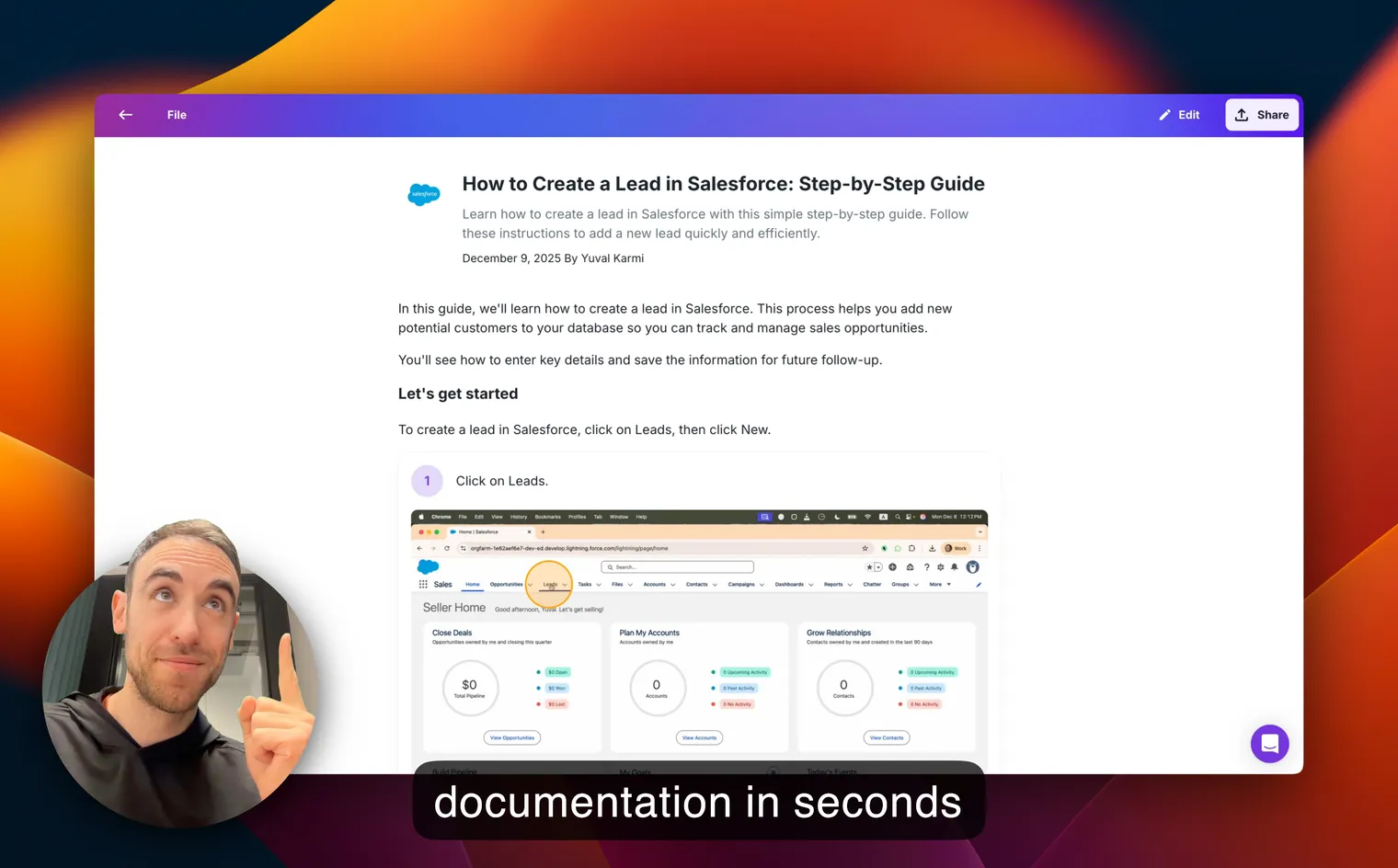
Teach your co-workers or customers how to get stuff done – in seconds.

Why SOP Training Fails (And How to Fix It)
Before we dive into how to train employees on SOPs effectively, let’s talk about why it usually goes sideways.
Information Overload Kills Retention
Dumping 50 pages of procedures on someone in a single training session doesn’t work. Our brains just can’t absorb that much at once.
I learned this the hard way. After my failed marathon training session at my first startup, I realized I was trying to teach everything at once instead of focusing on what people actually needed to know right now.
SOPs Feel Disconnected from Real Work
When you train someone on an SOP weeks before they’ll actually use it, they forget it. Then when they need it, they’re starting from scratch anyway.
The best SOP training happens as close to the actual work as possible. Not a month in advance. Not even a week. When they need it.
Nobody Wants to Read 10-Page Documents
Let’s be honest. When was the last time you read a long instruction manual cover to cover? Exactly.
If your SOP training relies on people reading lengthy documents, you’re already fighting an uphill battle. People want quick, visual, step-by-step guidance they can follow along with.
There’s No Clear Way to Know If They Got It
You walk through the SOP. Everyone nods. You assume they understand. Then they go do the task completely wrong.
Without some kind of verification or practice, you’re just hoping people absorbed what you taught them.
The Foundation: Creating Training-Friendly SOPs
Here’s something I wish someone had told me earlier: if your SOPs aren’t built for training in the first place, no amount of clever training techniques will save you.
Start with Visual Documentation
Text-heavy SOPs are harder to teach and harder to follow, which is the core idea behind creating SOPs employees actually follow. Before you even think about training, make sure your SOPs include:
- Screenshots for every step - People need to see what they’re supposed to do
- Clear numbering - So they don’t lose their place
- Short, simple sentences - No one has time to decode complex instructions
- Highlights or arrows showing exactly where to click or what to focus on
I built Glitter AI specifically to solve this problem. It automatically captures screenshots as you perform a task and generates step-by-step guides, which lines up with broader SOP adoption best practices and the mechanics of writing effective work instructions. What used to take me hours now takes minutes.
Break Complex Procedures into Smaller SOPs
Instead of one massive “How to Onboard a Client” SOP, create several focused ones:
- How to set up client account
- How to schedule kickoff call
- How to configure client dashboard
- How to send welcome email
Smaller SOPs are easier to teach, easier to update, and easier to remember. Plus, people can find exactly what they need without wading through irrelevant steps.
Write for Your Actual Audience
An SOP for a junior employee should look different than one for a senior team member. Consider:
- What do they already know?
- What terminology are they familiar with?
- How much context do they need?
I usually create SOPs assuming the person has never done this task before. It’s better to over-explain than to leave gaps.
Create visual, step-by-step guides in minutes with Glitter AI
The SOP Training Template That Actually Works
After years of trial and error, I’ve landed on a training approach that consistently works. Here’s the framework I use.
Step 1: Set the Context (5 minutes)
Before diving into the steps, explain:
- Why this SOP exists - What problem does it solve?
- When they’ll use it - What triggers the need for this procedure?
- What happens if they skip it - Real consequences, not just “because I said so”
- How it fits into the bigger picture - Where does this task live in the overall workflow?
Example: “You’ll use this customer refund SOP whenever someone requests their money back. It ensures we process refunds consistently and keeps us compliant with our payment processor’s requirements. If we skip steps, we risk chargebacks or payment processing issues.”
Step 2: Walk Through Together (15-20 minutes)
This is where you actually demonstrate the SOP while they follow along on their own screen or device.
Here’s the key: go slow. Way slower than you think you need to.
I used to rush through demonstrations because I knew the process well. But the person learning doesn’t. They need time to:
- Find the right screen
- Locate the button or field you’re talking about
- Process what you just said
- Ask questions
Share your screen, open the SOP document, and go through it step-by-step. Pause after each step to make sure everyone’s keeping up.
Step 3: Let Them Try With You Watching (10-15 minutes)
Now flip it. They share their screen, and you watch them perform the task while following the SOP.
This is crucial. Just because someone nodded along during your demonstration doesn’t mean they can actually do it.
As they work through it:
- Don’t jump in immediately when they struggle
- Let them figure things out (with the SOP as their guide)
- Only intervene if they’re truly stuck
- Ask questions: “What does the next step say to do?”
This builds their confidence in using the SOP independently.
Step 4: Solo Practice (First Real Use)
The first time they do the task solo, make yourself available for questions but don’t hover.
Tell them: “Go ahead and follow the SOP to complete this. I’m here if you get stuck, but try to work through it yourself first.”
This is where you discover gaps in your SOP documentation. If multiple people get stuck at the same step, that’s a sign your SOP needs better explanation or visuals for that part.
Step 5: Quick Feedback Session (5 minutes)
After they’ve completed the task using the SOP, have a brief conversation:
- What went smoothly?
- What was confusing?
- What could make the SOP clearer?
- Do they feel comfortable doing this on their own now?
Use this feedback to improve your SOP. The best procedures evolve based on how people actually use them.
Teach your co-workers or customers how to get stuff done – in seconds.
Advanced SOP Training Strategies
Once you’ve got the basics down, here are some techniques I’ve found that level up your SOP training game.
Create a Training Checklist
For roles that require learning multiple SOPs, I create a checklist that tracks:
- Which SOPs they need to learn
- Which they’ve been trained on
- Which they’ve practiced independently
- Which they’re certified to do solo
This helps both you and the employee see their progress. There’s something satisfying about checking off completed training items.
You can grab more ideas from my post on employee training onboarding guides.
Use the “See One, Do One, Teach One” Method
This is borrowed from medical training, and it’s incredibly effective:
- See one - They watch you perform the procedure
- Do one - They perform it while you supervise
- Teach one - They teach it to another person
That third step is magic. Teaching forces them to truly understand the SOP at a deeper level. Plus, it scales your training efforts.
Build in Spaced Repetition
Don’t train someone on an SOP once and consider it done. Schedule follow-ups:
- Day 1: Initial training
- Week 1: Quick check-in - any questions?
- Week 2: Spot check - watch them do it once
- Month 1: Review and refresh
This spaced repetition dramatically improves long-term retention.
Create Quick Reference Guides
Even after training, people forget details. Create condensed “quick reference” versions of your SOPs:
- One-page overview
- Checklist format
- Just the key steps
- Emergency troubleshooting
These shouldn’t replace your full SOPs, but they’re great for people who’ve already been trained and just need a quick reminder.
Record Training Videos
If you’re training the same SOP to multiple people, record yourself walking through it once. Then new team members can watch the video before or instead of a live training session.
I’ve written more about this in my training video tips post.
But here’s the thing: videos get outdated quickly. When your process changes, you need to re-record. That’s a pain.
This is another reason I love visual SOP tools like Glitter AI. When the process changes, updating the guide takes minutes instead of hours of re-recording.
Assign Training Buddies
Pair each new employee with someone who’s already mastered the SOPs. The buddy system:
- Gives them someone safe to ask “dumb questions”
- Provides real-time help when they get stuck
- Reinforces learning for the experienced employee (see “teach one” above)
- Builds team connections
The best training buddy is someone who learned the SOP recently themselves. They remember what was confusing and can explain it in a relatable way.
The SOP Training Timeline: When to Train What
Not all SOPs need to be taught on day one. Here’s how I typically sequence training for new team members.
Day 1-3: Critical SOPs Only
Focus on procedures they absolutely need to do their job:
- How to log in and access systems
- How to use primary tools
- Basic communication protocols
- Emergency procedures (if relevant)
Don’t overwhelm them. Just cover what they’ll use today.
Week 1: Core Responsibilities
Introduce the SOPs for tasks they’ll do regularly:
- Main job functions
- Common workflows
- Standard tasks they’ll encounter daily
Week 2-4: Edge Cases and Variations
Now you can cover the “what if” scenarios:
- Less common procedures
- Troubleshooting SOPs
- Exception handling
- Advanced features
Month 2+: Specialized and Advanced SOPs
Finally, train on:
- Rarely-needed procedures
- Complex workflows
- Cross-functional processes
- Advanced techniques
This gradual approach prevents information overload and connects training to actual work needs.
Common SOP Training Mistakes (I’ve Made Them All)
Let me save you some pain by sharing the mistakes I’ve made with SOP training.
Assuming People Remember Everything
Just because you trained someone three weeks ago doesn’t mean they remember it. Especially if they haven’t used that SOP since the training.
Fix: Make SOPs easily accessible so people can reference them whenever needed. Create a searchable knowledge base or SOP library.
Training Too Far in Advance
I used to train people on every possible SOP during onboarding, even ones they wouldn’t need for months. Waste of everyone’s time.
Fix: Train on SOPs when they’re about to be used. Just-in-time training sticks better.
Not Updating SOPs After Process Changes
Your process evolved, but your SOP didn’t. Now you’re training people on the wrong procedure.
Fix: Update SOPs immediately when processes change. I wrote a whole guide on keeping process documentation updated because this is so critical.
No Verification That People Actually Learned It
You showed them the SOP. You assume they got it. You’re wrong.
Fix: Always include a practice component where they demonstrate the procedure back to you.
Making SOPs Too Complicated
Some of my early SOPs were way too detailed. Trying to cover every possible scenario made them impossible to teach or follow.
Fix: Create simple SOPs for the standard path. Create separate SOPs for exceptions and edge cases.
Relying Solely on Written SOPs
If your entire training approach is “here’s the document, read it,” you’re setting people up to fail.
Fix: Combine written SOPs with demonstration, practice, and feedback. Multiple learning modalities work better.
How to Measure SOP Training Effectiveness
You need to know if your training is actually working. Here’s what I track.
Completion Rate
Simple but important: are people finishing the training?
If lots of people start but don’t complete your SOP training, something’s wrong. Maybe it’s too long, too boring, or poorly structured.
Time to Proficiency
How long does it take for someone to perform the procedure independently and correctly?
Track this for each SOP. If it’s taking way longer than you expect, either the SOP is unclear or your training approach needs work.
Error Rate
How often do people mess up when following the SOP?
A few errors during initial practice is normal. But if people keep making the same mistakes after training, your SOP or training method has problems.
Self-Reported Confidence
After training, ask: “On a scale of 1-10, how confident do you feel doing this task on your own?”
If they’re rating it below 7, they probably need more practice or a clearer SOP.
Time Savings
One of the main points of SOPs is consistency and efficiency. Are people completing the task faster after training compared to before you had SOPs?
If not, your SOPs might be adding unnecessary steps or complexity.
Reference Frequency
How often do people need to refer back to the SOP after training?
Some reference is normal and good. But if they’re constantly checking every single step even after multiple uses, the SOP might be too complicated or the training wasn’t effective.
Creating an SOP Training Program That Scales
As your team grows, you can’t personally train every new hire on every SOP. Here’s how to scale.
Designate SOP Owners
Each SOP should have an owner who’s responsible for:
- Keeping it updated
- Training new team members
- Answering questions about it
- Tracking issues and improvements
This distributes the training load and ensures expertise is spread across your team.
Build a Self-Service Training Library
Create a central hub where people can:
- Find all relevant SOPs
- Watch training videos
- Access quick reference guides
- Search for specific procedures
Make it easy to find what they need without asking someone.
I’ve found that combining SOPs with training materials in one place works best. When someone looks up “how to process a refund,” they see both the SOP and the training resources for it.
Standardize Your Training Approach
Use the same training framework for all SOPs. This consistency:
- Makes training more predictable
- Helps people learn faster (they know what to expect)
- Makes it easier to delegate training to others
- Ensures quality regardless of who’s doing the training
The template I shared earlier is a good starting point.
Create Training Tracks for Different Roles
Don’t make everyone learn every SOP. Organize SOPs into role-based training tracks:
- Customer Service track
- Sales track
- Operations track
- Management track
New hires in each role follow their specific track.
Automate What You Can
Use tools to handle the repetitive parts:
- Automated reminders for refresher training
- Progress tracking dashboards
- Completion certificates
- Quiz systems for knowledge checks
This frees you up to focus on the human parts of training: answering questions, providing feedback, and building relationships.
The Tools I Actually Use for SOP Training
Let me be straight with you about what I use and why.
For Creating SOPs: Glitter AI
I built Glitter AI because I was frustrated with how long it took to create visual, step-by-step guides.
With Glitter AI, I just perform the task while the screen records. It automatically captures screenshots, generates step-by-step instructions, and creates a clean guide I can share immediately.
When I need to update an SOP, I don’t have to recreate the whole thing. I just re-record the steps that changed.
For training purposes, having visual SOPs is a game-changer. People can see exactly what to do instead of interpreting text descriptions.
For Organizing SOPs: Notion or Confluence
Once I’ve created SOPs, I organize them in a searchable knowledge base. Notion works great for smaller teams. Confluence is better if you’re larger and need more enterprise features.
The key is making SOPs easy to find. Good search and logical categorization matter more than which tool you pick.
For Training Videos: Glitter AI
When I want to record a walkthrough of an SOP with my voice explaining it, Glitter is the tool. I hit record, narrate the workflow, and walk away with both the video AND a written step-by-step guide from the same recording - no need to record once for video and write the guide separately. (Loom works fine if all you need is the video link, but for SOP training where people need to skim and search, the written guide matters.)
For Quizzes and Knowledge Checks: Google Forms
Nothing fancy needed. A quick Google Form with 5-10 questions tests whether someone understood the key points of an SOP.
For Progress Tracking: Spreadsheets or HRIS
For small teams, a simple spreadsheet tracking who’s trained on what is sufficient. Larger companies might integrate this into their HRIS or LMS.
Don’t overthink the tools. The framework matters more than the software.
Teach your co-workers or customers how to get stuff done – in seconds.
The Future of SOP Training
Things are changing fast in the documentation and training world. Here’s what I’m seeing.
AI-Assisted Training
AI can now:
- Generate quiz questions from your SOPs
- Create different versions of SOPs for different skill levels
- Answer employee questions about procedures
- Identify gaps in documentation
I’m building some of this into Glitter AI. The goal is to make SOP creation and training almost effortless.
Interactive SOPs
Instead of static documents, imagine SOPs that:
- Guide you through the process step-by-step in the actual software
- Validate that you completed each step correctly
- Adapt based on which path you take
- Provide help exactly when you’re stuck
We’re moving toward this. The line between SOPs and training is blurring.
Microlearning Approaches
Rather than hour-long training sessions, we’re seeing a shift toward:
- 2-3 minute SOP modules
- Just-in-time training right when you need it
- Bite-sized refreshers
- Mobile-accessible procedures
This aligns better with how people actually work and learn.
Integration with Actual Workflows
The best SOP training will happen inside the tools where work happens. Instead of switching to a separate training platform, the SOP guidance appears contextually as you work.
Getting Started with Better SOP Training
You don’t have to overhaul everything at once. Start here:
- Pick your most important SOP - The one that matters most or that people struggle with most
- Make it visual - Add screenshots, break it into clear steps, simplify the language
- Test the training framework - Use the “context, walk through, practice, solo, feedback” approach with one person
- Refine based on feedback - What worked? What didn’t? Adjust.
- Document your training process - Create your own “SOP for SOP training” (very meta, I know)
- Scale it - Apply your refined approach to other SOPs
The biggest mistake is trying to perfect everything before you start. Just pick one SOP and make it better. Learn from that experience. Then do another.
If you want to speed up the SOP creation part, try Glitter AI for free. You can create your first 10 guides at no cost and see if it works for your team.
Frequently Asked Questions
What is SOP training?
SOP training is the process of teaching employees how to follow standard operating procedures for specific tasks or processes. Effective SOP training goes beyond simply showing someone a document - it includes demonstrating the procedure, allowing hands-on practice, providing feedback, and verifying that the employee can perform the task independently. The goal is ensuring employees can execute procedures consistently and correctly without supervision.
How do you train employees on SOPs effectively?
The most effective approach uses a five-step framework: (1) Set context by explaining why the SOP exists and when to use it, (2) Walk through the procedure together while they follow along, (3) Let them practice with you watching, (4) Have them perform it solo while available for questions, and (5) Conduct a quick feedback session. This hands-on approach ensures comprehension and builds confidence. Training should happen just before employees need to use the SOP, not weeks in advance, and should always include visual documentation with screenshots for each step.
What should be included in an SOP training template?
An effective SOP training template includes: context section explaining why the SOP exists and when to use it, step-by-step demonstration guide, practice exercises or scenarios, verification checklist to confirm understanding, common mistakes section, troubleshooting tips, quick reference guide for post-training use, and a feedback form to improve the SOP and training process. Each section should be concise and focused, with visual elements like screenshots or diagrams to support different learning styles.
How long does SOP training usually take?
Simple SOPs typically require 30-45 minutes of training time, including demonstration, practice, and feedback. Complex procedures might need 1-2 hours broken into multiple sessions. The key is avoiding information overload - break lengthy training into smaller sessions rather than trying to cover everything at once. Training time also depends on the employee's experience level and how well the SOP is documented. Visual, well-organized SOPs with clear screenshots typically require less training time than text-heavy procedures.
How do you know if SOP training was successful?
Success is measured through several indicators: the employee can perform the procedure independently without errors, they complete tasks within expected timeframes, they demonstrate confidence when executing the SOP (rating 7+ out of 10 on self-assessment), error rates decrease after training, and they only need to reference the SOP occasionally rather than checking every step. The clearest indicator is when an employee successfully teaches the procedure to someone else, demonstrating true mastery of the SOP.
What's the best format for SOP training materials?
Visual, step-by-step formats work best for both SOPs and training. Each step should include a screenshot showing exactly what to do, accompanied by brief, clear instructions in simple language. Breaking complex procedures into smaller, focused SOPs (each covering one specific task) makes training more manageable and improves retention. Combining written visual SOPs with a short training video walkthrough serves different learning styles. Avoid text-heavy documents without visuals - research consistently shows people retain significantly more visual information than text alone.
When should you train employees on SOPs?
The most effective timing is just-in-time training - right before employees need to use the SOP. For new hires, prioritize critical SOPs they need immediately (days 1-3), then core responsibility SOPs they'll use regularly (week 1), followed by edge cases and variations (weeks 2-4), and finally specialized procedures (month 2+). Training on SOPs weeks or months before they're needed results in poor retention. Employees forget procedures they don't use immediately, making the training largely wasted effort.
The Bottom Line
SOP training isn’t about dumping information on people and hoping it sticks.
It’s about creating clear, visual procedures and then guiding people through them in a way that builds real competence and confidence.
The framework I’ve shared works. I’ve used it across multiple companies and teams. But like any framework, you’ll need to adapt it to your specific situation.
Start with one SOP. Make it visual. Train someone using the five-step approach. Get their feedback. Refine. Repeat.
Your SOPs are only valuable if people actually follow them. And people only follow them if they’ve been trained properly.
The time you invest in training employees on SOPs pays back tenfold in consistency, quality, and your own sanity when you’re not constantly answering the same questions.
If you want help creating SOPs that are actually trainable - visual, clear, and easy to update - give Glitter AI a try. First 10 guides are free, and you’ll have a better sense of how much time you can save on documentation.
Now go train someone on an SOP. And make it good.
Stop spending hours on documentation. Start for free.