
Read summarized version with
I used to spend entire afternoons writing training documentation.
You know the drill. Open a Google Doc, start taking screenshots, paste them in, add captions, format everything, try to explain the steps clearly. Three hours later, you’ve got a 15-page document that’ll probably be outdated in a month.
And here’s the kicker - half the time, people would still come ask you how to do it instead of reading the doc.
I’m Yuval, founder of Glitter AI. I’ve created more training documentation than I care to admit, both at my previous startup and now with Glitter. I’ve seen what works and what ends up being a waste of time, including how to write an SOP people actually follow. Let me share what I’ve learned about creating training documentation that people actually use.
Teach your co-workers or customers how to get stuff done – in seconds.

What Is Training Documentation?
Training documentation is written material that teaches people how to perform specific tasks or processes. It’s the instruction manual for your business operations, and it overlaps heavily with the practices in our complete guide to process documentation.
But here’s the thing - training documentation isn’t just dry technical manuals anymore. The best training docs in 2026 are visual, interactive, and easy to update. They’re more like guided walkthroughs than traditional text-heavy documents.
Common types of training documentation include:
- Step-by-step process guides
- Software training manuals
- Onboarding documentation
- Standard operating procedures (SOPs)
- Work instructions
- Quick reference guides
- Video tutorials with transcripts
The goal of all training documentation is simple: help someone learn to do something without needing to ask for help. If your training docs aren’t doing that, they’re not working.
Why Most Training Documentation Fails
Let me be brutally honest about why most training documentation sucks.
It’s Text-Heavy
Reading 10 pages of instructions to learn a 5-minute task feels like punishment. Our brains are wired to process visuals much faster than text. Yet most training docs are still walls of text with maybe a few screenshots thrown in as an afterthought.
It’s Hard to Update
You write a detailed training document. Two weeks later, the software gets updated and half your screenshots are outdated. Updating the doc takes almost as long as creating it initially, so it just… doesn’t get done.
I’ve been there. I’ve skipped updates because the thought of re-taking 30 screenshots made me want to cry.
It’s Not Searchable or Scannable
Someone needs to know one specific thing - how to export a report, for example. But your training documentation is a 40-page PDF, and they can’t quickly scan to find what they need. So they interrupt you instead.
It’s Created Once and Forgotten
Training documentation often gets made during onboarding season, then sits untouched for months. By the time the next new hire arrives, it’s so outdated it’s basically useless.
It Doesn’t Match How People Learn
Different people learn differently. Some need videos. Some prefer written steps. Some want to try it themselves with minimal guidance. Most training documentation only serves one learning style.
Best Practice 1: Make It Visual
This is the most important thing you can do to improve your training documentation.
People need to see what they’re supposed to do, not just read about it. I can’t stress this enough.
Why Visuals Matter
Research shows people remember:
- 10% of what they read
- 20% of what they hear
- 80% of what they see and do
When I create training documentation now, I aim for a screenshot or visual element every 2-3 steps. Sometimes more.
What “Visual” Actually Means
Visual training documentation includes:
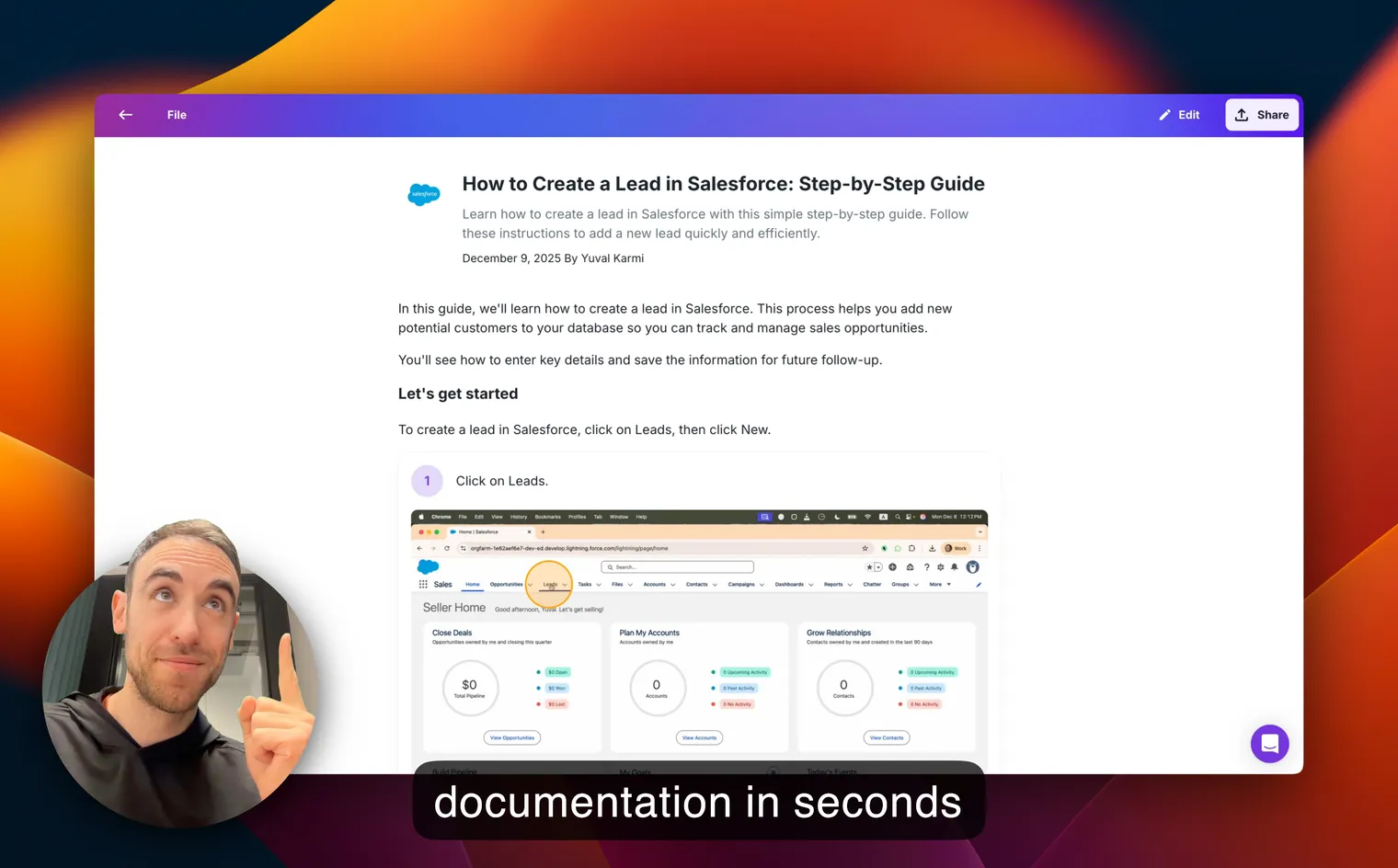
Screenshots with annotations. Don’t just paste a screenshot - add arrows, boxes, or highlights to show exactly where to click or what to look for.
Short video clips. Sometimes a 30-second screen recording explains more than a page of text ever could. I’ve written about this in my post on making better instructional videos.
GIFs for quick actions. A 3-second GIF showing how to navigate somewhere beats a paragraph of directions.
Diagrams and flowcharts. For complex processes, visual workflows help people understand the big picture.
How I Do It Now
I use Glitter AI to create visual documentation (yes, shameless plug - but I built it specifically for this problem). I just walk through the process while recording my screen and talking. The AI captures screenshots automatically and generates step-by-step documentation.
What used to take me 2-3 hours now takes 5 minutes.
But even if you’re not using AI tools, commit to adding visuals. Take the screenshots. Make the effort. Your training documentation will be 10x more useful.
Best Practice 2: Use Step-by-Step Format
Break everything into discrete, numbered steps.
Not paragraphs. Not long explanations. Steps.
Why Steps Work
Our brains like sequential information when learning a new task. Steps provide:
- Clear progression
- Easy-to-follow structure
- Natural checkpoints (“okay, I did step 3, now step 4”)
- Simple way to resume if interrupted
How to Write Good Steps
Each step should be one action. Don’t combine multiple actions into a single step.
❌ Bad: “Navigate to Settings, click on User Management, and add the new user’s email address in the text field.”
✅ Good:
- Click Settings in the left sidebar
- Select User Management from the menu
- Click the Add User button
- Enter the user’s email address
Include Expected Results
Tell people what should happen after each step. This helps them confirm they’re on the right track.
Example:
- Click the Export button in the top right You should see a dropdown menu with export options
- Select PDF from the dropdown A download dialog will appear
Number Your Steps
Always use numbered lists for sequential processes. Save bullet points for non-sequential information like features or benefits.
Teach your co-workers or customers how to get stuff done – in seconds.
Best Practice 3: Write Like You’re Talking to Someone
Training documentation doesn’t need to sound like a technical manual from 1987.
Write like you’re explaining the process to a colleague sitting next to you.
Use Simple Language
Avoid jargon unless it’s absolutely necessary. And if you do use technical terms, explain them the first time.
❌ “Utilize the navigational UI elements to access the configuration parameters”
✅ “Click the Settings icon to change your preferences”
Use Active Voice
Tell people what to do, not what should be done.
❌ “The report can be generated by clicking the Export button”
✅ “Click the Export button to generate the report”
Address the Reader Directly
Use “you” to speak directly to the person reading.
❌ “Users should ensure all fields are completed”
✅ “Make sure you fill out all the fields”
Keep Paragraphs Short
Nobody wants to read a wall of text when they’re trying to learn something. I aim for 2-4 sentences max per paragraph.
Like this.
See? Much easier to read.
Best Practice 4: Organize by Task, Not Feature
Here’s a mistake I made early on: organizing training documentation around features instead of tasks.
The Problem with Feature-Based Docs
“Here’s the Dashboard tab. It has widgets, charts, and filters. The widgets show…”
Cool. But what am I trying to do?
Task-Based Organization Works Better
People come to training documentation with a goal: “I need to create a new project” or “I need to run the monthly sales report.”
Organize your docs around those tasks:
- How to Create a New Project
- How to Run the Monthly Sales Report
- How to Add Team Members
- How to Export Client Data
Each document should be focused on accomplishing one specific thing.
Make Docs Easy to Find
If someone needs to know how to reset a password, they shouldn’t have to dig through a 50-page manual about your entire system.
Create a library of focused, task-specific guides. Make them searchable. Use clear, descriptive titles.
Best Practice 5: Include Prerequisites and Context
Don’t assume people know where to start.
Every training document should begin with:
What This Guide Covers
One sentence explaining what the person will learn.
Example: “This guide shows you how to create and send a customer invoice in under 2 minutes.”
Who This Is For
Who should use this guide? What should they already know?
Example: “This guide is for team members who need to invoice clients. You should already have access to the Billing module and know how to navigate to the Invoices section.”
What You’ll Need
List any prerequisites, permissions, or information needed before starting.
Example:
- Admin access to the CRM
- The client’s billing information
- An approved quote or proposal number
This context saves people from getting halfway through a process and realizing they can’t actually complete it.
Generate comprehensive guides automatically with Glitter AI
Best Practice 6: Plan for Multiple Learning Styles
Different people learn differently. I’m a visual learner - show me once and I’ve got it. My co-founder needs to read detailed explanations. Some people need to just try it themselves.
Combine Multiple Formats
The best training documentation offers options:
Visual learners: Screenshots, diagrams, annotated images
Auditory learners: Video tutorials with clear narration, voice-over explanations
Reading/writing learners: Detailed text instructions, downloadable PDFs
Kinesthetic learners: Hands-on practice exercises, interactive demos
The Video + Written Combo
My favorite approach: create a short video walkthrough, then provide the written steps below it.
People who prefer video can watch. People who prefer text can read. People who want both can do both.
And honestly? Creating both at once is easier than you think. Record yourself doing the task while explaining it (there’s your video). Then transcribe it and turn those steps into written documentation.
With Glitter AI, this happens automatically. Record once, get both formats. But even manually, it’s worth the effort.
Interactive Learning
For complex processes, consider adding practice exercises or quizzes. Nothing fancy - just simple questions that help people confirm their understanding.
Example: Try it yourself: Create a test invoice for a fictional client. Then check if it appears in the Pending Invoices list.
Best Practice 7: Keep It Updated
This is the hardest part. And the most important.
Out-of-date training documentation is worse than no documentation. It wastes people’s time and erodes trust in your resources.
The Update Problem
I wrote an entire post about keeping process documentation updated because it’s such a common struggle.
The problem: creating documentation is hard enough. Updating it when things change feels impossible.
Make Updates Easy
The easier updates are, the more likely they’ll actually happen.
Assign ownership. Every training document should have an owner responsible for keeping it current.
Set review schedules. Calendar reminders to review docs quarterly, even if nothing’s changed.
Update when processes change. Build documentation updates into your workflow when you roll out changes. Don’t wait.
Use tools that make updates simple. This is literally why I built Glitter AI. Re-recording a process takes 5 minutes instead of spending an hour re-taking and formatting screenshots.
Version Control
Keep old versions accessible. Sometimes people are still using an older version of your software or process, and they need documentation that matches what they’re seeing.
Add a “Last Updated” date to every document. This helps people know if the info is current.
Best Practice 8: Add Search and Navigation
Training documentation that can’t be found might as well not exist.
Make Docs Searchable
If you’re using a documentation platform, make sure it has robust search functionality. People should be able to type “reset password” and immediately find the right guide.
Use Clear Naming Conventions
Your document titles should clearly state what the document covers. Use keywords people would naturally search for.
❌ “Admin Panel Guide Section 3.2”
✅ “How to Reset a User Password”
Create an Index or Table of Contents
For longer documentation, add a clickable table of contents at the top. Let people jump directly to what they need.
Tag and Categorize
Use tags and categories to group related documentation. Someone learning the CRM should be able to see all CRM-related guides in one place.
Best Practice 9: Get Feedback and Iterate
Your training documentation isn’t done when you publish it. That’s just version 1.
Ask for Feedback
Actively seek input from people using your training docs:
- What’s confusing?
- What’s missing?
- Where did you get stuck?
- What would make this more helpful?
Track Usage
If you can, monitor which docs get used most (and least). High-traffic docs might need more detail or better organization. Low-traffic docs might be poorly titled or missing from search results.
Watch People Use It
This is incredibly valuable. Watch someone - especially a new employee - actually use your training documentation to complete a task.
You’ll immediately see where they get confused, what they skip, what they need that’s not there.
Iterate Based on Reality
Don’t get precious about your docs. If something isn’t working, change it. Training documentation is a living resource that should evolve based on how people actually use it.
Teach your co-workers or customers how to get stuff done – in seconds.
Best Practice 10: Leverage AI for Creation and Maintenance
Look, I’m biased here. But AI has genuinely transformed how I create training documentation.
What AI Can Do
Auto-generate documentation. Record yourself doing a process, and AI creates the step-by-step guide with screenshots. This is what Glitter AI does.
Transcribe videos. Turn your video tutorials into searchable, readable text automatically.
Translate documentation. If you have a global team, AI can translate your training docs into multiple languages quickly.
Suggest improvements. AI can analyze your documentation and suggest where to add clarity or identify confusing sections.
What AI Can’t Replace
AI can handle the tedious parts - capturing screenshots, formatting, transcribing. But it can’t replace your expertise and judgment.
You still need to:
- Understand what actually needs to be documented
- Organize content in a logical way
- Add context and tips based on experience
- Review for accuracy and clarity
- Update when processes change
Think of AI as a tool that handles the busywork so you can focus on the strategic and creative parts.
Real-World Example: How I Document at Glitter AI
Let me show you my actual process for creating training documentation now.
Step 1: I identify what needs to be documented. Usually it’s a new feature or a process that people keep asking about.
Step 2: I open Glitter AI and hit record. I walk through the process while talking through each step naturally, like I’m teaching someone sitting next to me.
Step 3: The AI captures screenshots automatically as I go. I don’t pause to manually screenshot anything.
Step 4: When I’m done (usually 3-5 minutes), I stop recording. Glitter AI generates the documentation with all the screenshots, annotations, and text.
Step 5: I review and edit. Usually minor tweaks - adding context, adjusting wording, maybe adding a tip or warning.
Step 6: I share it with the team or publish it to our knowledge base.
Total time: 10-15 minutes for something that used to take 2-3 hours.
And when the process changes? I just re-record it. Another 5 minutes.
This approach has completely changed how I think about documentation. It’s no longer this dreaded task I avoid. It’s quick enough that I actually want to document things.
Common Training Documentation Mistakes to Avoid
Let me save you some pain by highlighting mistakes I’ve made (or seen others make).
Mistake 1: Making It Too Comprehensive
You don’t need to document every possible edge case and exception in your main training docs. That overwhelms people.
Create focused guides for the common path. Then create separate, advanced guides for edge cases if needed.
Mistake 2: Using Screenshots Without Annotations
A plain screenshot requires people to figure out what they’re looking for. Add arrows, boxes, or highlights to direct attention to the important elements.
Mistake 3: Assuming Too Much Prior Knowledge
What’s obvious to you might not be obvious to someone new. Define terms. Explain context. Don’t skip steps because they seem basic.
Mistake 4: Creating PDFs
PDFs are a pain to update and terrible for searchability. Use a documentation platform or wiki that’s easy to update and search.
Mistake 5: Writing for Yourself Instead of Your Audience
Remember who’s reading this documentation. A guide for executives looks different than a guide for technical admins.
Mistake 6: No Version Control or Update Tracking
People need to know if the documentation matches what they’re currently seeing. Always include dates and version info.
Try Glitter AI's automated documentation
Training Documentation Templates and Formats
Here’s a basic template I use for most training documentation:
Standard Training Doc Template
Title: [Clear, descriptive title with the task]

Last Updated: [Date]

What You'll Learn: [One sentence summary]

Who This Is For: [Target audience and prerequisites]

What You'll Need: [Required access, info, or tools]

---

## Step-by-Step Instructions

1. [First action]
   *[Expected result]*

2. [Second action]
   *[Expected result]*

[Continue with numbered steps...]

---

## Tips and Best Practices

- [Helpful tip]
- [Common pitfall to avoid]

---

## Troubleshooting

**Problem:** [Common issue]
**Solution:** [How to fix it]

---

## Related Resources

- [Link to related guide 1]
- [Link to related guide 2]
For Different Use Cases
Software training: Heavy on screenshots, step-by-step, very specific
Process training: May include flowcharts, decision points, approvals
Onboarding: Broader context, links to multiple specific guides, includes company culture and policies
Quick reference: Minimal explanation, just the steps, assumes prior knowledge
Choose the format that matches your audience and use case.
Measuring Training Documentation Effectiveness
How do you know if your training documentation is actually working?
Track These Metrics
Usage rates: Are people actually accessing the docs?
Completion rates: Do people finish reading/watching, or drop off halfway?
Search queries: What are people searching for? Are they finding it?
Support ticket reduction: After publishing documentation, do related support questions decrease?
Time to competency: How quickly can new employees become productive using your training docs?
Ask Direct Questions
Send a quick survey to people who used training documentation recently:
- Did this guide help you complete the task? (Yes/No)
- What would make this guide more helpful?
- Was anything confusing or missing?
Observe Real Usage
The most valuable feedback comes from watching someone actually use your documentation. You’ll instantly see what works and what doesn’t.
Tools for Creating Training Documentation
You don’t need expensive enterprise software to create good training documentation. But the right tools do help.
Documentation Platforms
Notion: Great for searchable, organized docs. Easy to update. Free tier is generous.
Confluence: If you’re already using Atlassian tools, it integrates well. More corporate-feeling.
GitBook: Clean, professional-looking docs. Good for technical documentation.
Screen Recording and Annotation
Glitter AI: I built this specifically for creating training docs quickly. Records screen + voice, auto-generates documentation with screenshots and steps.
Loom compared with Glitter AI: Great for simple video tutorials. Easy to share.
SnagIt: Powerful screenshot and annotation tool. One-time purchase.
how Scribe measures up to Glitter AI: Auto-generates how-to guides from your screen recording - clicks and screenshots, no voice narration, so the output often reads like a rough draft. I’ve written separately about Scribe alternatives if you want options.
Video Editing
Descript: Makes video editing ridiculously easy. Edit video by editing the transcript.
Camtasia: Full-featured screen recording and video editing. Industry standard but pricey.
OBS Studio: Free, open-source screen recording. Steeper learning curve.
Diagramming
Lucidchart: Flowcharts, process diagrams, org charts.
Miro: Great for collaborative diagramming and visual planning.
Excalidraw: Simple, sketch-style diagrams. Free and easy.
Pick tools that match your budget and technical comfort level. The best tool is the one you’ll actually use consistently.
Getting Started with Better Training Documentation
Don’t try to overhaul all your training documentation at once. You’ll burn out.
Start small:
Week 1: Identify your top 3 most-requested processes. The things people ask about constantly.
Week 2: Create visual, step-by-step documentation for those 3 processes. Use the template I shared earlier.
Week 3: Share them with your team and ask for feedback. Iterate based on what you learn.
Week 4: Pick 3 more processes and repeat.
In a month, you’ll have documentation for 6 key processes. That’s probably more useful documentation than most companies have.
Then just keep going. One process at a time. Build the habit.
Make It Part of Your Workflow
The real key is making documentation creation part of how you work:
- Launching a new feature? Create the training docs at the same time.
- Changing a process? Update the documentation as part of the change.
- Someone asks how to do something twice? Document it.
When documentation becomes automatic rather than a separate project, it actually gets done.
Frequently Asked Questions
What is training documentation?
Training documentation is written material that teaches people how to perform specific tasks or processes in your organization. It includes step-by-step process guides, software training manuals, onboarding materials, standard operating procedures (SOPs), work instructions, quick reference guides, and video tutorials. The goal is to help someone learn to do something without needing to ask for help. Effective training documentation in 2026 is visual, interactive, easy to update, and organized around specific tasks rather than general features.
How do you create effective training documentation?
Create effective training documentation by making it visual with screenshots and annotations for every 2-3 steps, using a step-by-step format with numbered actions, writing in simple conversational language, and organizing content by task rather than feature. Include prerequisites and context at the beginning, offer multiple formats for different learning styles (video + written), and make docs easily searchable with clear titles. Most importantly, plan for regular updates and assign ownership to ensure documentation stays current. Tools like Glitter AI can automate much of the creation process by recording your screen and generating documentation automatically.
What are the best practices for training documentation in 2026?
The top best practices for training documentation in 2026 are: making it heavily visual with screenshots and videos rather than text-heavy, using step-by-step numbered format, writing conversationally in active voice, organizing by task instead of feature, including prerequisites and expected results, offering multiple learning formats (video and written), keeping docs updated with assigned owners and review schedules, making content searchable with clear navigation, gathering feedback and iterating based on usage, and leveraging AI tools to automate creation and maintenance. Visual content is especially critical - people remember 80% of what they see versus only 10% of what they read.
How often should training documentation be updated?
Training documentation should be updated immediately whenever the process or software it documents changes, and reviewed quarterly even if nothing has changed. Out-of-date documentation wastes people's time and erodes trust in your resources. Make updates easier by assigning ownership of each document to a specific person, setting calendar reminders for regular reviews, building documentation updates into your workflow when rolling out changes, and using tools that simplify the update process. Always add a "Last Updated" date to every document so people know if the information is current.
What tools should I use to create training documentation?
For creating training documentation, use a documentation platform like Notion (searchable, easy to update), Confluence (integrates with Atlassian tools), or GitBook (clean, professional). For screen recording and generating guides, tools like Glitter AI automate documentation creation by recording your screen and generating step-by-step instructions with screenshots automatically. Other options include Loom for simple video tutorials, SnagIt for screenshot annotation, and Scribe for auto-generated guides. For video editing, Descript makes editing easy by letting you edit video by editing the transcript. The best tool is whichever one you'll actually use consistently.
Why does most training documentation fail?
Most training documentation fails because it's too text-heavy (our brains are wired to process visuals much faster than text), hard to update when processes change, not easily searchable or scannable, created once and then forgotten, and doesn't match how different people learn. Training docs that are walls of text with few visuals, organized by feature rather than task, lacking clear navigation, and quickly outdated end up being ignored. People interrupt colleagues to ask questions instead of using the documentation because finding the answer in the docs takes longer than just asking someone. Effective documentation solves these problems by being visual, task-focused, searchable, and easy to keep current.
Final Thoughts
Training documentation doesn’t have to be a painful, time-consuming process.
The key shifts:
- Make it visual
- Keep it simple
- Organize by task
- Make updates easy
- Use tools that automate the tedious parts
I spent years doing training documentation the hard way. Taking screenshots manually. Pasting them into docs. Formatting everything. Spending hours on each guide.
Now I can create comprehensive training documentation in minutes. Not because I’m faster, but because I stopped doing things manually that could be automated.
If you’re still spending hours on training docs, I invite you to try Glitter AI. Record your process once, get professional documentation automatically. First 10 guides are free.
Your future self will thank you for making documentation easy enough that you actually keep it current.
Create visual, step-by-step guides in minutes with Glitter AI