
Read summarized version with
I remember the first training manual I ever created.
It was for my first startup. We were scaling the support team, and I kept getting pulled into the same conversations over and over. “How do I handle refund requests?” “What’s our policy on this?” “Where do I find that information?”
So I sat down and cranked out a 40-page Word document. Took me a week. It was thorough, detailed, and - I’m not gonna lie - kind of ugly.
But you know what? It worked.
People actually used it. New hires stopped interrupting me every five minutes. The team started handling things consistently. That manual probably saved me 10+ hours a week.
The thing is, I didn’t need to reinvent the wheel. Looking at training manual examples from other companies would’ve saved me days of work. I could’ve adapted what was already working instead of starting from zero.
I’m Yuval, founder of Glitter AI. Since that first manual, I’ve created dozens more (and helped thousands of companies create theirs). I’ve learned what works and what doesn’t.
Let me show you some training manual examples that actually work - plus templates you can steal.
Teach your co-workers or customers how to get stuff done – in seconds.

What Makes a Good Training Manual?
Before we dive into examples, let’s talk about what separates a useful training manual from one that collects digital dust.
A good training manual has three key characteristics:
It’s scannable. People don’t read manuals cover to cover. They jump to the section they need right now. Use clear headings, bullet points, and visual breaks. Make it easy to find stuff fast.
It’s specific. Generic advice doesn’t help anyone. “Provide excellent customer service” is useless. “Respond to customer emails within 2 hours during business days” is actionable. Good manuals tell people exactly what to do.
It’s visual. Screenshots, diagrams, checklists - these aren’t optional. They’re essential. A picture really is worth a thousand words when you’re explaining a process.
The best training manual examples I’ve seen nail all three of these things.
Training Manual Example #1: New Employee Onboarding Manual
This is probably the most common type of training manual, and for good reason. Onboarding new hires takes forever without proper documentation, and even structured manager onboarding leans on it heavily.
What to Include
A solid onboarding manual typically covers:
- Company overview and culture - Mission, values, history, team structure
- Day 1 logistics - Where to go, who to meet, what to bring (see our onboarding checklist for more details)
- Systems and tools - How to access email, Slack, project management tools
- First week roadmap - What to expect, what to complete, who to shadow
- Role-specific training - Links to additional training guides for their specific position
- Common questions - HR policies, PTO, benefits, equipment requests
Sample Structure
Here’s a simple structure that works:
1. Welcome & Company Introduction2. Your First Day Checklist3. Tools & Systems Setup - Email and Calendar - Communication Tools (Slack, Teams) - Project Management - Time Tracking4. Week 1 Schedule5. Company Policies Quick Reference6. Who to Contact for What7. Resources & Next StepsWhy It Works
The best onboarding manuals don’t try to teach everything at once. They guide people through their first days and weeks, then point them to more detailed resources for their specific role, the same principle behind our complete guide to employee training and onboarding.
I’ve found that breaking it into day-by-day or week-by-week sections works really well, which is exactly the kind of structure an onboarding specialist builds so new hires feel less overwhelmed when they can focus on “what do I need to know today” instead of drinking from the fire hose.
Record your onboarding process once - Glitter AI generates the manual
Training Manual Example #2: Software/System Training Manual
If your team uses specific software - whether it’s an ERP system, CRM, or proprietary tools - you need documentation on how to use it.
What to Include
A good software training manual includes:
- Overview of the system - What it does, why you use it, when to use it
- Login and access - How to get credentials, password reset procedures
- Basic navigation - How to find what you need, main menu structure
- Common tasks - Step-by-step guides for the 20% of features people use 80% of the time
- Troubleshooting - What to do when things break, plus a clear escalation procedure for who to contact for help
- Advanced features - Optional reading for power users
Sample Section: CRM Training Manual
Let’s say you’re documenting Salesforce for your sales team:
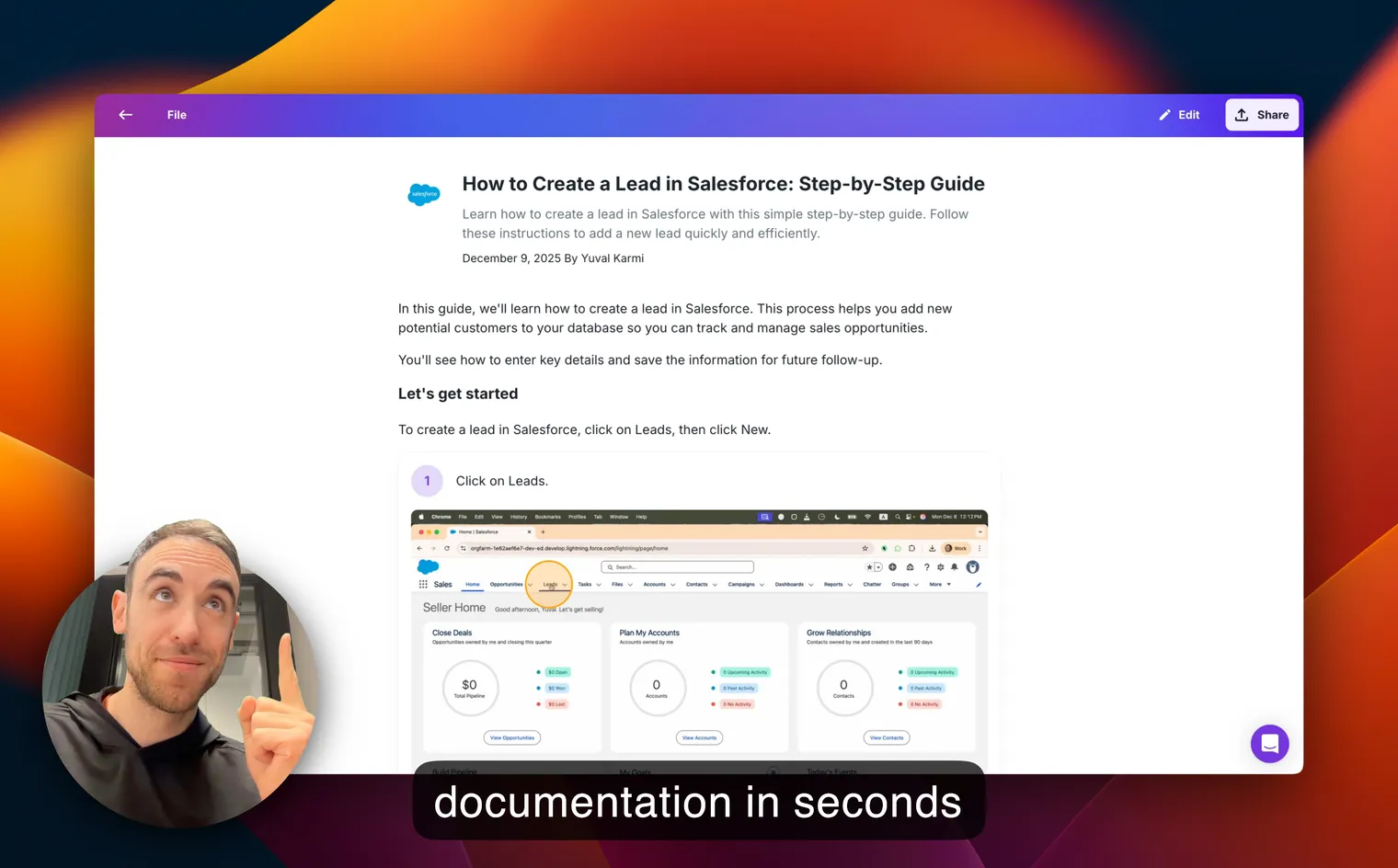
How to Create a New Lead in Salesforce
1. Click the "Leads" tab in the top navigation2. Click "New Lead" button (top right)3. Fill in required fields:   - First Name   - Last Name   - Company   - Email   - Phone4. Select Lead Source from dropdown5. Assign Lead Status (default: "New")6. Click "Save"
[Screenshot showing each step]
Common issues:- "Required field missing" error → Check that Company and Last Name are filled- Can't find the lead after saving → Make sure you're in "All Leads" view, not "My Leads"
Why It Works
System training manuals work best when they’re task-focused, not feature-focused. Don’t document every button in the interface. Document the actual jobs people need to do.
And please, PLEASE include screenshots. I can’t stress this enough. Every single step should have a visual reference.
Training Manual Example #3: Customer Service Manual
Customer service manuals are critical for maintaining consistent support quality as your team grows.
What to Include
Your customer service manual should cover:
- Response time expectations - How quickly to respond to different channels
- Tone and voice guidelines - How to sound like your brand
- Common scenarios - Scripts or frameworks for frequent situations
- Escalation procedures - When and how to involve managers
- Product knowledge - Key features, pricing, common questions
- Troubleshooting guides - Step-by-step solutions for common issues
Much of this overlaps with a formal customer service SOP. Our practical guide on how to document customer service processes walks through capturing each scenario.
Sample Section: Handling Refund Requests
When a customer requests a refund:
1. Acknowledge their request within 2 hours   Template: "Thanks for reaching out about this. I'd be happy to help you with your refund request."
2. Verify the purchase details   - Order number   - Purchase date   - Reason for refund
3. Check refund eligibility:   ✅ Within 30 days of purchase   ✅ Not already used for billing   ✅ Not a discounted/promo purchase (see exceptions)
4. Process the refund:   - Go to Admin → Orders → [Order Number]   - Click "Issue Refund"   - Select refund amount   - Add internal note with reason   - Click "Process"
5. Confirm with customer:   Template: "I've processed your refund of $XX. It should appear in your account within 5-7 business days. Is there anything else I can help you with?"
Special cases:- Refund requested after 30 days → Escalate to support manager- Partial refund request → Offer prorated amount based on usage
Why It Works
Customer service manuals work when they give people exact words to use and clear decision trees. Nobody wants to guess how to handle a situation when a frustrated customer is waiting.
The best ones I’ve seen include templates for common responses. Copy-paste-customize is way faster than writing from scratch every time.
Teach your co-workers or customers how to get stuff done – in seconds.
Training Manual Example #4: Safety and Compliance Manual
If you’re in manufacturing, healthcare, food service, or any regulated industry, you probably need compliance training manuals.
What to Include
Safety manuals typically need:
- Safety protocols - PPE requirements, hazard awareness, emergency procedures
- Regulatory requirements - Industry-specific compliance standards
- Incident reporting - How to report injuries, near-misses, violations
- Certification requirements - What training is required, renewal schedules
- Equipment operation - Safe handling procedures for machinery/tools
- Emergency contacts - Who to call in different situations
Sample Section: Lab Safety Protocol
Personal Protective Equipment (PPE) Requirements
Before entering the lab, you must wear:
✓ Safety glasses (available at station 1)✓ Lab coat (must be buttoned/closed)✓ Closed-toe shoes (no sandals, heels, or canvas)✓ Nitrile gloves when handling chemicals
Additional PPE required for specific tasks:- Chemical handling: Face shield + double gloves- Working with heat: Heat-resistant gloves- Working with biologicals: Full face respirator
[Photo showing proper PPE setup]
Failure to wear required PPE will result in:1st offense: Verbal warning2nd offense: Written warning + safety retraining3rd offense: Lab access suspension pending review
Why It Works
Compliance manuals need to be crystal clear about what’s required (not suggested) and what happens if you don’t follow the rules. No ambiguity.
Checklists work really well here. People can literally check off each requirement before starting work.
Training Manual Example #5: Sales Process Manual
Sales teams need consistent processes to hit targets and maintain quality.
What to Include
Your sales manual should document:
- Sales process overview - Stages from lead to close
- Qualification criteria - What makes a good fit vs. a waste of time
- Discovery questions - What to ask in initial conversations
- Demo guidelines - How to run effective product demonstrations
- Objection handling - Responses to common objections
- Pricing and discounting - What you can offer, approval required
- CRM hygiene - How to track and update opportunities
Sample Section: Initial Discovery Call
Discovery Call Framework (30 minutes)
First 5 minutes: Build rapport- How did they hear about us?- What prompted them to reach out now?- Current role and responsibilities
Next 15 minutes: Understand their situationAsk about:1. Current process: "Walk me through how you handle [X] today"2. Pain points: "What's frustrating about the current approach?"3. Impact: "How much time does this take per week?"4. Decision process: "Who else needs to be involved in this decision?"5. Timeline: "What's driving the timeline on this?"
Last 10 minutes: Next steps- Summarize what you heard- Explain how we can help (high level)- Propose next steps: "Based on what you've shared, I think a demo focusing on [X] would be valuable. Does Tuesday at 2pm work?"
Red flags (disqualify or deprioritize):🚩 Won't share basic information about their process🚩 No budget or unrealistic budget expectations🚩 No urgency or timeline🚩 Can't identify the decision maker
Why It Works
Sales manuals work best when they provide frameworks, not scripts. Give people the structure and key questions, but let them adapt to each conversation.
The examples I’ve seen work include both the “happy path” and the “what if” scenarios.
Training Manual Example #6: Remote Work Manual
Remote and hybrid teams need clear documentation on how to work effectively outside the office.
What to Include
A remote work manual should cover:
- Communication expectations - Response times, which channel for what, meeting etiquette
- Work hours and availability - Core hours, flexibility, time zone considerations
- Collaboration tools - How and when to use each platform
- Security requirements - VPN usage, password policies, data handling
- Home office setup - Equipment provided, ergonomic guidelines, expense reimbursement
- Building connection - Virtual social events, team bonding practices
Sample Section: Communication Guidelines
Which channel to use when:
Slack:✅ Quick questions (response expected within 1-2 hours during work hours)✅ Updates that don't need immediate action✅ Sharing wins or celebrating team members❌ Urgent issues (use phone/text)❌ Long discussions (schedule a call)❌ Sensitive topics (use email or 1:1)
Email:✅ External communication✅ Formal requests or documentation✅ Information that needs to be searchable/archived✅ Non-urgent updates to leadership❌ Time-sensitive questions
Video call:✅ Complex discussions✅ Brainstorming sessions✅ Conversations with a lot of back-and-forth✅ Anything requiring screen sharing❌ Simple status updates (use async instead)
Phone/Text:✅ Urgent issues only✅ System outages or emergencies❌ Routine communication
Why It Works
Remote work manuals prevent the “I didn’t know that was the expectation” problem. When everyone’s distributed, you can’t rely on people picking things up through osmosis.
The best ones I’ve seen are super specific about expectations. “Respond quickly” means different things to different people. “Respond to Slack messages within 2 hours during your core work hours” doesn’t.
Glitter AI keeps documentation current automatically
How to Choose the Right Training Manual Template
With all these examples, you might be wondering which one you actually need.
Here’s how I think about it:
Start with the biggest pain point. Where do people ask the most questions? Where do mistakes happen most often? That’s where you need a manual first.
Think about your audience. New hires need different documentation than experienced employees learning a new system. Frontline workers need different formats than remote knowledge workers.
Consider your industry. Regulated industries need more formal, compliance-focused manuals. Tech companies can be more casual and conversational.
Match the medium to the message. Some things are better as video tutorials. Some work better as step-by-step written guides. Some need both.
Don’t try to create every type of manual at once. Pick one, make it great, then move to the next.
Common Mistakes in Training Manual Examples
I’ve seen a lot of training manuals over the years. Here are the mistakes I see most often:
Too Much Information
People try to document everything. Every edge case, every possible scenario, every feature of every system.
The manual becomes overwhelming. Nobody reads it.
Instead: Document the 20% of situations that happen 80% of the time. You can always add more later.
Not Visual Enough
Walls of text don’t work for training. People need to SEE what you’re talking about.
Every procedure should have screenshots, diagrams, or videos. Especially for software and systems training.
No Clear Structure
I’ve seen manuals that jump randomly between topics with no logical flow. Or use inconsistent formatting so you can’t tell what’s important.
Good manuals have a clear hierarchy. Main sections, subsections, consistent formatting. Use the exact same structure for similar processes.
Written Once, Never Updated
This is the big one. Someone creates a manual, it’s great for six months, then the process changes or the software updates and the manual becomes useless.
Worse than no manual, actually. People follow outdated instructions and things break.
You need a process to keep manuals current. Assign owners. Review quarterly. Make it easy to suggest updates.
Free Training Manual Templates You Can Use
Here are some actual templates you can steal and customize:
Basic Employee Training Manual Template
[COMPANY NAME] Training Manual[Department/Role]
Table of Contents1. Welcome & Introduction2. Getting Started3. Core Procedures4. Tools & Systems5. Policies & Guidelines6. Resources & Support
---
1. WELCOME & INTRODUCTION
About [Company Name][Brief company overview, mission, values]
About This Role[Role overview, key responsibilities, success metrics]
How to Use This Manual[Navigation guide, when to reference, how to suggest updates]
---
2. GETTING STARTED
Your First Day□ Complete new hire paperwork□ Set up computer and accounts□ Meet your manager and team□ Review this training manual□ [Add other day 1 tasks]
Your First Week□ Complete system training□ Shadow team member on [X]□ Complete first [task/project]□ Schedule 1:1s with key stakeholders□ [Add other week 1 tasks]
---
3. CORE PROCEDURES
[Procedure Name]When to use: [Situation when this applies]Steps:1. [Step with screenshot if applicable]2. [Step with screenshot if applicable]3. [Step with screenshot if applicable]
Common issues:- [Problem] → [Solution]- [Problem] → [Solution]
[Repeat for each core procedure]
---
4. TOOLS & SYSTEMS
[Tool Name]What it's for: [Purpose]How to access: [URL, credentials process]Key features: [What you'll use most]
Quick Start:[Most common tasks with this tool]
[Repeat for each tool]
---
5. POLICIES & GUIDELINES
Communication- [Response time expectations]- [Which channel for what]- [Meeting etiquette]
Time & Attendance- [Work hours]- [PTO requests]- [Sick day procedures]
[Other relevant policies]
---
6. RESOURCES & SUPPORT
Who to Contact For What- [Issue type]: [Contact person/team]- [Issue type]: [Contact person/team]
Additional Resources- [Link to resource]- [Link to resource]
How to Suggest Updates to This Manual[Process for submitting feedback or corrections]
Quick Reference Guide Template
For processes that people reference frequently, a one-page quick reference works better than a long manual:
[PROCESS NAME] QUICK REFERENCE
When to use this: [Situation]
Before you start:□ [Prerequisite]□ [Prerequisite]
Steps:
1. [Action]   → Result: [What should happen]
2. [Action]   → Result: [What should happen]
3. [Action]   → Result: [What should happen]
Troubleshooting:⚠️ [Problem] → [Solution]⚠️ [Problem] → [Solution]
Need help? Contact: [Name/Team]Last updated: [Date]
How to Create Training Manuals Faster
Here’s the thing I learned after creating dozens of training manuals:
The hardest part isn’t writing them. It’s keeping them updated.
At my first startup, I’d spend hours creating a detailed manual, then three months later someone would point out that half the screenshots were outdated because we’d redesigned the interface.
That’s actually why I built Glitter AI. I got tired of manually updating documentation every time something changed.
Now I just record myself doing the process while explaining it. Glitter AI generates the step-by-step guide with screenshots automatically. When something changes, I record it again and the manual updates.
It’s not magic - it’s just removing the painful parts of documentation so you can focus on teaching people instead of formatting Word documents.
But whether you use Glitter AI or not, here are some tips for creating training manuals faster:
Start with existing materials. If you have training videos, presentation slides, or email explanations you’ve already sent, adapt those instead of starting from scratch.
Record yourself doing it. Whether you use AI or not, recording yourself walking through a process forces you to think through each step. You can transcribe it later.
Use templates. Don’t reinvent the structure every time. Pick a format that works and reuse it.
Get someone else to review it. Have a new employee or someone unfamiliar with the process try to follow your manual. They’ll find the gaps immediately.
Accept “good enough.” A simple manual that exists is better than a perfect manual you never finish.
Teach your co-workers or customers how to get stuff done – in seconds.
Real Company Training Manual Examples
Let’s look at a few companies that do training manuals really well:
Basecamp’s Employee Handbook
Basecamp (the project management company) has made their entire employee handbook public. It’s a great example of a company manual that covers culture, policies, and values.
What makes it work:
- Clear, simple language (no corporate jargon)
- Organized by topic, not by department
- Short sections that are easy to digest
- Updated publicly so everyone sees changes
Zapier’s Remote Work Guide
Zapier has been remote-first since the beginning. Their remote work documentation is extensive and public.
What makes it work:
- Practical, tested advice (not theory)
- Covers the hard parts of remote work honestly
- Includes examples and specific recommendations
- Written from real experience, not consultant speak
GitLab’s Company Handbook
GitLab takes documentation to another level - their entire company operates from a massive public handbook.
What makes it work:
- Everything is documented (which is both a strength and weakness)
- Easy to search and navigate
- Anyone can suggest changes
- Acts as single source of truth for the company
You probably don’t need something as comprehensive as GitLab’s handbook. But the principle is solid: document how things work, make it easy to find, and keep it updated.
Training Manual Examples: Key Takeaways
Here’s what I’ve learned from creating (and studying) dozens of training manuals:
Good training manuals are specific. Don’t tell people to “provide excellent service.” Tell them exactly what to say, when to say it, and how to handle common scenarios.
Visual beats text. Every procedure should have screenshots or diagrams. If you can show it, show it - don’t just describe it.
Structure matters. Use consistent formatting, clear headings, and logical organization. People should be able to find what they need in under 30 seconds.
Keep it current. An outdated manual is worse than no manual. Build a process for updates and reviews.
Start small. Don’t try to document everything at once. Pick the highest-impact topic and nail that first.
The best training manual is the one that actually gets created and used. Don’t let perfect be the enemy of done.
Frequently Asked Questions
What's the difference between a training manual and an employee handbook?
A training manual focuses on how to do specific job tasks and procedures. An employee handbook covers company-wide policies, rules, benefits, and culture. Think of it this way: the manual teaches you how to do your job, the handbook tells you how to be an employee at the company. Most companies need both.
How long should a training manual be?
As long as necessary to cover the essentials, but no longer. For a specific role or process, aim for 15-30 pages. If it's getting longer than 50 pages, you probably need to break it into separate manuals by topic. Remember: people won't read a 200-page manual cover to cover. They'll search for what they need.
What's the best format for a training manual?
Digital formats work best for most companies - Google Docs, Notion, or specialized documentation software. They're easier to update, search, and share. PDFs are fine for regulated industries that need version control, but they're harder to keep current. Video tutorials work great for visual processes, but provide written guides too - some people prefer reading.
How often should training manuals be updated?
Review manuals quarterly at minimum. Update them immediately when processes change significantly. Assign each manual an owner who's responsible for keeping it current. The worst thing you can do is create a manual and never touch it again - it becomes useless within months.
Can I use AI to create training manuals?
Yes, and it can save you a ton of time. AI tools like Glitter AI can automatically generate step-by-step guides from screen recordings. You demonstrate the process once while talking through it, and AI creates the documentation with screenshots. It's especially useful for software training and processes that change frequently. You still need to review and refine the output, but it's way faster than creating manuals from scratch.
Who should write the training manual?
The person who knows the process best should create the first draft - usually someone who's been doing it for a while. But have someone new to the process review it. They'll spot gaps and confusing parts that experts miss. Ideally, test it with a new hire before finalizing. If they can successfully complete the process following the manual, you've done it right.
What's the most important part of a training manual?
Clear, step-by-step instructions with visuals. Everything else - the introduction, the policies, the troubleshooting section - is supporting material. The core of any training manual is telling people exactly how to do the thing they need to do. If your steps aren't crystal clear, nothing else matters.
The training manual examples and templates in this post are starting points. Adapt them to your company, your industry, and your people.
Or if you want to skip the manual work (pun intended), try Glitter AI. Record your process once, get a complete training manual automatically.
Either way, stop winging it and start documenting. Your future self - and your team - will thank you.
Yuval / Founder & CEO, Glitter AI