
Read summarized version with
I used to dread creating training guides.
Not because I didn’t see their value. I absolutely did. Every time I hired someone new at my first startup or brought on a contractor, I wished I had solid training documentation ready to go.
But sitting down to actually write a training guide from scratch? That felt like climbing a mountain. Where do I start? What should I include? How much detail is too much? How do I make it not completely boring?
So I’d procrastinate. Then scramble to throw something together last minute. Or worse - just walk people through things verbally and hope they remembered everything.
Here’s what changed that for me: a solid template.
Once I had a proven structure to follow, creating training guides became about filling in the blanks instead of staring at a blank page. Everything got easier and faster.
I’m Yuval, founder of Glitter AI. I’ve created dozens of training guides (some terrible, many pretty decent), and I’ve spent a lot of time thinking about what makes training documentation actually work.
In this post, I’ll share the exact training guide template I use, break down each section, and show you how to customize it for different situations.
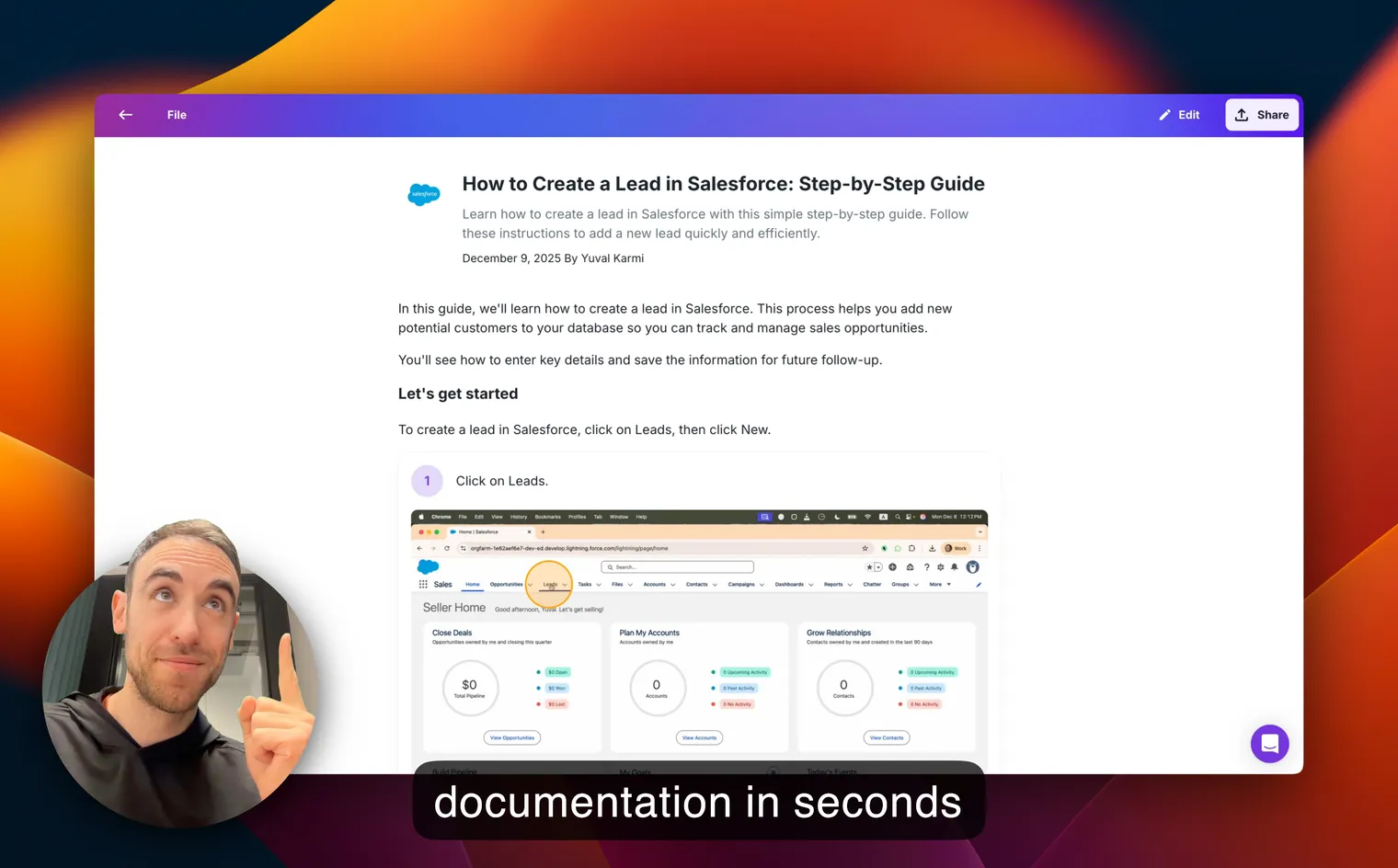
Teach your co-workers or customers how to get stuff done – in seconds.

What Is a Training Guide?
Before jumping into the template, let’s clarify what we’re talking about.
A training guide is documentation that teaches someone how to perform a specific task, process, or use a particular system. It’s focused, practical instruction designed to get someone from “I don’t know how to do this” to “I can do this myself.”
Training guides are different from:
- Training manuals - those are comprehensive documents covering an entire role or department
- Standard Operating Procedures (SOPs) - those focus on standardizing processes for consistency
- Quick reference guides - those are brief cheat sheets for people who already know the basics
Think of a training guide as the middle ground. More detailed than a quick reference, more focused than a full manual.
When You Need a Training Guide
You probably need a training guide if:
- You’re onboarding new employees who need to learn specific systems
- You’re training people on updated processes or software
- You keep answering the same questions repeatedly
- You need to delegate tasks but don’t have time to train people directly
- You’re scaling your team and can’t personally train everyone
I learned this the hard way at my first startup. After we won Product Hunt, we had to scale fast. I couldn’t personally train everyone, and we didn’t have good documentation. The result? Inconsistent work, repeated mistakes, and me spending hours on Slack answering questions I’d already answered ten times before.
Never again.
The Essential Training Guide Template
Here’s the template structure I use for almost every training guide I create. Copy this framework and customize it for your specific needs.
Template Structure
1. Title and Overview2. Who This Is For3. Prerequisites4. What You'll Learn5. Tools and Resources Needed6. Step-by-Step Instructions7. Common Issues and Troubleshooting8. Practice Exercise (Optional)9. Additional Resources10. Questions and SupportLet me break down each section and show you exactly what to include.
Record your process once, get professional documentation automatically
Section 1: Title and Overview
Start with a clear, descriptive title that tells people exactly what they’re learning.
Good titles:
- “How to Process Customer Refunds in Shopify”
- “Setting Up Your Development Environment”
- “Managing Inventory in Our Warehouse System”
Bad titles:
- “Refunds” (too vague)
- “A Comprehensive Deep Dive Into the Intricacies of Our Refund Processing Workflow” (too wordy)
Follow the title with a brief overview - two or three sentences explaining what this guide covers and why it matters.
Example overview: This guide walks you through our complete refund process in Shopify. You’ll learn how to verify refund requests, process them correctly, and communicate with customers. Following this process ensures we maintain consistent customer service and accurate financial records.
The overview answers: What is this? Why should I care? What will I accomplish?
Section 2: Who This Is For
Specify who should use this guide. This helps people quickly determine if they’re looking at the right document.
Examples:
- “This guide is for customer service representatives processing refunds”
- “Designed for new developers joining the engineering team”
- “For operations staff managing warehouse inventory”
If there are prerequisites or prior knowledge needed, mention that here too. Don’t assume everyone starts from the same place.
Section 3: Prerequisites
List everything someone needs before starting. This might include:
- Access to specific systems or software
- Completed training modules
- Permissions or credentials
- Background knowledge
- Physical materials or equipment
Example: Before starting this guide, make sure you have:
- Admin access to Shopify
- Completed the “Customer Service Basics” training
- Access to our refund approval spreadsheet
- Slack access to reach the finance team if needed
I can’t tell you how many times I’ve watched someone get halfway through a training guide only to realize they don’t have the access they need. List prerequisites upfront and save everyone the frustration.
Section 4: What You’ll Learn
Set clear expectations about what someone will be able to do after completing this guide.
Use action-oriented language. Instead of “understanding the refund process,” say “process refunds from start to finish.”
Example: By the end of this guide, you’ll be able to:
- Verify if a refund request meets our policy requirements
- Process a full or partial refund in Shopify
- Send appropriate customer communication
- Update our refund tracking spreadsheet
- Escalate edge cases to the right person
This section doubles as a checklist. When someone finishes the guide, they can look back and confirm they’ve actually learned these things.
Teach your co-workers or customers how to get stuff done – in seconds.
Section 5: Tools and Resources Needed
List all the tools, resources, or references someone will need while following this guide.
Include direct links where possible. Don’t make people hunt for things.
Example: You’ll use these tools and resources:
- Shopify Admin Panel: [link]
- Refund Request Form: [link]
- Customer Communication Templates: [link]
- Refund Tracking Spreadsheet: [link]
- Our Refund Policy: [link]
I like to include both what they’ll actively use and what they might need to reference. Better to have too many helpful links than too few.
Section 6: Step-by-Step Instructions
This is the core of your training guide. Break down the process into clear, sequential steps.
How to Write Great Steps
Be specific. “Click the Submit button” is better than “Submit the form.”
Use screenshots. Show people exactly what they’re looking for. A picture really is worth a thousand words here.
Number your steps. Make it easy to follow and reference (e.g., “I’m stuck on step 7”).
Keep steps focused. Each step should be one action. If you find yourself using “and” multiple times in a step, split it up.
Explain why when it matters. Sometimes knowing why you’re doing something helps it stick.
Example Step Structure
Step 1: Open the refund request Navigate to the Refund Requests folder in your email. Open the customer’s refund request email.
Why this matters: Starting from the original request ensures you have all the context you need.
[Screenshot of email inbox showing refund request folder]
Step 2: Verify the request meets our policy Check that the request was submitted within 30 days of purchase and includes the order number. If it doesn’t meet policy requirements, go to Step 8 for how to handle policy exceptions.
[Screenshot of refund policy checklist]
See how each step is clear, specific, and tells you exactly what to do? That’s what you’re aiming for.
Breaking Down Complex Processes
If you’re documenting something complex, break it into phases or major sections. Use H3 headings to create sub-sections within your instructions.
Example structure for complex process:
Phase 1: Initial Verification
- Step 1: …
- Step 2: …
Phase 2: Processing the Refund
- Step 3: …
- Step 4: …
Phase 3: Customer Communication
- Step 5: …
- Step 6: …
This makes long processes feel less overwhelming and helps people find their place if they take a break.
Section 7: Common Issues and Troubleshooting
This section saves you from answering the same questions over and over.
Document the issues people actually run into. Don’t try to anticipate every possible problem - start with the ones you know happen.
Use a Q&A format:
Problem: “I don’t see the Refund button in Shopify” Solution: Check that you’re logged in with admin credentials. Standard user accounts don’t have refund permissions. If you should have admin access but don’t see the button, contact IT.
Problem: “The customer ordered 60 days ago - can I still process this?” Solution: Our standard policy is 30 days, but there are exceptions. Review the customer’s situation and if it seems reasonable, escalate to Sarah (Customer Service Manager) for approval before processing.
Problem: “The refund failed when I tried to process it” Solution: This usually means the original payment method is no longer valid. Try processing again. If it fails a second time, reach out to finance team on #finance-help.
I add to this section over time. Whenever someone asks me a question about the process, I add it here.
Build comprehensive training guides with Glitter AI
Section 8: Practice Exercise (Optional)
For complex processes, include a practice scenario. This helps people test their understanding before doing it for real.
Example: Practice Scenario: A customer, Jane Smith, submitted a refund request for order #12345. She purchased the item 15 days ago and says it arrived damaged. Use our test environment to practice processing this refund from start to finish.
You can find test customer accounts and orders in [Shopify Test Environment].
Not every training guide needs this, but it’s incredibly valuable for high-stakes processes or when mistakes are costly.
Section 9: Additional Resources
Link to related documentation, training materials, or helpful resources.
Example: Related guides and resources:
- Training manual for employees - Our complete customer service training manual
- Employee training best practices - How we approach training at our company
- Customer Service Standards - Our service level commitments
- Shopify Help Documentation - Official Shopify refund documentation
These links help people go deeper on related topics and build a more complete understanding.
Section 10: Questions and Support
Tell people where to get help if they’re stuck.
Be specific. “Contact your manager” is less helpful than “Post in #customer-service-help on Slack or DM Sarah directly.”
Example: Questions about this process?
- Post in #customer-service-help on Slack for quick questions
- DM Sarah (@sarah) for policy clarifications
- Submit a ticket to IT if you’re having system access issues
- Suggest improvements to this guide: [feedback form link]
That last point is important. Your first version of a training guide won’t be perfect. Make it easy for people to suggest improvements.
Customizing the Template for Different Situations
This template works for most training guides, but you can adapt it based on what you’re documenting.
For Software/System Training
Add these sections:
- Navigation overview (how to find your way around)
- Key features and what they do
- Keyboard shortcuts
- Settings and preferences
For Physical Processes
Include:
- Safety considerations (first, always first)
- Equipment maintenance notes
- Visual diagrams or photos of physical setup
- Quality checkpoints
For Quick Training Guides
You can simplify the template:
- Combine “Who This Is For” and “Prerequisites”
- Skip the practice exercise
- Keep troubleshooting to top 3 issues only
- Merge “Additional Resources” into relevant steps
For Complex Multi-Day Training
Expand the template:
- Break into modules or chapters
- Add learning checkpoints after each section
- Include quizzes or knowledge checks
- Create a suggested timeline or schedule
The structure stays the same. You’re just adjusting the depth.
Training Guide Template Examples
Let me show you how this template looks in practice.
Example 1: Software Training Guide
Title: “How to Schedule Social Media Posts in Hootsuite”
Overview: This guide teaches you how to schedule social media posts across multiple platforms using Hootsuite. You’ll learn to create, schedule, and manage posts efficiently.
Who This Is For: Marketing team members responsible for social media management.
Prerequisites:
- Hootsuite account with publisher access
- Completed “Social Media Guidelines” training
- Access to our brand assets folder
What You’ll Learn:
- Create a new post in Hootsuite
- Schedule posts for specific dates and times
- Schedule the same post across multiple platforms
- Review and edit scheduled posts
- Monitor scheduled post performance
[Continue with steps, troubleshooting, etc.]
Example 2: Process Training Guide
Title: “How to Open and Close the Store”
Overview: This guide covers our complete opening and closing procedures. Following these steps ensures the store is ready for customers and secured properly each day.
Who This Is For: All retail floor staff.
Prerequisites:
- Store keys and alarm code
- Completed workplace safety training
- Access to the register system
What You’ll Learn:
- Complete the morning opening checklist
- Set up registers and cash drawers
- Verify inventory and displays
- Run end-of-day reports
- Complete closing security procedures
[Continue with steps, troubleshooting, etc.]
See how the same structure works for completely different types of training?
How to Create Your Training Guide (The Practical Part)
Okay, you’ve got the template. Now how do you actually create your training guide without it taking forever?
Method 1: Write It Out (Traditional Approach)
- Copy the template structure into a Google Doc or Notion page
- Fill in each section, starting with the easy ones (title, overview)
- Record yourself doing the process and take screenshots as you go
- Write out the steps based on your screenshots
- Have someone else follow your guide and note where they get stuck
- Revise based on their feedback
This works, but it’s time-consuming. Expect 2-4 hours for a solid training guide.
Method 2: Record and Generate (Faster Approach)
This is how I do it now, and honestly, I don’t think I’ll ever go back to the old way.
- Open Glitter AI (shameless plug, but seriously)
- Hit record and walk through the process while talking through what you’re doing
- Glitter AI automatically captures screenshots and transcribes your explanation
- Review the generated guide and fill in the template sections
- Add your troubleshooting and resources sections
- Share with your team
This cuts creation time to 15-30 minutes. Same quality, way less work.
I built Glitter AI specifically because I was tired of spending hours on documentation that I knew was important but felt like such a drag to create. If you’re documenting software processes, screen recordings, or anything on your computer, it’s worth trying.
Teach your co-workers or customers how to get stuff done – in seconds.
Training Guide Best Practices
A few tips I’ve learned from creating way too many training guides:
Keep It Scannable
Use short paragraphs. Bullet points. Clear headings. People skim training documentation - make it easy to find what they need.
Use Visuals Generously
Screenshots, diagrams, photos - whatever helps people see what you mean. Visual learning is real. I’ve watched people struggle with written instructions and then immediately get it when shown a screenshot.
Update Regularly
Set a reminder to review your training guides quarterly. Things change. Software updates. Processes evolve. Your documentation should too.
I write more about this in my guide on keeping documentation updated.
Get Feedback From Users
The people using your training guides will spot issues you miss. Ask them. Listen to them. Update based on what they tell you.
Version Your Guides
Note the last update date at the top of your guide. If you make major changes, consider keeping old versions accessible for a transition period.
Make Them Easy to Find
The best training guide in the world is useless if no one can find it. Organize your documentation logically and make it searchable.
Test With Real People
Before rolling out a training guide widely, have someone unfamiliar with the process try to follow it. Watch where they struggle. Those moments are gold for improving your documentation.
Common Training Guide Mistakes to Avoid
I’ve made all of these mistakes. Learn from my pain:
Mistake 1: Assuming Too Much Knowledge
Just because something is obvious to you doesn’t mean it’s obvious to someone new. Spell things out.
Mistake 2: Skipping Screenshots
“It’s easy, they’ll figure it out” - no, they won’t. Add the screenshot.
Mistake 3: Writing Encyclopedia Entries
Keep it focused on what people need to know to do the task. You can always link to deeper resources for people who want to learn more.
Mistake 4: Using Jargon Without Explanation
Either avoid jargon or define it the first time you use it. Remember, someone completely new to your company might be reading this.
Mistake 5: Creating and Forgetting
Documentation isn’t a one-and-done thing. It needs maintenance. Build in a review process.
Mistake 6: Making It Too Pretty
Don’t let design perfectionism stop you from shipping documentation. Clear and complete beats beautiful but delayed. Every time.
Start with the content. Make it pretty later if you want.
Storing and Sharing Your Training Guides
Where should you keep your training guides? A few options:
Knowledge Base or Wiki
Tools like Notion, Confluence, or even a simple Google Drive folder. Organize by department or topic.
Learning Management System (LMS)
If you have formal training programs, an LMS makes sense. But it’s overkill for most small teams.
Within the Tool Itself
Some platforms let you embed documentation right in the interface. This is great for just-in-time learning.
Shared Drives
Simple and accessible, though harder to search and organize as you scale.
I use a combination. Glitter AI for creation and storage, with links embedded in our Notion wiki for easy discovery.
The most important thing? Make sure everyone knows where to find training documentation and can access it when they need it.
If you’re interested in how we handle sharing documentation, I wrote about free documentation sharing that might be helpful.
Frequently Asked Questions
What should be included in a training guide template?
A complete training guide template should include: a clear title and overview, target audience specification, prerequisites list, learning objectives, required tools and resources, step-by-step instructions with screenshots, common troubleshooting issues, optional practice exercises, additional resources, and contact information for support. This structure ensures learners have everything they need to successfully complete the training and know where to get help if they encounter problems.
How long should a training guide be?
Training guides should be as long as necessary to cover the topic completely, but no longer. Most effective training guides are between 5-15 pages or 1,500-3,000 words. For simple processes, a 2-3 page guide might suffice. For complex systems, you might need 20+ pages. Focus on clarity and completeness rather than hitting a specific length. If your guide exceeds 20 pages, consider breaking it into multiple focused guides or creating a comprehensive training manual instead.
What's the difference between a training guide and a training manual?
A training guide is focused documentation that teaches one specific task, process, or system. It's designed to get someone from not knowing how to do something to being able to do it independently. A training manual is a comprehensive document covering an entire role, department, or set of related processes. Think of training guides as chapters that might live within a broader training manual. For example, a customer service training manual might contain separate training guides for processing refunds, handling complaints, and using the CRM system.
How do you create a training guide quickly?
The fastest way to create a training guide is to record yourself performing the process while talking through your steps, then use those recordings to build the documentation. Screen recording tools can automatically capture screenshots as you work. Start with a proven template structure so you're filling in sections rather than creating from scratch. Focus on getting the core steps documented first, then add screenshots, troubleshooting, and polish in a second pass. Using AI-powered documentation tools like Glitter AI can reduce creation time from hours to minutes by automatically generating structured guides from screen recordings.
How often should training guides be updated?
Review training guides quarterly at minimum and update them immediately whenever the process changes. Set calendar reminders for regular reviews every 3 months. Also assign each guide an owner who's responsible for keeping it current. The best practice is to update documentation at the same time you roll out process changes, not weeks later. Out-of-date training guides are worse than no documentation because they teach people incorrect methods. Include a "last updated" date on each guide so users know if they're looking at current information.
What format should I use for training guides?
The best format depends on how your team works, but most teams benefit from digital formats that are easy to update and share. Popular options include: documentation platforms like Notion or Confluence for searchable, linkable guides; PDF for guides that need version control or formal approval; video format for visual learners or complex demonstrations; or web-based interactive guides that can include embedded videos and clickable elements. Many teams use a combination - for example, a written guide with embedded video demonstrations. Choose formats that your team can actually access and that you can realistically keep updated.
Start Creating Your Training Guides
You’ve got the template. You know the structure. You understand what makes training documentation actually work.
Now it’s just about doing it.
Start small. Pick one process people keep asking questions about. Follow the template. Create that first guide.
It won’t be perfect. That’s okay. Ship it anyway. Get feedback. Make it better.
Your second guide will be easier than your first. Your tenth will practically write itself.
And here’s something I’ve noticed: once you have a few solid training guides, people start contributing. Someone will improve your guide, or create their own for a process they own. Documentation becomes part of your culture.
That’s when the real magic happens.
If you want to make the creation process faster, give Glitter AI a try. Your first guides are free, and you can create comprehensive training documentation in minutes instead of hours.
But whether you use our tool or not, please - create the documentation. Your future self (and your future hires) will thank you.
Create professional training documentation in minutes with Glitter AI