
Read summarized version with
Whale has built a respectable reputation as a knowledge management platform. Their “Alice” AI assistant and browser extension do a decent job of helping teams find and share SOPs without too much friction.
But here’s the thing: it won’t work for everyone.
I’m Yuval, founder of Glitter AI. I spent years wrestling with knowledge management systems at my first startup before I finally decided to build my own documentation tool. That experience gave me a pretty honest view of where Whale excels and where teams start running into problems.
In this guide, I’ll walk you through the best Whale alternatives for 2026, with my honest thoughts on each option. You can also check out our detailed Whale vs Glitter AI comparison for a head-to-head breakdown.
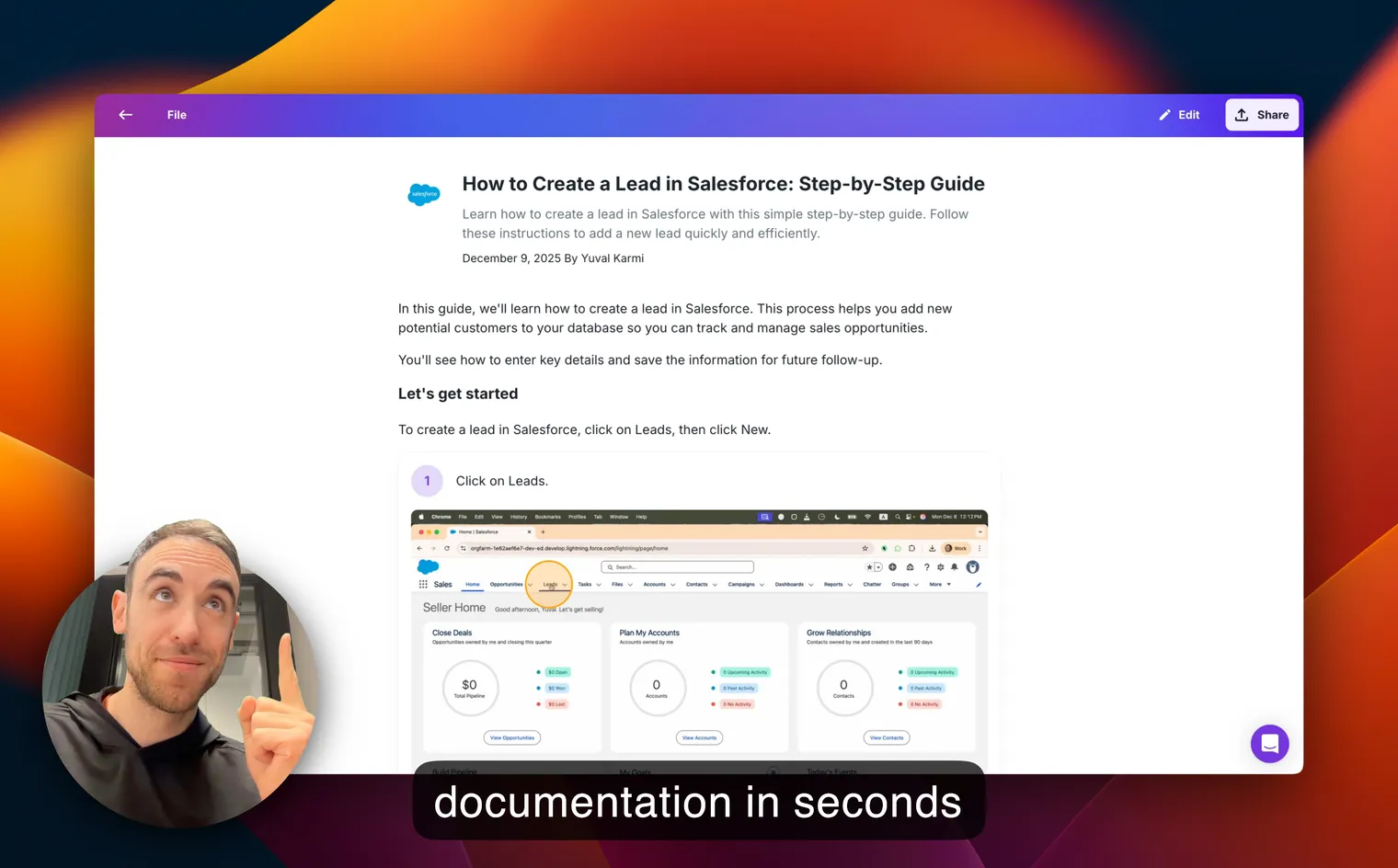
Teach your co-workers or customers how to get stuff done – in seconds.

Top Whale Alternatives at a Glance
| Tool | Best For | Starting Price | Desktop Support | Free Tier |
|---|---|---|---|---|
| Glitter AI | Visual documentation with voice | $16/mo | Yes | 10 guides total |
| Trainual | Structured employee training | $249/mo | No | 7-day trial |
| SweetProcess | Team-based SOP management | $99/mo | No | 14-day trial |
| Scribe | Browser-based guides | $25/mo annual | Pro only | Yes (limited) |
| Notion | Flexible knowledge base | $10/user/mo | Yes | Yes (unlimited) |
| Confluence | Enterprise documentation | $5.67/user/mo | Yes | Yes (10 users) |
Why Look for Whale Alternatives?
Look, Whale has real strengths. The “Alice” AI assistant consistently gets praise for answering questions based on your company’s docs, and the browser extension is genuinely useful for surfacing contextual knowledge inside other tools (imagine your CRM SOPs popping up while you’re working in Salesforce). The Step Recorder that auto-captures clicks and screenshots? Also pretty handy. And their support team is responsive.
Still, teams often find themselves searching for whale alternatives for a handful of reasons:
AI Token Limits
Whale runs on a “token” system that caps how much you can use features like AI quiz generation or video-to-text conversion. Free plan? 20 tokens, one-time. Team gets 25 per month, Scale gets 75, and Enterprise tops out at 500.
The “Alice” Q&A chatbot sits outside this token system and reviews suggest it works well for contextual search. But those generation limits can feel tight if you want to lean into AI automation.
Access Control Restrictions
Certain user access controls are locked to Whale’s higher-tier plans. Smaller teams that need role-based document security but can’t justify premium pricing often find this frustrating.
Editor Limitations
For everything Whale does well, the editor seems to be a recurring pain point. Users frequently describe it as too basic, with formatting limitations that get in the way.
Real user complaints:
“Inefficient text tool interface: The text editor feature in Whale is not perfect. Selecting fonts, font size, etc. is not possible with Whale and this results in a messy typing interface.”
“Lack of customization on formatting, super occasional minor bugs.”
Some users call the customization “very minimal.” Everyone sees the same options, and there’s not much room to adjust things.
API Access Only on Enterprise
API access? That’s Enterprise-only, starting at $1,200/month ($14,400/year). If you need to connect your knowledge management system to other tools or automate workflows, this could be a dealbreaker unless you’re ready for enterprise-level pricing.
Pricing Considerations
Whale’s pricing jumps can catch you off guard. The free tier covers up to 5 users, but moving to Team ($99/month for 10 users) costs $149/month on monthly billing. The bigger jump hits at Scale: $299/month (or $449 if you pay monthly) for 25 users.
Training Flows and AI Quizzes? Locked behind that $299/month Scale plan. Smaller teams end up paying premium prices just to access basic onboarding features. Extra users run $10-12/month depending on your tier.
Users have expressed frustration:
“The jump from the ‘Free’ plan (5 users) to the ‘Team’ plan ($99/mo) is steep for very small businesses (e.g., a team of 6).”
Import and Migration Challenges
Moving your existing documentation into Whale can get messy. Word docs and PDFs often import with broken formatting, and cleaning it up takes real time.
“Importing existing documents into Whale is challenging: If you have an already existing policy procedure, importing them into Whale is not an easy feat; it might be easier to start from scratch.”
That friction makes switching from another system harder than it needs to be.
Security and Compliance Gaps
Whale is GDPR compliant with European servers, but they don’t prominently advertise SOC 2 Type II certification the way many whale competitors do. Advanced SSO features like SCIM provisioning require the Enterprise plan at $1,200/month.
Also worth noting: there’s no clear statement that Whale won’t use customer data to train AI models for other customers. Security-conscious organizations may want to ask about this directly.
TL;DR: Our Top Picks
Best for Visual Documentation: Glitter AI - Talk through your process, and voice-narrated guides create themselves. Desktop capture is free, and you’ll finish 11x faster than typing everything out.
Best for Structured Training: Trainual - Full-featured onboarding and training with role-based content, visual org charts, and progress tracking.
Best for SOP Management: SweetProcess - A dedicated SOP tool with transparent pricing. Every feature included, no tiers to navigate.
Best for Automated Guides: Scribe - Click through your browser workflow and it generates step-by-step guides with screenshots automatically.
Best for Flexibility: Notion - A workspace that molds to your documentation style, whatever that looks like.
Best for Enterprise Teams: Confluence - The go-to for large organizations. Deep Atlassian integration and enterprise-grade security.
1. Glitter AI - Best for Visual Documentation
Best for: Teams creating training materials and SOPs with visual walkthroughs
Full disclosure: I built this one. But I created Glitter specifically because I kept hitting the same walls with traditional knowledge management tools.
How It Works
You record your screen (desktop or browser) while explaining what you’re doing out loud. Glitter captures screenshots automatically and converts your voice into clear, natural steps. What used to take hours now takes minutes.
The magic is in the narration. Instead of manually typing “Click the Submit button to send the report,” you just say it as you record. Your documentation ends up capturing your actual explanation, complete with context.
Key Features
- Desktop and browser capture (both free, Chromium browsers only)
- Voice narration in 99 languages with automatic transcription
- Magic Article: AI transforms guides into full documentation
- Video-to-guide conversion (upload existing recordings)
- Screenshot editing with blur and annotation tools
- Sensitive data redaction (paid plans only)
- Multiple export formats (PDF, HTML, Markdown, PowerPoint)
- Embed guides anywhere with no viewer fees
- 5-15 minute recording time (depending on plan)
Pricing
- Free: 10 guides total, 5 min recording time, desktop + web capture, Magic Article
- Pro: $20/month ($16/month annual) - Unlimited guides, 15 min recording time, Magic Editor, sensitive data redaction
- Team: $75/month for 5 users ($15/user) - 30 min recording time, team collaboration
- Enterprise: Starts at $8,000/year - SSO, audit trails, custom teams
Pros
- Likely the fastest documentation creation on this list
- Output sounds natural because it’s based on your actual words
- Desktop support is free (most competitors charge for this)
- 99 language support
- No per-viewer fees, so costs stay predictable
- Video-to-guide feature repurposes recordings you already have
- You end up with both visual guides and searchable text
Cons
- You need to narrate out loud, which can feel weird in open offices
- As a newer product, the template library isn’t as big as established players
- Not built for long-form written documentation (visual procedures are the sweet spot)
- Chromium browsers only (Safari isn’t supported)
- No GIF export
- AI voiceover/narration is on the roadmap but not available yet
- Sensitive data redaction requires a paid plan
When to Choose Glitter AI
Glitter AI makes sense if you need visual documentation fast and want it to sound like an actual human wrote it. Customer support teams, product trainers, IT departments, anyone documenting software processes, really. Voice narration is genuinely faster than typing everything out manually.
Your first 10 guides are free - no credit card needed
2. Trainual - Best for Structured Training
Best for: Companies that need full-featured employee onboarding and training programs
How It Works
Trainual focuses on structured training programs, business playbooks, and employee handbooks. Content is organized by roles, departments, and processes, so assigning the right training to the right people is pretty straightforward.
Key Features
- Visual org chart and role builder
- Progress tracking and testing
- E-signature compliance
- Content creation with videos, images, and flowcharts
- Role-based content assignments
- Mobile and desktop apps
- Integrations with Microsoft Teams, Google Drive, Slack, and more
Pricing
Trainual starts at $249/month for the Core plan (as of 2025), with higher tiers adding more users, storage, and features. You can get a free trial, but there’s no free version.
Pricing scales with team size, and features vary by tier. Expect your bill to grow alongside headcount.
Pros
- Clear training paths with role-based assignments
- Good compliance and testing features
- Org chart makes team structure visible at a glance
- Decent mobile app for learning on the go
- Monthly payment option (lots of whale competitors push annual commitments)
Cons
- High starting price ($249/month minimum)
- No free tier whatsoever
- Some premium features cost extra (like e-signatures)
- Can overwhelm small teams with simple needs
- Mobile experience isn’t as polished as desktop
- Mandatory $1,000 implementation fee is often required
Real user feedback on pricing:
“It’s an empty platform to hold your SOPs for a monthly fee charged per person in your team. It was costly.” - Reddit User, 2024
When to Choose Trainual
Trainual is worth considering if you’re building a serious employee training program and need strong role-based organization. Growing businesses that want structured onboarding paths, compliance tracking, and room to scale will likely find value here.
3. SweetProcess - Best for SOP Management
Best for: Teams focused on documenting and managing standard operating procedures
How It Works
SweetProcess is built specifically for SOP documentation. It helps teams document procedures, policies, and processes with collaborative editing and task management at the core. Assign procedures to team members, track who’s completed what, and keep everything organized.
Key Features
- Procedures, policies, and processes documentation
- Process maps and flowcharts
- Task assignment and progress tracking
- Version history and document control
- Public or private knowledge base creation
- Export in various formats
- Integrations with 1,000+ apps
Pricing
SweetProcess runs $99/month for up to 20 team members. Additional members cost $5 each. Smaller teams can request a custom quote.
The selling point here is simple: transparent pricing with every feature included. No premium tiers, no hidden costs. Everyone gets everything.
Free 14-day trial available (no credit card needed).
Pros
- Simple, transparent pricing with all features included
- Only charged for active team members who actually use it
- Focused specifically on process documentation
- Real-time collaboration
- Good integration ecosystem (1,000+ apps)
- Flexible export options
Cons
- More expensive than Whale for small teams (base $99 vs Whale’s free tier)
- Interface looks a bit dated next to newer tools
- Limited AI features compared to newer competitors
- Better suited for written procedures than visual documentation
When to Choose SweetProcess
SweetProcess works well if you want a dedicated SOP tool with clear pricing and no feature gates. Teams that want to document processes collaboratively without navigating complex pricing tiers will appreciate the simplicity.
4. Scribe - Best for Automated Browser Guides
Best for: Teams documenting browser-based workflows quickly
How It Works
Install the browser extension, click through your process, and Scribe builds a step-by-step guide with screenshots and instructions. It’s similar in spirit to Whale’s approach but focused purely on documentation rather than training, a contrast we dig into in our Whale vs Scribe breakdown.
Key Features
- Automatic screenshot and step capture
- Browser extension for web apps
- Desktop application (Pro plans only)
- Combine multiple guides into documents
- Brand customization (remove Scribe branding)
- Multi-language translation
- Share via link or embed in knowledge bases
Pricing
- Basic (Free): Web apps only, limited features
- Pro Personal: $23/month - Desktop capture and exports
- Pro Team: $12/user/month (5-seat minimum, $60/month total) - Team collaboration
- Enterprise: Custom pricing (reports suggest $18,000 annually for small teams)
20% off with annual billing.
Pros
- Very fast documentation for browser workflows
- No narration needed (it just captures your clicks)
- Clean, professional output
- Good for documenting internal web applications
- Used by 94% of Fortune 500 companies
Cons
- Desktop app only on paid plans
- Output can feel generic without narration context (“Click here” instead of “Click Submit to send report”)
- Can’t edit screenshots after capture
- Five-seat minimum on Team plan pushes costs up
- Annual billing required for best pricing
- Desktop app reliability has been hit or miss
Users have shared frustrations with the desktop recorder:
“I have recorded and completed the same process 15 or so times now - 95% of them show up as a blank scribe with ‘no steps’.” - Reddit User, 2025
When to Choose Scribe
Scribe makes sense if your documentation is mostly browser-based and you want the fastest possible creation time. SaaS companies documenting their own products or IT teams building guides for web applications will probably get the most out of it.
5. Notion - Best for Flexibility
Best for: Teams that want an all-in-one workspace for documentation, projects, and collaboration
How It Works
Notion combines wikis, databases, and documents into one flexible workspace. It wasn’t built specifically for SOP management, but teams use it as their knowledge base all the time because it adapts to almost anything.
Key Features
- Unlimited pages and blocks
- Database and table views
- Templates for SOPs and procedures
- Real-time collaboration
- AI features with GPT-4.1 and Claude 3.7 (Business plan)
- Integrations with Slack, Google Drive, and more
- Mobile and desktop apps
Pricing
- Free: Unlimited pages for individuals, 5MB file upload limit
- Plus: $10/user/month (annual) - Unlimited file uploads, 30-day version history
- Business: $20/user/month (annual) - Full AI access, 90-day version history, advanced permissions
- Enterprise: Custom pricing - Advanced security, SAML SSO
Annual billing saves about 20% (roughly 2.4 months free).
Pros
- Extremely flexible, adapts to whatever documentation style you prefer
- Generous free tier with unlimited pages
- Clean, modern interface
- Solid AI features on Business plan
- Good mobile experience
- Active community with tons of templates
Cons
- Search feels basic compared to dedicated knowledge base tools
- Can overwhelm new users at first
- Not built specifically for SOP management
- Performance can slow down with very large databases
- Requires more setup than purpose-built SOP tools
When to Choose Notion
Notion fits well if you want a flexible workspace that handles documentation alongside projects, meeting notes, and databases. Startups and small teams that prefer one unified tool over a collection of specialized apps will probably like it.
6. Confluence - Best for Enterprise Teams
Best for: Large organizations needing enterprise-grade knowledge management with Atlassian integration
How It Works
Confluence is Atlassian’s enterprise wiki and knowledge base. You get structured documentation with strong search, version control, and tight integration with Jira and other Atlassian products.
Key Features
- Unlimited pages and spaces
- Pre-made documentation templates
- Automatic versioning and content library
- AI-powered search and intelligent agents
- Native Jira integration
- Whiteboards and databases
- Enterprise security and compliance
Pricing
- Free: Up to 10 users, 2GB storage, 3 whiteboards per user
- Standard: $5.67/user/month annual (10 user minimum)
- Premium: $11-12.30/user/month depending on user count
- Enterprise: Custom pricing with dedicated support
- Data Center: $28,000/year for 500 users (self-hosted)
Pros
- Good search engine with suggested results
- Seamless Jira integration for development teams
- Enterprise-grade security and compliance
- Generous free tier (10 users)
- Mature product with extensive features
- Solid version control and collaboration
Cons
- Interface can feel cluttered for newcomers
- Large pages load slowly
- Mobile functionality lags behind desktop
- Feature set can be overwhelming for simple use cases
- Works better for technical teams than general business users
When to Choose Confluence
Confluence is the obvious pick if you’re already using Jira, Trello, or other Atlassian tools. It’s also a strong choice if you need enterprise-grade documentation. Software development teams, IT departments, and large organizations with complex needs tend to find it fits well.
Feature Comparison Table
| Feature | Glitter AI | Trainual | SweetProcess | Scribe | Notion | Confluence |
|---|---|---|---|---|---|---|
| Desktop Capture | Yes (free tier) | No | No | Pro only | N/A | N/A |
| Video Documentation | Yes | Yes | Limited | No | Embed only | Embed only |
| Voice Narration | Yes (record your own) | No | No | No | No | No |
| AI Voiceover | Coming soon | No | No | No | No | No |
| AI Features | Magic Article, transcription | Limited | Limited | Auto-capture | GPT-4.1, Claude (Business) | Search, agents |
| Free Tier | 10 guides total | Trial only | Trial only | Limited web | Unlimited pages | 10 users |
| Mobile Editing | Coming soon | Yes | Yes | No | Yes | Limited |
| Offline Access | No | Yes | No | No | Yes | Yes |
| Custom Branding | Pro plan | All plans | All plans | Pro+ | No | No |
| API Access | Coming soon | Limited | No | Enterprise | Yes | Yes |
| Role-Based Access | Team plan | All paid plans | All plans | Team+ | Business+ | Standard+ |
| Data Redaction | Paid plans | All plans | All plans | Pro+ | No | No |
Pricing Comparison
Here’s how costs compare for a team of 10 users:
| Tool | Monthly Cost (10 users) | Annual Cost | Free Tier |
|---|---|---|---|
| Whale | $99 (annual) / $149 (monthly) | $1,188 | Yes (5 users) |
| Glitter AI | $150 ($15/user) | $1,440 ($12/user annual) | 10 guides |
| Trainual | $249+ | $2,988+ | No |
| SweetProcess | $99 (up to 20 users) | $1,188 | No |
| Scribe | $130 ($13/user annual, 5-seat min) | $1,560 | Yes (web only) |
| Notion | $100 ($10/user) | $1,200 | Yes (unlimited) |
| Confluence | $56.70 ($5.67/user) | $680 | Yes (10 users) |
Note: Prices based on publicly available information as of 2025. Custom enterprise pricing may differ.
How to Choose the Right Whale Alternative
A few factors to think through:
1. Documentation Type
Visual guides? Glitter AI or Scribe Structured training programs? Trainual Flexible wiki-style documentation? Notion or Confluence Process-focused SOPs? SweetProcess (see our standard operating procedures guide for more on building effective SOPs)
2. Team Size and Budget
Small team (under 10) watching costs? Notion Free or Confluence Free Growing team (10-50) with some budget? SweetProcess or Glitter AI Large enterprise with complex needs? Confluence or Trainual
3. Technical Complexity
Non-technical teams? Glitter AI or Scribe (automatic capture) Technical/development teams? Confluence (Jira integration) Mixed teams? Notion (flexible for everyone)
4. Content Creation Speed
Need speed above all else? Glitter AI (voice narration) or Scribe (auto-capture) Can invest time in structured content? Trainual or Confluence Flexible timeline? Notion or SweetProcess
5. Integration Requirements
Need Jira integration? Confluence Need 1,000+ app integrations? SweetProcess Basic integrations are fine? Most tools cover Slack, Google Drive, etc.
Frequently Asked Questions
Is Whale better than Trainual?
They’re built for different things. Whale focuses on knowledge management and SOP documentation with AI features. Trainual specializes in employee training and onboarding with structured learning paths. Whale has a free tier; Trainual starts at $249/month. If you want general knowledge management, lean toward Whale. For comprehensive training programs, Trainual is probably the better fit.
What is the best free alternative to Whale?
Notion probably has the strongest free tier with unlimited pages for individuals, though it’s limited to personal use. Confluence offers a solid free plan for up to 10 users with 2GB storage. Glitter AI gives you 10 free guides total (not monthly) with full desktop and web capture. The best whale alternative really depends on what matters most: flexibility (Notion), team size (Confluence), or visual documentation (Glitter AI).
Can I migrate my Whale content to another platform?
Whale only allows PDF export on paid plans (Team, Scale, or Enterprise). The free tier doesn’t include export at all. SOPs come out as PDF files, so you’ll need to manually recreate structure and formatting when moving to another platform.
One workaround: Glitter AI accepts video uploads, so you could record your Whale content as screen recordings and convert them to guides if you want to preserve visual walkthroughs.
Which Whale alternative has the best mobile app?
Trainual offers the most polished mobile experience with full editing and learning features. Notion also has a solid mobile app.
Whale does have mobile apps for iOS and Android, but users report they’re less robust than the desktop version. Occasional stability issues and missing features make it harder for admins managing content on the go. If mobile access matters a lot, Trainual or Notion are stronger choices. Skip Scribe for mobile entirely (no mobile editing).
Are there any open-source Whale alternatives?
This guide focuses on commercial solutions, but open-source options like BookStack, Wiki.js, and Outline do exist. Keep in mind they lack SOP-specific features and AI capabilities, and they require self-hosting and technical setup.
What alternative is best for video-based training?
Glitter AI combines video and text by converting voice-narrated recordings into searchable guides. For pure video training, Loom’s video tool and Guidde are worth looking at. Both come up again in our Scribe alternatives guide. Trainual and SweetProcess support embedded videos but don’t create them automatically.
Can I use multiple tools together?
Absolutely. Plenty of teams combine tools: Glitter AI or Scribe for visual process documentation, Notion or Confluence for long-form written docs, and Trainual for structured employee onboarding. The trick is picking tools that integrate well (most support Slack, Google Drive, and embed capabilities).
Our Verdict
Honestly, there’s no single best whale alternative. It depends on what you’re trying to accomplish:
Fastest visual documentation? Glitter AI. Voice-narrated guides create themselves in minutes. The free tier is generous, and desktop support comes included from the start.
Comprehensive employee training? Trainual offers the most structured approach: role-based assignments, progress tracking, org charts. Worth the premium if training is your primary goal.
Simple, transparent SOP management? SweetProcess gives you everything at one price with no tiers or hidden costs. Good for teams that just want straightforward process documentation.
Flexible, all-in-one workspace? Notion adapts to almost anything and has the strongest free tier. Ideal if you want one tool to handle everything.
Enterprise needs? Confluence delivers the security, scale, and Atlassian integration that large organizations require.
What these tools have in common: each one solves specific problems better than a general-purpose platform. Figure out your primary use case (visual guides, training programs, flexible wiki, whatever) and choose based on that.
Whichever option you go with, you’ll likely find it addresses the specific limitations that sent you searching for whale alternatives in the first place.
Start with 10 free guides - no credit card needed