
Read summarized version with
I got an email last week from an operations manager at a logistics company. She’d been putting off documenting her warehouse processes for six months. Not because she didn’t know the processes - she literally ran them every day. But because every time she opened a Word document to write it all down, she froze.
“I’m not a writer,” she told me. “I can DO the process in my sleep, but putting it into words? That’s torture.”
Here’s the thing: the best documentation doesn’t come from professional writers. It comes from the people who actually do the work.
I’m Yuval, founder and CEO of Glitter AI. I’ve talked to hundreds of operations managers, team leads, and subject matter experts who feel stuck because they think documenting processes means becoming a writer overnight. It doesn’t.
Let me show you how to document processes when writing isn’t your thing - and never will be. If the process you’re documenting belongs to someone else entirely, capturing what a colleague does without ever having done it yourself takes a slightly different approach, but the same “don’t write, record” mindset still applies.
Teach your co-workers or customers how to get stuff done – in seconds.

Why the Best Process Documentation Comes From Doers, Not Writers
Before I get into the “how,” let’s talk about why you’re actually the perfect person to document your processes, even if you hate writing.
You Know the Real Process (Not the Imaginary One)
When I was running Simpo, we had this beautiful process manual written by a consultant. Super polished, very professional. Completely useless.
Why? Because it described how the process was supposed to work, not how it actually worked. The consultant had never done the process herself. She just interviewed people and wrote down what they told her.
You don’t have that problem. You know where the landmines are. You know the gotchas. You know the thing that always breaks on Thursdays for some reason nobody understands.
That knowledge is worth more than perfect grammar.
You Understand Context That Writers Miss
I once watched someone try to train a new employee using documentation written by a technical writer. The documentation was clear and well-structured. But it missed a critical detail: this particular process had to happen before 2 PM because that’s when the system went into batch processing mode.
The technical writer didn’t know that. The person who did the work every day? They knew it instinctively.
You have context that no writer can capture without doing your job for months.
Your Audience Needs Your Brain, Not Shakespeare
The people reading your documentation don’t need elegant prose. They need to know what button to click, in what order, and what to do when things go wrong.
They need your expertise, not your writing skills.
Teach your co-workers or customers how to get stuff done – in seconds.
The “I Hate Writing” Framework for Process Documentation
Here’s my framework for documenting processes when you’d rather do literally anything else besides write. I use it myself, and I’ve seen it work for everyone from warehouse managers to software implementation consultants.
Step 1: Just Record Your Screen
Seriously. Just hit record and do the thing.
Don’t script it. Don’t rehearse it. Just talk through what you’re doing like you’re showing someone standing next to you.
Why this works: You already know how to explain things verbally. You do it every time someone asks you a question. Recording yourself doing the process is literally just that - explaining while you work.
I use Glitter AI for this (shameless plug), but honestly, use whatever screen recorder you have. Windows has one built in. Mac has QuickTime. Loom is free, and if you want to weigh the dedicated capture tools, see how Tango stacks up against Scribe.
The tool doesn’t matter much, though a look at how lightweight capture tools differ helps if you want narration turned into a written guide. What matters is capturing what you DO, not what you WRITE.
Step 2: Speak in Your Natural Voice
When you’re recording, talk like you’re training someone sitting next to you. Don’t try to sound formal or professional.
Say things like:
- “Okay, so first I’m going to click here…”
- “Now watch out - this part is weird…”
- “If you see this error message, don’t panic, just…”
The best documentation sounds like a conversation. Not a legal document.
I learned this the hard way when I tried to write formal SOPs at Simpo. Nobody used them. When I started just recording myself explaining things naturally? People actually watched the recordings and followed along.
Step 3: Do the Process Slowly
Here’s a mistake I made early on: I’d record myself doing a process at normal speed - which meant my fingers were flying and I was clicking through things in three seconds flat.
Nobody could follow it.
When you’re recording for documentation, slow down. Like, really slow down. Annoyingly slow.
- Pause before each click
- Say what you’re about to do before you do it
- Give people time to see what you’re looking at
Think of it like teaching someone to drive. You don’t just zip around corners - you explain what you’re doing and why.
Teach your co-workers or customers how to get stuff done – in seconds.
Templates and Structures That Make Documentation Easy
If you absolutely have to write something down (and sometimes you do), use these dead-simple structures. No creativity required.
The “Before-During-After” Structure
This is literally the easiest way to document any process:
Before: What you need to have ready
- List out the prerequisites
- Any systems you need access to
- Any information you need to gather
During: What you do, step by step
- Just number the steps
- One action per line
- No paragraphs, just bullet points
After: How you know it worked
- What should happen if you did it right
- What to check to make sure it’s complete
That’s it. You just answered three questions. You’re done.
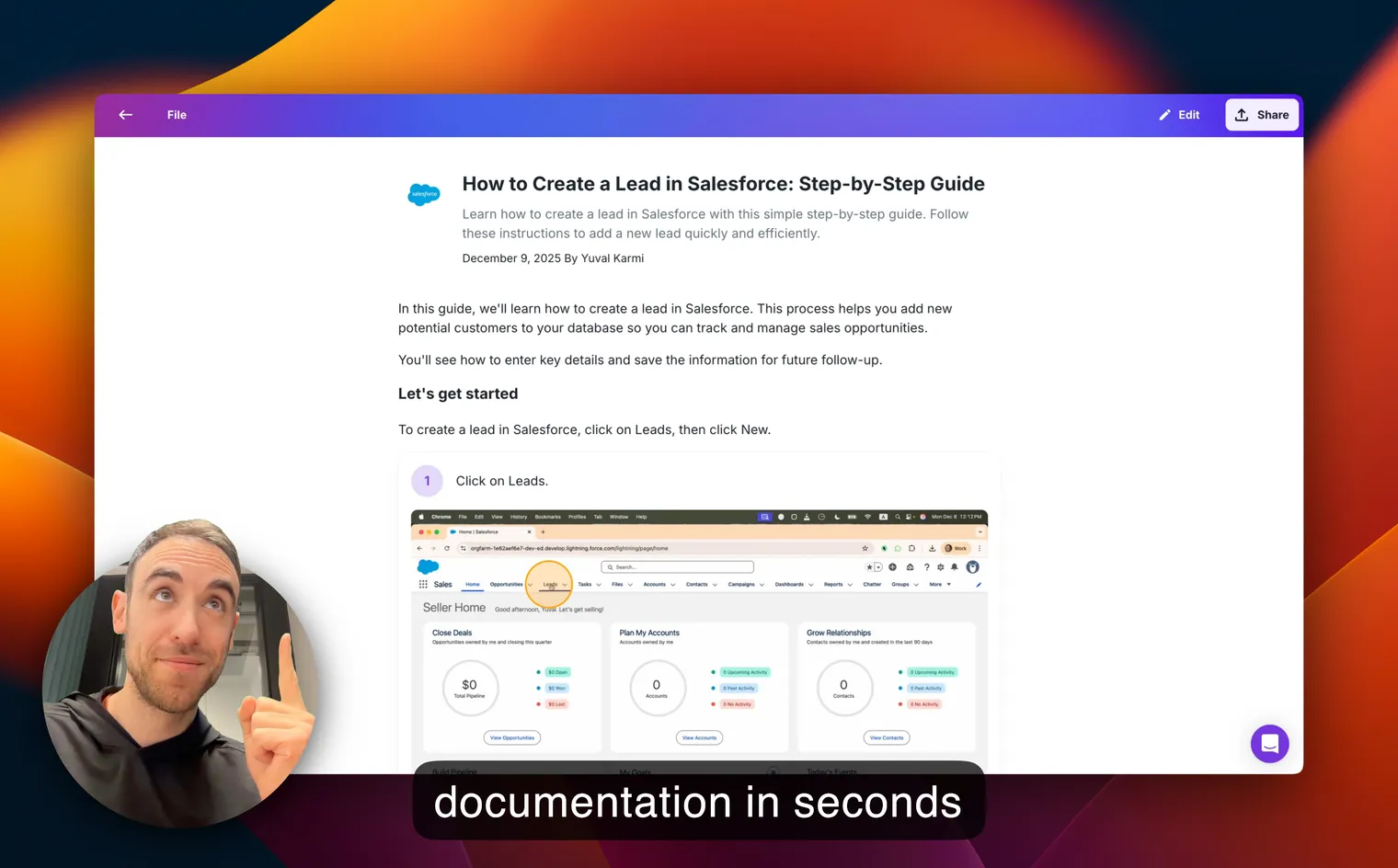
The Screenshot + One Sentence Method
If you’re documenting something visual (like a software process), this format is magic:
- Take a screenshot
- Write ONE sentence explaining what to do in this step
- Take the next screenshot
- Write the next sentence
- Repeat
I’ve seen people who claim they “can’t write” create fantastic documentation using this method. Because you’re not writing an essay - you’re just captioning images.
The “Record Then Extract” Approach
Here’s something I do all the time: I record a screen recording of myself doing the process, then I use AI to transcribe it and clean it up.
Most screen recording tools now have automatic transcription. Or you can use tools like Otter.ai or even ChatGPT to transcribe your video.
Then I just edit the transcription to make it clearer. Way easier than starting from scratch.
Using Screen Recordings to Bypass Writing Entirely
Let’s be real: sometimes you just don’t want to write at all. And honestly? You might not need to.
When Screen Recordings Are Enough
For most process documentation, a good screen recording is all you need. Especially for:
- Software processes where people need to see what you’re clicking
- Processes that change frequently (easier to re-record than rewrite)
- Training new employees who learn better by watching
- Complex workflows where showing is easier than telling
I’ve seen operations teams go months using just screen recordings. No written docs at all. And it worked fine.
How to Make Screen Recordings People Actually Watch
The difference between a screen recording that helps and one that frustrates people comes down to a few simple things:
Keep them short. If your process takes 30 minutes, break it into five 6-minute recordings. People’s attention spans are finite.
Show the cursor. Make sure your screen recording highlights where your cursor is. Sounds obvious, but I’ve seen recordings where you can’t tell what they’re clicking.
Explain your clicks. Don’t just click silently. Say “Now I’m clicking on Settings in the top right…” Even if it seems obvious to you, it helps people follow along.
Record in HD. Make sure text is readable. Nothing worse than a blurry screen recording where you can’t read the button labels.
Combining Recordings with Minimal Text
Here’s my favorite hybrid approach: screen recording for the process, minimal text for the context.
At the top of your documentation, write three things:
- What this process is for (one sentence)
- When you need to do it (one sentence)
- Who should do it (one sentence)
Then just embed your screen recording.
That’s it. Total writing time: maybe five minutes.
Teach your co-workers or customers how to get stuff done – in seconds.
How to Document While You Work (Not After)
The biggest mistake I see people make is thinking they need to set aside “documentation time” to write everything down. That’s why it never happens.
Instead, document as you work.
The “Next Time” Method
Next time someone asks you how to do something, instead of just telling them, record yourself showing them.
Boom. You just created documentation without any extra time.
I started doing this years ago and it’s saved me hundreds of hours. Someone asks a question, I hit record, I show them, and now I have a video I can send to the next person who asks.
The “I’m Doing This Anyway” Approach
If you’re doing a process you know needs to be documented, just hit record before you start.
You were going to do it anyway. Recording yourself takes zero extra time.
I do this constantly. Need to update the quarterly reporting process? Hit record. Doing month-end close? Hit record. Onboarding a new vendor? Hit record.
Half the time I don’t even use the recording. But when I need to show someone how to do it later? Gold.
Document the Questions You Get Asked
Every time someone asks you how to do something, that’s a signal that it needs to be documented.
I keep a running list of questions people ask me. Then, when I have 15 minutes, I pick one and create a quick screen recording answering it.
After a few months of this, you’ll have documentation for all the common processes without ever setting aside “documentation time.”
Simple Methods Anyone Can Use
Let me give you some concrete examples of documentation methods that require almost no writing.
The Checklist Method
Sometimes a simple checklist is all you need. No explanations, no screenshots, just:
☐ Do this thing ☐ Then do this thing ☐ Then do this thing ☐ Check that this result happened
For processes people already know but just need reminders, this is perfect. And writing a checklist barely counts as writing.
We have a free template for this if you want to grab it.
The Annotated Screenshot Method
Take a screenshot. Draw some arrows. Add some text boxes with quick notes.
Tools like Snagit or even PowerPoint make this easy. You’re not writing paragraphs - you’re just adding labels to images.
I’ve seen warehouse managers document entire picking processes this way. Just photos with arrows and short notes like “Stack here” or “Check quantity matches sheet.”
The Video Walkthrough Method
Record a video on your phone walking through a physical process. Narrate as you go.
This works great for manufacturing processes, lab procedures, or anything hands-on that isn’t on a computer.
No editing required. Just hold up your phone, hit record, and explain what you’re doing.
The “Steal Someone Else’s Structure” Method
Find process documentation for something similar to what you’re documenting. Copy the structure. Fill in your specific details.
Not plagiarism - just using a proven framework so you don’t have to invent your own.
Most SOP templates online are free to use. Grab one, delete their content, add yours. Done.
What to Do When You Absolutely Must Write
Okay, sometimes you really do need written documentation. Maybe your industry requires it. Maybe it’s for compliance. Maybe your boss insists.
Here’s how to make writing as painless as possible.
Write Like You Talk
Forget everything you learned about formal writing. Just type what you would say.
Imagine explaining the process to a coworker over lunch. Type that.
Use short sentences. Use simple words. It’s okay to start sentences with “and” or “but.” It’s okay to use contractions.
The goal is clarity, not impressiveness.
Use Bullet Points Instead of Paragraphs
Bullet points are your friend. They’re easier to write and easier to read.
Instead of:
“The user should first navigate to the settings menu by clicking on the gear icon in the upper right corner of the screen, then select the option labeled ‘User Preferences’ from the dropdown menu that appears.”
Just write:
- Click the gear icon (upper right)
- Select “User Preferences”
See? Way easier to write. Way easier to read.
Write the Steps First, Context Later
Don’t try to write the introduction first. That’s where people get stuck.
Just write the steps. Get the process down. Then, if you need an intro, write one sentence: “This process is for [what].”
Done. You can always add more context later if you want to. But you might not need to.
Get AI to Help
Look, we’re in 2026. Use AI.
I’m not saying let ChatGPT write your documentation - it doesn’t know your process. But you can:
- Talk through the process and have AI transcribe it
- Give AI your bullet points and ask it to make them clearer
- Feed it your screen recording transcription and ask it to organize it better
Think of AI as a writing assistant who handles the parts you hate (sentence structure, grammar, formatting) while you focus on the parts you’re good at (knowing what the hell you’re talking about).
Teach your co-workers or customers how to get stuff done – in seconds.
Getting Started Today
Here’s what I want you to do right now. Not tomorrow, not next week. Right now.
Pick One Process
Don’t try to document everything. Pick ONE process that:
- You do regularly
- People ask you about
- Would save time if it was documented
Just one.
Record Yourself Doing It
Open whatever screen recorder you have. If you don’t have one, use the free one built into Windows or Mac.
Hit record. Do the process. Narrate as you go. Stop recording.
That’s it. You just created your first piece of process documentation.
Share It With One Person
Send the recording to one person who needs to learn this process.
Ask them: “Did this make sense? What was confusing?”
Use their feedback to make it better next time.
You Don’t Need to Be a Writer to Document Processes
Here’s what I want you to remember: the hard part isn’t the writing. The hard part is having the knowledge in the first place.
You already have the hard part figured out. You know your processes inside and out.
The writing - or in most cases, the recording and narrating - is the easy part. It just feels hard because you’re thinking about it like homework instead of thinking about it like teaching.
You already know how to teach people. You do it all the time when someone asks you a question.
Documentation is just teaching, but recorded so you don’t have to repeat yourself.
You’ve got this.
And if you want to make it even easier, I built Glitter AI specifically for people like you who know their processes but don’t want to spend hours writing them down. Just record your screen while you work, and we’ll turn it into polished documentation automatically.
But honestly? Even if you just start recording your screen with whatever tool you already have, you’re 90% of the way there.
The best documentation in the world isn’t the most beautifully written. It’s the documentation that actually exists.
So go create some.
Yuval / Founder & CEO, Glitter AI
Frequently Asked Questions
Do I need to be a good writer to create process documentation?
No. The best process documentation comes from people who know the process, not people who are good at writing. You can create effective documentation using screen recordings, annotated screenshots, and simple bullet points without writing paragraphs at all.
What's the easiest way to document a process without writing?
Record your screen while doing the process and narrate what you're doing as if you're teaching someone standing next to you. Most screen recording tools are free and built into your computer. This method captures both what you do and why you do it without requiring any writing.
How do I make screen recordings that people actually follow?
Keep them short (under 10 minutes), slow down your actions, explain each click before you make it, and make sure your cursor is visible. Break long processes into multiple short recordings rather than one long video. Speak naturally like you're talking to a coworker.
Should I use templates for process documentation?
Templates can help, especially simple ones like the Before-During-After structure or screenshot-plus-one-sentence format. But don't let templates become a barrier. A screen recording with no template is better than perfect documentation that never gets created because you're stuck on formatting.
How can I document processes while I work instead of setting aside separate time?
Hit record before you start any process that might need documentation later. When someone asks you how to do something, record yourself showing them instead of just telling them. Keep a list of common questions and create quick recordings answering them when you have 10-15 minutes between tasks.
What if my documentation needs to be in writing for compliance reasons?
Record yourself doing and explaining the process first, then use the transcription as your starting point. Most screen recording tools auto-transcribe, or you can use AI tools to transcribe your video. Then just clean up the transcription. This is much easier than writing from scratch.
How detailed should my process documentation be?
Detailed enough that someone unfamiliar with the process can complete it successfully, but not so detailed it becomes overwhelming. Focus on the steps people actually take and the gotchas that trip people up. You can always add more detail later based on questions you get.
Can I use AI to help create process documentation?
Yes. Use AI to transcribe your screen recordings, clean up your bullet points, or improve sentence structure. Don't let AI write the documentation from scratch since it doesn't know your specific process, but it's excellent for handling the parts you hate like formatting and grammar while you focus on the actual process knowledge.