
Read summarized version with
What is a Process Flow Diagram?
A process flow diagram is basically a graphical tool that shows how work moves through a series of steps from start to finish. It uses standardized shapes and arrows to capture the sequence of activities, decision points, inputs, and outputs that make up any given process. There’s something about the visual format that just makes things click faster than reading through paragraphs of description.
You’ll hear people call these diagrams by different names: process flowcharts, workflow diagrams, or just flow diagrams. They all do the same thing though, which is making complex organizational workflows easier to understand. Whether you’re trying to map out how customer orders get fulfilled or how expense reports wind their way through approvals, a process flow diagram turns something abstract into something you can actually point at and discuss.
Companies rely on process flow diagrams for all sorts of things, from getting new employees up to speed to figuring out where operations are getting stuck. They tend to be especially useful during process improvement projects, where a process analyst really needs to see the current state before making meaningful changes.
Key Characteristics of Process Flow Diagram
- Standardized Symbols: Rectangles represent process steps, diamonds show decision points, ovals mark start/end points, and arrows indicate direction of flow
- Sequential Logic: Activities appear in the order they actually occur, which makes dependencies and handoffs obvious
- Decision Branching: Shows where processes split based on conditions like yes/no, pass/fail, or approve/reject
- Inputs and Outputs: Can indicate what goes into each step and what comes out, typically using parallelogram shapes
- Scalable Detail: Works equally well for high-level phase overviews or granular diagrams that document every micro-step
Process Flow Diagram Examples
Example 1: Order Fulfillment
Picture an e-commerce company that builds a process flow diagram starting with “Order Received.” From there it flows through inventory check, payment verification, picking and packing, shipping label generation, and finally delivery confirmation. Decision diamonds pop up at key moments: “Item in stock?” branches to backorder notification when needed, and “Payment approved?” routes to payment failure handling if things go sideways.
Example 2: IT Support Ticket
A help desk process flow diagram might begin with “Ticket Submitted” and work through initial triage, categorization, assignment to the right team, troubleshooting, resolution, and customer confirmation. You’d also see escalation paths for the tricky issues and loops that send tickets back when they need more information from whoever submitted them. A swimlane diagram variation can make it even clearer who handles each step.
Process Flow Diagram vs Process Map
People use these terms interchangeably pretty often, but there are some subtle differences worth knowing about.
| Aspect | Process Flow Diagram | Process Map |
|---|---|---|
| Focus | Movement and sequence of steps | Broader view including roles and systems |
| Complexity | Can be simple or detailed | Usually more comprehensive |
| Primary use | Understanding workflow logic and timing | Process improvement, training, compliance |
| Ownership | Tends to focus on the steps themselves | Often includes swimlanes showing who’s responsible |
How Glitter AI Helps with Process Flow Diagram
Traditionally, creating accurate process flow diagrams (or formal BPMN models) means someone has to observe the process flow, interview stakeholders, and then manually draw each step. It’s time-consuming, whether you’re building a process map, scoping a SIPOC diagram, or doing full process mapping. Glitter AI takes a different approach by letting you record yourself actually performing a process. The AI picks up on each action, captures decision points, and helps generate documentation that reflects how work really happens, not just how you think it happens.
What this means in practice is that your process flow diagrams stay grounded in reality rather than becoming those aspirational documents that nobody actually follows. And when processes change, updating the documentation becomes as straightforward as recording the revised sequence of steps.
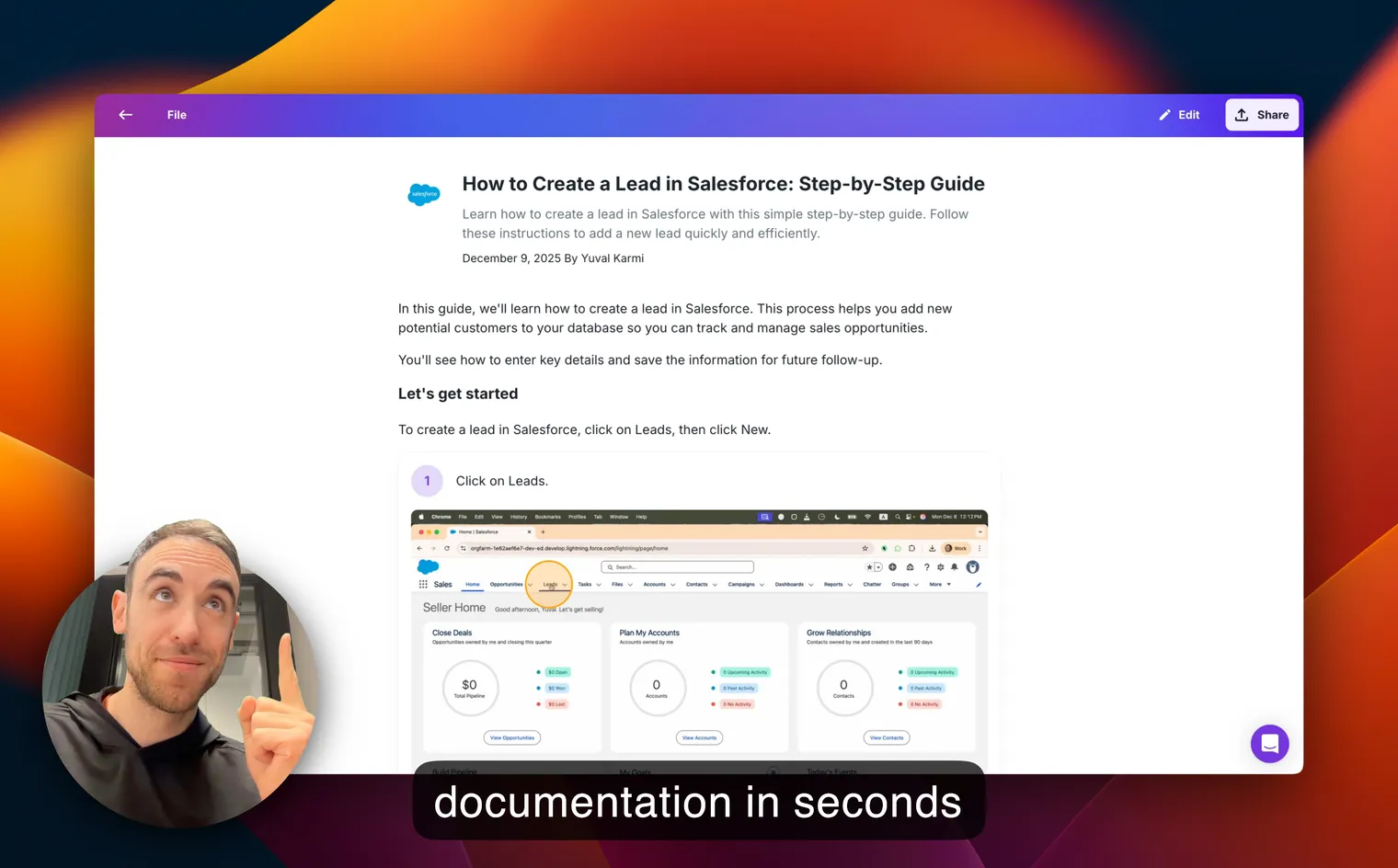
Teach your co-workers or customers how to get stuff done – in seconds.

Frequently Asked Questions
What is a process flow diagram?
A process flow diagram is a visual representation that uses standardized symbols like rectangles, diamonds, and arrows to show the sequence of steps, decision points, and flow of activities in a process from start to finish.
What is the difference between a process flow diagram and a flowchart?
Honestly, the terms are used interchangeably most of the time. A process flowchart is essentially the same thing as a process flow diagram. Both use standardized symbols to visualize steps and decisions in a process or workflow.
What are the basic symbols used in a process flow diagram?
The core symbols include rectangles for process steps or activities, diamonds for decision points, ovals for start and end points, arrows showing flow direction, and parallelograms for inputs and outputs.
How do I create a process flow diagram template?
Start by defining your process scope and endpoints. List all steps in sequence, identify the decision points, then arrange everything using standard flowchart symbols. Tools like Glitter AI can speed this up by capturing workflows through screen recording.
What is an example of a process flowchart?
A typical example would be an order fulfillment process flowchart showing steps from order receipt through inventory check, payment processing, picking, packing, shipping, and delivery confirmation. It would include decision branches for things like stock availability and payment approval.
Why are process flow diagrams important for businesses?
They help organizations see how work actually gets done, spot inefficiencies and bottlenecks, train employees consistently, improve communication between teams, and document processes for compliance requirements.
What software can I use to create a process flow diagram?
There are dedicated diagramming tools like Lucidchart and Miro, general-purpose options like Microsoft Visio, and AI-powered solutions like Glitter AI that can automatically generate diagrams from recorded workflows.
When should I use a process flow diagram vs a process map?
Go with a process flow diagram when you mainly need to understand the sequence and logic of steps. A process map makes more sense when you also need to show who handles each step, which systems are involved, or other contextual information.
How detailed should a process flow diagram be?
It really depends on what you're trying to accomplish. High-level diagrams work well for executive presentations and initial planning. Detailed diagrams are better suited for training, troubleshooting, and process improvement work.
Can process flow diagrams help with process improvement?
Absolutely. They're kind of essential for it. When you visualize the current state, teams can spot redundant steps, bottlenecks, unnecessary handoffs, and opportunities to streamline before making any actual changes.