
Read summarized version with
What is Process Mapping?
Process mapping is how organizations turn messy, invisible workflows into something you can actually see and fix. Using diagrams like flowcharts, swimlane diagrams, and SIPOC charts, it shows how work really moves through your business. The goal? Figure out where things get stuck, where effort gets duplicated, and where a deeper process redesign could make things better.
Think of it this way: written procedures tell you what to do in writing. Process mapping shows you the whole picture at once. When you can see the sequence of activities, decision points, inputs and outputs, and who owns what, everyone gets on the same page. That kind of visual clarity makes it much easier for teams and departments to actually talk about their workflows.
There’s a reason companies keep coming back to this technique. Process mapping tends to expose inefficiencies that written docs just can’t surface, and pairs well with data-driven process mining for an even sharper picture. Organizations that map their processes typically see 20-30% improvements in operational efficiency once they start systematically cutting waste, cleaning up handoffs, and clarifying who’s accountable for what. This kind of visibility into a business process simply isn’t possible with text alone.
Key Characteristics of Process Mapping
- Visual Representation: Standardized symbols and diagrams show process flow so people can understand complex workflows at a glance, instead of reading through pages of documentation.
- Multiple Abstraction Levels: You can zoom in or out depending on what you need. Show high-level phases for executives, or drill down to granular step-by-step details for the people doing the work.
- Standardized Notation: Rectangles for activities, diamonds for decisions, arrows for flow. These consistent symbols, formalized in standards like BPMN, create a universal language that anyone can read, regardless of their department.
- Stakeholder Clarity: Swimlanes and role assignments make it obvious who owns each step. Less confusion, better accountability.
- Analysis-Oriented: Process maps aren’t just for documenting what exists. They’re built to help you spot inefficiencies, bottlenecks, and delays so you can actually fix them.
Types of Process Maps
Flowcharts
Flowcharts, sometimes formalized as a process flow diagram, are the most common type of process map, and for good reason. Simple shapes show sequential steps: rectangles for activities, diamonds for decisions, arrows for direction. They work best for straightforward processes where you want to make inefficiencies visible without overcomplicating things.
SIPOC Diagrams
SIPOC stands for Suppliers, Inputs, Process, Outputs, and Customers. It gives you the bird’s-eye view. You document who provides the inputs, what materials or information you need, the high-level process steps, what comes out the other end, and who receives it. SIPOC diagrams are especially helpful early on when you’re trying to define process boundaries and identify stakeholders before getting into the weeds.
Swimlane Diagrams
Sometimes called cross-functional flowcharts, swimlane diagrams organize steps into horizontal or vertical lanes. Each lane represents a person, role, team, or department. The format immediately shows who’s responsible for what and where handoffs happen. If your chain of work crosses departmental lines and you suspect handoffs are causing delays, swimlane diagrams will probably surface the problem.
Process Mapping Examples
Example 1: Customer Support Ticket Resolution
Say a software company wants to understand its support ticket resolution process. They create a swimlane diagram with four lanes: Customer, Support Agent, Engineering Team, and Manager. Following the flow, they can see exactly how a ticket moves from initial submission through triage, escalation to engineering when needed, manager approval for tricky solutions, and finally back to the customer. The visual makes something obvious: 40% of tickets require manager approval. That’s a bottleneck they could eliminate just by raising approval thresholds.
Example 2: New Product Development
A manufacturing company uses a SIPOC diagram to map how new products get developed. Suppliers are R&D, Marketing, and External Vendors. Inputs include market research, technical specifications, and material requirements. The process breaks into five phases: Concept Development, Design, Prototyping, Testing, and Production Launch. Outputs are finished product designs and manufacturing instructions. Customers are Production Teams and Sales. This high-level view helps leadership see dependencies quickly and decide which phase needs a deeper dive.
Process Mapping vs Process Documentation
These two approaches work well together, but they’re not the same thing.
| Aspect | Process Mapping | Process Documentation |
|---|---|---|
| Format | Visual diagrams with flowcharts and standardized symbols | Text-based written instructions and descriptions |
| Purpose | Analyze workflows, find inefficiencies, drive improvement conversations | Give people a detailed reference for doing the work correctly |
| Detail Level | Can range from high-level overview to moderate detail | Usually includes step-by-step instructions |
| Best For | Understanding flow, spotting bottlenecks, getting stakeholders aligned | Training employees and keeping execution consistent |
| When to use | Process improvement projects, optimization work, or onboarding stakeholders to complex workflows | Creating standardized task procedures or step-by-step task guides for routine tasks |
How Glitter AI Helps with Process Mapping
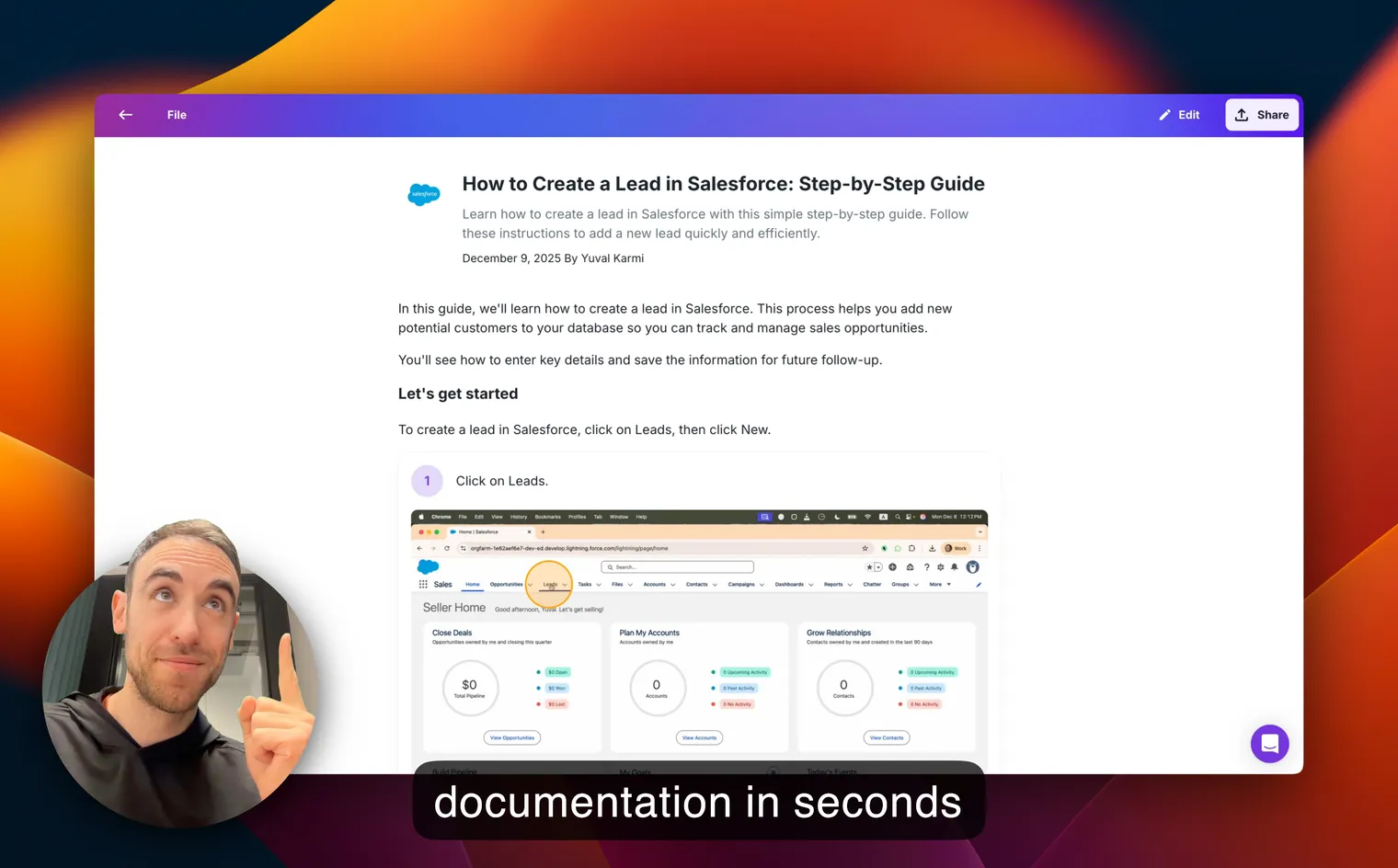
Glitter AI sits right at the intersection of process mapping and process documentation. Traditional mapping requires someone to manually create diagrams after watching and analyzing workflows. Glitter takes a different approach: it captures your actual process execution through screen recording and generates visual step-by-step guides automatically.
These guides function as practical process maps showing real work flowing through applications and systems. You get screenshots, annotations, and clear sequencing without the manual effort. Teams use them to spot improvement opportunities, train new hires, and keep execution consistent. Instead of treating process mapping as a one-time project, Glitter makes it something you can do continuously.
Teach your co-workers or customers how to get stuff done – in seconds.

Frequently Asked Questions
What is process mapping?
Process mapping uses visual diagrams like flowcharts and swimlane charts to show how work flows through a business process. It reveals steps, decision points, and who's responsible for what, making it easier to spot improvement opportunities.
What are the different types of process maps?
The main types are flowcharts for sequential steps, swimlane diagrams for cross-functional processes that show roles, SIPOC diagrams for high-level supplier-to-customer views, and value stream maps for finding waste and delays.
Why is process mapping important?
Process mapping gives you visual clarity that makes inefficiencies obvious at a glance. It helps teams communicate, surfaces bottlenecks and redundancies, and supports improvement efforts. Organizations that map their processes typically see 20-30% gains in operational efficiency.
When should you use process mapping?
Use process mapping when you're analyzing workflows for improvements, bringing stakeholders up to speed on complex processes, clarifying roles and responsibilities, preparing for automation, or documenting workflows that cross departmental lines.
What is the difference between process mapping and process documentation?
Process mapping creates visual diagrams to analyze workflows and find improvements. Process documentation provides written instructions for executing work. Mapping is about understanding and optimization. Documentation is about consistent execution.