
Read summarized version with
What is a Quick Start Guide?
A quick start guide is a short instructional document that gets users set up and using a product, service, or process as fast as possible, covering only the essential first steps. It leaves out advanced features, edge cases, and detailed troubleshooting on purpose, so nothing gets in the way of that first success. Also called a QSG, it usually runs one to five pages or screens and leans on numbered steps and visuals.
A full manual walks you through every feature and every scenario. A QSG does the opposite. It narrows down to the minimum needed to get going, and that focus is what cuts the time it takes new users to see value. The logic is simple: people want to do something right now, not study every capability first. This isn’t a hunch either. Users skip manuals and go straight to trying the product, a pattern the Nielsen Norman Group traces back to the fact that people scan rather than read. Front-load the essential steps and you earn their attention. The upside tends to be lower early frustration, fewer support tickets during initial adoption, and users who feel more confident after a quick win or two. You’ll find QSGs behind software apps, physical products, business processes, and internal systems, pretty much anywhere fast onboarding matters for adoption and satisfaction.
So what makes a quick start guide effective? Ruthless prioritization. It answers “What’s the bare minimum someone needs to know to get going?” and skips “What might someone eventually want to know?” That’s the line between a QSG and training manuals, operations manuals, or broader training documentation. Each has its own job in the documentation mix.
Key Characteristics of Quick Start Guide
- Essential Steps Only: A QSG sticks to the minimum actions needed to start using a product or finish a basic workflow. Advanced features, edge cases, optional configurations? Those wait.
- Goal-Oriented Structure: Each guide points users at one or two outcomes that pay off right away. No attempt at full coverage, just quick success and a little confidence. When teams need something for ongoing reference, they’ll often pair a QSG with a quick reference guide.
- Minimal Prerequisites: A good quick start guide assumes little beyond basic familiarity with the general domain. That lowers the barrier and lets people at different experience levels jump in.
- Visual and Scannable Format: Screenshots, diagrams, numbered steps, a clear visual hierarchy. QSGs lean on visuals so users can follow along without wading through dense paragraphs.
- Concise Length: Most land somewhere between one and five pages or screens. The idea is to respect users’ time and stay on immediate value rather than transfer everything at once.
Quick Start Guide Examples
Example 1: Software Application Onboarding
A project management platform puts together a quick start guide covering three things: creating your first project, inviting a team member, adding a task. Annotated screenshots carry each step. Automation rules, custom fields, integrations? None of that shows up here. The user gets to a first success inside five minutes instead.
Example 2: Hardware Device Setup
A smart home device maker tucks a quick start guide into the box. Four steps: unbox and identify the parts, download the app, connect to WiFi, do one basic thing. Clear diagrams and minimal text mean it works for someone anywhere in the world, with no need to hunt down a full manual or call support.
Example 3: Business Process Documentation
A company rolling out a new expense system writes a quick start guide showing employees how to submit a simple claim with a receipt. That’s the whole thing. International travel rules, per diem calculations, approval chains, all of it gets saved for later. People start using the system right away and pick up the rest as they go. This QSG might sit inside a broader list of new-hire onboarding tasks for new employees.
How to Write a Quick Start Guide
Writing a good quick start guide is less about adding words and more about cutting until only the essentials are left. Here’s a structure you can reuse:
- Pick one outcome. Name the single most important thing a new user should accomplish first, the “aha” moment that proves the product works.
- List only the steps to reach it. Cut anything optional. If a step isn’t required to hit that first outcome, it belongs in a training manual or quick reference guide, not here.
- Number the steps and add visuals. Screenshots, annotated diagrams, and a clear numbered sequence let people follow along by scanning instead of reading dense prose.
- Keep it to one to five pages. Length tends to track focus. If the guide runs long, you’re probably documenting features instead of the fastest path to value.
- Test with a real new user. Watch someone work through the guide on their own. Wherever they hesitate is a step to clarify or a prerequisite you assumed but never spelled out.
What you want is something that reads like a checklist someone finishes in minutes, not a document they have to study. Teams that ship quick start guides often standardize this structure so every product gets onboarding of the same quality.
Quick Start Guide vs Getting Started Guide
People throw these two terms around as if they mean the same thing, and mostly they do. Still, there are small differences in scope and depth worth knowing.
| Aspect | Quick Start Guide | Getting Started Guide |
|---|---|---|
| Purpose | Achieve immediate success with minimal steps | Provide foundational understanding and initial setup |
| Depth | Ultra-focused on one or two basic tasks | Broader introduction covering multiple foundational concepts |
| When to use | When users need immediate value and quick wins | When users benefit from understanding core concepts before diving in |
How Glitter AI Helps with Quick Start Guide
Glitter AI turns quick start guide creation from a drawn-out documentation project into something that mostly runs itself. That’s the angle teams weigh when they look at Supademo versus Glitter AI. You perform the essential steps you want to document. Glitter captures everything, then generates visual guides with screenshots, annotations, and clear instructions, the same capture-driven approach teams assess when they look at GuideJar versus Glitter AI. No more grabbing screens by hand, writing descriptions, and fiddling with layouts, the stuff that has always made QSG creation slow and inconsistent.
Keeping guides accurate gets easier too. When a setup process shifts or an interface gets a redesign, you record the new workflow and regenerate the guides in minutes rather than hours. For organizations that need quick start guides at scale, like customer success teams building SaaS help docs by recording, Glitter can turn out consistent documentation across many products, features, or processes without a dedicated writer or designer for each one. That consistency is part of why teams compare Glitter AI to SwipeGuide and weigh it against Gyde, GuideMaker, Trainn, and Folge when they’re evaluating tools.
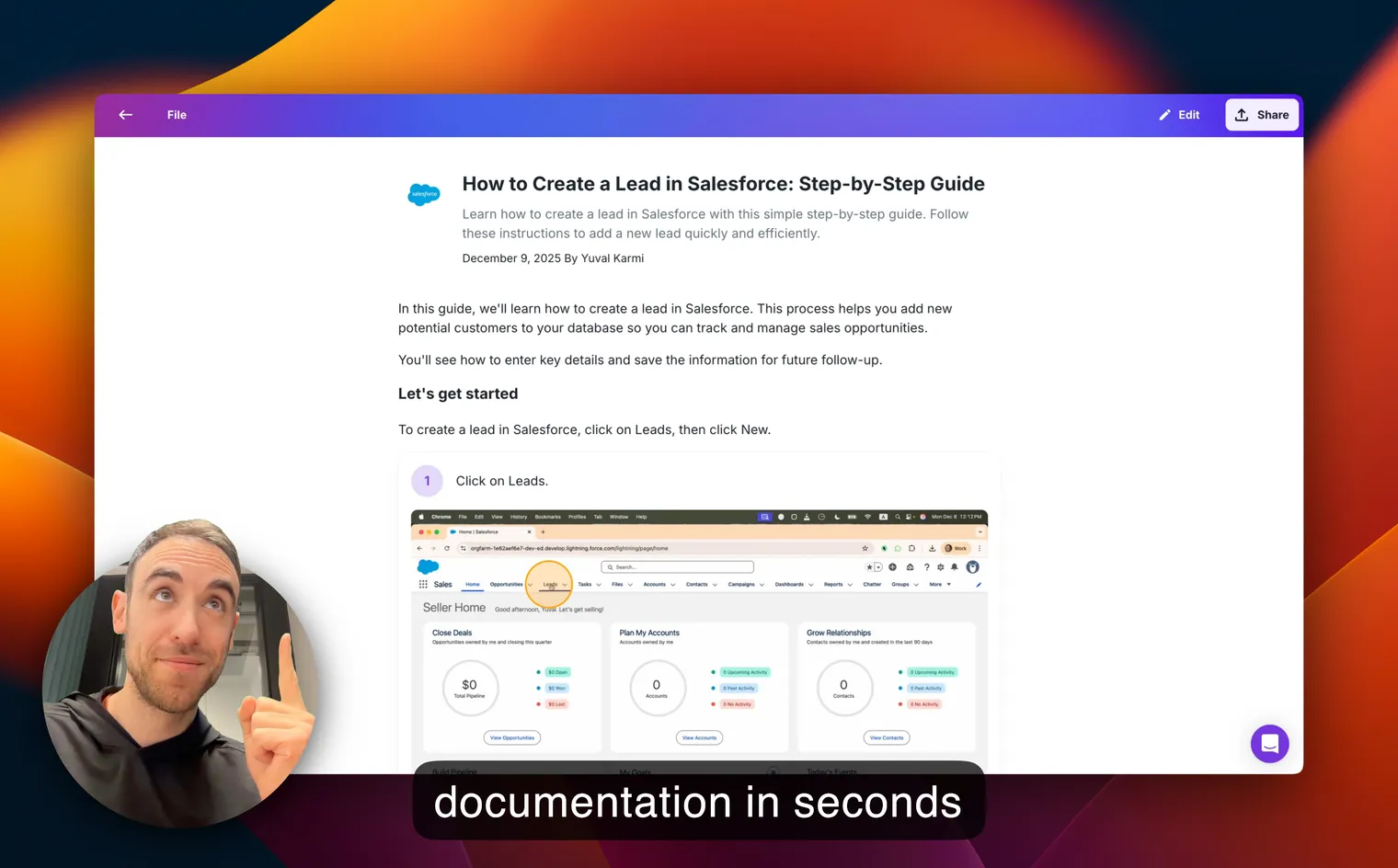
Teach your co-workers or customers how to get stuff done – in seconds.

Frequently Asked Questions
What is a Quick Start Guide?
A Quick Start Guide (QSG) is a concise instructional document that focuses on the minimum essential steps needed to begin using a product, service, or process successfully. It prioritizes speed and immediate value over comprehensive coverage, typically ranging from one to five pages.
What is an example of a Quick Start Guide?
A common example is a software app's quick start guide showing new users how to create their first project, invite a team member, and add a task - focusing only on these core actions without explaining advanced features, settings, or troubleshooting that users can learn later.
Why is a Quick Start Guide important?
Quick start guides reduce time-to-value by helping users achieve early success quickly, minimize initial frustration and support requests, improve adoption rates by building confidence through immediate wins, and respect users' time by avoiding information overload during the critical first experience.
How do I create a Quick Start Guide?
Identify the single most important outcome users need to achieve first, document only the essential steps required to reach that outcome, use visual elements like screenshots and numbered steps for clarity, limit length to one to five pages, and test with actual users to ensure they can succeed independently. Tools like Glitter AI can automate guide creation from screen recordings.
What is the difference between a Quick Start Guide and a manual?
A manual provides comprehensive documentation covering all features, scenarios, and troubleshooting information for complete product understanding. A Quick Start Guide focuses exclusively on the minimum steps needed to begin using the product successfully, deliberately excluding advanced features and detailed explanations to prioritize speed and immediate value.