
Read summarized version with
I found out about the retirement knowledge crisis the hard way.
A few years back, our head of operations at my first startup told us he was retiring. He gave three months’ notice, which seemed like plenty of time to hand everything over.
It wasn’t.
This guy had been with the company for its whole lifespan. He knew everything: which vendors you could actually trust, how to handle weird edge cases in our logistics, the reasons behind why certain processes existed in the first place. Most of that knowledge? It lived nowhere except inside his head.
We scrambled to write things down, but honestly, we probably lost about 40% of his institutional knowledge the day he walked out. Maybe more than that.
I’m Yuval, founder and CEO of Glitter AI. That experience taught me something important: knowledge transfer for retiring employees isn’t something you can wing at the last minute. You need a real plan, and you need to get started way earlier than you’d expect.
With 75 million Baby Boomers hitting retirement by 2030 (and COVID-19 accelerated a lot of those decisions), this isn’t just my problem. It’s probably yours too.
Here’s what actually works when it comes to capturing critical knowledge before your experienced people retire.
Why Knowledge Transfer from Retiring Employees Is Critical
Let me share some numbers that should grab your attention if you’re a business leader.
Research shows that only 3% of organizations consider themselves extremely effective at transferring critically important information from retirees to the people who stay behind. Just three percent. Meanwhile, 42% said they’re “somewhat effective” and 37% admitted they’re “minimally effective.”
That’s a disaster waiting to happen.
Baby Boomers made up about a quarter of the workforce back in 2018. Nearly 29 million people from this generation retired in 2020 alone, which was three million more than the year before. Here’s the thing: every single Baby Boomer will reach retirement age by 2030.
That’s a massive wave of knowledge headed for the exit.
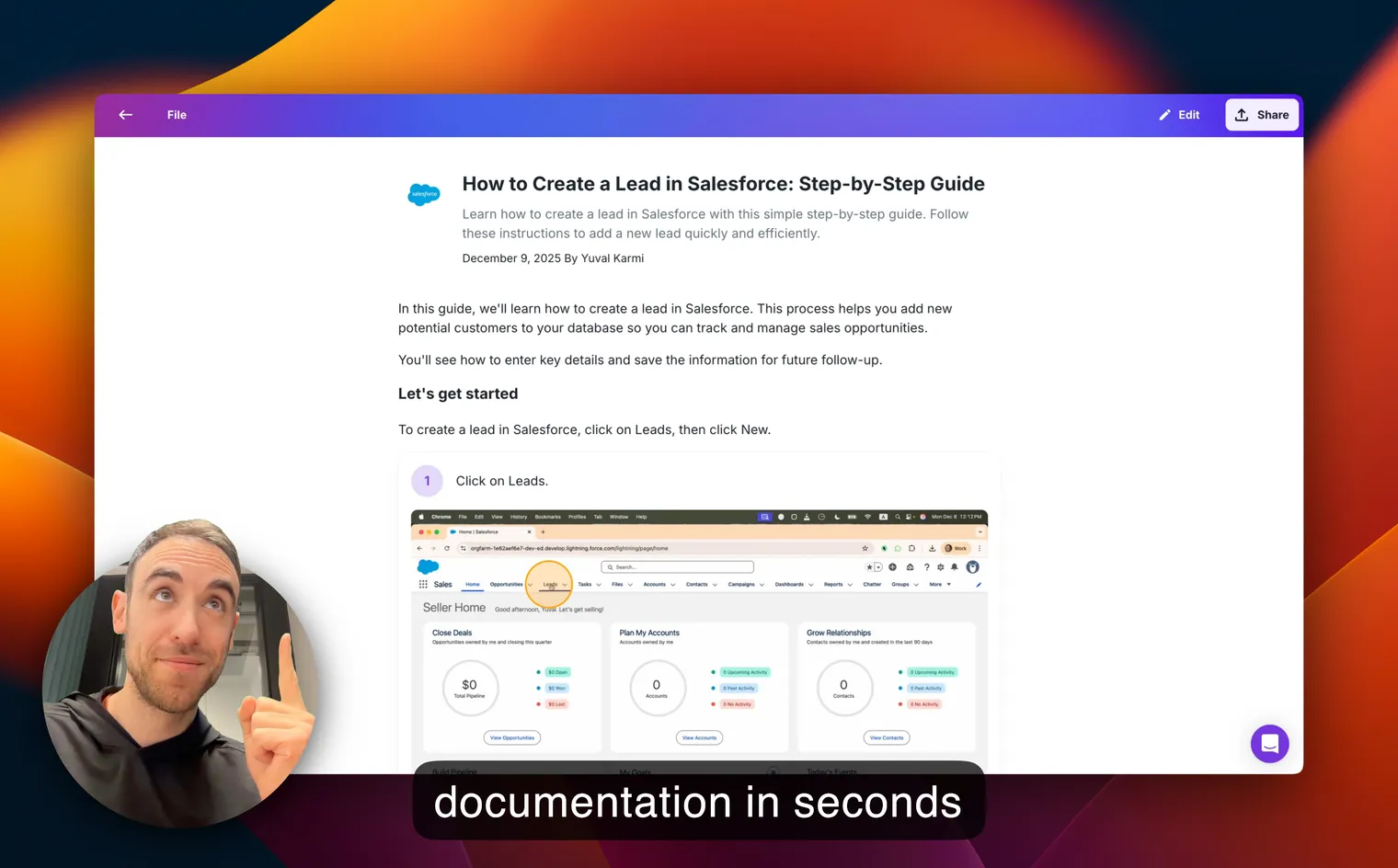
Teach your co-workers or customers how to get stuff done – in seconds.

Companies lose billions every year from poor knowledge sharing and knowledge transfer. For small and medium businesses, the impact can hit even harder because you can’t afford to lose that institutional expertise. Following knowledge sharing best practices helps prevent this loss.
When experienced employees retire without proper knowledge transfer, here’s what typically happens:
- Critical processes break because nobody really understands how they work
- New employees make mistakes that veterans would have sidestepped
- Vendor relationships suffer because the context and history are gone
- Decision-making slows to a crawl because historical knowledge is missing
- The same problems get solved over and over since nobody wrote down the solutions
Research shows that companies with mentoring programs (a key knowledge transfer strategy) had 18% higher profits than average. Companies without them? 45% worse profits than average.
This isn’t something nice to have. It’s a business necessity.
The Two Types of Knowledge You’re Losing
Before talking about solutions, you should understand what knowledge you’re actually trying to capture.
Explicit Knowledge
This is the straightforward stuff: information that can be written down, documented, and transferred directly:
- Standard operating procedures and work instructions
- Technical specifications and configurations
- Policy documents and guidelines
- Customer account details and history
- Product knowledge and specifications
Explicit knowledge matters, but it’s also the kind most organizations already try to capture (even when they don’t do it particularly well).
Tacit Knowledge
Here’s where things get tricky. Tacit knowledge is the wisdom that comes from experience, the stuff that’s hard to put into words:
- Judgment calls and decision-making expertise
- Understanding of organizational culture and internal politics
- Relationships and knowing who to call for what
- Intuition about what works and what doesn’t
- Context behind why things are done certain ways
When I talk about losing 40% of our operations head’s knowledge, I’m mostly talking about tacit knowledge. The things he just knew after a decade of experience.
A retiring employee can probably tell you the documented procedure for dealing with a difficult vendor. But can they transfer the instinct for when to push back versus when to give ground? The sense of which customers need extra attention? The knowledge of which processes everyone follows strictly and which ones people know to bend?
That’s tacit knowledge. And it’s far more valuable and far harder to transfer.
The best knowledge transfer strategies capture both types. If you want a structured way to pull that harder-to-articulate expertise out of someone before they walk out the door, our guide on how to capture tacit knowledge breaks down the specific questions to ask.
Start Early: Don’t Wait Until the Retirement Party
Here’s the biggest mistake companies make with retiring employee knowledge transfer: they wait too long.
Knowledge transfer takes time and real effort. You can’t capture ten years of expertise in a single week before someone’s retirement party.
Organizations that do this well start knowledge transfer activities years in advance, not months.
When to Start Knowledge Transfer
For critical positions: Start succession planning and knowledge transfer 2-3 years before expected retirement age.
For specialized roles: Begin documenting unique knowledge at least 1-2 years before retirement.
For all employees: Build a culture of continuous documentation so knowledge transfer happens all the time, not just when someone announces retirement.
I know what you’re thinking: “But Yuval, we don’t always know when people are going to retire!”
Fair enough. That’s exactly why the best approach is to have ongoing knowledge capture for all critical roles, especially for employees over 55.
Make documentation part of how you work, not something you rush to do when someone gives notice.
Capture institutional knowledge with AI-powered documentation
Strategy 1: Implement Mentoring and Shadowing Programs
Mentoring is one of the most effective knowledge transfer strategies for retiring employees.
The idea is simple: pair retiring staff with newer employees for an extended period of structured knowledge transfer.
Why Mentoring Works
Mentoring addresses both explicit and tacit knowledge transfer. The mentee learns not just what to do, but why and how to handle tricky situations.
Research indicates that 84% of Fortune 500 companies have mentoring programs, and there’s good reason. Mentoring programs tend to produce:
- Higher employee engagement (significantly more likely with strong mentoring)
- Better retention (decreased turnover rates)
- Improved productivity (roughly 25% increase)
- Stronger succession pipelines
One of the key ingredients in successful succession planning is mentoring that gives employees opportunities to gain knowledge, experience, and exposure to new challenges.
How to Structure Effective Mentoring
Make it formal, not informal. Don’t just say “Hey, can you show Sarah the ropes?” Create a structured program with:
- Clear objectives and timelines
- Regular check-ins and progress reviews
- Defined knowledge areas to transfer
- Documentation of what’s being learned
Allow enough time. Effective mentoring for knowledge transfer typically needs 3-6 months at minimum, sometimes longer for complex roles. One-month assignments won’t cut it.
Include shadowing. Have the mentee shadow the retiring employee during actual work. You learn far more watching someone handle a tough customer call than reading about it.
Encourage reverse mentoring too. While retiring employees knowledge share about institutional expertise, newer employees can share insights about recent technologies and trends. This two-way exchange of exchanging knowledge makes the relationship feel more valuable for both people.
Document the process. As mentoring happens, capture what’s being transferred. Record sessions, write guides, create process documentation. Otherwise, the knowledge just lives in one more person’s head.
At Glitter AI, we make it easy to document mentoring sessions. Just screen record the walkthrough while the mentor explains what they’re doing, and AI generates the documentation automatically. No extra work required.
Example: Structured Mentoring in Action
Say your head of procurement is retiring in 18 months. Here’s what a structured mentoring program might look like:
Months 1-3: Mentee shadows all major procurement activities, attends vendor meetings, observes negotiations.
Months 4-6: Mentee begins handling smaller procurement decisions with mentor oversight and feedback.
Months 7-12: Mentee takes primary responsibility for most tasks, with mentor available for questions and guidance on complex situations.
Months 13-18: Mentor steps back to an advisory role, intervening only when needed. Knowledge gaps are identified and addressed.
This gradual transition gives the mentee time to build both skills and confidence.
Strategy 2: Cross-Training as an Antidote to Brain Drain
Cross-training is another powerful strategy for preventing knowledge loss when employees retire.
The concept is simple: employees learn skills and knowledge outside their primary role, creating redundancy in your organization’s knowledge base.
Why Cross-Training Matters for Retirement Planning
When only one person knows how to do something, you’re exposed. They go on vacation, you’re stuck. They retire, you’re in crisis mode.
Cross-training creates backup expertise so no single person becomes irreplaceable. It also:
- Reduces business continuity risk
- Increases workforce flexibility
- Improves employee engagement (people tend to like learning new things)
- Creates natural succession candidates
Cross-training is especially valuable as protection against the brain drain that happens when veteran employees leave.
How to Implement Cross-Training
Identify critical knowledge dependencies. Map out who knows what and where you have single points of failure.
Create rotation programs. Set up 3-6 month cross-training assignments where employees work in adjacent roles or shadow colleagues with specialized knowledge.
Make it reciprocal. The retiring procurement expert spends time exchanging knowledge about purchasing processes while learning about inventory management from someone else. Everyone gains something.
Document everything during cross-training. As people learn new roles, have them create documentation from a learner’s perspective. They’ll catch things that aren’t obvious to the expert.
Start early for retiring employees. If someone is planning to retire in two years, start cross-training their replacement(s) now.
The goal isn’t to make everyone an expert at everything. It’s to make sure critical knowledge exists in multiple people, reducing your exposure when someone leaves.
Strategy 3: Capture Knowledge Through Documentation
Yes, I know. Nobody enjoys writing documentation. But here’s the reality: if the knowledge isn’t documented, it will disappear when people retire.
The trick is making documentation as effortless as possible.
What to Document
Focus on these high-value areas:
Standard Operating Procedures: The step-by-step processes for critical tasks. Check out my guide on how to create effective SOPs.
Decision-making frameworks: Not just what to do, but how to make judgment calls. “When X happens, consider Y factors, and generally Z is the right choice.”
Institutional history: Why processes are designed certain ways. What’s been tried before. Context that helps people make better decisions.
Relationships and contacts: Who to call for what. Which vendors are reliable. Which customers need special handling.
Tribal knowledge: The unwritten rules, workarounds, and insider knowledge that make things actually function.
How to Make Documentation Happen
Assign it as a formal responsibility. Make knowledge documentation part of the job description for senior employees approaching retirement, with time set aside for it.
Use the right tools. Written documentation matters, but video walkthroughs and screen recordings often capture knowledge faster and more completely.
At Glitter AI, retiring employees can create comprehensive training documentation in minutes by screen recording themselves doing their work while explaining their thought process. It’s much faster than writing it all out.
Conduct documentation interviews. Sit down with retiring employees and interview them about their expertise. Record these conversations and turn them into guides.
Create templates. Give people process documentation templates to fill out. Starting from scratch feels daunting; filling in blanks is manageable.
Review and refine. Have other team members review documentation created by retiring employees to spot gaps and unclear areas while the expert is still around to clarify.
The goal is capturing not just the “what” but the “why” and “how,” the context and judgment that transforms information into wisdom.
Teach your co-workers or customers how to get stuff done – in seconds.
Strategy 4: Consider Phased Retirement Programs
Phased retirement is an approach that benefits both employees and employers.
Instead of going from full-time to completely retired overnight, employees gradually reduce their hours over 6-12 months while focusing on knowledge transfer and mentoring.
Benefits of Phased Retirement
For the organization:
- Extended time for knowledge transfer
- Continued access to expertise during transition
- Smoother succession planning
- Reduced knowledge loss
For the retiring employee:
- More gradual transition to retirement
- Continued income and benefits
- Sense of purpose and contribution
- Time to adjust to retired life
How Phased Retirement Works
A typical phased retirement program might look like:
Months 1-3: Employee reduces to 80% time, with the freed-up time used for mentoring and documentation.
Months 4-6: Reduction to 60% time, transitioning more responsibilities to successors.
Months 7-9: Down to 40% time, now primarily in an advisory/consulting role.
Months 10-12: 20% time or as-needed basis, available for questions and edge cases.
Throughout this period, the retiring employee is actively transferring knowledge through mentoring, documentation, and hands-on training of their replacement.
This gradual approach gives successors time to learn while still having direct access to the expert when questions come up.
Making Phased Retirement Work
Formalize the arrangement. Create clear agreements about hours, responsibilities, compensation, and knowledge transfer expectations.
Define specific knowledge transfer goals. What needs to be documented? Who needs to be trained? What does “successful transfer” look like?
Maintain engagement. Make sure phased retirees still feel valued and integrated, not pushed aside.
Build in flexibility. Life happens. The phased schedule might need adjustments.
Not every role or employee is suited for phased retirement, but when it works, it’s one of the most effective knowledge transfer strategies out there.
Strategy 5: Conduct Thorough Exit Interviews
Exit interviews for retiring employees should be different from typical exit interviews.
You’re not trying to understand why they’re leaving (you already know, they’re retiring). You’re trying to capture valuable insights before they’re gone.
What to Cover in Retirement Exit Interviews
Critical knowledge gaps: “What do you know that you’re worried nobody else knows?”
Lessons learned: “What are the biggest lessons you’ve learned during your time here?”
Relationships: “Who are the key contacts, both internal and external, that your successor needs to know?”
Institutional history: “What’s important to understand about how we got here?”
Advice for successors: “What advice would you give someone stepping into your role?”
Process improvements: “What should we change or improve after you’re gone?”
How to Conduct Effective Exit Interviews
Start early. Don’t wait until the last week. Begin these conversations 3-6 months before retirement.
Record and document. With permission, record the interview so you can capture everything accurately.
Have multiple sessions. One interview isn’t enough to capture decades of knowledge. Schedule several conversations focusing on different areas.
Include the right people. The direct manager should participate, but also consider including the successor, HR, and senior leadership.
Follow up. Review the interview notes and identify knowledge gaps that need more documentation or explanation.
Exit interviews capture valuable insights, but they work best when combined with other strategies like mentoring and documentation.
Strategy 6: Build Strong Succession Planning
Succession planning and knowledge transfer for retiring employees go hand in hand.
Organizations that excel at this have structured succession plans for all critical positions, ideally with multiple potential successors ready at different stages.
The 3:1 Succession Planning Ratio
Best practice in succession planning means maintaining a 3:1 ratio: for every critical position, have three people who are developing toward readiness to step into the role.
This might include:
- One person ready now (could step in tomorrow)
- Two people ready soon (1-2 years of development needed)
- Three or more people future ready (3-5 years out)
According to research, succession planning starts to positively affect revenue growth when 70% of key positions have replacements ready.
A good target is 90% coverage for critical positions, meaning at any time, you should have qualified successors ready for 90% of your key roles.
How to Identify Critical Positions
Not every role needs extensive succession planning. Focus on positions where:
- The role has significant business impact
- The skills are difficult to hire from outside
- The knowledge is specialized or unique
- A vacancy would seriously disrupt operations
For these critical roles, start succession planning well before retirement age, not when someone announces they’re leaving.
Developing Successors
Identify potential successors early. Look for high-potential employees who could grow into these roles with proper development.
Create development plans. What skills, knowledge, and experiences do successors need? Build plans to get them there.
Provide stretch assignments. Give potential successors challenging projects that develop the skills they’ll need.
Implement mentoring. As discussed earlier, pair potential successors with current role holders for knowledge transfer.
Monitor progress. Regular check-ins to assess readiness and adjust development plans.
Succession planning ensures that when someone retires, you’re not scrambling to fill the void. You have prepared candidates ready to step up.
Capture critical processes before your experts retire
Strategy 7: Use Technology to Capture and Preserve Knowledge
Technology can significantly speed up knowledge transfer from retiring employees.
Knowledge Management Platforms
A centralized knowledge management system provides a single place to store and access organizational knowledge.
Good platforms should:
- Make it easy to create and update content
- Provide powerful search functionality
- Support multiple content types (text, video, documents)
- Allow tagging and organization
- Track what knowledge exists and what’s missing
Tools like Notion, Confluence, and similar platforms work well for centralized knowledge bases.
Video Documentation Tools
Honestly, for process knowledge, video beats written documentation nearly every time. Watching someone do something teaches you far more than reading about it.
Tools for video knowledge capture:
Screen recording: Loom, Glitter AI, and similar tools let retiring employees record themselves completing tasks while explaining their thought process.
Video walkthroughs: Quick video explanations of complex processes, customer scenarios, or technical procedures.
Recorded training sessions: Capture live training sessions for future reference.
At Glitter AI, I specifically built features for this use case. A retiring employee can screen record themselves doing their job while talking through what they’re doing and why. AI automatically generates step-by-step documentation with screenshots, making it easy to create comprehensive guides without the painful manual documentation process.
Knowledge Transfer Software
Specialized knowledge transfer platforms help structure and track the transfer process:
- Mentoring management software
- Skills mapping tools
- Learning management systems
- Succession planning platforms
The right technology doesn’t replace the human element of knowledge transfer. It enhances it by making capture, storage, and access dramatically easier.
Strategy 8: Create Communities of Practice
Communities of Practice (CoPs) are groups of people who share expertise in a specific domain and learn from each other regularly.
How CoPs Help with Retirement Knowledge Transfer
CoPs create distributed expertise rather than knowledge concentrated in individual experts. When a veteran employee retires from a CoP, the knowledge they contributed has already been shared with the community.
For example, you might have a CoP for:
- Customer service best practices
- Technical troubleshooting
- Sales techniques
- Project management approaches
Implementing Effective CoPs
Make them cross-functional. Include people from different teams who share interest in a specific domain.
Meet regularly. Monthly meetings work well for most CoPs.
Document discussions. Capture insights, solutions, and lessons learned from each meeting.
Encourage sharing. Create a culture where people bring challenges and solutions to the community.
Assign facilitation. Each CoP needs someone to coordinate meetings and keep things moving.
When retiring employees participate in CoPs throughout their tenure, much of their knowledge naturally spreads to colleagues before they ever leave.
Common Mistakes to Avoid
Let me save you from some painful mistakes I’ve seen (and made myself):
Mistake 1: Waiting Too Long
Starting knowledge transfer three weeks before retirement is basically pointless. Start years early for critical roles.
Mistake 2: Relying Only on Documentation
Written docs matter, but they can’t capture everything. You need mentoring, shadowing, and hands-on transfer too.
Mistake 3: No Follow-Through
Creating a knowledge transfer plan and then not enforcing it is worse than having no plan at all. Make it a tracked priority.
Mistake 4: Ignoring Tacit Knowledge
Focusing only on explicit knowledge (procedures, facts) while missing tacit knowledge (judgment, relationships, context) means you’ll lose the most valuable stuff.
Mistake 5: Making It Optional
Knowledge transfer from retiring employees can’t be something you do “if you have time.” It needs to be a formal requirement with allocated time and resources.
Mistake 6: Focusing Only on Technical Knowledge
Don’t forget to transfer knowledge about culture, relationships, politics, and the human side of the organization.
Mistake 7: No Knowledge Transfer Ownership
Someone needs to be responsible for making sure knowledge transfer happens. Without clear ownership, it falls through the cracks.
Creating a Knowledge Transfer Plan
Alright, let’s put this into action. Here’s how to create a structured knowledge transfer plan for retiring employees:
Step 1: Identify Retiring Employees and Critical Roles
- List all employees approaching retirement age (typically 55+)
- Identify which roles are critical to operations
- Prioritize based on retirement timeline and role criticality
Step 2: Assess Knowledge and Skills
For each critical retiring employee:
- What unique knowledge do they possess?
- What skills are difficult to replace?
- What relationships and networks would be lost?
- Where is their knowledge already documented vs. only in their head?
Step 3: Identify Successors
- Who are potential successors for each critical role?
- What’s their current readiness level?
- What development do they need?
Step 4: Create Individual Transfer Plans
For each retiring employee, document:
- Knowledge transfer timeline (start early!)
- Specific knowledge to be transferred
- Transfer methods (mentoring, documentation, shadowing, etc.)
- Responsible parties
- Success metrics
- Regular review checkpoints
Step 5: Implement and Monitor
- Allocate time and resources for transfer activities
- Track progress against the plan
- Adjust as needed based on what’s working
- Ensure accountability
Step 6: Validate Transfer
Before retirement:
- Test successor readiness
- Identify remaining knowledge gaps
- Fill gaps while the expert is still available
- Consider phased retirement if more time is needed
Frequently Asked Questions
What is knowledge transfer for retiring employees?
Knowledge transfer for retiring employees is the systematic process of capturing and transferring the expertise, skills, relationships, and institutional knowledge that retiring workers possess to their successors and colleagues. It includes both documented explicit knowledge (procedures, facts) and harder-to-capture tacit knowledge (judgment, experience, context) to prevent critical organizational knowledge from being lost when experienced employees retire.
When should knowledge transfer for retiring employees begin?
Knowledge transfer should begin 2-3 years before expected retirement for critical positions, and at least 1-2 years before retirement for specialized roles. Don't wait until someone announces retirement. Start building knowledge transfer into succession planning early. The best practice is continuous documentation of critical knowledge for all senior employees so you're prepared whenever retirement happens.
What are the most effective knowledge transfer strategies?
The most effective strategies include mentoring and shadowing programs (pairing retiring staff with successors for 3-6 months), cross-training to create knowledge redundancy, comprehensive documentation of processes and expertise, phased retirement programs that gradually reduce hours while focusing on knowledge transfer, and thorough exit interviews. Combining multiple strategies works better than relying on just one approach.
How do you capture tacit knowledge from retiring employees?
Capture tacit knowledge through extended mentoring relationships where successors shadow retiring employees during actual work, conduct multiple interview sessions asking about lessons learned and decision-making approaches, record and document real work scenarios as they happen, and create case studies of how the expert handled complex situations. Video documentation of experts explaining their thought process while working is particularly effective for capturing tacit knowledge.
What is phased retirement and how does it help with knowledge transfer?
Phased retirement is when employees gradually reduce their work hours over 6-12 months instead of retiring completely all at once. Employees might go from 100% to 80% to 60% to 40% time while focusing their remaining hours on mentoring successors and documenting knowledge. This gives organizations extended time for knowledge transfer while keeping experts accessible during the transition period, resulting in smoother succession and less knowledge loss.
How does succession planning relate to knowledge transfer?
Succession planning identifies and develops future leaders and role-holders before they're needed, while knowledge transfer ensures those successors actually gain the expertise they need. Best practice is maintaining a 3:1 ratio with three potential successors at different readiness stages for every critical position. Effective succession planning includes structured knowledge transfer from current role holders to identified successors, ideally starting years before retirement.
What role does mentoring play in retirement knowledge transfer?
Mentoring is one of the most effective knowledge transfer methods because it transfers both explicit knowledge (procedures, facts) and tacit knowledge (judgment, relationships, context) through extended one-on-one relationships. Research shows 84% of Fortune 500 companies use mentoring programs, which lead to significantly higher employee engagement and decreased turnover. Effective mentoring for retiring employees should be formal, structured, last 3-6 months minimum, and include shadowing opportunities.
How can technology help with knowledge transfer from retiring employees?
Technology accelerates knowledge transfer through video documentation tools that capture screen recordings and walkthroughs (like Glitter AI and Loom), knowledge management platforms that centralize organizational knowledge (like Notion and Confluence), and specialized succession planning software. Video documentation is particularly powerful because watching someone complete a task while explaining their thought process captures both explicit and tacit knowledge faster than written documentation.
Don’t Let Decades of Knowledge Walk Out the Door
I’m not going to sugarcoat this: effective knowledge transfer from retiring employees takes real effort and commitment.
You can’t do it halfway. You can’t wait until the last minute. You can’t rely on one strategy or hope documentation just happens on its own.
But here’s what I know for certain: the cost of not doing it is far higher than the effort required.
Every time a veteran employee retires and takes critical knowledge with them, you’re setting your organization back. You’re forcing successors to relearn lessons that were already learned. You’re losing relationships, context, and expertise that took decades to build.
With 75 million Baby Boomers retiring by 2030, this isn’t a problem you can ignore. It’s happening now, and it’s accelerating.
Start early. Create structured plans. Use multiple strategies. Make it a priority, not an afterthought.
And please, document critical knowledge before it’s too late.
If you’re serious about capturing knowledge from retiring employees, especially process knowledge and procedural expertise, I built Glitter AI specifically for this. Screen record your experts doing their work while explaining what they do, and AI generates comprehensive documentation automatically.
But whether you use Glitter AI or something else, just start capturing knowledge now. Your future self will thank you when that veteran employee announces their retirement and you’re prepared instead of panicking.
Yuval / Founder & CEO, Glitter AI