
Read summarized version with
When Simpo started expanding beyond the founding team, I thought documentation was important.
Then we opened our second office. One team in Tel Aviv, the other in San Francisco. Suddenly, documentation wasn’t just important - it was survival.
Here’s what happened: I’d assign a task at the end of the day. The Tel Aviv team would wake up hours later, try to complete it, get stuck on something, and then have to wait for me to wake up and answer their question. We were moving at a snail’s pace, and I could feel the frustration building on both sides.
That’s when it hit me. In a remote team, your documentation is your infrastructure. It’s not a nice-to-have. It’s the difference between a team that moves fast and one that’s constantly blocked.
I’m Yuval, founder and CEO of Glitter AI. I’ve built and managed distributed teams across multiple time zones, and I’ve learned this lesson the hard way more times than I’d like to admit. Process documentation for remote teams isn’t just about writing things down - it’s about enabling people to do their best work when you’re not around.
Let me show you exactly how to do it.
Teach your co-workers or customers how to get stuff done – in seconds.

Why Documentation Matters Even More for Remote Teams
Let me be blunt: remote teams magnify every documentation problem.
In an office, you can tap someone on the shoulder when you’re confused. You overhear conversations that fill in context. You see people doing things and learn by osmosis.
Remote? You get none of that.
The Hidden Tax of Poor Documentation
When documentation is missing or unclear in a remote environment, here’s what actually happens:
You create a Slack/messaging dependency. Every time someone has a question, they ping you. Sounds harmless until you realize you’re getting interrupted 20 times a day across different timezones. Your deep work time disappears.
People improvise and create inconsistency. Without clear processes, everyone develops their own approach. Now you’ve got five people doing the same task five different ways, and good luck maintaining quality.
Onboarding becomes a nightmare. New remote hires can’t just watch and learn. If it’s not documented, they literally can’t figure it out. I’ve seen companies take 3-4 months to onboard remote employees for roles that should take 2 weeks.
Timezone differences kill velocity. Remember my example from the intro? That’s what happens when people can’t self-serve answers. Simple tasks that should take an hour stretch across multiple days.
I learned this running Simpo. Once we grew beyond five people and had teams split between Tel Aviv and San Francisco, coordination got harder. The difference between a productive week and a frustrating one came down to whether we had documented the process clearly.
The Unique Challenges of Documenting for Distributed Teams
Remote documentation isn’t just “regular documentation but remote.” There are specific challenges you need to solve.
Challenge 1: You Can’t Just Show People
In an office, I used to train people by having them shadow me, the same way you might walk a hire through a Xero training workflow step by step. “Watch me do this a few times, then you try.”
Doesn’t work remotely.
You need documentation that replaces in-person demonstration. That means more screenshots, more screen recordings, more explicit detail about things you’d normally just point to. It’s the same limitation that trips up job shadowing as a documentation method: watching someone work doesn’t transmit the reasoning behind what they’re doing, remote or not.
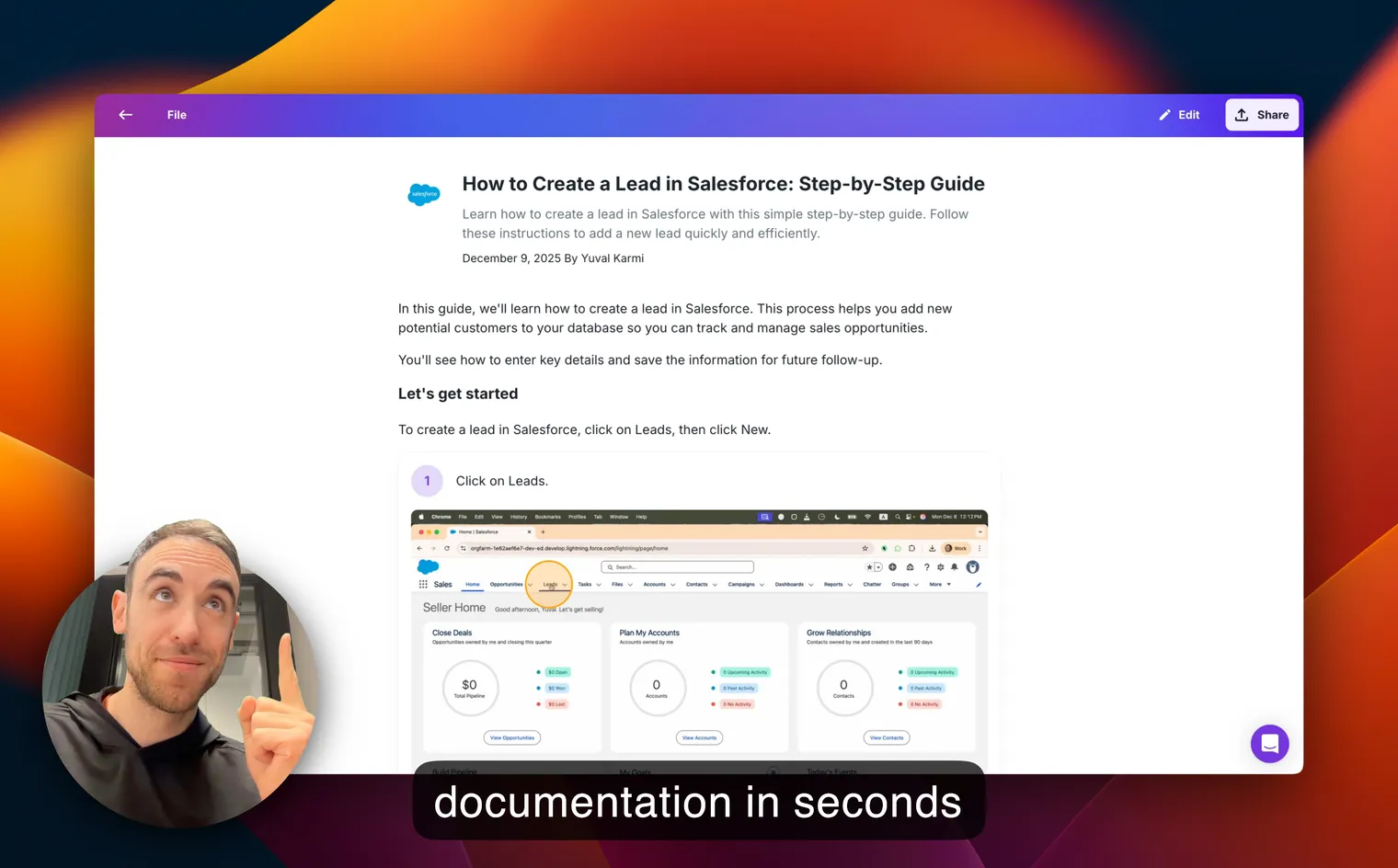
Record your screen once, and Glitter AI creates step-by-step guides your team can reference anytime.
Challenge 2: Context Gets Lost
When you’re all in the same room, there’s shared context. People know what’s been happening, what changed recently, what the current priorities are.
Remote teams lose this ambient awareness. Your documentation needs to fill in the context that would normally be implicit.
I started adding “Why we do it this way” sections to our process docs. Sounds obvious, but it made a huge difference. People understood not just what to do, but why it mattered.
Challenge 3: Updates Are Harder to Communicate
In an office, you can announce “Hey everyone, we’re changing how we handle customer requests.” People hear it, they nod, they remember.
Remote? Someone’s in a meeting, someone’s off for the day, someone checked Slack after hundreds of messages piled up. Your announcement gets buried.
You need a documentation system where updates are visible and trackable. People need to know when something changed and what’s different.
Challenge 4: Time Zones Make Synchronous Training Expensive
When I tried to do live training sessions for my distributed team, finding a time that worked for everyone was brutal. Someone was always joining at 6 AM or 10 PM.
And here’s the thing - you shouldn’t need everyone on a call to teach a process. That doesn’t scale.
Async documentation is non-negotiable for remote teams. People need to learn on their own schedule, at their own pace.
Building an Async-First Documentation Culture
Here’s what I’ve learned about creating documentation that actually works for remote teams.
Make Video Your Default Format
Text documentation has its place, but for remote teams, video changes everything. A video SOP carries context a written one can’t, and our broader process documentation guide covers how to fold it into the rest of your docs.
When you record yourself walking through a process, you capture:
- Exactly where to click
- How long things should take
- What the UI should look like at each step
- Your tone and emphasis on important parts
- The “feel” of doing it right
I switched Glitter’s internal docs to be primarily video-based about a year ago. Our onboarding time dropped by half. Not kidding - half.
The trick is making video documentation easy to create. If it takes an hour to produce a 5-minute training video, people won’t do it. This is literally why I built Glitter AI - I needed a way to create video-based process docs in minutes, not hours.
Write for the 3 AM Question
Here’s my test for good remote documentation: Could someone follow this at 3 AM when they’re stressed and tired and nobody’s around to help?
That means:
- Zero assumptions about prior knowledge. Spell everything out.
- Screenshots for every single step. Don’t make people guess.
- Clear troubleshooting sections. What do you do when it doesn’t work?
- Simple language. If you need to read it three times to understand, it’s too complex.
I’ve seen people write docs like: “Navigate to the customer dashboard and update the relevant fields.”
That’s useless for remote teams. What’s the customer dashboard URL? Which fields exactly? What should they be updated to? Where’s the save button?
Create Single Sources of Truth
One of the biggest mistakes I see with remote teams is documentation scattered everywhere. Some stuff in Notion, some in Google Docs, some in Confluence, some in random Slack threads.
Pick one place for process documentation. I don’t care if it’s Notion, Confluence, or a wiki - just pick one and stick to it.
At Glitter, everything goes in our central knowledge base. When someone asks “how do I do X,” the answer is always a link to that knowledge base. Not a Slack message, not a PDF attachment - a link to the canonical source.
This has a second benefit: when you update the doc, everyone gets the latest version. You’re not dealing with five different versions of the same SOP floating around.
Specific Documentation Practices for Remote Teams
Let me get tactical. Here’s what actually works for distributed teams.
1. Record Yourself, Don’t Write
When you need to document a new process, don’t open a Word doc. Open a screen recorder.
Record yourself doing the task while talking through it. “Okay, first I go to this page… then I click here… now I fill in these fields…”
This takes 5 minutes instead of an hour. And it’s more useful than anything you’d write because people can see exactly what you’re doing.
With Glitter AI (shameless plug), I can record my screen once and get back a step-by-step guide with screenshots automatically. It’s faster than writing and more useful than raw video.
2. Include Decision Trees for Complex Processes
Some processes have multiple paths depending on the situation. For remote teams, you can’t just say “it depends - use your judgment.”
Create decision trees that show:
- If X condition, do Y
- If Z condition, do W
- If neither, do Q
For example, at Glitter we have a customer request process that branches based on whether it’s a bug, feature request, or support question. The decision tree makes it clear which path to take without needing to ask someone.
3. Add Asynchronous Checkpoints
For multi-step processes, build in checkpoints where people can verify they’re on track.
“After completing step 5, you should see X on your screen. If you don’t, stop and post in #help.”
This prevents people from getting lost and wasting hours going down the wrong path when you’re asleep.
4. Make Documentation Two-Way
Your team should be able to comment on and improve documentation easily.
At Glitter, when someone finds an error or unclear step, they can flag it directly in the doc. I review these flags weekly and update the documentation.
This works because:
- The people doing the work know where the gaps are
- Documentation stays current
- People feel ownership over the processes
Check out our guide on SOP management best practices for more on keeping documentation current.
Tools and Systems for Remote Team Documentation
The tools matter. Here’s my stack and why I chose each piece.
Screen Recording + Auto-Documentation
Like I mentioned, I use Glitter AI for creating process docs. Record once, get step-by-step guides with screenshots. For a remote team, this is the fastest way to go from “I know how to do this” to “everyone on the team knows how to do this.”
Central Knowledge Base
We use Notion for our central knowledge base. Could be Confluence, could be a wiki, doesn’t really matter. What matters is:
- Everyone knows where to find things
- It has good search
- It’s accessible from anywhere
- You can organize by team/function/process type
Video Storage and Transcription
For longer training videos or demos, I store them in a way that’s searchable. Transcripts are key - people can search for keywords and jump to the relevant part of the video.
Version Control for Process Changes
When you update a process, your team needs to know. We use:
- A #process-updates Slack channel for announcements
- Version numbers in our docs (v1.2, v1.3, etc.)
- Highlighted “What changed” sections at the top of updated docs
This way, even if someone hasn’t looked at the doc in months, they can quickly see what’s different.
Teach your co-workers or customers how to get stuff done – in seconds.
Training Remote Teams to Use Documentation
Having great documentation means nothing if your team doesn’t use it. Here’s how to build the culture.
Make “Check the Docs First” the Default
This was hard for me at first because I wanted to be helpful. Someone would ask a question, and I’d just answer it.
But that doesn’t scale.
Now my default response to questions is: “Good question - did you check the docs? Here’s the link: [URL]”
If the docs don’t answer it, we update them. Over time, people learn to check documentation first because they know it’s actually useful.
Celebrate Documentation Wins
When someone creates great documentation or improves existing docs, I make a point of recognizing it publicly.
“Shout out to Sarah for documenting our new QA process - super clear and helpful!”
This reinforces that documentation is valued work, not just a chore.
Include Doc Creation in Work Estimates
When someone’s working on something new, the task includes: do the thing AND document how you did it.
Not “we’ll document it later.” We all know later never comes.
Build documentation time into every project. It’s part of the work, not extra.
Run Async Documentation Reviews
Once a quarter, we do a documentation review where everyone spends 2-3 hours:
- Testing documentation by following it step-by-step
- Flagging outdated or unclear sections
- Suggesting improvements
This keeps our docs current and reinforces that using documentation is part of the job.
Common Pitfalls (And How to Avoid Them)
Let me save you from the mistakes I made.
Pitfall 1: Over-Documenting Everything
Early on, I tried to document every single thing. Every edge case, every possible scenario, every exception.
The docs became overwhelming. Nobody read them.
Solution: Document the 80% case first. Add edge cases as they come up. Start simple and iterate.
Pitfall 2: Writing Docs Nobody Maintains
Creating documentation is easy. Keeping it current is hard.
If you don’t have a maintenance plan, your docs will be outdated within months. And outdated docs are worse than no docs - they create confusion and erode trust.
Solution: Every doc needs an owner and a review date. Set calendar reminders. Make maintenance part of someone’s job.
Pitfall 3: Making Documentation Too Hard to Create
If creating documentation requires special tools, training, or hours of work, people won’t do it.
The easier you make it, the more documentation you’ll get. This is why screen recording works so well - anyone can do it.
Solution: Choose tools that are dead simple. Remove barriers. Make documentation the path of least resistance.
Pitfall 4: Not Testing Your Documentation
You write a process doc, you publish it, you move on.
Then someone tries to follow it and gets stuck on step 3 because you forgot to mention a critical detail.
Solution: Have someone who’s never done the process try to follow your documentation. Watch them do it. You’ll immediately see what’s confusing.
If you’re documenting processes but struggling to get people to actually follow them, check out my post on how to create SOPs employees actually follow.
Measuring Documentation Success for Remote Teams
How do you know if your documentation is actually working? Here are the metrics I track:
Repeat Questions
If people keep asking the same questions, your documentation has gaps or isn’t discoverable.
I keep an eye on our Slack channels. When I see the same question three times, that’s a signal to create or improve documentation.
Time to Productivity for New Hires
How long does it take a new remote hire to complete tasks independently?
We measure this. When our documentation improved, this number dropped significantly - from 6 weeks to 3 weeks for complex roles.
Documentation Usage Stats
Track which docs get viewed most. Which ones never get opened?
Popular docs are either really useful or cover frequently needed processes. Ignored docs might be outdated, unnecessary, or poorly titled.
Support Ticket Volume
When I improved our customer support documentation, our support ticket volume dropped by 30%. People could self-serve instead of reaching out.
Same principle applies internally. Good documentation reduces the “I need help” requests.
The Remote Documentation Mindset
Here’s what I want you to take away from this: documentation for remote teams isn’t just about writing things down.
It’s about creating an environment where people can do their best work without waiting for someone to wake up in another timezone.
It’s about respecting that people have different schedules and working styles.
It’s about building systems that scale beyond you.
When I started treating documentation as infrastructure - as critical as our codebase or our product - everything changed. My team became more autonomous. Onboarding got faster. I spent less time answering the same questions and more time on work that actually moved the business forward.
Getting Started: Your First Steps
If you’re reading this and thinking “our remote team needs better documentation,” here’s where to start:
Week 1: Pick one high-frequency process that people always have questions about. Document it. Use screen recording to make it easy. Test it with someone who’s never done it.
Week 2: Create a central location for all process docs. Move existing documentation there. Make it the single source of truth.
Week 3: Start the “check the docs first” culture. When people ask questions, point them to documentation. If it’s not documented, create it.
Week 4: Assign owners to your top 10 processes. Set quarterly review dates. Build in maintenance.
Don’t try to document everything at once. Start small, prove the value, then expand.
The hidden costs of undocumented processes are real, especially for remote teams. But you can fix this incrementally.
Final Thoughts
Remote work is here to stay. The teams that thrive are the ones that master async communication and documentation.
You can’t build a great remote team on Slack messages and Zoom calls alone. You need robust, clear, accessible documentation that empowers people to work independently.
Is it more work upfront? Yes.
Does it pay off? Absolutely.
Every hour you invest in documentation saves 10 hours of interruptions, confusion, and delays down the road.
Start today. Your future self - and your team - will thank you.
Ready to level up your remote team documentation? Glitter AI helps you create visual process docs in minutes. Record your screen, get step-by-step guides with screenshots automatically. Try it free.
Frequently Asked Questions
What's the most important type of documentation for remote teams?
Process documentation is critical for remote teams. It enables people to complete tasks independently without waiting for someone in another timezone to answer questions. Visual, step-by-step guides work best.
Should remote team documentation be text or video-based?
Video-based documentation is generally more effective for remote teams because it shows exactly what to do and replaces in-person demonstrations. Combine screen recordings with written steps and screenshots for best results.
How often should remote team documentation be updated?
Review documentation quarterly at minimum, and update immediately when processes change. For remote teams, outdated documentation is especially problematic because people can't easily ask for clarification across timezones.
What tools are best for remote team documentation?
Choose a centralized knowledge base like Notion or Confluence, screen recording tools for creating visual guides, and version control for tracking changes. The key is having one single source of truth that's accessible to everyone.
How do I get my remote team to actually use documentation?
Make documentation easy to find and genuinely useful. Respond to questions with documentation links, include doc creation in project work, and celebrate good documentation. Test docs with new team members to ensure they're clear.
What's the biggest mistake with remote team documentation?
Scattering documentation across multiple platforms. When process docs are in Slack, Google Docs, emails, and wikis, people can't find what they need. Pick one central location and make it the single source of truth.
How detailed should documentation be for distributed teams?
More detailed than for in-office teams. Include screenshots for every step, spell out things that seem obvious, and add troubleshooting sections. Remote team members can't just ask someone nearby when they get stuck.
Can async documentation replace meetings for remote teams?
Good documentation can replace many synchronous training meetings. Instead of scheduling calls across timezones, create video-based documentation that people can review on their own schedule. Save meetings for discussion and Q&A.