
Read summarized version with
If you’re the one responsible for Uphance training, I get it. You’re probably already wearing ten hats, and now you’ve got to figure out how to bring everyone up to speed on this apparel management software that, let’s be honest, has more tabs and menus than anyone would like.
I’m Yuval, founder of Glitter AI. Before Glitter, I ran a SaaS startup called Simpo, where I saw firsthand how hard it is to get a team up to speed on complicated internal tools. The software itself works fine. Training people on it? That’s where things fall apart.
Here’s what I’ve come to understand: Uphance training isn’t really about Uphance itself. It’s about capturing how your best people actually use this fashion wholesale software and making that knowledge available to everyone else. Let me walk you through how to pull that off without losing your sanity.
Teach your co-workers or customers how to get stuff done – in seconds.

The Real Problem Isn’t Uphance. It’s Tribal Knowledge.
Let me paint a picture that’ll probably feel familiar.
Your warehouse manager, Sarah, has been running Uphance for two years. She knows every shortcut, every workaround, every quirk in this apparel management software. She can process a wholesale return in three minutes flat. She knows you have to click “Confirm” before “Generate Invoice” or the whole thing breaks.
None of that is written down.
Then Sarah leaves. Or takes a vacation. Or just gets sick for a week. Suddenly your team is staring at UpHance like it’s written in another language. Orders pile up. Invoices go out wrong. Someone accidentally ships to the wrong warehouse.
This is what we call the undocumented know-how that lives only in people’s heads, and it’s the silent killer of operations teams. The know-how lives in people’s heads, not in any system. When those people walk out the door, the knowledge walks with them.
This problem compounds as you grow. At 20 people, you can probably get by with Slack messages and shoulder taps. At 50, 100, 200? It’s chaos. Every new hire takes longer to onboard. Every departure opens a knowledge gap that takes weeks to close.
Why Your Current Uphance Training Probably Isn’t Working
I’m going to take a guess at how you’ve tried to solve this before.
The Google Doc Approach
Someone sat down and wrote a 30-page doc full of screenshots. It took them a full day. Within a month it was outdated because Uphance changed their UI. Nobody reads it. It lives in a shared drive folder that new hires can never find.
The “Shadow Someone” Approach
New hires follow an experienced team member around for a week. This works okay-ish, but it pulls your best person away from their actual job. And every new hire ends up getting a slightly different version of the training depending on who they shadow and what kind of day that person is having.
The Zoom Recording Approach
Someone records a 45-minute Zoom call walking through Uphance. The resulting video is massive, unsearchable, and impossible to skim. When someone needs to know how to do one specific thing, like processing a credit note, they have to scrub through the entire recording to find it.
None of these approaches are terrible on their own. The issue is that each one is incomplete. Written docs miss the visual context. Shadowing doesn’t scale. Long videos aren’t useful as reference material. What you really need is all three formats working together.
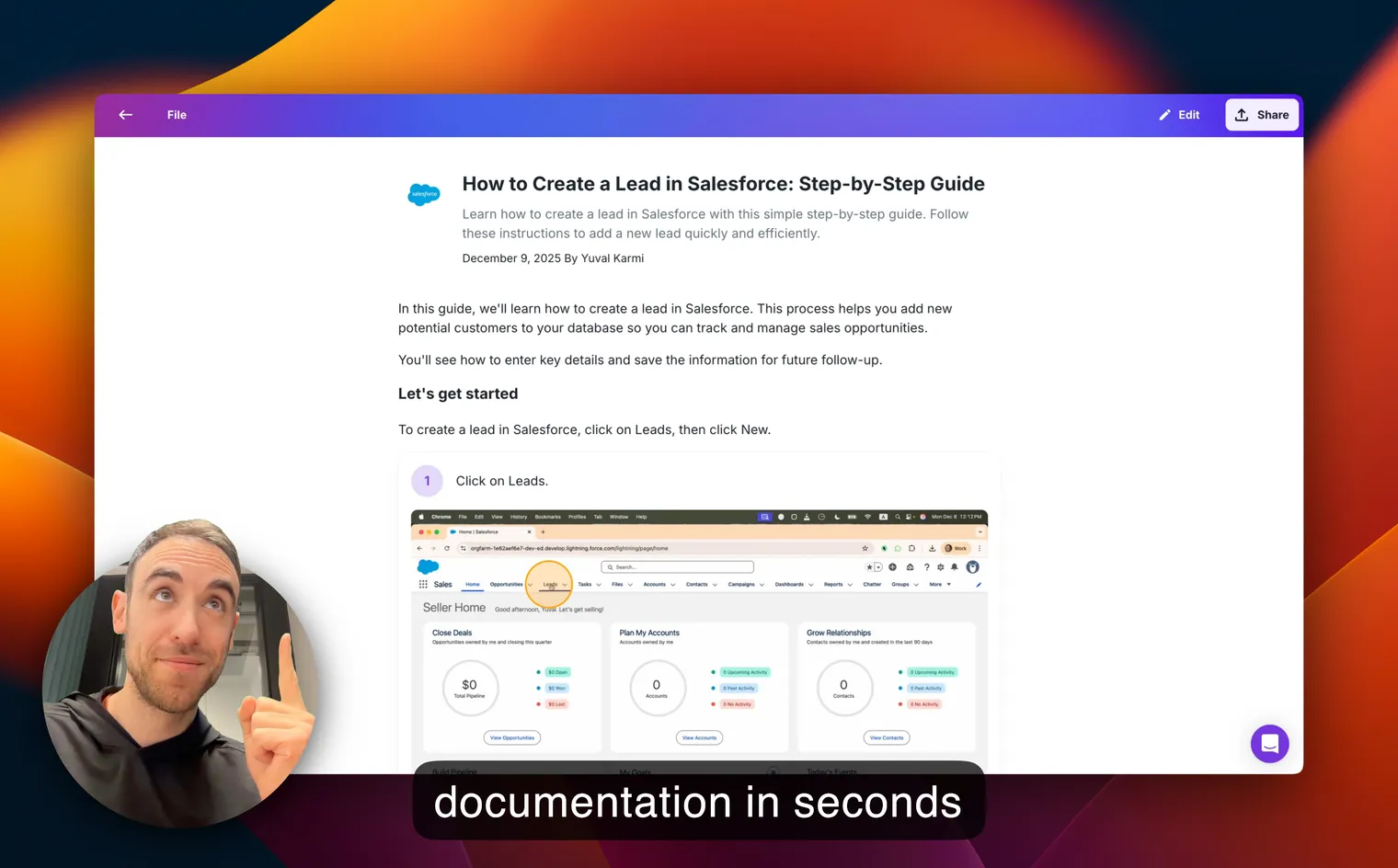
Video, screenshots, and written steps from one recording
A Better Way: Record Once, Get Everything
This is where I’ll mention Glitter, because we genuinely built it for this exact problem.
The idea is simple. You open Glitter, hit record, and walk through a process in Uphance while talking out loud. Explain what you’re doing and why, the same way you would if you were training someone sitting right next to you. When you’re done, Glitter automatically generates a complete training guide with the video recording, annotated screenshots of each step, written instructions with clear descriptions, and voiceover narration synced to each step.
One recording. Three formats. Zero extra work.
It beats the old “shadow someone for a week” model too, since job shadowing shows you the clicks but not the judgment calls behind them. I’ve watched operations teams go from no documentation at all to a full Uphance training library in a single afternoon. Not because they’re superhuman, but because they don’t have to write anything by hand. They just do the process and talk through it.
If you want to explore this approach further, check out our guide on pairing each step with a screenshot. It covers why combining formats works so much better than relying on any single one.
The 5 Uphance Workflows You Should Document First
Let’s get specific. If you’re staring at Uphance and wondering where to start, here are the five workflows I’d tackle first. These are the ones I’ve seen cause the most confusion and do the most damage when they go wrong.
1. Processing a Wholesale Order End-to-End
This is your bread and butter in any fashion wholesale software. From the moment a wholesale order comes in, whether through Uphance’s B2B portal, an email, or a phone call, to the moment it ships out the door. Your guide should cover creating the sales order in Uphance, adding line items with the correct styles, colors, and sizes, confirming the order and checking inventory availability, generating the pick ticket, and marking the order as shipped.
Pro tip: When you record this in Glitter, talk through the “why” behind each step. Don’t just say “click Confirm.” Say “I click Confirm here because it locks the order and prevents anyone else from editing it. If you skip this, you might end up with duplicate shipments.” That kind of context is what separates a useful guide from a useless one.
2. Generating and Managing Invoices
Invoicing in Uphance has a few different methods, and I’ve heard from plenty of teams that this is one of the trickiest areas to pick up. Your guide should show how to generate invoices from confirmed orders, explain the different invoicing methods Uphance supports, demonstrate how to adjust payment terms for specific customers, and walk through sending invoices as PDFs via email.
This is one of those workflows where a training video paired with written steps really works well. The video shows the flow and timing. The written steps serve as a quick reference when someone just needs a refresher.
3. Processing Returns and Credit Notes
Returns are where mistakes get expensive fast. A wrong credit note or a botched return check-in can throw off your inventory counts and your accounting. Document the full return flow: receiving the return request, checking in the returned units (Uphance lets you do this individually or in bulk), generating the credit note, and updating inventory. Make sure whoever records this explains the difference between a full return and a partial return. I’ve seen that trip people up more times than I can count.
4. Setting Up New Product Lines
When your brand launches a new season or adds new styles, someone has to get all of that into Uphance. That means creating products with the right attributes, adding size runs and colorways, setting wholesale pricing, and publishing to your B2B portal and connected channels like Shopify or JOOR. This is where Uphance ERP really shows its value as fashion wholesale software.
This workflow has a lot of fields and options. It’s easy to miss something. A visual guide with annotated screenshots of each screen makes it nearly impossible to skip a step.
5. Managing Customer Accounts and the B2B Portal
Your wholesale customers interact with Uphance through the B2B portal, so your team needs to know how to set up new customer accounts, assign pricing tiers, manage order history, and handle portal-related questions that come up.
I’d actually suggest having the person who handles customer accounts record two separate guides here. One for internal use (how your team manages accounts in the backend) and one you can share directly with customers so they can self-serve on the portal. Both end up saving a lot of time.
Document every workflow so knowledge never walks out the door
How to Structure Your Uphance Training for New Hires
Individual workflow guides are great, but you also need a plan for how new hires actually work through Uphance training. Here’s the structure I’d recommend, based on what I’ve seen work at companies using Glitter.
Week 1: Watch and Learn
Give new hires access to your full library of Uphance guides. Have them watch the video walkthroughs for the five core workflows above. Don’t ask them to do anything in the system yet. Just let them absorb how things work.
This is where having video plus screenshots plus written steps really pays off. Some people prefer watching the videos. Others will read the steps. Most do a mix of both. You end up covering every learning style without having to create three separate sets of training materials.
Week 2: Guided Practice
Now they start doing tasks in Uphance, but with the guides open as a reference. They process their first order while following the step-by-step guide. They generate their first invoice with the screenshots right there showing them what each screen should look like.
This is also when they’ll hit edge cases and questions your guides don’t cover yet. That’s actually a good thing. Have them record those edge cases as new guides using Glitter. Now your newest team member is already contributing to the knowledge base.
Week 3 and Beyond: Independent Work with a Safety Net
By week three, most people can handle the core workflows on their own. But they still have the guides available as a quick reference whenever they get stuck. No more interrupting the warehouse manager to ask how to process a return. No more guessing which button to click.
I’ve seen this approach cut onboarding time roughly in half for ops teams. Instead of three to four weeks of hand-holding, you get independent contributors in about two weeks. That matters a lot when you’re dealing with high turnover in operations roles.
Why Video + Screenshots + Written Steps Beat Any Single Format
I want to spend a moment on this because it’s something I have strong opinions about.
Video alone is great for showing flow and context, but terrible for quick reference. Nobody is going to rewatch a 10-minute video just to remember which dropdown to select.
Screenshots alone show you what things look like but don’t explain the reasoning or the sequence. They also go stale fast.
Written steps alone are scannable and searchable, but they can’t show what a screen is supposed to look like or how a process feels when it’s moving. This is exactly why visual SOPs outperform text-only documentation every time.
When you combine all three, you get something that works for initial learning (watch the video), daily reference (scan the written steps), and troubleshooting (check the screenshots to see if your screen looks right).
And the best part? With Glitter, you don’t have to create these three things separately. One recording gives you all of them.
Tips for Recording Great Uphance Training Guides
Whether you use Glitter or not, here are some practical tips for creating Uphance training content that actually sticks.
Talk Like a Human, Not a Manual
When you’re recording, pretend you’re explaining the process to a friend who just started. Use plain language. Say “click the blue button in the top right” instead of “navigate to the order confirmation interface.” Your team members aren’t reading a spec sheet. They just need to know what to click.
One Workflow Per Guide
Don’t try to cover everything in one massive guide. Break it down. “How to process a wholesale order” is one guide. “How to generate an invoice” is another. Keep each guide focused on a single task. That makes them searchable, easy to scan, and simple to update when things change.
If you want more guidance on structuring your guides, our post on how to create a training manual goes deep on this.
Include the Common Mistakes
The most valuable part of any training guide isn’t the happy path. It’s the warnings about what goes wrong. “Don’t click Save before you’ve added the shipping address, or you’ll have to start over.” “If you see this error message, it means the inventory hasn’t synced yet, wait 5 minutes and try again.”
These are things that take new hires weeks to figure out through trial and error. Capture them in your guides and you save everyone a lot of frustration.
Keep Guides Updated
Uphance releases updates regularly. When the UI changes, your guides need to change too. The nice thing about recording-based guides is that updating them is quick. Just re-record the workflow with the new UI, and you’ve got a fresh guide in minutes. No need to manually retake 20 screenshots and rewrite paragraphs of text.
Build a Complete Knowledge Base, Not Just One Guide
As someone who built Glitter, I’ve seen that the most successful teams document 5+ different operational workflows across their business. The ones who get the most value aren’t creating a single guide. They’re building an entire knowledge base for how their company operates. Don’t stop at Uphance. Document your shipping process. Document how you handle customer complaints. Document your month-end reconciliation. Once your team sees how quick it is to create guides, the documentation culture builds itself.
Making It Stick: Getting Your Team to Actually Use the Guides
Creating great training guides is pointless if your team doesn’t use them. Here’s what I’ve seen work.
Make guides findable. Put them where your team already spends their time. If they live in Slack, share guides in Slack. If they’re in UpHance all day, bookmark the guides in their browser. Don’t bury them in a folder three levels deep.
Assign ownership. Each core workflow should have an owner who keeps the guide current. This doesn’t mean they do all the work. It just means someone is on the hook for it.
Celebrate contributions. When someone creates a new guide or updates an existing one, call it out. A simple “hey, thanks for documenting the new returns process” in your team channel goes a long way. You want documentation to feel like part of the job, not extra homework.
Use guides in meetings. When someone asks “how do we do X?” in a meeting, pull up the guide. This reinforces that the guides exist and are the single source of truth. After a few weeks, people start checking the guides before they ask.
The Bottom Line
Training your team on Uphance doesn’t have to be a months-long project. Whether you think of it as Uphance ERP or just your order management system, the approach is the same. You don’t need a dedicated training department or a professional instructional designer. You need one person who knows the process, a screen recorder, and a willingness to talk through what they’re doing.
The teams that do this well aren’t just training faster. They’re building something bigger: a knowledge base that survives turnover, scales with growth, and gets better over time. That’s the difference between a company where knowledge lives in people’s heads and one where it lives in a system anyone can access.
Start with one workflow. Pick the one that causes the most confusion or generates the most questions. Record yourself walking through it. Talk through each step naturally. See how it feels to have that knowledge captured, organized, and ready for the next person who needs it.
I think you’ll find it’s easier than you expected. And your future self, the one who doesn’t have to explain the returns process for the fifteenth time, will thank you for it.
Frequently Asked Questions
What is Uphance used for?
Uphance is an apparel management software designed for fashion wholesale and B2B operations. It helps brands manage sales orders, inventory, invoicing, production, shipping, returns, and customer accounts all in one platform. It also includes a B2B portal where wholesale customers can browse catalogs and place orders.
How long does Uphance training take for new hires?
With traditional shadowing and written docs, most teams report 3-4 weeks before a new hire is fully independent on Uphance. Using visual training guides with video, annotated screenshots, and written steps, you can cut that down to about 2 weeks. The key is having a structured library of workflow guides they can reference on their own.
What Uphance workflows should I document first?
Start with the five core workflows: processing wholesale orders end-to-end, generating and managing invoices, processing returns and credit notes, setting up new product lines, and managing customer accounts. These cover the majority of daily operations and are where mistakes are most costly.
Can I create Uphance training videos without professional equipment?
Absolutely. All you need is a screen recorder and a microphone (your laptop mic works fine). Tools like Glitter let you record your screen while talking through a process, then automatically generate a complete training guide with video, annotated screenshots, and written steps. No editing or production skills required.
How do I keep Uphance training materials up to date?
The easiest approach is to use recording-based tools where updating a guide means simply re-recording the workflow. Assign an owner to each core workflow guide who is responsible for keeping it current. When Uphance releases updates that change the UI, re-record the affected guides, which takes minutes rather than the hours it takes to manually update screenshots and text.
What's the best format for Uphance training - video, written docs, or screenshots?
The answer is all three together. Video shows flow and context for initial learning. Written steps are scannable for quick daily reference. Screenshots help with troubleshooting by showing what each screen should look like. Tools like Glitter generate all three from a single screen recording, so you don't have to choose.
How do I train remote team members on Uphance?
Visual training guides work especially well for remote teams because they don't require synchronous time with a trainer. Record your screen walking through each Uphance workflow, share the guides in your team's communication channels, and let remote team members learn at their own pace. They can rewatch videos and reference written steps whenever they need to.
How do I handle Uphance training for different roles on my team?
Create role-specific guide collections. Your warehouse team needs pick-pack-ship workflows. Your accounting team needs invoicing and credit note guides. Your sales team needs customer account and B2B portal guides. Organize your guides by role so each person only sees what's relevant to their job, rather than wading through everything.
What if my team resists using training documentation?
Resistance usually comes from bad past experiences with outdated or hard-to-find docs. Make guides easy to find by putting them where your team already works. Keep them visual and scannable rather than text-heavy. When someone asks a question that's covered in a guide, pull up the guide instead of answering verbally. After a few weeks, checking the guides first becomes a habit.
Can I share Uphance training guides with wholesale customers?
Yes, and you should. Create separate guides for how your wholesale customers use the Uphance B2B portal: browsing your catalog, placing orders, tracking deliveries, and viewing order history. Sharing these guides reduces support questions from your customers and makes your brand easier to do business with.