
Read summarized version with
If you’re reading this, you probably already know how to train your team on Front app. You get shared inboxes. You understand message templates and routing rules. The real challenge with Front app training is getting all of that knowledge out of your head and into everyone else’s.
I’m Yuval, founder of Glitter AI. Through building a tool that helps teams create training guides from screen recordings, I’ve talked to dozens of Front teams who all describe the same problem: one person becomes the Front expert, everyone else bugs them with questions all day, and when that person leaves, the team scrambles. It’s the textbook tribal knowledge trap.
Front is powerful software. Shared inboxes, rules, tags, SLAs, message templates, conversation assignments, escalation workflows. There’s a lot going on. And while Front’s own documentation is decent enough, it doesn’t tell your team how your company uses Front. That gap is what gets you.
Let me show you how to close it.
Teach your co-workers or customers how to get stuff done – in seconds.

Why Front App Training Is Harder Than It Looks
Front app isn’t like most software where everyone follows the same playbook. Every company configures it differently. Your shared inboxes, tags, rules, escalation paths – they’re all specific to your business.
So generic shared inbox training falls flat. You can’t just send someone a link to Front’s help center and call it done.
The Tribal Knowledge Problem
Here’s what I’ve seen play out dozens of times. Your ops lead spends months building out Front app. They set up shared inboxes for sales, support, and billing. They create rules that auto-tag conversations. They build message templates for common responses. They know exactly when to escalate and to whom.
Then they go on vacation. Or they quit. Or they get promoted.
Suddenly, nobody knows why the “urgent-billing” tag triggers a Slack notification. Nobody remembers the rule that routes VIP customer emails to the senior team. The hidden cost of undocumented processes hits you all at once.
Teams tell us the same thing. One company we work with lost their ops lead on a Friday. By Monday, their shared inbox was chaos. Conversations were getting assigned to the wrong people. SLA timers were being ignored because nobody even knew they existed. It took them three weeks to recover.
Three weeks. Because one person left.
Why Traditional Documentation Fails for Front
You might be thinking, “We’ll just write it all down.” Here’s why it falls apart.
Front is deeply visual and interactive. Trying to explain how to create a rule in Front with text alone is like explaining how to drive using only written directions. You can technically do it, but it’s painful and people make mistakes.
The interface changes. Screenshots from six months ago might not match what new hires see today. Written docs go stale fast.
Context matters. Your ops lead doesn’t just click buttons in a sequence. They make judgment calls. “This type of email goes to this inbox because…” That reasoning gets buried in bullet points.
Nobody reads long docs. Be honest – when was the last time a new hire actually read through a 30-page training manual? They skim it, get confused, and come ask you anyway.
This is why I think the best approach to training documentation pulls together multiple formats. Not just text. Not just video. All of it together.
A Better Way to Handle Front App Training: Record Yourself Walking Through It
Here’s what actually works. Instead of sitting down to write documentation, just do the work and record yourself doing it.
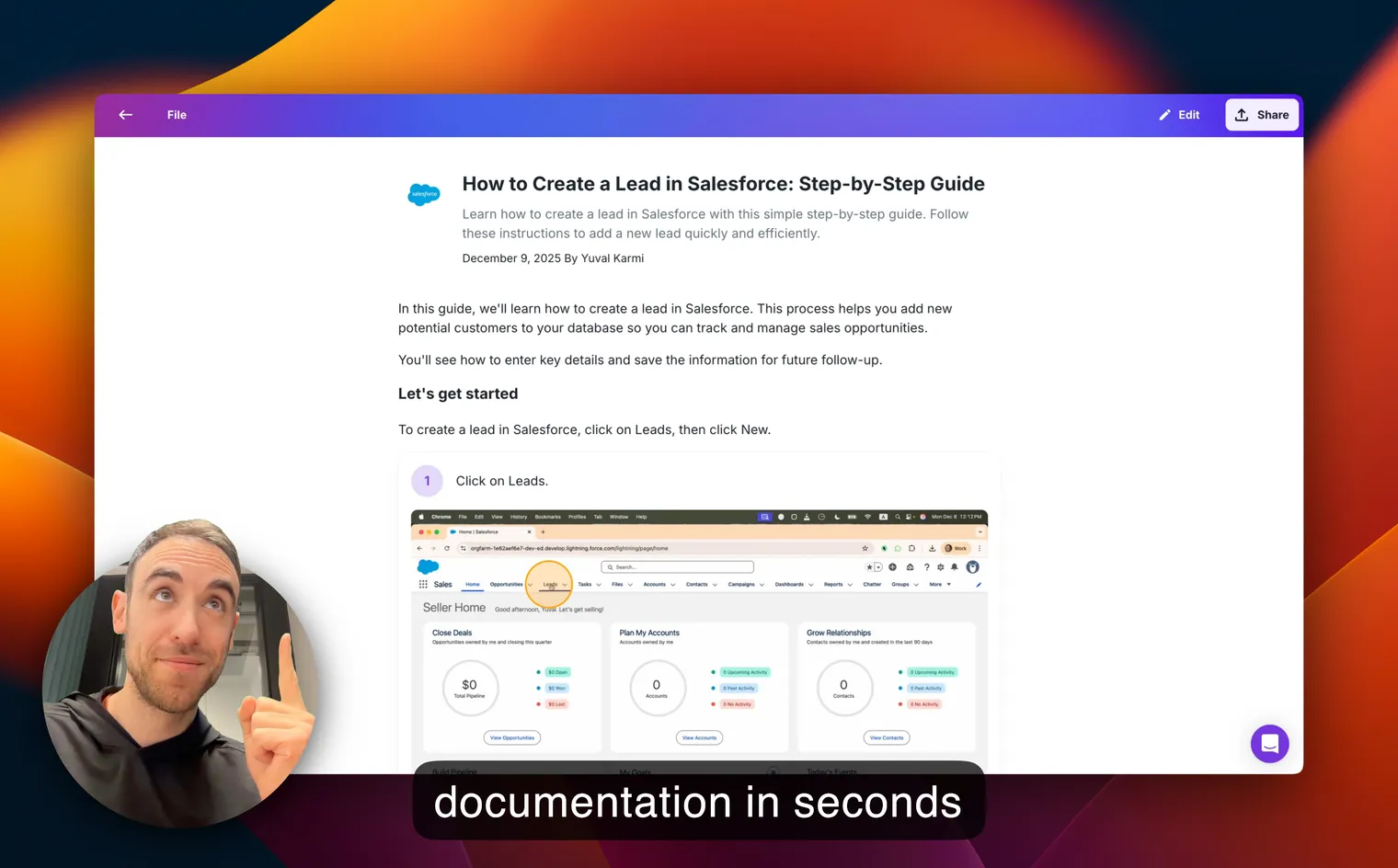
Open Glitter. Hit record. Walk through the process in Front while talking out loud. Explain what you’re doing and why. When you stop, Glitter automatically creates a complete training guide with the video recording, timestamped screenshots of every step, written instructions, and voiceover narration.
That’s it. No writing. No formatting. No taking screenshots and pasting them into a Google Doc. You just do the thing you already know how to do, and the guide creates itself.
I built Glitter specifically for this moment. The moment where someone says, “Can you show me how to do that?” and instead of spending 20 minutes walking them through it live, you hand them a guide that shows everything – video they can watch, screenshots they can scan, and written steps they can follow.
The teams that get the most out of Glitter tend to document 5+ different operational workflows across their business. They’re not creating one guide – they’re building an entire knowledge base for how their company actually runs.
Record yourself walking through any Front workflow. Get a complete guide with video, screenshots, and written steps automatically.
The Front App Workflows You Need to Document
Don’t try to document everything at once. Start with the workflows that cause the most confusion and the ones new hires ask about first.
1. Managing Shared Inboxes
This is foundational. Every new team member needs to understand how your shared inboxes are organized and what goes where.
What to cover in your recording:
- Which shared inboxes exist and what each one is for (support@, billing@, sales@, etc.)
- How to switch between inboxes and your personal inbox
- The difference between individual and shared conversations
- How to move a conversation from one inbox to another
- When to use “archive” vs. leaving something in the inbox
- Your team’s conventions for inbox zero vs. triaging
Walk through a real example. Open the support inbox, show a few conversations, explain the flow. Talk about why certain conversations sit in certain places. That context is what makes training stick.
2. Assigning and Managing Conversations
Assignment is where things get messy without clear guidelines. Who handles what? When do you reassign?
What to cover:
- How to assign a conversation to yourself or a teammate
- Your team’s rules for claiming vs. being assigned
- When to reassign to someone else (and how to do it without losing context)
- How to use @mentions and internal comments to loop in teammates
- Shared drafts – how to collaborate on a response before sending
Show the internal comments feature. This is one of Front’s most useful capabilities for training because comments are invisible to the customer. New hires need to see how your team uses them to ask questions, share context, and get approvals.
3. Creating and Using Message Templates
Templates save a ton of time, but only if people know they exist and when to use them.
What to cover:
- Where to find your team’s message templates
- Which templates to use for which situations
- How to personalize a template before sending (because nobody wants to receive a robotic response)
- How to create new templates when you notice a pattern
- Your team’s naming conventions for templates
Record yourself responding to a real email using a template. Show the whole flow: select template, personalize it, review, send. Then show what happens when there isn’t a perfect template and you need to modify one or write from scratch.
4. Setting Up and Understanding Rules and Automation
This is where Front gets powerful – and where most teams lose people.
What to cover:
- What rules exist and what they do (explain each one in plain English)
- How conversations get auto-tagged, auto-assigned, or auto-moved
- The difference between individual rules and workspace rules
- How to tell if a rule has been applied to a conversation
- Who to talk to if a rule isn’t working correctly
You don’t necessarily need to train everyone on creating rules. But everyone should understand what the existing rules do. Record a walkthrough of your rule library and explain each rule’s purpose. “This rule watches for emails from @bigclient.com and automatically tags them as VIP and assigns them to Sarah.”
5. Using Tags and Filters Effectively
Tags are the backbone of organization in Front, but they only work if everyone uses them consistently.
What to cover:
- Your tag taxonomy – what tags exist and what each one means
- Required vs. optional tags
- How to filter conversations by tag
- When to add tags manually vs. relying on automation
- Your conventions for tag naming (so people don’t create duplicates)
This is a great workflow to record because you can show the visual interface – clicking tags, filtering, watching results appear in real time. Written docs just can’t capture how smooth this feels when done right.
6. Handling Escalations
Every team has escalation paths, but they’re rarely documented well. This is critical for training employees faster with documentation.
What to cover:
- What qualifies as an escalation
- The escalation path: who to loop in and how
- How to use Front’s assignment and comment features for escalations
- What information to include when escalating (so the next person isn’t starting from scratch)
- SLA implications of escalations – does the clock reset?
Record a mock escalation. Show yourself receiving a conversation, recognizing it needs to go up the chain, adding an internal comment with context, and reassigning it to the right person. Walk through your thinking out loud.
7. Managing SLAs and Response Time Goals
If your team uses Front’s SLA features, this deserves its own training guide.
What to cover:
- Which SLAs are active and what the targets are
- How to see SLA status on a conversation
- What happens when an SLA is about to breach
- Priority order when multiple conversations are approaching their SLA limits
- How SLA metrics are tracked and reported
Show the SLA indicators in real time. Point out the visual cues – the color changes, the timers, the warnings. New hires need to develop a feel for SLA urgency, and seeing it live is way more effective than reading about it.
8. Team Email Management and Collaboration
Front app’s collaboration features are what set it apart from regular email. Good team email management is what makes or breaks your operations.
What to cover:
- Internal comments vs. reply vs. reply-all (critical distinction)
- Shared drafts for getting feedback before sending
- Using @mentions to get a teammate’s input without reassigning
- Following conversations you’re not assigned to
- The etiquette of jumping into someone else’s conversation
This is another area where visual work instructions really shine. Show the difference between an internal comment and a reply. Show what happens if someone accidentally hits reply instead of comment. That visual lesson sticks with people in a way that written warnings never will.
Teach your co-workers or customers how to get stuff done – in seconds.
How to Structure Your Front App Training Program
Now that you know what to document, here’s how to put it all together.
Week 1: Foundations
Start new hires with the basics before letting them touch live conversations.
Day 1-2: Orientation recordings
- Overview of your shared inboxes and what each one handles
- How to navigate Front’s interface (switching inboxes, searching, filtering)
- Your team’s communication norms (when to comment, when to assign, when to Slack)
Day 3-4: Core workflows
- Managing conversations: claim, respond, archive
- Using message templates
- Tagging conventions
Day 5: Shadow day
- Watch recorded examples of experienced teammates handling real conversations
- Review escalation and SLA guides
Week 2: Guided Practice
Let new hires start handling conversations with supervision.
- Assign simple, low-risk conversations
- Review their responses before they send (using shared drafts)
- Point them to specific guides when they get stuck
- Have them write down any questions the guides don’t answer
Ongoing: Build the Knowledge Base
Here’s what separates good teams from great ones. Don’t stop at initial training.
Every time someone asks “how do I…?” in Slack, that’s a signal to create a guide. Record the answer once, save it, and link to it next time someone asks.
Over time, you build a full knowledge base for how your company uses Front app. Not generic shared inbox training. Your Front app training.
This is exactly what I mean when I talk about employee training best practices. The best training isn’t a one-time event. It’s a living library that grows with your team.
Why Video + Screenshots + Written Steps Beat Any Single Format
I’m biased here – I built a tool that combines all three. But let me explain why this matters specifically for Front training.
Video captures context and judgment. When you watch someone navigate Front, you pick up on things that can’t be written down. The pause before they choose a tag. The way they scan the inbox. The “hmm, this one’s tricky” moment before an escalation. Video captures the thinking, not just the clicking.
Screenshots let people scan. When someone’s in the middle of handling a conversation and needs a quick refresher, they don’t want to sit through a 5-minute video. They want to see the screenshot of exactly which button to click. Screenshots are the “just show me” format.
Written steps are searchable. You can’t search inside a video. But you can search written steps for “SLA” or “escalation” or “billing tag” and find exactly what you need in seconds.
Together, they cover every learning style. Some people learn by watching. Some by reading. Some by doing with a reference guide open. When all three formats are there, you don’t have to guess which one works for each person. They pick what works for them.
This is why tools that produce only video - like Loom - or only screenshots leave a gap. Loom viewers have to watch end-to-end to find the step they need; Glitter readers can skim written steps, jump to a screenshot, or watch the video clip, whichever works for them in the moment. You need the complete picture to document customer service processes effectively.
Common Mistakes When Training Teams on Front App
Let me save you some pain.
Mistake 1: Training Everyone the Same Way
Your support team uses Front differently than your sales team. Your billing team has different workflows than your account managers. One giant training for everyone just doesn’t work.
Instead: Create role-specific guides. A support rep needs deep training on SLAs and escalations. A sales rep needs to understand shared drafts and templates. Tailor the training to the role.
Mistake 2: Training Once and Forgetting
Front evolves. Your processes evolve. A training guide from six months ago might reference rules that no longer exist or tags that have been renamed.
Instead: Review your guides quarterly. When you change a workflow in Front, record an updated guide the same day. Make it part of the change process.
Mistake 3: Not Documenting the “Why”
Showing someone which buttons to click is only half the job. If they don’t understand why a conversation gets tagged a certain way or why an escalation goes to a specific person, they’ll make mistakes the moment something doesn’t fit the script.
Instead: Always explain your reasoning while recording. “I’m tagging this as urgent-billing because the customer mentioned they were double-charged, and our policy is to prioritize billing errors within 2 hours.”
Mistake 4: Keeping Training Materials in One Person’s Head
If only your ops lead knows where the training guides live or how to update them, you haven’t solved the tribal knowledge problem. You’ve just relocated it.
Instead: Store guides in a shared, searchable location. Make sure multiple people know how to create and update them.
Build a training library your whole team can access, search, and update. Start with one Front workflow today.
Getting Started Today
You don’t need to document every Front workflow before this becomes useful. Start with one.
Pick the process your team asks about most. Maybe it’s “how do we handle a billing dispute?” or “what’s the process for onboarding a new client in Front?” or “how do I set up a new message template?”
Record yourself doing it. Talk through each step. Let the guide generate itself.
Share it with your team. Ask for feedback. Then do another one.
Within a couple of weeks, you’ll have a library of Front app training guides that actually reflect how your company works. New hires will get up to speed faster on team email management. Your team will stop pinging you with the same questions. And when someone leaves, their knowledge stays.
That’s the whole point. Not perfect documentation. Just knowledge that doesn’t walk out the door.
Frequently Asked Questions
How long does it take to create a Front app training guide with Glitter?
Most Front app training guides take 5-10 minutes to create. You simply record your screen while walking through the workflow and talking through each step. Glitter automatically generates the complete guide with video, screenshots, and written instructions. Compare that to the hours it takes to manually write documentation with screenshots.
What Front app workflows should I document first?
Start with the workflows that cause the most confusion or that new hires ask about first. For shared inbox training, this typically includes managing shared inboxes, assigning conversations, using message templates, and understanding your tagging system. Escalation procedures and SLA management should follow shortly after.
How do I train remote team members on Front app?
Visual Front app training guides that combine video, screenshots, and written steps work perfectly for remote teams because they're self-service. Team members can watch the video walkthrough, reference screenshots, and follow written steps at their own pace regardless of time zone. No need to schedule live training sessions.
How often should I update Front app training materials?
Review your Front app training guides quarterly at minimum. Update them immediately whenever you change a workflow, add new rules or automations, modify your tag taxonomy, or restructure your shared inboxes. Outdated training materials are worse than no materials because they erode trust in your documentation.
Can I create role-specific Front app training for different teams?
Yes, and you should. Your support team, sales team, and billing team all use Front differently. Create separate training guides for each role's specific workflows. Shared guides can cover universal basics like navigation and communication norms, while role-specific guides cover the workflows unique to each team.
What's the best way to handle Front app training for new hires?
Structure onboarding in phases. Start with foundational guides covering inbox navigation and communication norms in the first few days. Move to core workflows like templates, tagging, and assignments in the first week. Then transition to guided practice with supervised conversation handling in week two. Visual guides let new hires learn at their own pace.
How do I make sure my team actually follows Front app training?
Make Front app training materials easy to find and search. Store them in a central, shared location. Reference specific guides when answering questions instead of re-explaining team email management processes. Use Front's built-in analytics to monitor whether conversations are being tagged, assigned, and handled according to your documented workflows.
Should I train everyone on Front's rules and automation features?
Not necessarily. Everyone should understand what your existing rules do and how they affect conversations. But creating and editing rules can be limited to team leads or admins. Record a walkthrough of your rule library so the whole team understands the automations, but keep rule creation training for those who need it.
How do I document Front app escalation procedures effectively?
Record a mock escalation from start to finish. Show yourself recognizing that a conversation needs escalation, adding context via internal comments, and reassigning to the right person. Explain what information to include, who handles which types of escalations, and how SLAs are affected. The visual walkthrough captures nuance that written procedures miss.
What if my team uses Front alongside other tools like Slack or a CRM?
Document the handoff points between tools. Create guides that show the full workflow, including when to move from Front to Slack for internal discussion, how to log Front conversations in your CRM, and when to create tickets in other systems. Glitter captures everything on your screen, so cross-tool workflows are documented naturally.