
Read summarized version with
If you’ve ever tried to train someone on Kloudville, you know the frustration. It’s a capable wholesale order management platform – product catalogs, pricing tiers, invoicing, all of it – but good luck finding documentation that actually walks your team through things step by step. Figuring out Kloudville training usually boils down to sitting next to someone and clicking through every screen together.
I’m Yuval, founder of Glitter AI. Through building a tool that helps teams create training guides from screen recordings, I’ve talked to dozens of teams using niche B2B commerce tools like Kloudville who all describe the same problem. The platform powers their daily work but doesn’t ship with a training manual that reflects how their team actually uses it.
Here’s the thing about wholesale order management platforms like Kloudville: every company sets them up differently. Your pricing tiers, your customer account structure, your bulk order workflows – none of it is generic. It’s all custom to your business. And it all lives in someone’s head.
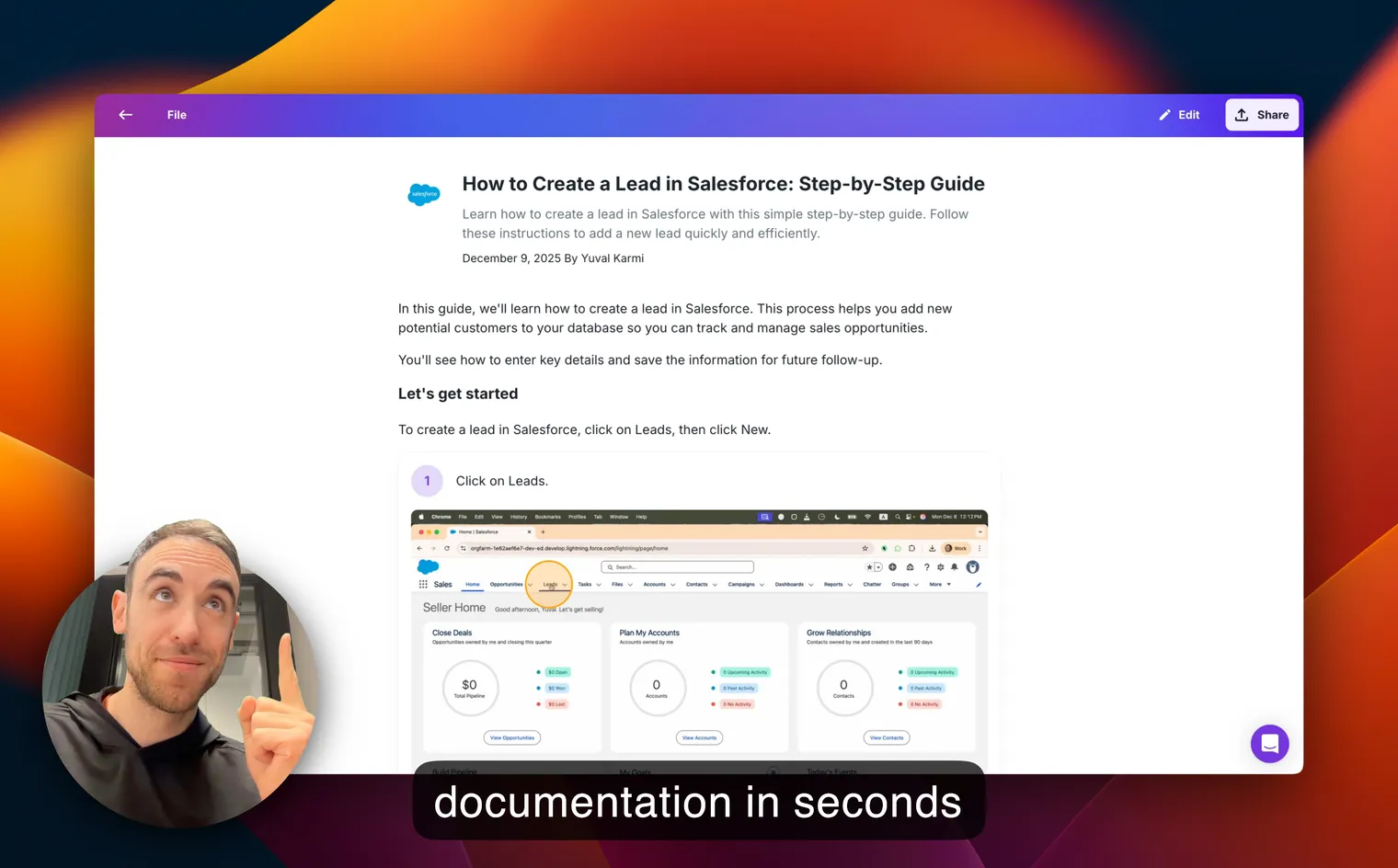
Teach your co-workers or customers how to get stuff done – in seconds.

When Your Kloudville Expert Leaves, B2B Order Management Falls Apart
I see this pattern all the time. A company runs its whole wholesale operation through Kloudville. Orders flow in, invoices go out, product catalogs get updated, pricing tiers get adjusted for different customer segments. It works because one or two people know exactly how to do everything.
Then one of them leaves.
Suddenly the team is fumbling through screens they’ve never navigated on their own. Orders that used to take three minutes now take twenty. Someone accidentally applies the wrong pricing tier to a bulk order and nobody catches it until the invoice goes out. A customer account gets set up wrong, and their portal starts showing the wrong product catalog.
This is tribal knowledge at its most damaging. Not the abstract version you read about in management books – the practical kind that costs you real money and real relationships every time someone walks out the door.
Why Niche Wholesale Order Management Platforms Create Bigger Knowledge Gaps
Enterprise tools like Salesforce or HubSpot have armies of trainers, certification programs, and thousands of YouTube tutorials. Niche platforms like Kloudville don’t have that ecosystem. The documentation that does exist tends to cover features at a high level – here’s what the product catalog does, here’s where orders live – but it won’t tell you how your company uses those features.
That gap is where all the problems hide. Your team doesn’t need to know what Kloudville ERP can do. They need to know how your company uses Kloudville. Completely different things.
The hidden cost of undocumented processes gets amplified with niche platforms because there’s no external resource to fall back on. When your Kloudville expert quits, you can’t just Google the answer. The answer is specific to your setup, your pricing rules, your customer segments.
Why Traditional Documentation Fails for Kloudville Training
Let me save you some time by running through what doesn’t work.
Written Procedures Miss the Visual Context
Kloudville ERP’s interface has a lot going on. Order forms with dozens of fields. Product catalog views with filtering and sorting options. Pricing configuration screens with nested rules and tiers. You can write “navigate to the pricing module and select the customer tier” – but which of the three pricing-related menu items is the right one? What does “customer tier” actually look like in the interface? Where exactly do you click?
Written steps fall apart when the interface is complex. And in B2B order management, the interface is always complex.
Screenshots Go Stale
Screenshots are better than pure text, sure. But Kloudville updates its interface, your company changes its configuration, and suddenly those annotated screenshots don’t match what’s on screen anymore. Your new hire stares at the guide, stares at their screen, and the two don’t line up. Trust in the whole document falls apart.
Creating screenshot-based documentation is also painfully slow. You’re bouncing between Kloudville, your screenshot tool, and your document editor. Adding annotations. Formatting. It takes hours for a single workflow, which means it almost never gets updated.
Shoulder-Tap Training Doesn’t Scale
The most effective way to train someone on Kloudville is to sit next to them and walk through it. But your operations team is busy processing orders. They don’t have two hours to give every new hire a personal tour. And even when they do, the new hire forgets half of it by the next day because they were trying to absorb too much at once.
Record It Once, Train Everyone After
Here’s what actually works. Instead of choosing between video, screenshots, or written instructions, use all three – generated from a single recording.
With Glitter, you open Kloudville, hit record, and walk through a workflow while talking through what you’re doing. Just like you’d explain it to a colleague sitting next to you. When you stop, Glitter produces a complete training guide: the video recording, annotated screenshots of each key step, and written instructions. All from that one take.
No screenshot tools. No document formatting. No re-creating guides when the interface changes. You just do the process while explaining it, and the guide builds itself.
Having built Glitter, I’ve watched our best teams document 5+ different operational workflows. The ones who stick aren’t creating a single guide – they’re building an entire knowledge base, the same habit that pays off when documenting platforms like eBay seller workflows.
This approach works particularly well for Kloudville training because wholesale order management is inherently visual and sequential. You need to see the order form to understand it. You need to watch someone configure a pricing tier to grasp how the rules interact. Reading about it just doesn’t cut it.
The Kloudville Training Workflows You Should Document First
Don’t try to document everything at once. Start with the wholesale order management workflows that hurt the most when someone doesn’t know them.
1. Entering Wholesale Orders
This is the bread and butter. Every day, your team enters orders in Kloudville – selecting customers, adding products, applying the right pricing, confirming quantities, and submitting. Each step has nuances that only your experienced people know.
Record your best order entry person walking through a complete wholesale order from start to finish. Have them narrate their thinking: “I always double-check the customer’s payment terms here because some accounts are net-30 and others are net-60” or “This product has a minimum order quantity, so I check the total before adding it.”
Those spoken cues capture the judgment calls that never make it into written SOPs. They’re what separates a guide that technically covers the steps from one that actually prevents mistakes.
2. Managing Customer Accounts
Kloudville lets you manage the full customer lifecycle – creating accounts, setting up contacts and locations, configuring account-specific pricing and payment terms. Getting this wrong ripples through everything downstream. A misconfigured account means wrong prices on orders, wrong payment terms on invoices, and frustrated customers.
Record the process for setting up a new customer account from scratch. Show how to enter company details, add contacts, assign locations, and configure the account’s pricing tier. Then create a separate guide for modifying existing accounts – because the “edit” flow is often quite different from the “create” flow.
3. Configuring Pricing Tiers
Pricing in wholesale is rarely simple. You’ve got tiered pricing, volume discounts, customer-specific rates, contract pricing, and promotional pricing all layered on top of each other. Kloudville supports these structures, but configuring them correctly requires knowing both the platform and your company’s pricing strategy.
This is a prime candidate for visual work instructions. You really can’t explain nested pricing rules with text alone. Your team needs to see the configuration screen, watch someone build a pricing tier step by step, and understand how the rules interact.
4. Processing Bulk Orders
Bulk orders are where things get complicated. Multi-line orders with dozens of SKUs, split shipments to multiple locations, special handling for high-value items. Kloudville supports bulk order import and multi-location fulfillment, but the workflow for getting a complex bulk order right – from initial entry through confirmation – involves steps that your experienced people do without even thinking about it.
Record the full bulk order workflow. Show how to import order data, validate line items, handle exceptions (out-of-stock items, discontinued products), and confirm the order. Cover the edge cases your team runs into regularly.
5. Handling Order Modifications
Orders change. Customers call to add items, reduce quantities, swap products, or change delivery dates. Modifying an order in Kloudville after it’s been submitted is different from creating one from scratch, and the consequences of getting it wrong are real – you might ship the wrong quantity or miss a pricing adjustment.
Document the modification workflow end to end. Show how to locate the original order, make changes, recalculate pricing, and confirm the updates. Include the common gotchas your team has learned the hard way.
Start documenting workflows today
6. Generating Invoices
Invoicing in wholesale goes beyond pressing a “generate invoice” button. You need to verify that the order details are correct, that the right pricing was applied, that payment terms match the customer agreement, and that tax calculations are accurate. Kloudville handles invoice generation, but your team’s process for reviewing and sending invoices probably involves steps outside the platform too.
Record the complete invoice workflow – from pulling up the fulfilled order to generating the invoice, reviewing it, and sending it to the customer. Include any cross-checks your team does against the order or the customer account.
7. Managing Product Catalogs
Your product catalog in Kloudville is the foundation of everything else. Product data, images, descriptions, SKUs, pricing, categories – it all lives here. When the catalog is messy, everything downstream suffers. Orders reference wrong products. Pricing calculations break. Reports show inaccurate data.
Document how to add new products, update existing listings, manage categories, and handle discontinued items. This is a workflow where a clear training walkthrough makes a huge difference because the catalog management interface is typically dense and hard to navigate.
8. Running Order Reports
Kloudville includes reporting features for tracking order volume, analyzing sales by customer or product, monitoring fulfillment status, and spotting trends. But most teams only use a fraction of the available reports because nobody showed them what’s there or how to read the data.
Record your most experienced person walking through the reports they pull weekly or monthly. Show how to set filters, select date ranges, segment by customer or product category, and export the data. Explain what each report tells you and what actions you’d take based on the results.
Structuring Your Kloudville ERP Training Program
Creating guides is step one. Organizing them so people can actually find and use them is step two.
Organize by Role
Don’t organize your Kloudville ERP training by feature. Organize it by role. Your order entry clerks need different guides than your operations managers, who need different guides than your sales coordinators.
An order entry clerk’s training path might look like: entering orders, handling modifications, processing bulk orders. A sales coordinator’s path: managing customer accounts, configuring pricing, running reports. An operations manager’s path: all of the above, plus catalog management and invoice workflows.
This follows what we know about training employees effectively and keeps each person focused on what they actually need to know.
Layer Complexity
Start each workflow with the happy path – a straightforward order, a simple customer account, a basic pricing tier. Then create follow-up guides for edge cases. How to handle a return. What to do when a product is discontinued mid-order. How to apply a one-time promotional discount.
New hires get productive quickly this way, and they still have resources for the complicated situations when those come up.
Make Guides Findable
If your guides are buried in a shared drive folder or scattered across Slack threads, they won’t get used. Build a central knowledge base where everything is organized, searchable, and always accessible. The teams that train employees faster with documentation are the ones that built a system – not just a folder of files.
Why Multiformat Guides Win
I want to make a direct case for combining video, screenshots, and written steps in every training guide. Not as a nice-to-have – as a fundamental approach.
People learn differently. Some of your team members want to watch the video to get the overall flow. Others prefer to scan written steps and only look at screenshots when they’re stuck. Most people use a mix – they watch the video first, then follow the written steps when they do it themselves.
When you record a Kloudville walkthrough with Glitter, you get all three from one recording:
- The video captures the complete flow, including mouse movements, timing, and your verbal explanations of why you’re doing each step
- The annotated screenshots show each key moment with highlights on exactly where to click
- The written steps give your team a scannable reference they can follow alongside Kloudville
And here’s the practical upside: when Kloudville updates its interface or your company changes a configuration, you re-record the affected workflow. One recording, five minutes, and all three formats update at once. Compare that to manually revising a 20-page document with 40 screenshots.
Getting Started This Week
You don’t need a documentation project or a committee. Here’s a simple plan:
Day 1: Pick the one Kloudville workflow your team asks about most. It’s probably entering wholesale orders or managing customer accounts. Record yourself walking through it. Talk naturally, like you’re showing someone next to you. Use Glitter to generate the guide.
Day 2-3: Share the guide with your team. Ask what’s missing. Are there edge cases you skipped? Steps that need more explanation? Update it.
Week 2: Record two more workflows. Prioritize the ones that trip up new hires or cause the most errors.
Month 1: You should have 5-8 core Kloudville guides covering your critical workflows. Organize them by role, put them in a central location, and point every new hire to them on day one.
That’s the whole strategy. No grand plan. No training committee. Just one workflow at a time, recorded by the people who know it best.
The teams I’ve seen transform their wholesale operations didn’t start with some big documentation initiative. They started because someone was tired of explaining the same order entry process for the fourth time. They recorded it once. And then they never had to explain it again.
Frequently Asked Questions
How long does Kloudville training take with Glitter?
Most Kloudville workflows take 5-15 minutes to record, depending on complexity. Glitter automatically generates the full guide -- video, annotated screenshots, and written steps -- from that single recording. Compare that to the hours it takes to build traditional documentation by hand.
Do I need to be a Kloudville expert to create training guides?
You should be comfortable with the workflow you're recording, but you don't need to be a platform expert. Some of the best training guides come from people who learned the process recently, because they naturally explain the confusing parts more clearly.
What Kloudville ERP workflows should I document first?
Start with the wholesale order management workflows that generate the most questions: order entry, customer account setup, pricing tier configuration, and bulk order processing. These are the daily operations where mistakes are most costly and where new hires struggle the most.
How do I keep Kloudville training guides updated when the platform changes?
With Glitter, you just re-record the affected workflow. One new recording regenerates the entire guide with updated video, screenshots, and written steps. This takes minutes instead of the hours needed to manually update traditional documentation.
Can I create Kloudville training guides for pricing configuration?
Yes, and pricing configuration is one of the best use cases for visual B2B order management training guides. Tiered pricing, volume discounts, and customer-specific rates involve nested rules that are nearly impossible to explain with text alone. A recorded walkthrough shows exactly how the pricing layers interact.
How should I organize Kloudville training guides for different roles?
Group guides by role rather than by Kloudville feature. Order entry clerks, sales coordinators, and operations managers each need different workflows. Create role-based training paths so new hires only see what's relevant to their job.
What if my team members learn differently?
That's exactly why multiformat guides work best. Glitter generates video, annotated screenshots, and written steps from a single recording. Visual learners watch the video. Readers scan the written steps. Most people use a combination depending on the situation.
How do I train remote team members on Kloudville?
Recorded training guides eliminate the need to schedule live screen-share sessions across time zones. You create the guide once and share it. Team members can watch, pause, rewind, and reference the written steps at their own pace, wherever they are.
Should I document Kloudville ERP's reporting features?
Absolutely. Reporting is one of the most underutilized areas in Kloudville because teams don't know what reports are available or how to read them. Record your most experienced person walking through the reports they run regularly, explaining what each one shows and what actions to take.
How many Kloudville training guides does a typical wholesale team need?
Most wholesale teams need 8-15 core guides covering daily operations: order entry, customer accounts, pricing configuration, bulk orders, order modifications, invoicing, product catalogs, and reporting. Start with 3-5 covering your highest-impact processes and build from there.