
Read summarized version with
If you manage a retail store or restaurant running Clover POS, you know the pattern. Somebody quits, a new person starts, and suddenly you’re spending two weeks joined at the hip explaining how to process a refund, run end-of-day settlement, or configure a discount that doesn’t accidentally apply to everything in the store.
I’m Yuval, founder of Glitter AI. Through building a tool that helps teams create training guides from screen recordings, I’ve talked to dozens of Clover POS teams who all describe the same problem. The software itself is never the issue. Clover POS is actually pretty intuitive once you get the hang of it. The real problem is getting knowledge out of one person’s head and into everyone else’s.
That’s what this post is about. Not some generic “here’s how Clover works” walkthrough, but a practical framework for building Clover training that survives turnover, covers the workflows that actually matter, and doesn’t require you to moonlight as a technical writer.
Teach your co-workers or customers how to get stuff done – in seconds.

The Real Cost of Skipping Clover POS Training
Every retail store and restaurant has a Sarah. She’s the one who knows how to fix a stuck payment, override a discount, and pull the exact report the owner needs every Monday morning. She taught herself through trial and error over months. Everyone goes to her with questions.
Then Sarah leaves. Or takes a week off. And everything falls apart.
This is tribal knowledge in action — the critical know-how that lives in one person’s head and nowhere else. In retail and food service, the problem hits harder than in most industries because turnover is relentless. The Bureau of Labor Statistics puts annual turnover in retail around 60%. Restaurants? Even higher.
Every time someone walks out the door, they take their Clover POS knowledge with them. Every replacement you hire means starting Clover employee training from zero.
What This Actually Costs You
Let’s put numbers on it. Your shift lead spends 10 hours over two weeks training a new cashier on Clover. That’s 10 hours they’re not managing the floor, dealing with customer issues, or doing the work you’re actually paying them for. Multiply that by four or five new hires a year, and you’ve burned 40-50 hours of your best people’s time just on POS training.
And that’s the optimistic version — the one where the new hire actually retains everything. In practice, they’ll circle back with questions for weeks. “How do I void a transaction?” “Where’s the split payment button?” “The customer wants a refund on a different card than the one they paid with — what do I do?”
The hidden cost of undocumented processes goes beyond time. It’s mistakes. Wrong refunds. Missed settlements. Incorrect tip calculations. Each one costs real money and chips away at customer trust.
Why Traditional Clover POS Training Doesn’t Stick
I’ve talked to many operations managers at this point. Most have tried some version of the approaches below, and most have been let down.
Clover POS Built-In Help Is Too Generic
Clover provides documentation and webinar-style training resources. These are fine for understanding what Clover can do broadly. But they don’t know your store. They don’t know you run happy hour pricing from 4-6 on weekdays, or that your refund policy requires a manager override for anything over $50, or that your closing process includes a manual cash count before settlement.
The gap between “how Clover POS works” and “how we use Clover” is where all the training pain lives.
Written Checklists Get Ignored
I’ve seen stores with laminated checklists taped next to every register. Steps like “Press the Refund button” and “Enter the transaction amount.” But they don’t show which Refund button — there are multiple paths depending on your Clover setup. They don’t show what the screen looks like at each step, so the new cashier is constantly guessing whether they’re even in the right place.
Written instructions assume the reader can translate words into what they see on screen. With a POS system, that translation is trickier than it sounds.
Shadowing Burns Out Your Best People
The most common approach is having new hires shadow an experienced employee for Clover employee training. It works in the moment. But it doesn’t scale, it’s not repeatable, and it yanks your strongest team members away from their actual responsibilities. Over time, your best people get tired of being the unofficial Clover POS instructor. Some of them leave because of it.
A Better Approach: Record It, Share It, Move On
Here’s what I’ve seen from teams that actually crack this problem. They stop picking between video OR screenshots OR written steps. They use all three.
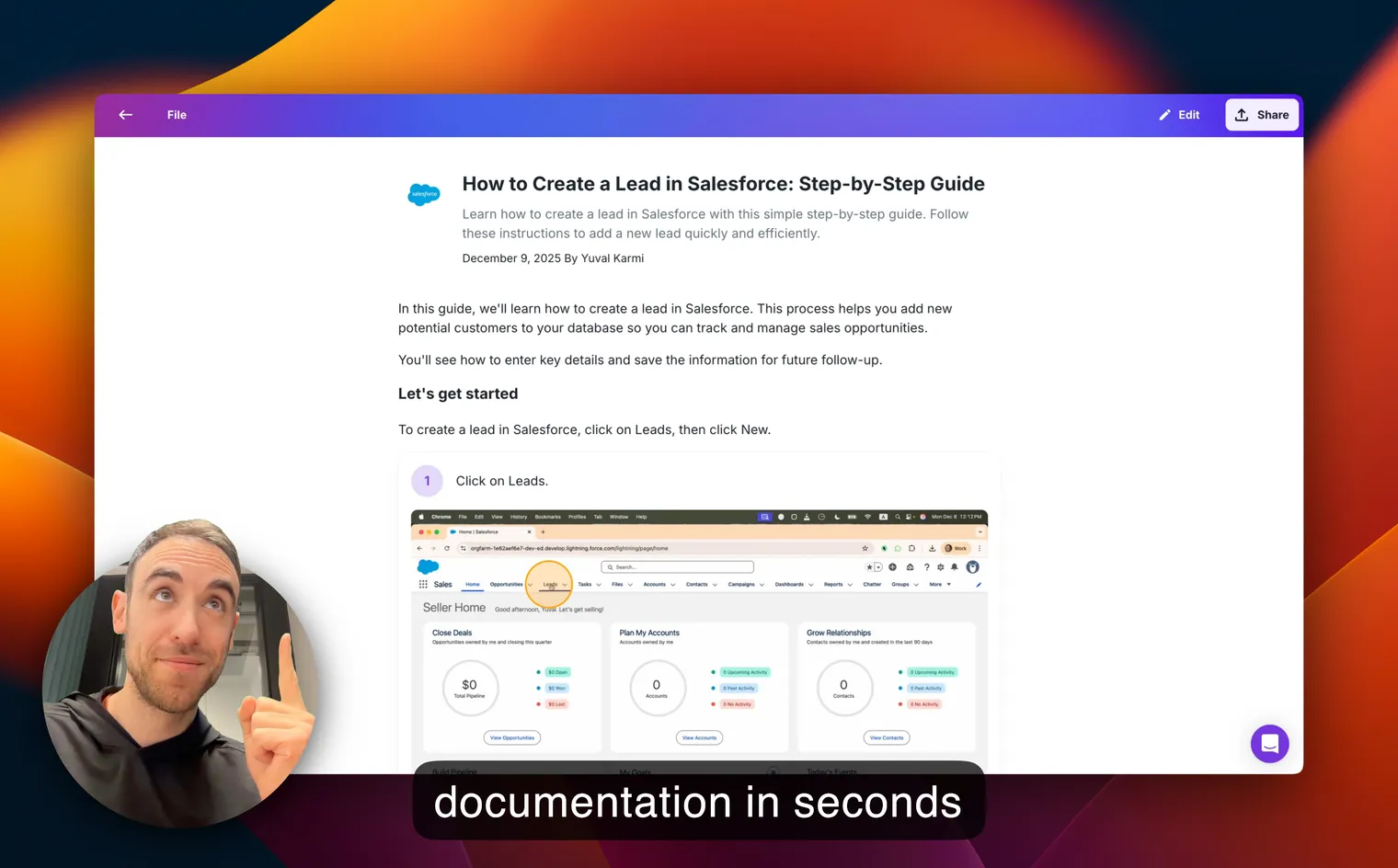
With Glitter, you record your screen while walking through a workflow in Clover POS. You talk through what you’re doing as you go — naturally, like you’re showing a coworker. When you stop recording, Glitter generates a complete training guide: the video, annotated screenshots of every key step, and written instructions. All from that one recording.
No bouncing between apps. No formatting a Google Doc. No taking 30 screenshots and labeling them one by one. You just do the thing while explaining it, and the guide builds itself.
As someone who built Glitter, I’ve watched our best teams use it to document 5+ different operational workflows. The ones who stick aren’t creating one guide — they’re building an entire knowledge base for how their company runs, the same pattern that works for documenting niche tools like Caselle Connect.
For Clover specifically, this approach is a natural fit. POS workflows are visual and sequential. You press this, then this, then that. What’s on screen at each step is critical context. A recording captures all of that without any extra effort.
The Clover POS Workflows You Should Document First
Don’t try to cover everything in a weekend. Start with the workflows that generate the most questions, cause the most mistakes, and create the most anxiety for new hires. Here’s my priority list.
1. Processing Sales and Accepting Payments
This is the bread and butter. Every team member who touches a register needs to know how to ring up a sale in Clover POS — selecting items, applying modifiers, handling different payment types (credit, debit, cash, contactless), splitting payments, and processing mobile wallet transactions like Apple Pay and Google Pay.
Record your fastest, most accurate cashier walking through a few different sale scenarios. Have them talk through the nuances: “When someone pays with two cards, here’s how I split it.” “If the contactless reader doesn’t pick up, switch to chip and tell them to leave the card in until the screen changes.” These little details matter a lot and they almost never make it into written docs.
2. Handling Refunds and Voids
This is where new employees freeze up. Refunds and voids have different rules, different steps, and different implications. A void cancels a transaction before it settles. A refund processes after settlement. Mix them up and you’ve got accounting headaches.
Document the exact flow for each: how to void a current-day transaction, how to process a refund on a settled transaction, how to handle partial refunds, and what to do when the original payment card isn’t available. Include your store’s specific policies — who can approve refunds, what the dollar thresholds are, and where to find the original transaction.
3. End-of-Day Settlement and Closing
Settlement is the workflow that makes new shift leads most nervous. It involves batching out the day’s transactions, reconciling the cash drawer, printing settlement reports, and making sure everything balances. Skip a step and your books are off.
This is a strong candidate for a visual work instruction because the sequence matters and each screen looks different. Record the full end-of-day process, including what to check if the numbers don’t match. Your experienced closers have a mental checklist of “things that go wrong” — get those into the recording.
4. Managing Tips
If you’re in food service, tip management in Clover is something every server and manager needs to understand. This covers adjusting tips on credit card transactions, handling tip pooling, configuring suggested tip percentages, and making sure tip reports are accurate for payroll.
Record two versions: one for servers (how to adjust tips on their orders) and one for managers (how to run tip reports, verify totals, and handle disputes). Tips are money, and mistakes here affect your team’s paychecks. Nobody forgets a training failure that hits their wallet.
Start documenting workflows today
5. Clover POS Inventory Management
Clover POS inventory management tools let you track stock in real time, set low-stock alerts, manage variants (sizes, colors), and update quantities. But most teams underuse these features because the setup feels intimidating and nobody ever walked them through the full workflow.
Record the day-to-day inventory tasks your team handles: receiving new stock, adjusting counts after a physical inventory, setting up a new product with variants, and checking stock levels. If you use Clover’s integration with an external inventory system, document the sync process and what to do when it breaks.
6. Clover Employee Training on Permissions and Access Levels
Clover POS lets you set role-based permissions — who can process refunds, who can access reports, who can modify inventory. Getting this right is a security and accountability issue. Getting it wrong means a new hire accidentally voids a $500 transaction or sees financial data they shouldn’t have access to.
Document how to set up a new employee account, assign the correct role, configure permissions, and handle clock-in/clock-out. This guide is mainly for your managers, but it’s one they’ll come back to constantly as your team changes.
7. Running Reports
Clover POS has solid reporting — sales summaries, tax reports, employee performance, inventory reports, and more. But most managers only know how to pull one or two reports because that’s all anyone ever showed them.
Record your most analytical manager walking through the five or six reports they pull regularly. Have them explain not just which buttons to press, but what the numbers actually mean and how they act on them. “I pull this report every Monday to see which items aren’t moving, and then I rearrange the floor layout.” That kind of context turns a tutorial into real training.
8. Setting Up Discounts and Promotions
Whether it’s a seasonal sale, a loyalty discount, or an employee discount, Clover’s promotion tools need specific setup to work correctly. Misconfigured discounts are one of the most common and expensive mistakes in retail — a 20% discount that accidentally applies to your entire catalog can destroy a day’s margins.
Document how to create a new discount, set the conditions (specific items, time-based, customer-based), test it before going live, and deactivate it when the promotion ends.
9. Configuring Menu Items (Restaurants)
If you’re running Clover Dining, your menu configuration directly affects the ordering experience. Items, modifiers, option groups, pricing, and display order all need to be set up correctly. When a new seasonal menu drops and nobody knows how to update it in Clover, things get messy fast.
Record the full process: adding a new menu item, setting up modifier groups (size, temperature, add-ons), configuring pricing, and organizing the display. This is a workflow where screenshots are especially helpful because the configuration screens are dense.
How to Structure Your Clover POS Training Program
Creating the guides is step one. Organizing them so people actually use them is step two.
Organize by Role
A cashier needs different training than a shift lead, who needs different training than a general manager. Don’t dump 15 guides on a new hire and say “watch all of these.” Build role-based paths instead.
Cashier path: Processing sales, handling returns, cash drawer basics, calling a manager for overrides.
Shift lead path: Everything a cashier knows, plus end-of-day settlement, tip management, basic reporting, and handling common problems.
Manager path: Employee setup and permissions, full reporting suite, inventory management, discount configuration, and troubleshooting.
When you organize training by role, new hires only see what’s relevant to them. This follows employee training best practices and keeps people from feeling overwhelmed on day one.
Layer Complexity
Start each workflow with the simple, happy-path version. A basic sale. A straightforward refund. A standard closing process. Then create separate guides for the edge cases: split payments, partial refunds, settlement errors.
New hires get productive fast with the basics, and they have somewhere to turn when something unusual pops up. This is how you train employees faster with documentation — you don’t front-load everything, you make information available when it’s needed.
Put Everything in One Place
If your training guides are scattered across Google Drive, Slack messages, and someone’s personal Notion, they won’t get used. Build a central knowledge base. Make it searchable. Make sure every team member knows where it is and how to find things.
The teams that get the most value from their training documentation are the ones that treat it as a living system, not a one-time project.
Why Video + Screenshots + Written Steps Work Better Together
I want to make the case for multiformat training here, because it matters more than most people think.
People learn differently. Some of your team members need to watch the video to understand the flow. Others want to scan the written steps and jump right in. Most will do both — watch the video first, then reference the steps while they work through it on their own.
When you record a Clover POS walkthrough with Glitter, you get all three formats from one recording:
- The video shows the complete flow — mouse movements, timing, your verbal explanations of why you’re doing what you’re doing
- The annotated screenshots capture each step with visual highlights showing exactly where to tap or click
- The written steps give your team a scannable reference they can follow alongside their own Clover screen
This isn’t about finding the “best” format. It’s about giving every person on your team the format that clicks for them. And when Clover pushes an update that moves a button or changes a screen, you just re-record the affected workflow. One recording, five minutes, all three formats updated at once.
Compare that to manually updating a 20-page document with new screenshots and rewritten descriptions. It just doesn’t happen. And that’s how documentation goes stale and people stop trusting it.
Getting Started This Week
Here’s my practical advice. Don’t form a training committee. Don’t schedule a documentation sprint. Just start.
Today: Pick the one Clover POS workflow your team asks about most. It’s probably processing refunds or end-of-day settlement. Record yourself or your most experienced team member walking through it. Use Glitter to generate the guide.
This week: Share the guide with your team. Ask: “Is anything missing? What would have helped you when you were learning this?” Refine it based on their feedback.
Next week: Record two more workflows. Pick the ones that new hires struggle with most.
By end of month: You should have 6-8 core Clover POS training guides organized by role. Put them somewhere central and accessible, and point every new hire to them on day one.
That’s the whole plan. One workflow at a time. Recorded naturally by the people who know it best.
The operations managers I talk to who’ve built this habit tell me the same thing: the first guide saves them from one repetitive conversation. By the tenth guide, they’ve fundamentally changed how their team runs. They’re not putting out fires anymore. They’re actually managing.
Frequently Asked Questions
How long does it take to create a Clover POS training guide with Glitter?
Most Clover POS workflows take 5-15 minutes to record, depending on complexity. A simple sales transaction might take 5 minutes, while a full end-of-day settlement walkthrough might take 12-15. Glitter generates the complete guide -- video, annotated screenshots, and written steps -- automatically from that single recording.
Do I need to be a Clover expert to create training guides?
You should be comfortable with the workflow you're recording, but you don't need to know every Clover feature. In fact, people who learned a process recently often create the best guides because they remember what was confusing and naturally explain those parts more clearly.
What Clover POS workflows should I document first?
Start with the workflows that generate the most questions: processing sales and payments, handling refunds and voids, and end-of-day settlement. These are the daily tasks where mistakes are most costly and where new hires feel the most pressure.
How do I keep Clover POS training guides updated when the system changes?
With Glitter, you simply re-record the affected workflow. One new recording regenerates the entire guide with updated video, screenshots, and written steps. This takes minutes instead of the hours required to manually update traditional documentation with new screenshots and rewritten instructions.
Can I create different training guides for different Clover hardware devices?
Yes, and you should. The workflow on a Clover Station Duo looks different from a Clover Flex or Clover Mini. If your team uses multiple devices, record separate guides for each one so employees see exactly the screens they'll encounter on the hardware they use.
How should I organize Clover training guides for a restaurant team?
Organize by role: servers need payment processing and tip adjustments, hosts might need table management, kitchen staff need order display workflows, and managers need settlement, reporting, and configuration guides. Role-based organization means each person sees only what's relevant to their job.
What if my team members learn differently -- some prefer video, others prefer reading?
That's exactly why multiformat guides work. Glitter generates video, annotated screenshots, and written steps from a single recording. Visual learners watch the video. Readers scan the written steps. Most people use a combination of both depending on the situation.
How do I handle Clover training for multiple store locations?
Create a core set of guides that cover standard workflows shared across all locations, then record location-specific guides for any processes that differ -- like different closing procedures or inventory workflows. A centralized knowledge base ensures every location has access to the same training materials.
Should I document Clover POS reporting and analytics features?
Absolutely. Reporting is one of the most underutilized Clover POS features because managers only learn the one or two reports they were shown during initial setup. Record your most analytical team member walking through the reports they pull regularly and explaining what each tells them and how they act on it.
How many Clover POS training guides does a typical team need?
Most retail or restaurant teams need 10-15 core Clover POS guides covering daily operations: sales processing, refunds, settlement, tips, inventory, employee management, reporting, and role-specific workflows. Start with 3-5 covering your highest-pain processes and build from there over a few weeks.