

Read summarized version with
If you’re figuring out how to train your team on eBay seller operations, let me be straight with you: being an eBay seller is one of those things that’s incredibly hard to hand off to another person. It’s not that the individual features are all that complicated. It’s that every eBay seller builds their own system over time. Their own workarounds. Their own “I just know where that setting is” muscle memory.
Then that person leaves. Or takes a vacation. Or gets promoted. And whoever replaces them is staring at the eBay Seller Hub like it’s the cockpit of a 747.
I’m Yuval, founder of Glitter AI. Through building a tool that helps teams create training guides from screen recordings, I’ve talked to dozens of eBay seller teams who all describe the same problem. Proper eBay seller training is a big part of why I built Glitter.
The eBay Seller Tribal Knowledge Problem
Every eBay seller operation I’ve talked to has the same basic structure: one or two people who genuinely know how to run things, and everyone else sort of following along. The experts know which listing templates actually convert. They know the exact sequence for filing a shipping claim. They remember that one obscure setting buried in the Business Policies page that took three hours to track down six months ago.
That’s tribal knowledge. And it’s probably the single biggest risk in marketplace operations.
This isn’t only about someone quitting. It’s vacations, sick days, role changes, and the plain fact that people forget things. I talked to an eBay seller last month who lost $8,000 in a single week because their returns specialist was out sick and nobody else knew the right process for handling eBay Money Back Guarantee cases. The rest of the team was issuing full refunds on items that should have been partial. They were accepting returns outside the window. Total mess.
The hidden cost of undocumented processes in e-commerce is staggering. With eBay specifically, though, the cost compounds because the platform actively punishes you for mistakes. Late shipments hurt your seller metrics. Mishandled cases tank your defect rate. And a bad defect rate means losing Top Rated Seller status, which translates to higher fees and lower visibility.
The stakes are real.
Teach your co-workers or customers how to get stuff done – in seconds.

Why Traditional Docs Fail for the eBay Seller Dashboard
I’ve seen teams try to document eBay seller workflows in Google Docs or Notion. They screenshot the eBay seller dashboard, paste it in, write “Click here, then here, then here,” and consider it done.
Then three things happen:
First, eBay updates their interface. They do this all the time. The screenshots go stale, and nobody bothers updating them because it took an hour to capture them all in the first place.
Second, the docs miss context. eBay’s interface is deeply layered. You click into an order, which opens a panel, which has tabs, which have sub-sections. A flat screenshot doesn’t convey the navigation flow. The new person clicks around, gets lost, and ends up walking over to someone’s desk to ask anyway.
Third, edge cases never make it into the doc. How do you handle a return request where the buyer selected “doesn’t match description” but the item is clearly as described? What about when a tracking number shows delivered but the buyer says they never got it? These situations require judgment, and judgment only gets transferred through explanation, not bullet points.
Traditional training documentation works well enough for straightforward tools. The eBay Seller Hub isn’t one of those. It’s a complex, multi-layered platform where context matters at every step.
How Glitter Fixes This
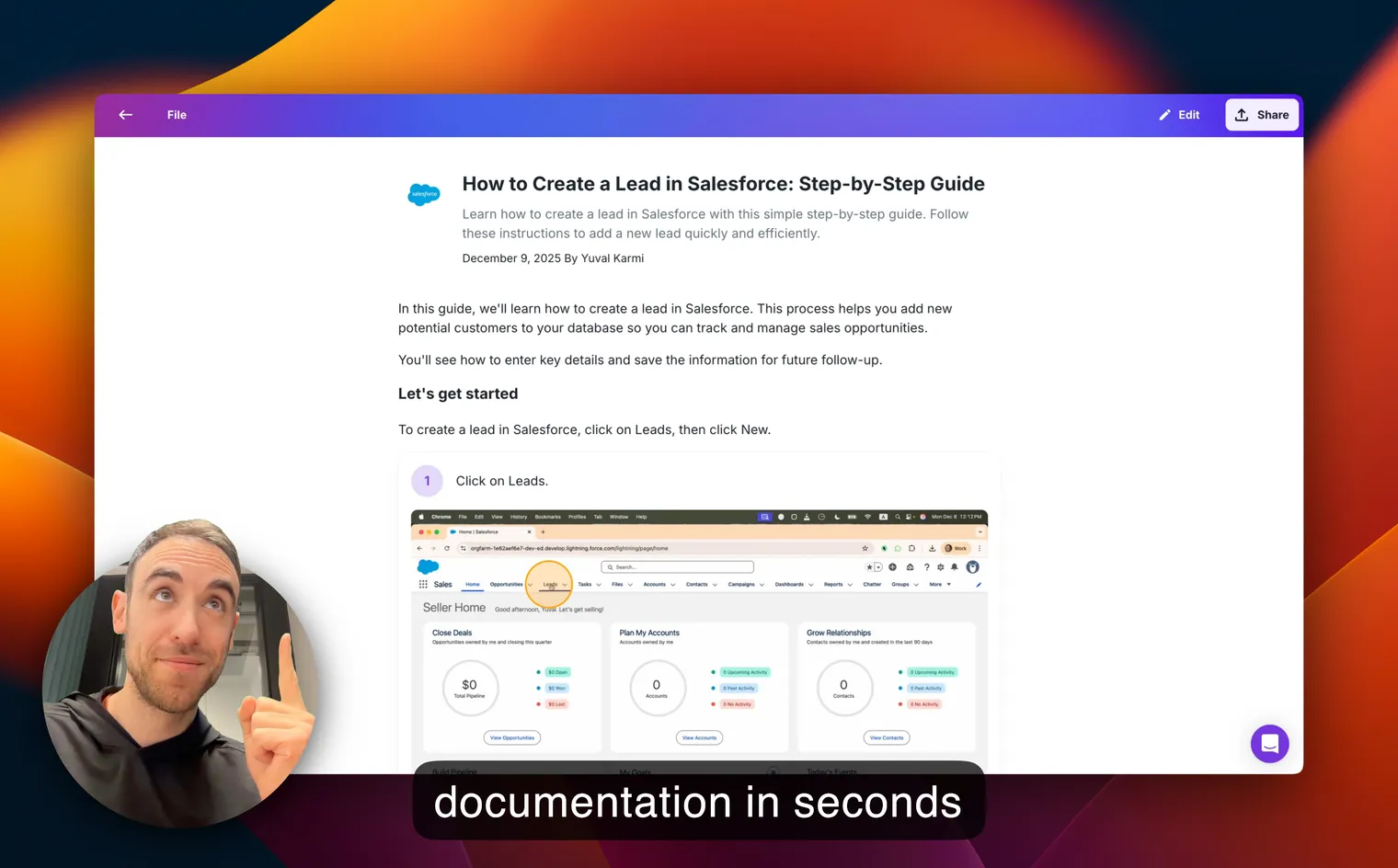
Here’s what Glitter does in plain terms: you record your screen while talking through a workflow, and Glitter generates a complete training guide with video, annotated screenshots, and written steps.
No writing. No screenshot-taking. No formatting. You just do the task the way you normally would, explain what you’re doing as you go, and the guide builds itself.
For eBay operations specifically, this changes things because:
- You capture the navigation flow. The video shows exactly how to get from point A to point B through eBay’s nested menus and panels.
- You capture the reasoning. When you talk through why you’re selecting a specific option or checking a particular field, that context becomes part of the guide.
- Screenshots land at exactly the right moments. Glitter identifies each meaningful action and captures an annotated screenshot, so the visual reference points stay relevant.
- Updating is easy. When eBay changes something, just re-record that workflow. Five minutes and you’re done.
The process itself is simple:
- Open Glitter and start recording
- Navigate to the eBay workflow you want to document
- Talk through each step naturally: “I’m going into Seller Hub, clicking on Orders, filtering by awaiting shipment…”
- Complete the workflow as you normally would
- Stop recording, and Glitter generates the complete guide
That’s it. What used to take a full afternoon of writing and screenshotting now takes as long as doing the task once.
Record your screen, talk through the process, and Glitter creates a complete training guide with video, screenshots, and written steps.
The eBay Seller Workflows You Need to Document
After talking with dozens of eBay seller teams, here are the workflows that cause the most chaos when they’re undocumented. Start with these.
1. Creating and Optimizing Listings
This is where most eBay seller operations spend the bulk of their time, and where consistency matters most. Your team needs to know:
- Your listing template: which fields to fill in, what format to use for titles, your keyword strategy
- Item specifics standards: eBay keeps adding required specifics, and they vary by category. Getting these wrong hurts search visibility
- Photo requirements: your standards for image size, background, angles, and the order photos should appear
- Pricing strategy: how you research comparable listings, when to use auction vs. fixed price, how to set Best Offer ranges
- Category selection: eBay’s category tree is enormous, and picking the wrong one buries your listing
Every experienced eBay seller has a system for all of this in their Seller Hub. The trouble is that system lives entirely in their head. A new hire following eBay’s default listing flow will produce wildly inconsistent listings that don’t match your store’s standards.
2. Processing Orders and Fulfillment
The Orders tab in Seller Hub is where operational speed matters most. Late shipments directly impact your seller metrics. Document:
- Daily order review process: how to check for new orders, verify payment, flag issues
- Printing shipping labels: your preferred carrier, service levels, package dimensions presets
- Handling combined shipping: when a buyer purchases multiple items and you need to ship together
- Uploading tracking numbers: where and when to enter them, what to do if a tracking number is wrong
- Managing handling time: how to stay within your stated handling time, what to do when you can’t
This is the workflow where mistakes are most visible to buyers. A late shipment triggers a defect. A wrong tracking number triggers a worried buyer message. Both are preventable with clear documentation.
3. Handling Returns and Refunds
Returns on eBay are emotionally charged and financially risky. There’s a right way and a wrong way to handle them, and the difference often amounts to thousands of dollars a month.
- Evaluating return requests: when to accept immediately vs. when to respond with more information
- Processing different refund types: full refunds, partial refunds, and when each is appropriate
- Restocking returned items: inspecting condition, updating inventory, relisting if appropriate
- Handling “Item Not As Described” claims: your response strategy, when to escalate, when to accept
- Return shipping labels: when you’re required to provide them vs. when the buyer pays
This is the workflow with the most edge cases, which makes it the one most likely to be handled inconsistently without documentation. It’s also where visual work instructions make the biggest difference, because the eBay return interface branches into multiple paths depending on the situation.
4. Responding to Buyer Messages
Buyer communication directly affects your seller rating. eBay tracks response time, and buyers who don’t hear back quickly tend to open cases.
- Response time standards: your team’s internal SLA for reply speed
- Common message templates: pre-written responses for frequent questions
- Escalation rules: which messages can be handled by anyone and which need a senior team member
- Offer and counteroffer handling: how to respond to Best Offer messages strategically
- Post-sale follow-up: whether and how you message buyers after delivery
5. Managing Promotions and Marketing
Seller Hub’s marketing tools are powerful but easy to misconfigure. Promoted Listings, Markdown Sales, Volume Pricing, and Codeless Coupons each have their own setup flow.
- Setting up Promoted Listings Standard: choosing ad rate percentages, selecting which listings to promote
- Creating markdown sales: scheduling sale events, setting discount percentages, configuring sale badges
- Volume pricing configuration: setting quantity discounts without cutting into margins
- Coupon creation and distribution: setting terms, expiration, usage limits
I’ve seen sellers accidentally run a Promoted Listings campaign at a 20% ad rate when they meant 2%. That’s an expensive mistake that proper documentation prevents.
6. Running Seller Reports and Analytics
Seller Hub’s reporting tools show you what’s working and what isn’t. But the data is scattered across multiple tabs and views, and knowing which metrics actually matter requires experience.
- Sales performance dashboard: which numbers to check daily vs. weekly
- Traffic reports: how to spot listing visibility issues
- Seller level monitoring: tracking defects, late shipments, and cases to maintain Top Rated status
- Terapeak research: using eBay’s built-in market research tool for pricing and demand analysis
- Financial reports: understanding fees, reconciling payments, tracking profitability
7. Managing Shipping Labels and Carrier Settings
eBay’s shipping integration has gotten more complex over the years. Your team needs to understand your specific setup.
- Carrier account connections: which carriers are linked and why
- Package presets: your saved package dimensions for common shipment types
- Shipping policies: your Business Policies for shipping, and when to use each one
- International shipping settings: Global Shipping Program vs. direct international, customs forms
- Handling shipping claims: the process when a package is lost or damaged
8. Handling eBay Cases and Disputes
When a buyer escalates to an eBay case, the clock starts ticking. Your response window is limited, and the outcome affects your defect rate.
- Responding to “Item Not Received” cases: gathering tracking evidence, communicating with the buyer
- Handling “Item Not As Described” escalations: when to accept the return, when to contest
- Payment disputes and chargebacks: providing evidence to eBay for resolution
- Appealing case outcomes: the process for contesting a decision that went against you
This is the highest-stakes workflow on the list. A single mishandled case can result in a defect that takes months to roll off your account.
9. Bulk Listing Management
If you’re managing more than a few dozen listings, you’re probably using eBay’s bulk tools: file exchange, bulk editing in Seller Hub, or third-party software.
- Bulk price updates: adjusting prices across hundreds of listings at once
- Bulk relist and renew: managing expired or ended listings
- Inventory sync: keeping stock levels accurate across eBay and other channels
- Bulk photo management: uploading and assigning images efficiently
- CSV file formatting: if you use file exchange, the exact format and field requirements
Teach your co-workers or customers how to get stuff done – in seconds.
Building Your eBay Seller Training Program
So you know what to document. Here’s how to structure your eBay seller training so it actually gets used.
Do a Recording Sprint
Block off two hours. Pick your top five workflows: the ones that generate the most questions, the most errors, or the most risk. Record each one in Glitter. You’ll walk away with a functional training library.
Don’t aim for perfection. Aim for “a new hire could follow this without asking for help.” You can always re-record when processes change.
Organize by Role
Don’t organize your eBay seller training guides by feature. Organize them by job function:
- Listing Specialist: creating listings, optimizing titles, managing photos, bulk operations
- Order Fulfillment: processing orders, printing labels, tracking shipments, handling combined orders
- Customer Service: buyer messages, returns, refunds, cases, disputes
- Operations Manager: reports, eBay seller dashboard analytics, promotions, seller metrics, account health
A new hire should be able to look at their role and immediately see every guide relevant to them.
Layer the Learning
Structure training in three tiers:
- Day one: the 3-4 essential workflows they need to start contributing right away
- First week: the complete set of workflows for their role, including common edge cases
- Reference library: guides for rare situations they’ll look up as needed
This is how you train employees faster with documentation. Not by dumping everything on them at once, but by giving them the right information at the right time.
Why the Multi-Format Approach Wins
Someone always asks me: “Can’t we just record a quick video?” Or: “Can’t we just write it up in a shared doc?”
Sure, you can. But it won’t work nearly as well.
Video alone is great for flow and context but terrible for quick reference. Nobody’s scrubbing through a 15-minute video to find the one step about issuing a partial refund.
Screenshots alone show what to click but not why. And they go stale every time eBay tweaks their UI.
Written steps alone are too abstract for a visually complex platform like Seller Hub. “Navigate to the Returns tab and select the appropriate resolution” doesn’t help when you don’t know what the Returns tab looks like or which resolution to pick.
The combination of video for flow, screenshots for reference, and written steps for scanning is what makes training stick. That’s the core idea behind effective training documentation, and it’s exactly what Glitter produces from a single recording.
Common Mistakes to Avoid
Documenting Only the Happy Path
Most teams document how things work when everything goes right. But eBay operations is roughly 50% handling things that go wrong. Document the exceptions, the edge cases, the “what do I do when…” scenarios. Those are the moments when people actually need a guide.
Letting One Person Own All the Knowledge
I’ve seen our best teams at Glitter document 5+ different operational workflows. The ones who stick with it aren’t creating one guide; they’re building an entire knowledge base. Everyone on the team records guides for their area of expertise. The listing person documents listing workflows. The returns person documents returns. That way, the knowledge gets distributed before anyone leaves.
Ignoring Seller Metrics Impact
Every eBay workflow connects back to seller metrics. Your training should make this connection explicit. “Here’s how to process an order” isn’t enough. It needs to be “Here’s how to process an order, and here’s why you need to do it within 24 hours, because late shipments count as defects, and too many defects drop us from Top Rated Plus status, which costs us 10% on every final value fee.”
When people understand the why, they take the process seriously.
Start Today
Pick one workflow. The one that’s caused the most problems, the most repeated questions, the most expensive mistakes. Open Glitter, record yourself doing it, and talk through each step like you’re showing a new team member sitting next to you.
That’s your first eBay seller training guide done. Ten minutes of effort that saves hours of repeated explanations and prevents costly errors.
Then do it again tomorrow with another workflow. And the day after with another.
Within a week, you’ll have something most eBay seller operations never build: a real knowledge base that doesn’t depend on any single person.
For more on building effective training systems, check out these employee training best practices. And if you want to understand why documented processes matter beyond training alone, read about the hidden cost of undocumented processes.
Try Glitter free and build your first eBay seller training guide today.
Frequently Asked Questions
How long does it take to create an eBay seller training guide with Glitter?
It takes as long as doing the workflow once. If processing a return takes you 4 minutes, recording it in Glitter takes 4 minutes. Glitter then automatically generates the full guide with video, annotated screenshots, and written steps. No additional editing or formatting needed.
Which eBay seller workflows should I document first for eBay seller training?
Start with the workflows that have the highest cost of failure: order processing and fulfillment, handling returns and refunds, and responding to eBay cases. These directly impact your seller metrics and defect rate. Once those are covered, move to listing creation, promotions, and bulk management.
Can I train new eBay team members without sitting with them?
Yes. That's the core benefit of building a Glitter guide library. New hires can watch the video walkthrough for context, follow annotated screenshots for visual reference, and use written steps for quick lookups - all on their own. They can go through training asynchronously and come to you only with specific questions.
How do I keep eBay seller training guides updated when Seller Hub changes?
Re-record the guide whenever the interface or process changes. With Glitter, this takes just a few minutes - do the updated workflow while recording and the new guide replaces the old one. Make it a team habit: when you notice a UI change or process update, re-record that day.
How many training guides does a typical eBay seller operation need?
Most eBay seller operations need 15-25 guides to cover core workflows. This includes 3-5 for listing management, 3-4 for order fulfillment, 3-4 for returns and customer service, 2-3 for promotions and marketing, 2-3 for reports and analytics, and a handful for shipping, cases, and bulk operations.
Should I organize eBay seller training guides by feature or by role?
Organize by role. Group your eBay seller guides by job function - listing specialist, order fulfillment, customer service, operations manager - so each team member can find everything relevant to their position in one place. Feature-based organization works for software manuals, but not for job training.
What's the best format for eBay seller training - video, text, or screenshots?
All three combined. Video captures the navigation flow and reasoning behind decisions. Screenshots provide exact visual references at each step. Written steps allow quick scanning and searching. Glitter generates all three formats from a single screen recording, so you don't have to choose.
How do I document eBay edge cases like disputes and chargebacks?
Record yourself handling a real case, or walk through the process using a past example. Talk through your decision-making at each step - why you're choosing a specific response, what evidence to provide, when to escalate. The narration captures the judgment calls that written docs miss.
Can non-technical team members create eBay training guides?
Absolutely. If you can do the task on eBay, you can create the guide. Glitter records your screen and voice, then generates the documentation automatically. No writing skills, design experience, or technical ability needed. Just talk through what you're doing naturally.
How does documenting eBay workflows protect my seller metrics?
Undocumented processes lead to inconsistent handling, which leads to late shipments, mishandled returns, and poorly resolved cases - all of which count as seller defects. Documented workflows ensure every team member follows the correct process every time, keeping your defect rate low and maintaining Top Rated Seller status.