
Read summarized version with
ADP training is one of those things that gets put off until it’s too late. And payroll is the one thing you absolutely cannot mess up.
Late paychecks. Wrong tax withholdings. A missed garnishment. These aren’t small inconveniences – they’re compliance violations, angry employees, and potential lawsuits. If you’re running payroll through ADP, there’s a decent chance one person on your team knows how everything works, and everyone else is just hoping that person never quits.
I’m Yuval, founder of Glitter AI. Through building a tool that helps teams create training guides from screen recordings, I’ve talked to dozens of ADP teams who all describe the same problem. Figuring out how to use ADP boils down to one terrifying reality: all the knowledge lives in someone’s head.
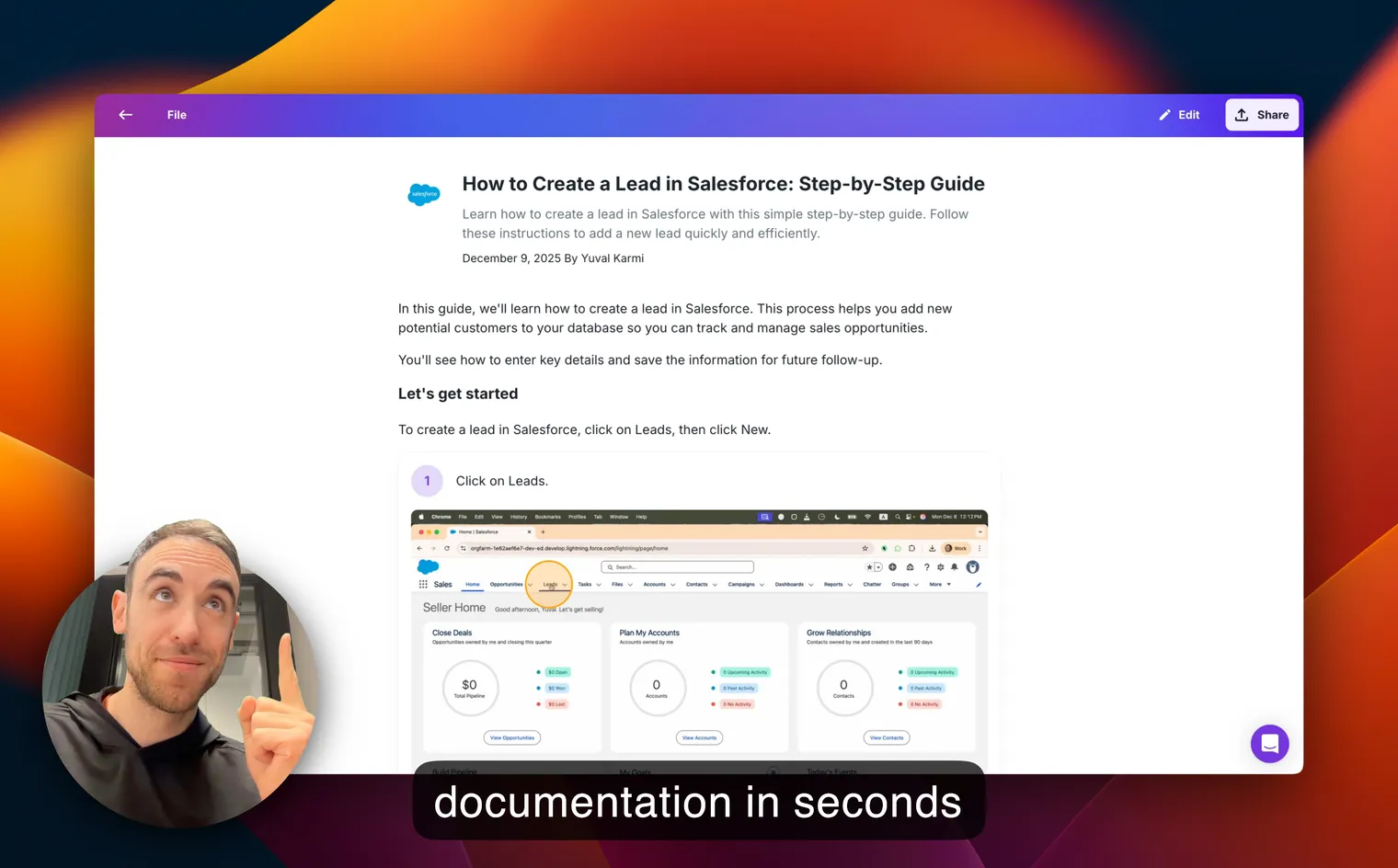
Teach your co-workers or customers how to get stuff done – in seconds.

Why ADP Training Is the Ultimate Tribal Knowledge Problem
Think about your payroll process for a second.
Someone on your team – let’s call him Dave – runs payroll every two weeks. Dave knows the exact sequence: pull time data, verify hours, check for new hires that need setup, review deductions, handle that one employee who always has a garnishment issue, run the preview, fix the three things that always need fixing, and submit. He knows which buttons to click in ADP Workforce Now, which reports to pull beforehand, and which edge cases to watch for.
Dave has been doing this for four years. None of it is written down.
Now Dave puts in his two weeks’ notice. You’ve got 10 business days to extract four years of tribal knowledge from his brain. Good luck with that.
This isn’t hypothetical. I’ve talked to dozens of companies where a single payroll person leaving caused weeks of chaos. Employees got paid late. Tax filings were wrong. Benefits deductions were miscalculated. One company told me they spent $15,000 on an outside consultant just to reverse-engineer their own ADP configuration after their payroll admin walked out.
The hidden cost of undocumented processes hurts in any department. In payroll, it’s catastrophic.
Why Traditional ADP Payroll Training Fails
Payroll isn’t like most software. You can’t just write “Step 1: Click Run Payroll” and call it done. Here’s why traditional approaches to ADP payroll training fall apart.
Too Many Edge Cases
Every payroll run is a little different. New hires need to be added. Someone changed their W-4. An employee went on FMLA leave. There’s a bonus to process. A contractor hit their 1099 threshold. Written documentation either tries to cover every scenario (and becomes a 50-page novel nobody reads) or covers the basics (and is useless when real questions come up).
Compliance Makes It High Stakes
When you’re documenting how to use a project management tool, a mistake means a task gets filed wrong. When you’re documenting payroll, a mistake means your company violates federal tax law. That pressure makes people reluctant to document at all – they’re afraid of writing something incorrect that someone follows to the letter.
The Interface Is Dense
ADP Workforce Now has hundreds of screens, menus, and configuration options. Trying to describe where to click using just text is like giving driving directions without a map. “Go to the HR module, then Workforce Management, then Time & Attendance, then select the pay period, then…” By step eight, the reader is completely lost.
It Changes Constantly
ADP updates their interface regularly and adds new features. Screenshot-based documentation goes stale within months. Teams stop trusting the docs, and they’re back to asking Dave.
This is exactly why the best HR documentation best practices lean heavily on visual, easily-updatable formats rather than static text documents.
Record your screen, talk through the steps, and Glitter creates the guide automatically
A Better Approach: Record Yourself Doing It
Here’s what actually works.
Instead of trying to write a payroll manual from scratch, just run through your payroll processing steps for real. Open ADP, start a Glitter recording, and walk through the process while talking out loud. Explain what you’re clicking, why you’re checking that report first, what to watch out for in the preview screen, and how to handle the weird thing that happens with salaried employees in a three-payperiod month.
When you stop recording, Glitter generates a complete ADP training guide with:
- Video of your full walkthrough so people can see the flow
- Annotated screenshots of every key screen and click
- Written step-by-step instructions pulled from your actions and narration
- Voiceover preserving all the verbal context and warnings
One recording captures what would take hours to write, and walking through your real payroll process end to end is what makes it useful. And because it shows your actual ADP instance with your actual configuration, it’s immediately useful – not generic help documentation that doesn’t match your setup.
The 8 ADP Workflows You Need to Document
Not every ADP feature needs a training guide on day one. Start with the workflows that matter most and cause the most confusion. Here’s my recommended list, in priority order.
1. Running Payroll
This is the big one. Walk through an entire payroll cycle start to finish. Show how to pull up the current pay period, review employee hours (whether they come from ADP’s time tracking or an external system), verify earnings and deductions, run the payroll preview report, catch errors, and submit for processing.
Don’t just show the happy path. Talk through what you check before submitting. Explain why you pull that one report to verify totals. Show what an error looks like and how to fix it. Edge cases are where people panic.
Pro tip: Record a real payroll run, not a practice one. Real data (with appropriate access controls) shows realistic scenarios that a demo environment simply can’t replicate.
2. Processing New Hires
New hire setup in ADP touches HR, payroll, and benefits all at once. Walk through entering personal information, setting up direct deposit, configuring tax withholdings based on their W-4, enrolling them in benefits, and assigning them to the correct pay group and department. Show how to verify everything looks right before their first paycheck.
This is one of the most error-prone workflows because it involves so many fields, and a mistake here ripples through every paycheck until someone catches it.
3. Handling Employee Terminations
Terminations have compliance implications. Show how to process a final paycheck (including unused PTO payouts if your company does that), how to end benefits, when the final paycheck needs to be issued (it varies by state), and how to update ADP so the terminated employee doesn’t show up in future payroll runs. Cover both voluntary and involuntary terminations if your process differs.
4. Managing Benefits Enrollment
Open enrollment is a yearly fire drill for most HR teams. Document how to set up a new enrollment period in ADP, how employees self-enroll through the portal, how to process enrollments on the admin side, and how to handle late enrollments or qualifying life events. This guide will save your sanity every October.
5. Running Tax Reports
ADP handles a lot of tax filing automatically, but your team still needs to run and review reports. Walk through pulling quarterly tax summaries, reviewing withholding accuracy, generating reports for your accountant, and verifying that ADP’s automated filings match your expectations. Show which reports actually matter and which ones are noise.
6. Processing Time-Off Requests
If you use ADP for PTO tracking, document the full lifecycle: how employees submit requests, how managers approve them, how approved time off flows into payroll, and how to handle the inevitable “I submitted it wrong” corrections. Show the admin view of adjusting balances and overriding accruals when needed.
7. Year-End W-2 Processing
W-2 season is stressful even when you know what you’re doing. Record the entire process: reviewing employee data for accuracy before W-2s are generated, running the preview, catching common errors (wrong addresses, missing SSNs, incorrect Box 12 codes), making corrections, and distributing the final forms. Do this recording in January while it’s all fresh, and your future self will thank you.
8. Handling Wage Garnishments
Garnishments are legally mandated and have specific rules about calculation, limits, and priority. Walk through receiving a garnishment order, setting it up in ADP with the correct deduction type and amount, verifying it calculates correctly on the next payroll preview, and generating the required remittance. This is low-frequency but high-consequence – exactly the kind of workflow that needs documentation.
Document every payroll workflow so your team isn't dependent on one person
How to Structure Your ADP Onboarding Program
Once you have guides for the core workflows, you need a plan for actually rolling them out. A solid ADP onboarding program makes the difference between a confident new hire and a stressed one. Here’s what I’d recommend based on what I’ve seen work for HR standard operating procedures.
Week 1: Orientation and Navigation
Start with the basics. How to log in, navigate the ADP dashboard, find employee records, and understand the menu structure. Give your new team member access to the guides for new hire setup and employee records – low-risk tasks where they can learn the interface without going anywhere near payroll.
Week 2: Payroll Fundamentals
Have them watch the payroll run guide, then shadow you through a real payroll cycle. Let them follow along in ADP while you narrate what you’re doing. After one supervised run, have them lead the next one with you watching. The guide is their safety net.
Week 3: Benefits and Time-Off
Move into benefits administration and PTO management. These workflows are important but more forgiving than payroll – a benefits enrollment error is fixable, while a payroll tax error is a compliance issue.
Week 4: Advanced Workflows
Terminations, garnishments, tax reports, and year-end processing. These come up less often but carry higher stakes. Pair the guides with real scenarios when they come up naturally rather than trying to simulate them.
The beauty of having recorded guides is that ADP training doesn’t need to happen all at once. People can come back to guides weeks or months later when a situation actually arises. Nobody remembers garnishment procedures from a training session three months ago – but they can pull up a guide in 30 seconds when they actually need it.
Tips for Recording Better ADP Training Guides
Talk About the Why, Not Just the What
Don’t just say “click here.” Say “I click here to run the pre-process report because last year we caught a $4,000 error on this screen that would have ended up in an employee’s paycheck.” Context is what turns a tutorial into real training.
Record Real Workflows With Real Data
Sanitized demo environments don’t have the messiness of real payroll data. Record with your actual system (being mindful of sensitive information on screen) so trainees see what real scenarios look like – the employee with three deduction overrides, the department that always submits time late, the garnishment that calculates differently.
Keep Guides Focused
“How to run payroll” is a guide. “Everything you need to know about ADP” is a book. One workflow per guide. Short and findable beats long and thorough every time.
Name Guides So People Can Find Them
“ADP - Running Biweekly Payroll” is a good title. “Training Video 3” is useless. When someone is stressed because payroll is due in two hours and they can’t remember a step, they need to find the right guide instantly.
Re-Record When Things Change
ADP updates their platform regularly. When a screen changes, re-record the affected guide. With Glitter, this takes minutes, not hours. Outdated guides are worse than no guides because people follow wrong steps with false confidence.
Why Video Plus Screenshots Plus Written Steps Beats Any Single Format
Let me explain why the multi-format approach matters so much for payroll software specifically.
Video shows the rhythm. People see how quickly an experienced admin moves through certain screens and where they slow down to double-check things. That pacing carries information that text just can’t.
Screenshots serve as checkpoints. When someone is mid-payroll-run and needs to verify they’re on the right screen, they glance at a screenshot. They don’t scrub through a 20-minute video looking for the right moment.
Written steps are searchable and scannable. “What’s the deduction code for 401k?” – they can search the text. You can’t search a video.
Voiceover captures the warnings and context. “Be really careful here because if you select the wrong pay group, it’ll process payroll for the entire company instead of just this division.” That kind of verbal warning often gets dropped in written documentation.
When all four come from a single recording, they stay perfectly in sync. The screenshot matches the video frame matches the written instruction matches the spoken warning. That alignment is what makes training documentation actually effective.
Build a Payroll Knowledge Base, Not Just Training Guides
As someone who built Glitter, I’ve seen our best teams document 5+ different operational workflows. The ones who stick around aren’t creating one guide – they’re building an entire knowledge base.
Your ADP training guides are just the starting point. Once payroll is documented, you’ll naturally want to capture your onboarding process, your benefits administration workflows, your compliance procedures, and your reporting cadences.
This is how you train employees faster with documentation – not by writing more, but by capturing what you already know how to do.
Start with one guide. Pick the workflow that scares you most when you think about your payroll person leaving. Record it today. It takes less time than one more “can you show me how to do this?” conversation.
Your next payroll run is the perfect time to hit record.
Video, screenshots, written steps, and voiceover -- all generated automatically from your ADP walkthrough
Frequently Asked Questions
How long does ADP training take for a new payroll admin?
Most teams need 3-6 weeks of ADP training to get a new payroll admin comfortable, depending on the complexity of your setup and how many modules you use. With documented training guides combining video, screenshots, and written steps, you can cut that timeline significantly because new team members can learn how to use ADP at their own pace and revisit guides during actual payroll runs. Simple ADP configurations with fewer than 50 employees can be learned in 2-3 weeks, while complex setups with multiple pay groups, garnishments, and benefits administration may take closer to 6-8 weeks.
What ADP modules should ADP payroll training cover first?
Start with payroll processing since that's the most time-sensitive and high-stakes workflow. Then move to new hire setup, since errors there affect every subsequent paycheck. After that, cover time and attendance (if you use ADP for time tracking), benefits administration, and reporting. Save less frequent workflows like garnishments, year-end W-2 processing, and terminations for later in your ADP onboarding plan, but make sure they're documented before you actually need them.
Can I use ADP's built-in resources for ADP training?
ADP offers training through ADP Bridge and their support portal, and these resources are useful for understanding general features. However, they won't cover your specific configuration, your pay groups, your custom deduction codes, your approval workflows, or your company-specific procedures. Generic resources teach the software. What your team needs is ADP payroll training on how your company actually uses the platform. Internal guides that show your actual setup are far more valuable for day-to-day operations.
How do I train remote employees on ADP payroll processing?
Screen-recorded training guides are ideal for remote payroll teams. Record yourself walking through each ADP workflow with narration explaining what you're doing and why. Tools like Glitter automatically generate video, screenshots, and written steps from a single recording. Remote team members can work through guides at their own pace, pause and practice in ADP, and revisit specific steps whenever needed -- all without scheduling live training sessions across time zones.
What's the biggest risk of not documenting ADP workflows?
The biggest risk is business continuity. If your payroll admin leaves, gets sick, or is unavailable during a critical pay period, undocumented ADP workflows mean payroll could be delayed or processed incorrectly. Late or inaccurate paychecks create compliance issues (many states have strict final paycheck timing requirements), damage employee trust, and can result in penalties. Beyond that, undocumented payroll processes make it nearly impossible to audit for accuracy or identify errors that have been compounding over time.
How often should I update ADP training guides?
Update your guides whenever ADP releases interface changes, whenever your internal processes change (new deduction codes, different pay schedules, updated benefits plans), and at minimum quarterly. You should also update after every open enrollment period and before year-end processing. If you use a tool like Glitter, re-recording a workflow takes just a few minutes, making regular updates practical. Set a calendar reminder to review your guides at the start of each quarter.
Should I create separate training guides for ADP Workforce Now vs ADP Run?
Yes. ADP Workforce Now and ADP Run are different platforms with different interfaces and capabilities. Workforce Now is designed for mid-size companies with more complex HR needs, while ADP Run is built for small businesses with simpler payroll requirements. Training guides should match the exact platform your team uses. If you're migrating from one to the other, create new guides from scratch rather than trying to update existing ones.
How do I handle sensitive employee data when recording ADP training guides?
Be mindful of what's visible on screen during recordings. For most training purposes, you can use your real ADP instance but avoid lingering on screens that display Social Security numbers, bank account details, or salary information for specific employees. If your recording tool supports it, you can blur or redact sensitive fields in post-production. Alternatively, focus your recording on the workflow steps and navigation rather than the specific data in the fields. Make sure training guides are shared only with authorized personnel who already have appropriate ADP access levels.
What's the best way to document ADP year-end processing?
Record your year-end process in January while it's fresh in your mind. Break it into separate guides: pre-year-end data verification, W-2 preview and error checking, W-2 corrections, final W-2 generation and distribution, and quarterly/annual tax reconciliation. Each guide should show the exact steps in your ADP instance with narration explaining common errors and how to fix them. This is one of the most valuable sets of guides you can create because year-end processing happens once a year, which means people forget the details between cycles.
How many ADP training guides does a typical company need?
Most small-to-mid-size companies need between 8 and 20 core ADP guides covering payroll runs, new hires, terminations, benefits enrollment, time-off management, tax reporting, year-end processing, and garnishments. Companies with more complex setups may add guides for multi-state payroll, shift differentials, union pay rules, or custom reporting. Start with the 5-8 workflows your team uses most frequently and expand from there. One guide per workflow is the right level of granularity -- don't try to combine multiple processes into a single guide.