
Read summarized version with
Zendesk training is one of those things every support team needs but few do well. If you manage a support team, you already know the turnover problem.
Someone spends months learning the ins and outs of your Zendesk instance – your macros, your views, your escalation paths, the dozen little tricks that make ticket handling actually efficient. Then they leave. All of that knowledge walks out the door with them.
If you’re trying to figure out how to use Zendesk the way your team has set it up, you’ve probably felt this pain firsthand. The new hire shows up, stares at a queue of 200 tickets, and has no clue which ones to grab first, what macros to use, or how your SLA policies actually work day-to-day.
I’m Yuval, founder of Glitter AI. Through building a tool that helps teams create training guides from screen recordings, I’ve talked to dozens of Zendesk teams (and teams running Front app training too) who all describe the same problem. The fix isn’t better Zendesk documentation from Zendesk. It’s capturing how your team uses Zendesk, before that knowledge disappears.
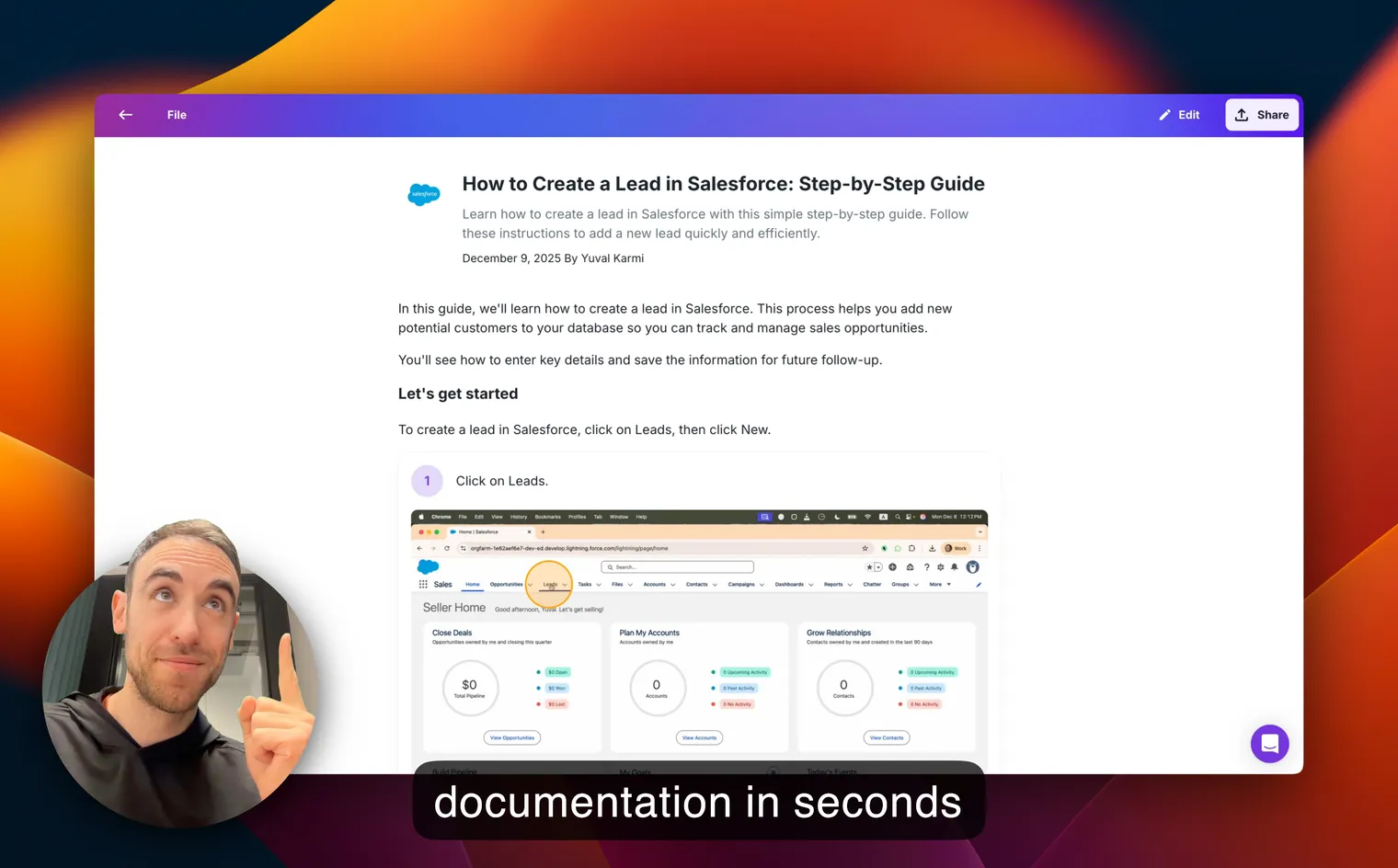
Teach your co-workers or customers how to get stuff done – in seconds.

Why Customer Support Software Training Falls Apart With Turnover
Customer support has some of the highest turnover rates in any industry. The average tenure for a support agent sits somewhere between 12 and 18 months. That means you’re basically rebuilding your team’s operational knowledge every year and a half.
Here’s what makes support teams different from, say, an engineering team. Every support organization develops its own unique workflows. Your Zendesk instance isn’t generic. You’ve built custom views for different ticket types. You’ve created macros that handle your most common customer issues. Triggers and automations route tickets based on your specific business rules. SLA policies reflect the promises you’ve made to your customers.
All of that is knowledge that exists only informally among your people. It lives in the heads of your experienced agents. When those agents leave – and they will – you lose the efficiency they built.
I’ve seen teams where a single departing agent took with them the knowledge of 30+ custom macros, a dozen specialized views, and an entire escalation decision tree that nobody else fully understood. The steep toll of leaving support processes undocumented in support is massive. Response times spike. CSAT drops. The agents who remain burn out trying to cover the gaps.
Why Traditional Zendesk Training Methods Fail
Most support teams try to train new agents using one of these approaches. None of them really hold up.
The Buddy System
You pair the new agent with an experienced one. They shadow them for a week, watching them work through tickets. The problem? Zendesk workflows move fast. An experienced agent resolves a ticket in 90 seconds – applying a macro, updating tags, adjusting priority, and moving on before the new person even processes what happened. Shadowing captures maybe 20% of what’s actually going on.
The Google Doc Approach
Someone writes up the procedures. “Step 1: Open the ticket. Step 2: Check the customer’s account status. Step 3: Apply the appropriate macro.” It reads fine. But it’s almost useless in practice because Zendesk is a visual, dynamic application. A written description of where to click can’t capture what the screen actually looks like, or the judgment calls that happen in real time.
I’ve written about this in how to document training the right way – the gap between what we write down and what people actually need to learn tends to be enormous.
Zendesk’s Own Resources
Zendesk has good general documentation. But it teaches people how Zendesk works generically, not how your company uses Zendesk. Your new agent doesn’t need to learn what a macro is in the abstract. They need to know which of your 47 macros to use when a customer asks about a billing dispute, and what to do when none of them quite fit.
Record your screen, talk through the steps, and Glitter creates the guide automatically
A Better Way: Record It, Don’t Write It
Here’s the approach I’ve seen work for the best support teams.
Instead of writing documentation or doing live shadowing, you just do the task. Open Zendesk, start a Glitter recording, and work through the workflow while talking out loud. Explain what you’re clicking, why you’re making that choice, and what to watch out for.
When you stop recording, Glitter automatically generates a complete training guide with:
- Video of the full walkthrough
- Annotated screenshots of each key step
- Written instructions pulled from what you said and did
- Voiceover so people can watch and listen
One recording. Four formats. Every learning style covered.
This is how you shorten ramp time by capturing what works in docs – not by writing more, but by capturing what your best agents already know how to do. The same approach works for WooCommerce store training or any other tool your team relies on. It also beats trailing a senior agent for a week, since job shadowing captures the actions but rarely the reasoning behind them.
The 9 Zendesk Workflows You Should Document First
Not everything in Zendesk needs a guide. Start with the workflows that eat the most time and cause the most confusion. Here’s my recommended priority order.
1. Ticket Management and Triage
This is the foundation. New agents need to understand how tickets land in the queue, how to assess priority, and how to work through them efficiently. Record yourself handling a batch of tickets – show how you read the ticket, check the customer’s history, determine the right response, and resolve or escalate.
Cover the basics: assigning tickets, changing priority levels, adding internal notes versus public replies, merging duplicate tickets. But also cover the judgment calls. How do you decide whether something is urgent? When do you escalate versus handle it yourself?
Pro tip: Record yourself handling a messy ticket, not a clean one. Edge cases are where new agents struggle the most.
2. Creating and Using Macros
Macros are what separate a fast agent from a slow one. Most teams have dozens of them, though, and new agents have no idea which to use when.
Record a walkthrough of your most-used macros. Show how to apply them to a ticket, how they auto-fill fields and responses, and when to modify the templated text before sending. Then show how to create a new macro from scratch – your team will need to build new ones as your product and customer base evolve.
Explain your naming conventions too. If your macros are organized by category, walk through the logic so new agents can find what they need without memorizing every single one.
3. Setting Up and Managing Views
Views are how agents make sense of the ticket queue. Your experienced agents have probably customized their personal views to surface exactly the tickets they need. Your new agents? They’re staring at the default view wondering where to start.
Record yourself setting up a view from scratch. Show the conditions – filtering by status, priority, assignee, tags, or whatever custom fields you use. Show your team’s shared views and explain the reasoning behind each one. Then show how agents can create personal views for their own workflow.
This is one of those areas where documenting customer service processes pays off right away. A well-organized view structure cuts wasted time dramatically.
4. Handling Escalations
Every support team has an escalation process, and it’s almost never as simple as “pass it to the next tier.” Record the full decision tree. When does a ticket get escalated? Who does it go to? What information needs to be in the internal notes before escalation? How do you communicate to the customer that their issue is being escalated?
Show the actual mechanics in Zendesk – reassigning the ticket, changing the group, adding the right tags, updating the priority. And show the communication side too – what does the escalation note to the next tier look like? What does the customer-facing response say?
5. Triggers and Automations
Triggers fire when tickets are created or updated. Automations run on a time-based schedule. Together, they’re the backbone of your ticket routing and notification system.
Your agents may not need to create triggers themselves, but they absolutely need to understand how they work. Record a walkthrough of your most important triggers – the ones that auto-assign tickets, send notifications, or change ticket properties. Walk through the logic: “When a ticket comes in with the tag ‘billing,’ this trigger automatically assigns it to the billing group and sets the priority to high.”
Then show the automations. Which ones send follow-up reminders? Which ones auto-close stale tickets? When agents understand what the system is doing behind the scenes, they stop fighting against it.
6. Managing SLA Policies
SLAs define your response and resolution time commitments. Your agents need to understand which tickets have SLAs attached, what those time targets are, and how to prioritize accordingly.
Record yourself navigating SLA views – show how to see which tickets are approaching breach, which have already breached, and how to use SLA status as a prioritization signal. Walk through your specific SLA tiers and explain the business context behind them. Why does Enterprise get a 1-hour first response while Standard gets 4 hours? That context helps agents make better decisions under pressure.
7. Writing Help Center Articles
If your team manages a Zendesk Guide help center, new agents need to know how to create and update articles. Record the full process: drafting an article, formatting it with Zendesk’s editor, assigning it to the right section and category, adding labels for searchability, and publishing it.
Also show how to recognize when a new article is needed. If agents are answering the same question five times a week, that’s a help center article waiting to be written. Teach them to spot patterns and contribute to self-service content.
Document every workflow so training doesn't depend on your best agent
8. Tagging, Categorizing, and Custom Fields
Clean data in Zendesk depends on consistent tagging and categorization. Show your team exactly how you expect tickets to be tagged. Walk through your tag taxonomy, your custom fields, and your ticket forms if you use them.
And explain why this matters. Tags and categories feed into your reporting. If agents tag inconsistently, your data becomes unreliable, and you can’t make informed decisions about where to invest in your support operation. Record yourself categorizing a few different ticket types to show the thought process behind choosing the right tags.
9. Running Satisfaction Surveys and Reports
Your agents should understand how CSAT scores are collected and what happens with the data. Show how satisfaction surveys get triggered in your Zendesk setup, where to find the results, and how to pull basic reports.
Walk through the reporting dashboard. Show how to filter by agent, by time period, by ticket type. Explain which metrics your team tracks and what the targets are. Agents who understand the metrics they’re measured on tend to perform better – that’s not rocket science, it’s just giving people visibility into what matters.
How to Structure Your Zendesk Onboarding Program
Recording the guides is step one. Organizing them into a Zendesk onboarding path is step two.
Days 1-3: Orientation
Start with ticket management basics, your view structure, and your most common macros. These are the daily tools. Have new agents handle simple, low-risk tickets with the guides open as reference. Let them get comfortable with the interface before throwing them into the deep end.
Days 4-7: Core Skills
Move into escalations, tagging and categorization, and SLA awareness. These require more judgment and context. Pair the guides with a few live practice sessions where a senior agent reviews their work and gives feedback.
Week 2: Advanced Workflows
Triggers and automations, help center management, reporting. These are the workflows that turn a functional agent into a strong one. By now they have enough context to understand the “why” behind these systems.
Week 3+: Independence with Safety Net
The agent works independently with the guide library as a reference. Check in regularly, review their CSAT and handle times, and identify any areas where an additional recording would help.
This approach follows the principles in proven ways to train your staff effectively – structured progression, multiple formats, and self-paced reference materials. It’s the kind of customer support software training that actually sticks.
Tips for Recording Great Zendesk Guides
Talk Through Your Reasoning
Don’t just show what you click. Explain why. “I’m checking the customer’s ticket history first because repeat contacts about the same issue usually mean we haven’t actually fixed the root cause.” That reasoning is the most valuable part of your guide – it teaches judgment, not just mechanics.
One Workflow Per Guide
Keep each recording focused on a single task. “How to handle a billing escalation” is a guide. “Everything you need to know about Zendesk” is a disaster. Short, focused guides are easier to find, easier to follow, and easier to update when your processes change.
Show Real Tickets
Use actual tickets (with sensitive customer data redacted if necessary) rather than made-up examples. Real tickets have the messiness and ambiguity that new agents will run into. Perfect test scenarios don’t prepare people for the real queue.
Name Them Clearly
“Zendesk - Handling Billing Escalations” beats “Training Video 7.” When an agent is in the middle of a shift and needs a quick refresher, they need to find the right guide in seconds.
Building a Complete Support Knowledge Base
As someone who built Glitter, I’ve seen our best teams document 5+ different operational workflows. The ones who stick aren’t creating one guide – they’re building an entire knowledge base.
Your Zendesk guides are just the start. Once you’ve documented ticket handling, macros, and escalations, you’ll naturally want to capture how your team handles refunds, how you deal with outages, how you manage VIP accounts, how you coordinate with engineering on bug reports.
Each guide you record reduces your dependency on any single person. That’s the real goal here. Not perfect documentation. Just enough captured knowledge that your team can function when someone’s out sick, on vacation, or moving on to their next role.
Why Video + Screenshots + Written Steps Work Better Together
Let me be specific about why the multi-format approach matters for Zendesk training.
Video shows the flow. Zendesk workflows involve navigating between multiple screens, and video captures the sequence and rhythm in a way written steps simply can’t. An agent watching video sees how quickly an experienced person moves through ticket triage and unconsciously picks up the pacing.
Screenshots show the details. When an agent is mid-ticket and needs to verify they’re looking at the right dropdown or the right field, they want a screenshot. Not a video to scrub through. Not a paragraph to read. Just a quick visual confirmation.
Written steps capture the rules. Your SLA thresholds, your escalation criteria, your tagging conventions – these are reference material that people need to scan quickly. Text is searchable, scannable, and easy to bookmark.
Voiceover carries the nuance. “Be careful with this one – the customer is usually frustrated by this point” isn’t something you’d write in a doc, but it’s exactly the kind of context that makes a new agent effective.
When all four come from a single recording, they stay perfectly in sync. The screenshot matches the video frame matches the written instruction matches the spoken explanation. That consistency is what makes training stick.
Video, screenshots, written steps, and voiceover -- all generated automatically
Getting Started Today
You don’t need to document every workflow this week. Here’s what I’d do.
- Identify the workflow that generates the most questions from new agents. For most teams, it’s ticket triage or escalation handling.
- Open Zendesk, start a Glitter recording, and just do the task. Talk through your decisions as you go. Don’t script it.
- Review the generated guide. Clean up any written steps that need a tweak.
- Share it with your team. Next time a new agent asks how to handle that scenario, send them the guide.
- Record one more guide next week. Then another the week after. In two months, you’ll have a library that covers your core operations.
The teams with the best support metrics aren’t the ones with the fanciest tools. They’re the ones where every agent has access to the same knowledge. Start recording. Start sharing. Your CSAT scores will thank you.
Frequently Asked Questions
How long does Zendesk training take for a new support agent?
Most teams need 2-4 weeks of Zendesk training to get a new agent handling tickets independently. The first week covers basics like ticket management, views, and common macros. Weeks two and three add escalations, SLA awareness, and advanced workflows. With documented training guides combining video, screenshots, and written steps, teams typically cut this timeline by 30-50% because new agents can self-serve instead of waiting for a senior agent to be available for questions.
What Zendesk features should I train my team on first?
Start with the daily essentials: ticket management and triage, your most-used macros, and your view structure. These are the tools agents interact with on every ticket. Then layer in escalation handling, tagging conventions, and SLA policies. Save advanced topics like triggers, automations, help center management, and reporting for after agents are comfortable with core workflows. Prioritize based on what generates the most questions from your current team.
Can I use Zendesk's own resources for Zendesk onboarding?
Zendesk's documentation and training resources are good for understanding general features, but they won't cover your specific setup. Your macros, your views, your escalation paths, your SLA tiers, and your tagging taxonomy are all unique to your organization. Generic customer support software training teaches agents what a macro is. Internal Zendesk training teaches them which of your 47 macros to use when a customer reports a billing error. You need both, but your internal guides do the heavy lifting for Zendesk onboarding.
How do I handle Zendesk training for remote support agents?
Screen-recorded training guides are ideal for remote Zendesk onboarding. Record yourself walking through each Zendesk workflow with narration explaining your decisions. Tools like Glitter automatically generate video, annotated screenshots, and written steps from a single recording. Remote agents can learn how to use Zendesk at their own pace, in their own time zone, and revisit guides whenever they need a refresher. This eliminates the scheduling challenges of live customer support software training across distributed teams.
How do I document Zendesk macros for my team?
Record a walkthrough of your most-used macros in action. Show how to find and apply each macro, what fields it auto-fills, when to modify the template text before sending, and which scenarios each macro is designed for. Organize your documentation by category (billing, technical, account management) so agents can find the right macro quickly. Also record how to create new macros from scratch, since your library will grow as your product evolves.
What's the biggest mistake teams make when training on Zendesk?
The biggest mistake is relying entirely on live shadowing with no documentation. When training happens only through observation, knowledge disappears the moment the experienced agent leaves. The second biggest mistake is creating text-only SOPs for a visual, dynamic application. Zendesk involves navigating between multiple screens, reading contextual cues, and making judgment calls. Text alone cannot capture the visual flow and decision-making process. You need screenshots and video alongside written steps.
How often should I update my Zendesk training guides?
Update guides whenever Zendesk changes its interface, whenever you add or modify macros, views, or triggers, and whenever your internal processes change (new escalation paths, updated SLA tiers, revised tagging conventions). Do a general review quarterly. If you're using Glitter, re-recording a workflow takes just a few minutes, which makes regular updates practical. Outdated guides are worse than no guides because they create confusion and erode trust in your training materials.
How do I handle Zendesk training for different support tiers?
Create separate guide sets for each tier. Tier 1 agents need guides focused on common ticket handling, basic macros, and when to escalate. Tier 2 agents need guides for advanced troubleshooting, specialized workflows, and deeper product knowledge. Tier 3 or specialist agents need guides for complex investigations, engineering coordination, and edge case handling. Some guides (like views, tagging, and SLA policies) apply across all tiers and should be shared.
How many Zendesk training guides does a typical support team need?
Most support teams need 10-20 core guides to cover essential Zendesk workflows. This includes ticket triage, common macros, views setup, escalation handling, SLA management, tagging conventions, help center article creation, and reporting. Teams with multiple products, complex escalation paths, or specialized workflows may need 25-30 guides. Start with the 5-7 workflows your team uses daily and expand from there based on where new agents struggle most.
Can I train my team on Zendesk automations and triggers without being an admin?
Agents don't need admin access to understand how triggers and automations affect their work. Record a walkthrough explaining your key triggers (what they do, when they fire, how they affect tickets) and automations (time-based rules, auto-close policies, follow-up reminders). Agents who understand the system's background behavior make fewer mistakes and stop fighting against automated workflows. Admin-level guide creation and editing is only needed for the team leads who actually manage these configurations.