
Read summarized version with
Every company has one. The Power BI person.
They built the sales dashboard everyone depends on. They know which data sources connect where. They wrote the DAX formulas that calculate margin by region, set up the scheduled refreshes, and manage who has access to which workspace. If you’re reading this, that person is probably you – and you’re probably wondering how to use Power BI knowledge to get the rest of your team up to speed.
Here’s the problem: when the Power BI person goes on vacation, gets promoted, or leaves, nobody knows how to train your team on Power BI fast enough to keep things running. Reports break. Dashboards go stale. Someone asks for a new chart and the whole office looks around hoping somebody else will step up.
I’m Yuval, founder of Glitter AI. Through building a tool that helps teams create training guides from screen recordings, I’ve talked to dozens of Power BI teams who all describe the same problem. It’s powerful, visual, and deeply customized to each company’s data, which makes tribal knowledge loss genuinely painful.
Teach your co-workers or customers how to get stuff done – in seconds.

The “Power BI Person” Problem
Let me paint the picture.
Your operations coordinator – let’s call him Marcus – has spent two years building out your Power BI environment. He connected your CRM, your accounting system, and your inventory database. He built relationships between tables, wrote DAX measures that calculate rolling 90-day averages and year-over-year growth percentages, and created dashboards your leadership team reviews every Monday morning.
Marcus didn’t document any of it. Not because he’s lazy. Because he was busy actually building the reports everyone needed.
Now Marcus is leaving. You have two weeks. And suddenly you realize your entire reporting infrastructure lives in one person’s head.
This is the hidden cost of undocumented processes at its most visible. When a dashboard breaks in front of your VP during a Monday meeting, everyone notices. But the real cost has been piling up quietly for months – every time someone asked Marcus to tweak a report instead of doing it themselves, every time a new hire waited three days for Marcus to have time for a walkthrough, every time a decision stalled because nobody else could pull the data.
Why Traditional Power BI Training Falls Short
Learning how to use Power BI is one thing. Teaching your team how to use it the way your company uses it? That’s a visual, interactive challenge that creates specific problems for traditional documentation approaches.
Written SOPs Miss the Context
Someone writes “Step 3: Create a calculated column using the formula RELATED(Sales[Amount]).” Technically correct. But it tells you nothing about where to click, what the screen looks like, how to handle the error message that pops up half the time, or why you’d use RELATED instead of LOOKUPVALUE.
Power BI has menus nested inside menus, right-click options, drag-and-drop interactions, and a formula bar that behaves differently depending on whether you’re in a measure or a calculated column. Text instructions just can’t capture all of that.
Vendor Documentation Is Generic
Microsoft’s Power BI documentation is extensive. But it’s written for everyone, not for your company. It won’t tell your team which tables in your data model matter, which DAX formulas you actually use, or how your specific dashboards are structured. Your team doesn’t need to learn Power BI in the abstract – they need to learn your Power BI setup.
Screen Recordings Without Structure Get Ignored
Some teams try recording Loom walkthroughs. Better than nothing - but Loom produces video only, so a 45-minute walkthrough has no written steps and no way to jump to the specific moment you need. When someone needs help at 4pm on a Friday, they’re not scrubbing through a video hunting for the two minutes that cover their specific question. They need the written steps and the screenshot right there.
I’ve written about this broader challenge in document processes even if you’re not a writer. The format matters just as much as the content.
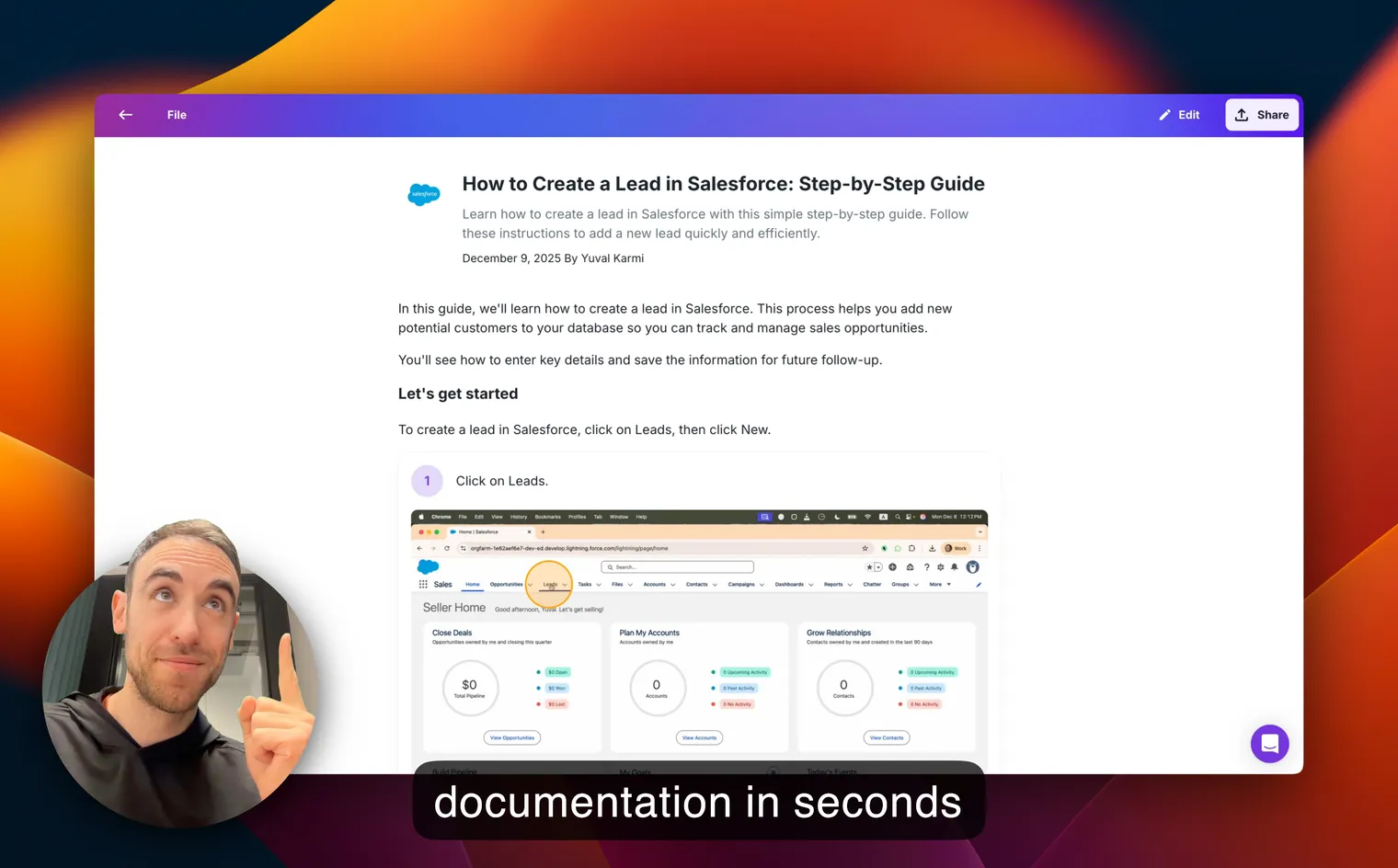
Record your screen, talk through the steps, and Glitter creates the guide automatically
How Glitter Solves This
Here’s the approach I’ve seen work best, and it’s the reason I built Glitter.
You open Power BI. You start a Glitter recording. You do the task – connecting a data source, building a report, writing a DAX formula, whatever it is – while talking out loud about what you’re doing and why.
When you stop recording, Glitter automatically generates:
- Video of your complete walkthrough
- Annotated screenshots of every key step
- Written instructions extracted from what you said and did
- Voiceover so people can watch and listen
One recording. Four formats. Every learning style covered.
This matters for Power BI specifically because it’s such a visual tool. The screenshots show exactly which ribbon tab to click, where the formula bar is, what the data model view looks like. The video captures the flow – how quickly you move through certain steps, where you pause to double-check something. The written steps carry the logic and reasoning. And the voiceover preserves the warnings and context that text tends to drop.
The 9 Power BI Workflows You Should Document First
Not every Power BI feature needs a training guide. Start with the workflows that cause the most confusion and the ones only one person currently knows how to handle.
1. Connecting Data Sources
This is the foundation. A huge number of teams want to know how to use Power BI with Excel, but the same applies for SQL Server, SharePoint lists, or cloud services like Salesforce or Google Analytics. Walk through connecting your most common data sources. Show the authentication steps, the navigator window where you select tables, and any query editor transformations you apply before loading data.
Pro tip: Don’t just show a clean connection. Show what happens when credentials expire or a data source changes location. Those are the moments when people panic.
2. Building Reports from Scratch
Start with a blank report and build something useful. Show how to drag fields onto the canvas, choose visualization types, format charts, add filters, and arrange everything into a coherent layout. Cover the difference between report-level filters, page-level filters, and visual-level filters – this trips up most new users.
Record yourself building a report your team actually uses, not a demo with sample data. Real data makes the training feel relevant.
3. Creating Dashboards
Dashboards in Power BI are different from reports, and this distinction confuses people constantly. Show how to pin visuals from reports to a dashboard, how to arrange tiles, and how to set up dashboard alerts. Explain when a dashboard makes sense versus when a report is the better choice for the audience.
4. Writing DAX Formulas
DAX is where most non-technical users hit a wall. Honestly, they don’t need to learn all of DAX. They need to learn the specific formulas your team uses.
Record yourself writing the 5-10 DAX measures that power your most important reports. Explain each one in plain language. Show what happens when you modify a formula – what changes in the visual, what breaks. Common formulas worth covering: CALCULATE, SUMX, RELATED, FILTER, and time intelligence functions like TOTALYTD or SAMEPERIODLASTYEAR.
Don’t try to teach DAX in its entirety. Teach the DAX your team actually needs.
5. Setting Up Scheduled Refresh
Stale data is one of the fastest ways to lose trust in your reports. Walk through setting up a data gateway (if you’re using on-premises data), configuring refresh schedules in the Power BI service, and troubleshooting failed refreshes. Show where to check refresh history and how to set up failure notifications.
This is one of those tasks that takes two minutes when you know what you’re doing and two hours when you don’t. A visual guide saves a lot of frustration.
6. Sharing Reports and Managing Permissions
Power BI’s sharing model has layers: workspaces, apps, direct sharing, row-level security. Your team needs to know your specific approach. Walk through how you share reports with different audiences, how you manage workspace access, and what the permission levels mean in practice.
Cover the mistakes too. Show what happens when someone shares a report without the right license, or when a viewer tries to edit something they shouldn’t.
7. Managing Workspaces
Workspaces are how Power BI organizes content, and a messy workspace structure makes everything harder. Show how yours are organized, how to publish reports to the right workspace, and how to move content between workspaces when needed.
If you have naming conventions, explain them. If certain workspaces map to certain departments, make that explicit.
8. Creating Calculated Columns
Calculated columns are different from measures, and mixing them up is one of the most common beginner mistakes. Show when to use a calculated column versus a measure, how to create each one, and what the performance trade-offs look like. Walk through a real example from your data model so the concept is grounded in something familiar.
9. Publishing to the Power BI Service
Whether you’re figuring out how to use Power BI on Mac (through the web service) or on Windows with Desktop, the gap between Power BI Desktop and the Power BI service causes constant confusion. Show the full publish workflow – from saving the file in Desktop, to publishing, to verifying it appears correctly in the service. Cover how updates work: when you change a report in Desktop and republish, what happens to the existing dashboards and shared links.
Document every workflow so reporting doesn't depend on one person
How to Structure Power BI Training for Your Team
Once you’ve recorded the core workflows, here’s how to roll them out.
Week 1: Navigation and Reading Reports
Don’t start with building. Start with using. New team members should learn how to navigate existing dashboards, apply filters, drill down into data, export data to Excel, and interpret the visualizations your team already has. Send them the relevant Glitter guides and let them explore.
This builds confidence without any risk. Nobody can break anything by reading a report.
Week 2: Basic Report Building
Move into creating simple reports. Connecting to a data source, dragging fields onto the canvas, choosing chart types, adding basic filters. Keep it simple – bar charts, tables, card visuals. Nothing fancy yet.
Week 3: Intermediate Skills
DAX basics, calculated columns, more complex visualizations, and understanding the data model. This is where the Glitter guides for your specific DAX formulas become essential. People can watch you write a formula, see exactly what it does, and reference the written steps when they try it themselves.
Week 4: Publishing and Sharing
How to publish reports to the service, set up scheduled refreshes, share with the right people, and manage workspaces. By now they should be comfortable enough in Power BI Desktop that the service-side tasks feel manageable.
This is really a training documentation framework applied to Power BI. The guides carry the weight. Your experienced team members answer questions and provide context. Nobody spends a full week doing nothing but live training sessions.
Tips for Recording Better Power BI Training Guides
The teams that create the most useful Power BI training tend to share a few habits.
Use Real Data
Don’t record with sample datasets. Use the actual data your team works with. When someone sees familiar table names, column headers, and business metrics in the training guide, the learning sticks faster.
Explain the Why, Not Just the How
“Click here, then click here” isn’t training. “We use CALCULATE here because we need to override the filter context from the slicer on the left – otherwise the numbers include regions we don’t want” – that’s training. The reasoning is what turns button-clicking into real understanding.
One Workflow Per Guide
“How to set up a scheduled refresh” is a guide. “Everything you need to know about Power BI” is an encyclopedia nobody will read. Keep each recording focused on a single task. Short, focused guides are easier to record, easier to find, and easier to update when things change.
I’ve covered this principle in employee training best practices – modular training consistently outperforms monolithic training.
Name Your Guides Clearly
“Power BI - Setting Up Scheduled Refresh” is findable. “Training Video 7” is not. When someone’s data is showing last month’s numbers and they need to fix the refresh right now, they need to find the right guide in seconds.
Show the Error States
Power BI throws cryptic error messages. When a refresh fails, when a DAX formula has a circular dependency, when a data source can’t connect – those are the moments people need help the most. If you hit an error during a recording, walk through how you diagnose and fix it. That’s often more valuable than a clean walkthrough where nothing goes wrong.
Building a Complete Power BI Knowledge Base
As someone who built Glitter, I’ve watched our best teams document 5+ different operational workflows. The ones who stick with it aren’t creating one guide – they’re building an entire knowledge base.
Your Power BI training guides are the starting point. Once you’ve documented report building, DAX formulas, and scheduled refreshes, you’ll naturally want to capture other processes too. How you pull data for quarterly reviews. How you build the board deck. How you handle ad-hoc data requests from different departments.
This is how you train employees faster with documentation – not by writing more, but by capturing what you already know how to do.
Why the Multi-Format Approach Matters for Power BI
Let me be specific about why combining formats matters so much for a tool like Power BI.
Video shows the flow. Power BI involves a lot of drag-and-drop, right-clicking, and navigating between views (report view, data view, model view). Video captures that spatial, interactive quality in a way text never will.
Screenshots show the details. When someone is staring at the DAX formula bar wondering why their CALCULATE function isn’t working, they need a screenshot showing exactly what the correct formula looks like in context – not a video they have to pause at just the right frame.
Written steps capture the logic. Which fields go where. What the filter should be set to. Why you chose a clustered bar chart instead of a stacked one. Text is searchable, scannable, and easy to reference while you’re in the middle of something.
Voiceover captures the nuance. The “watch out, this dropdown resets when you change the data source” warnings. The “this looks wrong but it’s actually fine” reassurances. Spoken context carries information that written steps often lose.
When all four come from a single recording, they stay perfectly in sync. The screenshot matches the video frame which matches the written step which matches the spoken explanation.
Video, screenshots, written steps, and voiceover -- all generated automatically
Getting Started Today
You don’t need to document everything at once. Here’s what I’d do.
- Identify the workflow only one person knows. For most teams, it’s the DAX formulas or the scheduled refresh setup.
- Open Power BI, start a Glitter recording, and do the task. Talk through what you’re doing and why. Don’t rehearse – just be natural.
- Review the generated guide. Edit the written steps if anything needs clarification.
- Share it with your team. Next time someone asks “how does this dashboard work?” send them the guide instead of walking them through it again.
- Record one more guide per week. In two months, you’ll have a complete Power BI training library.
The teams that get the most value aren’t the ones with the most polished documentation. They’re the ones who actually have documentation at all. Start messy. Start today. Your future self – and the person who eventually replaces Marcus – will thank you.
Frequently Asked Questions
How long does Power BI training take for a new team member?
Most teams need 3-5 weeks to get a new hire comfortable learning how to use Power BI for core tasks like navigating reports, building basic visualizations, and understanding your data model. With documented Power BI training guides that combine video, screenshots, and written steps, you can cut that timeline down because people learn at their own pace and revisit guides whenever they need to. The exact timeline depends on how complex your data model is, how many DAX formulas your team relies on, and the person's comfort level with data tools.
What Power BI skills should I train my team on first?
Start with reading and navigating existing reports and dashboards -- applying filters, drilling into data, and exporting to Excel. Then move to basic report building: connecting data sources, choosing visualizations, and adding filters. Save DAX formulas, calculated columns, and scheduled refresh setup for after they're comfortable with the fundamentals. Prioritize the workflows that generate the most questions from your current team.
Can I use Microsoft's Power BI documentation for team training?
Microsoft's documentation is helpful for learning general Power BI features, but it won't teach your team how your specific reports are built, which DAX formulas power your dashboards, or how your data model is structured. Generic documentation can supplement your internal training guides, but it shouldn't replace materials that show exactly how your company uses Power BI with your actual data sources and business logic.
How do I train non-technical staff on Power BI?
Focus on consumption first, creation second. Non-technical staff usually need to read dashboards, apply filters, and export data -- not write DAX formulas. Record visual guides showing exactly how to navigate your specific reports with narration explaining what each chart means and how to interact with it. Tools like Glitter generate video, screenshots, and written steps from a single screen recording, making it straightforward to create guides that work for all skill levels.
What's the biggest mistake teams make when training on Power BI?
The biggest mistake is letting one person become the sole Power BI expert without documenting anything. When that person is unavailable, reporting stops. The second biggest mistake is trying to teach everything at once -- DAX, data modeling, report design, the Power BI service -- in a single training session. Break it into focused modules covering one workflow each, and make sure guides are accessible for self-service learning.
How do I document DAX formulas for my team?
Record yourself writing each DAX formula your team actually uses. Talk through what the formula does in plain language, why you chose that approach, and what changes in the report when the formula is modified. Don't try to teach DAX in its entirety -- focus on the 5-15 formulas that power your most important reports. Include the formula text in the written steps so people can copy and paste rather than retyping from a video.
How often should I update Power BI training guides?
Update your guides whenever Microsoft changes the Power BI interface (which happens regularly with monthly updates), whenever your data sources or data model changes, and whenever your team modifies key reports or DAX formulas. A quarterly review is a good baseline. With a tool like Glitter, re-recording a workflow takes just a few minutes, which makes keeping guides current practical rather than painful.
How do I train remote employees on Power BI?
Screen-recorded training guides are ideal for remote Power BI training because they can be accessed from anywhere at any time. Record yourself walking through each workflow in your actual Power BI environment with narration explaining what you're doing and why. Remote employees can work through the guides at their own pace, rewind tricky sections, and come back to them later without scheduling live training across time zones.
What's the difference between Power BI Desktop and the Power BI service for training?
Power BI Desktop is where you build and design reports -- connecting data, creating visualizations, and writing DAX formulas. The Power BI service is the cloud platform where you publish, share, and view reports. If you're wondering how to use Power BI on Mac, the service is your primary option since Desktop currently runs on Windows only. Your team likely needs training on both, but start with the service if they only need to read reports, and start with Desktop if they need to build or modify them. Document the publish workflow that connects the two so people understand how changes in Desktop show up in the service.
How many Power BI training guides does a typical team need?
Most teams need somewhere between 8 and 15 core guides to cover their essential Power BI workflows. This typically includes guides for navigating reports, connecting data sources, building basic reports, creating dashboards, writing key DAX formulas, setting up scheduled refresh, sharing and permissions, and managing workspaces. Some teams add guides for specific report types, row-level security, or data model maintenance. Start with the 5-7 workflows your team uses most and expand from there.