

Read summarized version with
I remember the exact moment I realized knowledge management was broken.
It was 2 AM. I was digging through our company Confluence trying to find the latest API documentation. Seven different versions of the same doc. Three were outdated, two contradicted each other, and I had no idea which one was actually correct.
Sound familiar?
Here’s the thing: traditional software for knowledge management wasn’t designed for how fast companies move today. These systems require manual updates, manual organization, and manual searches through endless folders that nobody bothers to maintain.
But in 2026? AI is fundamentally changing how knowledge management works.
I’m talking about systems that flag outdated content on their own, answer questions with trusted citations, capture knowledge from video and audio, and deliver the right information at exactly the right moment. All without requiring someone to spend hours organizing a wiki.
I’m Yuval, founder and CEO of Glitter AI. After building knowledge systems at my last startup (which we grew to $15.5M in funding before acquisition), I’ve become obsessed with how AI can actually solve the knowledge management problems that have plagued companies for decades.
Let me show you what’s actually working in 2026.
The AI Knowledge Management Revolution
The AI-driven knowledge management market is exploding. We’re talking about growth from $5.23 billion in 2024 to $7.71 billion in 2025, a 47.2% compound annual growth rate.
And it’s not slowing down. By 2029, the market is expected to hit $35.83 billion. Some analysts predict it’ll reach $251.2 billion by 2034.
Why the explosion? Because AI is finally delivering on the promise that traditional tools for knowledge management never could: making organizational knowledge actually accessible and useful.
According to McKinsey, knowledge management is now one of the business functions with the most reported AI use. And 44% of experts agree that generative AI is the most important technology for knowledge management right now.
Here’s what that looks like in practice.
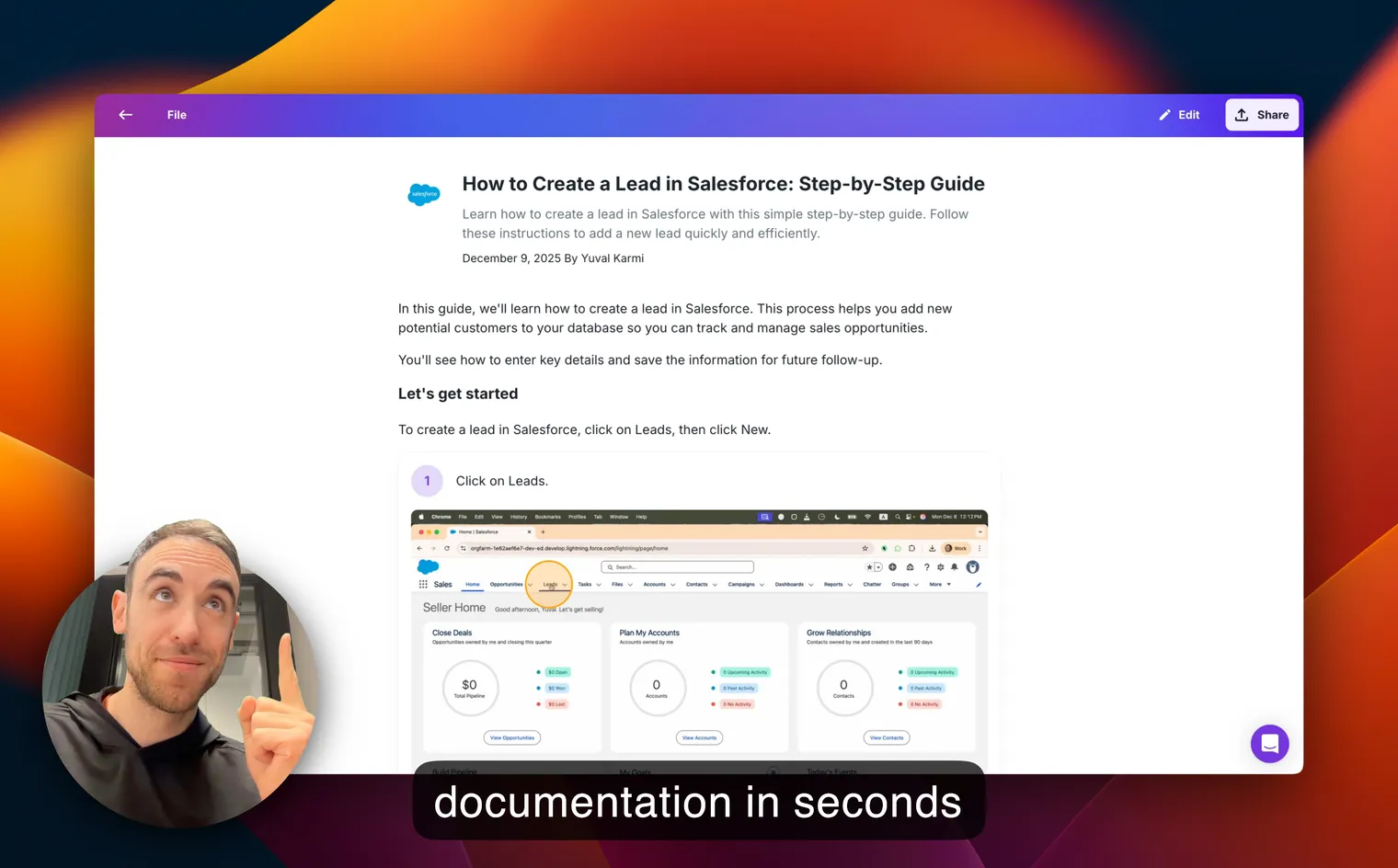
Teach your co-workers or customers how to get stuff done – in seconds.

The 2026 AI Knowledge Management Trends That Actually Matter
Let me cut through the hype and tell you what’s actually changing in 2026.
1. AI-Powered Search with Trusted Answers and Citations
The biggest shift? Generative AI search that doesn’t just find documents but answers questions with citations.
Traditional search gives you a list of potentially relevant documents and makes you figure out the answer yourself. AI-powered search in 2026 reads through your knowledge base, synthesizes information from multiple sources, and gives you a direct answer with clickable citations to the source material.
Cloud knowledge management systems like Bloomfire, Slite, and OpenAI’s Company Knowledge feature are leading this, and our full comparison of the best knowledge sharing tools breaks down how they stack up. When you ask a question, the AI looks across multiple sources to give comprehensive answers and includes clear citations so you can verify the information.
This matters. Instead of spending 30 minutes reading through five different docs, you get your answer in 30 seconds, with the ability to dig deeper if needed.
At Glitter AI, I see this as the future of knowledge sharing. The knowledge exists. We just needed better ways to retrieve it.
2. GenAI-Powered Insights and Personalized Recommendations
Here’s where it gets really interesting: AI that understands your role and proactively recommends relevant knowledge.
Instead of you searching for information, the system learns what you need based on your role, goals, and past behavior. It curates and recommends knowledge tailored specifically to you.
A customer success rep sees different recommended resources than an engineer. A new hire gets different knowledge pathways than a senior employee. The system adapts to what you need to know.
38% of knowledge management teams are already using AI to recommend content or knowledge assets. And 70% of organizations will use AI-powered KM systems to streamline information retrieval by the end of 2025.
This eliminates the biggest problem with traditional knowledge bases: nobody knows what they don’t know. AI surfaces the knowledge you need before you even realize you need it.
3. Automated Knowledge Capture from Any Source
This one’s personal for me because it’s exactly what I built Glitter AI to solve.
AI can now automatically capture, organize, and retrieve information from video, audio, text, and screen recordings without manual documentation work.
Think about it. Your subject matter experts spend hours in meetings, training sessions, and customer calls sharing valuable knowledge. Traditionally, all that knowledge disappeared unless someone manually took notes and organized them.
In 2026, AI can:
- Analyze video and audio from SME presentations to identify key concepts
- Extract key quotes from interview transcripts for learning modules
- Transform SME materials into standardized training content at scale
- Automatically generate documentation from screen recordings
Leading platforms like Fireflies.ai transcribe meetings and analyze conversations. Insight7 analyzes interview data at scale. Sonix detects recurring themes and important topics in transcripts.
The accuracy has gotten remarkably good: 95-98% in quiet conditions with clear speech.
I use this approach at Glitter AI constantly. Instead of asking team members to write documentation after they do something, I just have them screen record while they work and talk through what they’re doing. AI handles the rest.
Screen record once, get complete documentation automatically with AI
4. In-Workflow Knowledge Delivery
Here’s a trend that’s reshaping how knowledge actually gets used: delivering knowledge directly in the tools people already use.
Instead of making employees switch to a separate knowledge base, AI brings relevant information into Slack, Teams, Chrome browsers, and whatever app they’re already working in.
Platforms like Guru pioneered this with browser extensions and integrations that surface knowledge without context-switching. OpenAI’s Company Knowledge integrates with Slack, SharePoint, Google Drive, and GitHub to make information accessible where people actually work.
The impact? People actually use the knowledge because it’s right there when they need it.
At Glitter AI, we see massive adoption differences when knowledge is embedded in workflow versus requiring someone to open a separate app. Friction kills usage.
5. Content Health Automation and Self-Healing Knowledge Bases
You know what kills knowledge bases? Outdated information that nobody updates.
I found this out the hard way at my first startup. We’d create great documentation, then six months later it would be completely wrong because the product changed, but nobody updated the docs.
In 2026, AI solves this with automated content health monitoring.
Systems like Bloomfire use AI to flag outdated or redundant content before it pollutes your search results. The AI identifies when documentation contradicts newer information, when it hasn’t been accessed in months, or when it’s duplicating other content.
Some systems even auto-suggest updates based on changes in related systems or recent communications.
This “self-healing knowledge base” approach means your knowledge stays current without requiring constant manual maintenance. The AI does the monitoring. Humans just approve the changes.
6. Expert Verification Workflows Built In
Here’s something I learned building Glitter AI: trust is everything in knowledge management.
If people don’t trust the information, they won’t use the system. That’s why the best AI knowledge management platforms in 2026 include built-in expert verification workflows.
The AI can draft documentation, suggest updates, and answer questions. But it routes everything through subject matter experts for verification before it becomes official knowledge.
This combines the speed of AI with the accuracy of human expertise. You get documentation created 11x faster, but it’s still verified by people who actually know what they’re doing.
7. Role-Based Personalized Content Delivery
Not everyone needs the same knowledge. A sales rep needs different information than an engineer. A manager needs different resources than an individual contributor.
AI-powered knowledge systems in 2026 deliver personalized content based on roles and permissions.
The same question asked by different people might surface different answers based on what’s relevant to their role. The system understands context and delivers information accordingly.
This eliminates the problem of drowning in irrelevant information. You get exactly what you need for your job.
8. AI Analysis of SME Knowledge at Scale
Here’s where things get really powerful: AI that can analyze hours of expert knowledge and extract the key insights.
Traditional approaches to capturing SME knowledge involved interviews, transcription, manual analysis, and documentation, taking weeks or months. AI does it in hours.
Modern tools like Notably.ai offer SME-specific templates that automatically:
- Summarize expert perspectives from video, audio, or text
- Extract key moments, risks, and rewards
- Identify recurring themes across multiple expert interviews
- Generate actionable insights for business decisions
I’ve seen this transform how companies handle product development and competitive analysis. Instead of one person manually reviewing 20 expert interviews, AI analyzes all of them simultaneously and surfaces patterns humans might miss.
Teach your co-workers or customers how to get stuff done – in seconds.
Real-World Impact: What AI Knowledge Management Actually Delivers
Let me show you what these trends mean in practice with real numbers.
Productivity Gains:
- McKinsey research shows strong knowledge management systems can reduce time lost searching for information by up to 35%
- Organization-wide productivity increases by 20-25% with effective KM systems
- Collaboration tools in knowledge management boost productivity by 30%
Cost Savings:
- Fortune 500 companies lose $31-32 billion annually due to poor knowledge sharing
- Leading companies attribute more than 10% of their EBIT to generative AI deployments
- One health insurance company automated 90% of document classification using AI
Onboarding Improvements:
- 68% of organizations now use AI in their onboarding processes
- New hire time-to-productivity decreases significantly with AI-powered knowledge systems
- Companies with personalized onboarding generate 40% more revenue than those without
Employee Experience:
- 81% of consumers (and employees) believe AI has become essential to modern service
- 55% of organizations believe knowledge management is gaining ground
- 47% of professionals currently spend 1-5 hours daily searching for information (AI reduces this dramatically)
At Glitter AI, I’ve seen companies cut their training manual creation time from days to minutes using AI-powered documentation. That’s not hype. That’s what happens when you stop making people manually write everything.
How AI Solves Traditional Knowledge Management Problems
Let me get specific about what AI actually fixes.
Problem 1: Knowledge Fragmentation
The old way: Information scattered across Slack, email, Google Docs, Notion, wikis, and people’s heads. Nobody knows where to look for anything.
The AI solution: AI acts as an intelligent universal search engine that connects information across platforms and automatically presents relevant data in one place. It centralizes knowledge from different platforms into one searchable interface.
Platforms like OpenAI’s Company Knowledge look across Slack, SharePoint, Google Drive, and GitHub simultaneously to find answers. You ask once, it searches everywhere.
Problem 2: Outdated Documentation
The old way: Documentation gets created once and never updated. Six months later, it’s completely wrong but nobody knows it.
The AI solution: Automated content health monitoring flags outdated information proactively. The system identifies contradictions, tracks when docs were last accessed, and suggests updates based on changes in related systems.
This means your process documentation stays current without requiring someone to manually review every doc quarterly.
Problem 3: Knowledge Loss When Employees Leave
The old way: When your Customer Success Manager quits, all their knowledge about customer onboarding, support tickets, and renewals walks out the door with them.
The AI solution: AI automatically captures knowledge as people work. Their meetings get transcribed and analyzed. Their screen recordings become documentation. Their insights get preserved without requiring manual documentation time.
I learned this lesson painfully at my first startup. Now at Glitter AI, I make sure we’re constantly capturing knowledge in the background so we’re never dependent on one person’s brain.
Problem 4: Inconsistent Information
The old way: Five people give five different answers to the same question because there’s no single source of truth.
The AI solution: AI-powered search delivers consistent answers with citations to verified sources. Expert verification workflows ensure information is accurate before it becomes official knowledge.
This eliminates the problem of conflicting documentation and builds trust in the knowledge system.
Problem 5: Information Overload
The old way: Your wiki has 10,000 pages. Good luck finding what you need.
The AI solution: Personalized recommendations based on role, goals, and behavior. The AI surfaces relevant information proactively instead of making you wade through everything.
You get exactly what you need, when you need it, without the noise.
AI-powered documentation that captures expertise automatically
Best Knowledge Management Systems 2026
Let me break down the leading knowledge management software and what they’re actually good at.
For AI-Powered Search and Answers
Bloomfire: AI-powered platform that delivers verified answers with clickable citations. The self-healing knowledge base automatically flags outdated content. Best for companies that need trusted answers fast.
Slite: AI-powered knowledge base with fast information retrieval and automatic summarization. The “Ask” feature transforms scattered knowledge into instant answers. Great for smaller teams.
OpenAI Company Knowledge: Integrates with Slack, SharePoint, Google Drive, and GitHub to deliver comprehensive answers with clear citations. Best for companies already in the Microsoft/Google ecosystem.
For Knowledge Capture and Documentation
Glitter AI (I built Glitter AI to solve this exact problem): Screen record + voice explanation, AI generates step-by-step guides automatically. Best for capturing task-based knowledge and creating SOPs without manual writing.
Fireflies.ai: Automatically transcribes, summarizes, and analyzes all team conversations. Works across any video conferencing platform. Great for meeting knowledge.
Insight7: AI-powered analysis of interviews at scale. Extracts insights from video, audio, and text. Best for analyzing SME knowledge and customer research.
For Team Wikis and Knowledge Bases
Notion: Beautiful, flexible, easy to use with AI-powered enterprise search. Users ask questions in natural language and get AI-generated answers. Best all-around knowledge base.
Confluence with Atlassian Intelligence: Uses AI to automate tasks, assist with writing, summarize content, and streamline navigation. Best for larger organizations with complex needs.
Document360: Built-in AI Writing Agent auto-creates content, SEO metadata, FAQs, and ensures tone consistency. Best for customer-facing documentation.
For Knowledge Management Platforms
Guru: AI platform that serves as your “source of truth” with real-time permissions and trusted answers. Integrates into Slack, Chrome, and other tools people already use. Best for in-workflow knowledge delivery.
Zendesk Knowledge: Unifies all service content with AI agents, copilots, and generative search. Best for customer support knowledge.
The best platform depends on your specific needs. But the pattern I see in 2026? The winners are the ones that make knowledge capture effortless and knowledge retrieval instant.
How to Implement AI Knowledge Management in Your Organization
Alright, you’re convinced AI knowledge management is the future. How do you actually implement it?
Here’s the playbook I used at Glitter AI and recommend to others:
Step 1: Audit Your Current Knowledge Landscape
Start by understanding what you have and what’s missing:
- Where does knowledge currently live? (Slack, Docs, wikis, people’s heads)
- What knowledge is critical but undocumented?
- What pain points do people experience finding information?
- How much time is wasted searching for knowledge?
Survey your team. Ask what information they need most frequently and where they struggle to find it.
Step 2: Identify High-Impact Use Cases
Don’t try to solve everything at once. Focus on the highest-impact areas:
- Processes done frequently that waste time when undocumented
- Critical knowledge that only one person holds
- Onboarding processes that slow down new hires
- Customer support questions asked repeatedly
Start with 2-3 use cases where AI knowledge management will deliver obvious ROI.
Step 3: Choose Your AI KM Platform
Based on your use cases, select the right platform:
- Need trusted search with citations? Look at Bloomfire, Slite, or OpenAI Company Knowledge
- Need to capture process knowledge? Look at Glitter AI, Fireflies, or screen recording tools
- Need a comprehensive knowledge base? Look at Notion, Confluence, or Document360
- Need in-workflow delivery? Look at Guru or integrated solutions
Most companies end up with a combination: one for process documentation, one for general knowledge, one for customer support.
Step 4: Set Up Knowledge Capture Workflows
Make knowledge capture automatic, not manual:
- Record meetings and use AI transcription to extract key points
- Have SMEs screen record tasks while explaining them out loud
- Set up automated workflows that capture decisions and outcomes
- Create templates that make knowledge contribution effortless
The goal is capturing knowledge as people work, not asking them to do it as extra work later.
Step 5: Migrate and Organize Critical Knowledge
Don’t try to migrate everything. Focus on:
- Most frequently accessed information
- Critical processes and procedures
- Training materials for new hires
- Customer support playbooks
Let AI help organize and categorize as you migrate. Many platforms can auto-tag and auto-categorize content.
Step 6: Train Your Team and Drive Adoption
Show people how to:
- Find information using AI search
- Contribute knowledge effortlessly
- Verify AI-generated content
- Update outdated information
Make it part of onboarding. Celebrate people who contribute valuable knowledge. Track usage and iterate based on feedback.
Step 7: Implement Content Health Monitoring
Set up automated systems to:
- Flag outdated content for review
- Identify duplicate or contradictory information
- Track what’s being used versus what’s ignored
- Route updates to appropriate expert reviewers
This keeps your knowledge base healthy without manual audits.
Step 8: Measure and Optimize
Track metrics that matter:
- Time-to-answer for common questions (should decrease)
- Time-to-productivity for new hires (should decrease)
- Knowledge contribution rates (should increase)
- Search success rates (should increase)
- Employee satisfaction with knowledge access (should increase)
Review quarterly and optimize based on data.
Turn screen recordings into documentation in minutes, not hours
The Future of AI Knowledge Management
Here’s where I think this is all heading based on what I’m seeing and building.
AI Agents for Knowledge Work
We’re moving from passive knowledge systems to active AI agents that don’t just answer questions. They proactively complete knowledge work.
According to McKinsey, 23% of organizations are already scaling agentic AI systems, with another 39% experimenting with them.
Imagine an AI agent that not only finds information but:
- Automatically updates documentation when processes change
- Proactively alerts relevant people to new knowledge
- Identifies knowledge gaps and suggests what should be documented
- Routes questions to the right experts automatically
We’re not far from this. The technology exists. It’s just about implementation.
Real-Time Knowledge Synthesis
Instead of searching for documents, you’ll have conversations with AI that synthesizes knowledge from multiple sources in real-time.
Think ChatGPT, but connected to all your company’s knowledge and able to provide verified, cited answers instantly.
OpenAI is already doing this with Company Knowledge. It’s only going to get better.
Multimodal Knowledge Capture
AI that can learn from any format: video, audio, text, images, screen recordings, even watching you work.
You won’t need to explicitly document anything. AI will observe, learn, and create documentation automatically.
At Glitter AI, we’re working toward this. The vision is knowledge capture so effortless it’s basically invisible.
Predictive Knowledge Delivery
AI that knows what you’ll need to know before you need to know it.
Starting a new project? Here’s all the relevant context automatically delivered.
Customer call in 10 minutes? Here’s their history, common issues, and suggested talking points.
The AI becomes a proactive knowledge assistant, not a passive search engine.
Universal Knowledge Integration
By 2026, Gartner predicts enterprises that have adopted AI systems will outperform others by at least 25%.
The winners will be companies that integrate AI knowledge management across every function. Not as a separate tool, but woven into how work actually happens.
Common Challenges and How to Overcome Them
Let me be real about the challenges you’ll face implementing AI knowledge management.
Challenge 1: AI Hallucinations and Accuracy
The Problem: AI sometimes makes up information that sounds plausible but is wrong.
The Solution: Always use AI systems with citations and source linking. Implement expert verification workflows. Train your team to verify AI-generated content before trusting it completely.
Platforms like Scite analyze citations to show whether research supports or contradicts claims. Use systems that ground answers in actual documents, not just generate responses.
Challenge 2: Privacy and Security Concerns
The Problem: Your knowledge might contain sensitive information you don’t want AI models trained on.
The Solution: Use enterprise AI platforms with proper data governance. Ensure AI systems respect existing permissions and access controls. Consider on-premise or private cloud deployments for sensitive data.
Most enterprise AI knowledge platforms now offer options that don’t use your data for model training.
Challenge 3: Change Management and Adoption
The Problem: People resist new systems, especially if they’re already overwhelmed.
The Solution: Make the new system obviously better than the old way. Show quick wins. Start with volunteers and champions. Integrate into existing workflows instead of requiring behavior change.
At Glitter AI, we focus on making knowledge capture so effortless that people actually prefer it to the old way.
Challenge 4: Integration with Existing Systems
The Problem: You already have knowledge in multiple systems. Integration is complex.
The Solution: Choose AI platforms with strong integration capabilities. Start with the most critical integrations first. Use tools that offer universal search across platforms even if full integration isn’t possible.
Challenge 5: Cost and ROI Justification
The Problem: AI knowledge management platforms aren’t cheap. How do you justify the investment?
The Solution: Calculate the cost of current knowledge problems:
- Hours wasted searching for information multiplied by employee costs
- Lost productivity from poor onboarding
- Cost of repeated mistakes due to knowledge loss
- Impact of employee turnover
For most companies, the ROI is obvious once you do the math. Remember: Fortune 500 companies lose $31 billion annually from poor knowledge sharing.
Frequently Asked Questions
What is AI knowledge management?
AI knowledge management uses artificial intelligence to automatically capture, organize, search, and deliver organizational knowledge. Unlike traditional systems that require manual documentation and search, AI systems can analyze video, audio, and text to extract knowledge, answer questions with citations, and proactively recommend relevant information based on role and context.
How does AI improve knowledge management?
AI improves knowledge management by automating knowledge capture from meetings and recordings, providing intelligent search with cited answers instead of just document lists, flagging outdated content automatically, personalizing knowledge delivery based on roles, and reducing the time people spend searching for information by up to 35% according to McKinsey research.
What is a GenAI knowledge base?
A GenAI knowledge base uses generative AI to create, organize, and retrieve knowledge. Instead of just storing documents, GenAI systems can generate answers to questions by synthesizing information from multiple sources, create documentation automatically from recordings or conversations, and adapt responses based on user context and needs.
How much does AI knowledge management software cost?
AI knowledge management software typically ranges from $10-50 per user per month for platforms like Slite, Notion, and Guru, to enterprise pricing for comprehensive solutions like Bloomfire, Confluence, and custom implementations. Many platforms offer free trials or freemium plans. The ROI usually justifies the cost since companies can save millions by reducing time wasted searching for information.
Can AI replace traditional knowledge management systems?
AI isn't replacing traditional knowledge management. It's transforming it. The best approach combines AI capabilities like automated capture, intelligent search, and content health monitoring with human expertise for verification and context. By 2026, 70% of organizations are using AI-powered KM systems according to industry research, often integrating AI features into existing platforms.
How accurate is AI for knowledge management?
Modern AI transcription achieves 95-98% accuracy in clear conditions. AI search and synthesis accuracy depends on implementation. Systems with citations and expert verification workflows maintain high accuracy by grounding answers in verified source documents. The key is using AI to augment human expertise, not replace it entirely.
What's the difference between AI knowledge management and regular knowledge management?
Regular knowledge management requires manual documentation, organization, and search through static repositories. AI knowledge management automatically captures knowledge from any source, uses natural language search to deliver answers with citations, proactively recommends relevant information, monitors content health, and learns from usage patterns to improve over time.
How do you prevent AI hallucinations in knowledge management?
Prevent AI hallucinations by using retrieval-augmented generation (RAG) systems that ground answers in actual documents, requiring citations for all AI-generated responses, implementing expert verification workflows, training teams to verify AI content before trusting it, and choosing enterprise platforms with proper safeguards built in.
The Bottom Line: AI Makes Knowledge Management Actually Work
Look, I’m not going to tell you that implementing AI knowledge management is effortless or that it solves everything overnight.
It doesn’t.
But here’s what I know for sure after building knowledge systems at two startups: the old way is broken.
Manual documentation that nobody has time to create. Knowledge bases that get outdated immediately. Information scattered across seventeen different tools. Critical expertise that disappears when someone quits.
AI doesn’t just make these problems slightly better. It fundamentally changes how knowledge management works.
Instead of asking people to document, AI captures knowledge as they work. Instead of making people search through folders, AI delivers answers with citations. Instead of hoping someone updates documentation, AI flags outdated content automatically.
The companies that embrace this in 2026? They’ll have massive advantages in productivity, onboarding speed, and knowledge retention.
The ones that don’t? They’ll keep losing $31 billion annually to poor knowledge sharing like the Fortune 500 companies McKinsey studied.
Start somewhere. Pick one knowledge problem that’s costing your team time and productivity. Find an AI tool that solves it. Show the value. Build from there.
Whether you use Glitter AI, Bloomfire, Notion, or something else doesn’t matter as much as actually starting to capture and organize your knowledge with AI assistance.
The best time to implement AI knowledge management was two years ago. The second best time is right now.
If you’re serious about solving process documentation and knowledge capture, especially if your team is too busy to write traditional documentation, I built Glitter AI specifically for this. Screen record once while you work, talk through what you’re doing, and AI generates the complete guide.
But regardless of what tool you choose, just start using AI to manage your knowledge. Your team will thank you.
Yuval / Founder & CEO, Glitter AI